---
title: "B2B Sales Techniques: 12 Methods and When to Use Each"
description: "Discover 12 B2B sales techniques (SPIN, BANT, MEDDIC, Challenger...), a table to pick the right one by stage and cycle, and a free picker tool."
canonical: "https://derrick-app.com/b2b-marketing/sales-techniques"
category: "B2B Marketing"
updated: "2026-10-01"
---
# B2B sales techniques: 12 methods for every stage of the sale, and how to choose
> B2B sales techniques are methods that help a seller through one stage of a sale to another business. The best known serve discovery (SPIN, BANT, MEDDIC, active listening), making the case (FAB, AIDA, the Challenger Sale) or the whole cycle (consultative, SNAP, Sandler, value-based and account-based selling). The right one depends on the stage, the length of the cycle and the channel, and each assumes a fact you should know before the meeting, such as who decides or who sits on the committee.
*Canonical: https://derrick-app.com/b2b-marketing/sales-techniques* · *B2B Marketing*
---
## What B2B sales techniques are, and how B2B selling differs
**B2B sales techniques are methods that help a seller through one specific stage of a sale to another business: discovering the need, making the case, handling an objection or closing.** They are not the sales process itself. The process runs from the first lead to the signed contract, and we cover it step by step in our guide to the [sales process steps](https://derrick-app.com/b2b-marketing/sales-process-steps). A technique plugs into one of those steps. A methodology, such as consultative selling, bundles several techniques around one philosophy.
Selling to a business differs from selling to a consumer in four ways, and that is why the techniques differ:
- **More people decide.** A consumer decides alone or with a partner. A B2B purchase often involves a buyer, a user, someone from finance and sometimes legal. A technique that convinces one person is not enough; you need one that holds up when your contact repeats it to four colleagues.
- **The cycle is longer.** A few weeks for a simple purchase, several months for a complex one. Techniques for long cycles are built to keep a deal moving between meetings, not just to win one conversation.
- **The buyer is rational on paper.** Business buyers justify decisions with numbers, usually about time or money. Emotion still plays a part (nobody wants to be blamed for a failed project), but it has to be dressed as a business case.
- **The relationship continues.** In many B2B businesses, a large share of revenue comes from customers who renew and expand. A technique that closes a deal by overpromising costs you the renewal.
This guide covers the 12 B2B sales techniques you will meet most often, grouped by the stage they serve. Each one gets the same card: the stage, what the name or acronym stands for, an example line in a B2B conversation, and when not to use it. Before the cards, a table and a small tool tell you which one to pick for the stage, the length of the cycle and the channel you are on.
## Which B2B sales technique to use, and when
The right technique depends on three things: where you are in the sale, how long the cycle is, and which channel you are using. A short cycle is a decision made by one or two people within a few weeks. A long cycle runs over several months. A buying committee means five or more people have to say yes.
| Stage | Short cycle | Long cycle | Buying committee | On the phone |
| --- | --- | --- | --- | --- |
| First contact | AIDA (in writing) | AIDA, then SNAP | SNAP, account-based selling | A 20-second opener that ends on a question |
| Discovery | BANT | SPIN, active listening | MEDDIC | BANT, short version |
| Making the case | FAB | Consultative selling, FAB | Challenger Sale, value-based selling | One FAB sentence |
| Objections | Rephrase, then ask | Active listening | MEDDIC decision criteria | Rephrase, then ask |
| Closing | A dated proposal | Sandler up-front contract | BATNA, a mutual action plan | A dated next step |
Read the table row by row. One sale runs through several rows: you can open with AIDA, discover with SPIN, make the case with FAB and close on a mutual action plan. Nobody sells with a single technique.
If you would rather answer three questions, the tool below reads the table for you and gives you a four-line outline.
Technique picker
### Which sales technique for your next meeting?
Three questions. Results update as you click.
Stage
Cycle
Channel
Pick a stage, a cycle and a channel.
Features that read LinkedIn need your LinkedIn account connected through the Derrick Chrome extension. Costs shown are maximums.
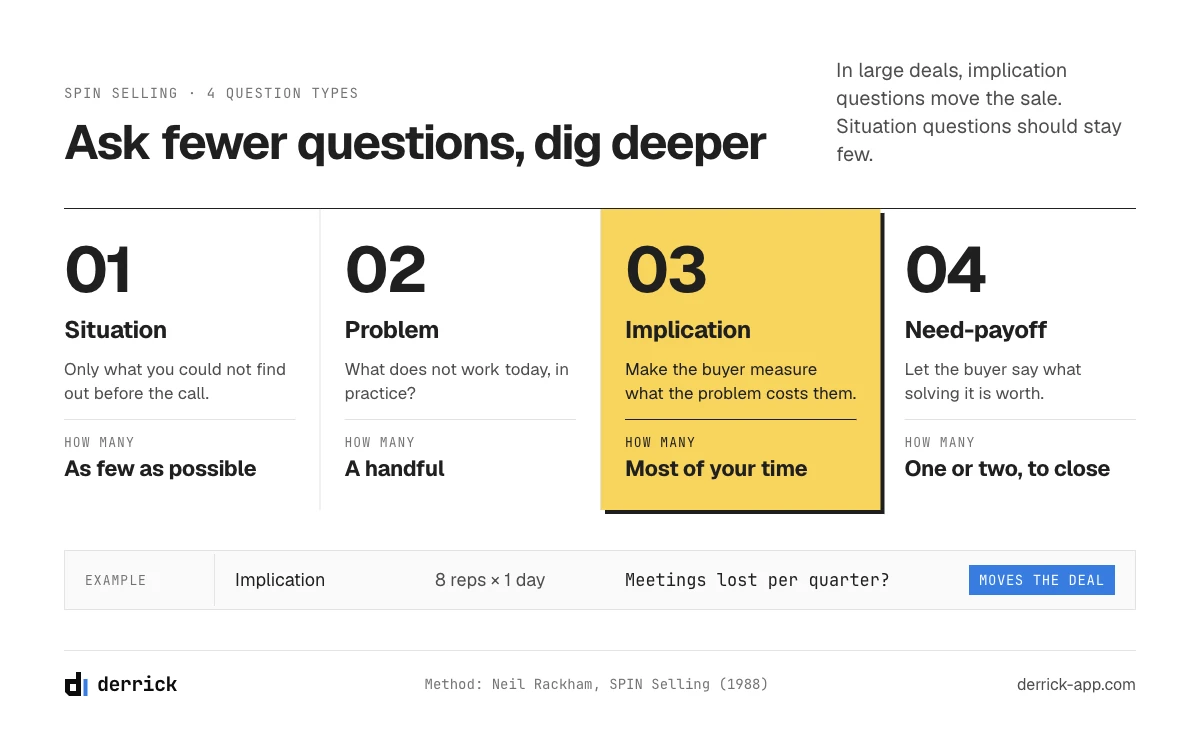SPIN Selling: few situation questions, most of the time on implication.
## B2B sales techniques for discovery
Discovery is where most B2B deals are won, and where most are lost. A seller who pitches before understanding the need talks about the product. A seller who has done discovery well talks about the buyer's problem, in the buyer's words. The four techniques below all serve that stage, at different depths. Two of them, BANT and MEDDIC, are also qualification frameworks: here we treat them as conversation techniques. How to check each criterion before the call is covered in our guide on [how to qualify sales leads](https://derrick-app.com/b2b-marketing/qualify-sales-leads).
### 1. SPIN Selling
**Stage:** in-depth discovery, long cycles. **Stands for:** Situation, Problem, Implication, Need-payoff.
SPIN Selling comes from research by Neil Rackham and Huthwaite on thousands of complex sales conversations, published in a 1988 book. Its central finding: in large deals, problem questions are not what moves a sale forward. Implication questions are, the ones that make the buyer measure what the problem costs them. Situation questions should stay few, because each one is a question you could have answered yourself by preparing.
**Example line:** "You said your reps spend a day a week looking up contact details. Across a team of eight, what does that add up to over a quarter, in meetings not booked?"
**When not to use it:** on a simple, fast purchase. Asking someone who just wants a quote to measure the implications of their problem is irritating. On a cold call, the four stages do not fit either: keep one implication question.
### 2. BANT
**Stage:** quick discovery. **Stands for:** Budget, Authority, Need, Timing.
BANT was formalised at IBM in the 1960s to sort opportunities fast. It remains the simplest discovery technique: four questions, and you know whether the conversation deserves a second meeting. That is its strength in short cycles, where one or two people decide within weeks.
**Example line:** "If we find something that fits, is this a project you want to start this quarter, or more likely next year?"
**When not to use it:** in complex deals where the budget does not exist yet. Many B2B projects start with no money set aside: the conversation creates the budget. If you disqualify every prospect with no budget on the first call, you drop some of your best deals. In that case, ask about budget last, not first.
### 3. MEDDIC
**Stage:** discovery and deal management with a buying committee. **Stands for:** Metrics, Economic buyer, Decision criteria, Decision process, Identify pain, Champion.
MEDDIC was developed at PTC in 1996. It is for deals that play out over months, in front of several people. It forces you to answer the question other B2B sales techniques skip: who inside the company will carry your project when you are not in the room? Some teams use MEDDPICC, which adds the paper process and the competition; the principle is the same.
**Example line:** "When you present this to your finance director, which number will they challenge you on first?"
**When not to use it:** on a single-decision-maker deal or a small contract. Filling six boxes for a deal one founder signs in two weeks is wasted time. Keep MEDDIC for deals where a committee decides.
### 4. Active listening
**Stage:** discovery and objections. **Principle:** listen to the end to understand; rephrase; ask the next question from the answer, not from your list.
Active listening has no acronym and may be the most useful of all sales techniques. It comes down to three moves. You leave silences, because the most useful sentence often comes after a pause. You rephrase in the buyer's words ("so if I follow you, the real issue is response time, not price"). And you follow up on what they just said instead of moving to question four on your list.
**Example line:** "You said 'again'. Has this delivery delay happened before?"
**When not to use it:** it rarely hurts, but it is not enough alone. Listening without structure gives you a pleasant meeting that ends with no decision-maker's name and no project date. Pair it with BANT or MEDDIC: the framework says what to find out, listening says how.
For these four techniques, the company's size, industry and description can be prepared before the meeting: that is what [Enrich Companies](https://derrick-app.com/features/enrich-companies) returns from the company's LinkedIn URL.
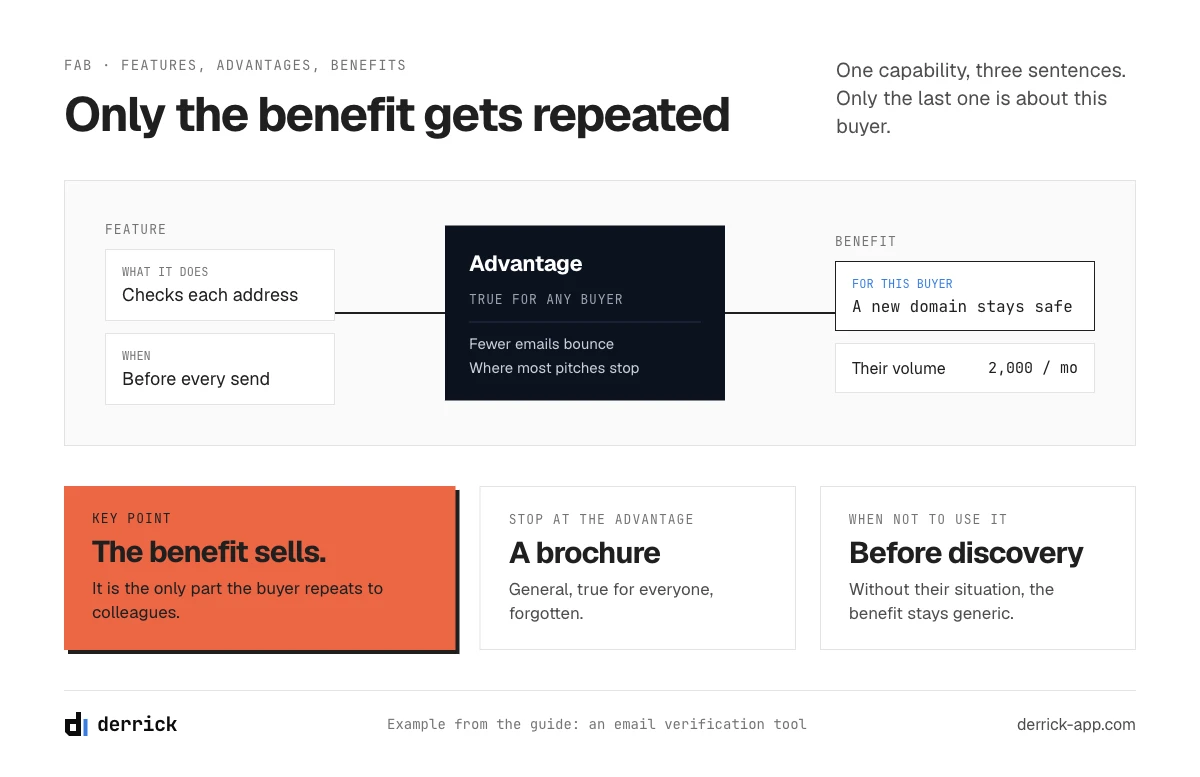FAB: the feature, the advantage, then the benefit for this buyer.
## B2B sales techniques for making the case
Once you understand the need, you have to connect it to what you sell. The three techniques in this part do not tell you what to say. They tell you in what order to say it, and which lever to pull. They work for a spoken presentation as well as an email. For complete worked examples, channel by channel, see our [sales pitch examples](https://derrick-app.com/b2b-marketing/sales-pitch-examples).
### 5. FAB (features, advantages, benefits)
**Stage:** making the case, mostly in short cycles. **Stands for:** Features, Advantages, Benefits.
FAB is the simplest way to turn a product capability into a reason to buy. The feature says what the product does. The advantage says what that allows in general. The benefit says what it changes for this buyer, in their situation. Many sellers stop at the advantage, which is why their pitch sounds like a brochure. The benefit is the only part the buyer repeats to colleagues.
**Example line:** "The tool checks every address before sending (feature). So fewer of your emails bounce (advantage). For your team, which sends 2,000 emails a month from a domain you just changed, that protects the domain's reputation while it is still new (benefit)."
**When not to use it:** before you know the buyer's situation. Without discovery, the benefit becomes generic and the buyer notices. On long cycles, FAB still works sentence by sentence, but it will not structure a whole presentation.
### 6. AIDA
**Stage:** first contact and written pitches. **Stands for:** Attention, Interest, Desire, Action.
AIDA is older than most modern sales techniques: it comes from late nineteenth-century advertising, where E. St. Elmo Lewis described it in 1898. It remains the best outline for a written message because it follows the order in which people read. Line one gets attention (a fact about the prospect, not about you), line two builds interest (the problem that fact implies), line three creates desire (what changes with you, with a number), and the last line asks for one action (a precise, dated step).
**Example line:** "You opened three sales roles this month. New reps often spend their first two weeks building lists. With a list ready on day one, they book their first meetings in week one. Fifteen minutes on Thursday?"
**When not to use it:** for a complex sale as a whole. AIDA describes one message, not a six-month relationship. It says nothing about discovery or the committee. Use it to open the door, then switch to SPIN or MEDDIC.
### 7. The Challenger Sale
**Stage:** making the case and the whole cycle, mostly with committees. **Principle, in three moves:** teach, tailor, take control.
The Challenger Sale comes from a study of thousands of B2B sellers, published in 2011 by Matthew Dixon and Brent Adamson. The finding: the best performers in complex sales are not the ones who build the warmest relationships, but the ones who teach the buyer something about their own market. You bring an insight they had not measured, you tailor it to each member of the committee, and you lead the next step instead of waiting.
**Example line:** "In your industry, companies your size that hire as many reps as you are this year usually lose a quarter to ramp-up. Here is what we saw at the ones that avoided it."
**When not to use it:** when you have nothing to teach. A Challenger pitch with no solid insight comes across as arrogance. It assumes a precise fact about their market or company that you can show. Without that fact, stay with classic discovery.
## Techniques that run the whole sales cycle
The techniques in this part do not serve one stage: they shape the whole relationship, from first contact to renewal. They combine with the stage techniques above rather than replace them.
### 8. Consultative selling
**Stage:** the whole cycle. **Principle:** the seller acts as an adviser who diagnoses before recommending, and can advise against buying when the offer does not fit.
Consultative selling and value-based selling are close cousins; we compare them, with the account facts to gather before the meeting, in our guide to [value-based selling](https://derrick-app.com/b2b-marketing/value-based-selling). **When not to use it:** on a low-value transactional sale where the buyer wants a price and a date, not a diagnosis.
### 9. SNAP Selling
**Stage:** first contact and the whole cycle, with overloaded buyers. **Stands for:** Simple, iNvaluable, Aligned, Priority.
SNAP Selling starts from an observation by Jill Konrath in her 2010 book: buyers are flooded with requests and sort them in seconds. To get through, your message has to be simple to grasp, bring something they cannot get elsewhere, be aligned with what matters to them and touch one of their current priorities. SNAP also separates three decisions the buyer makes in turn: to engage at all, to change how they do things, then to pick you.
**Example line:** a three-line first message, no attachment, answering the priority the company has made public (a new office, a hiring push) and proposing one step.
**When not to use it:** when the buyer is already running a project and asks you for a full proposal. SNAP simplifies; a formal tender needs detail.
### 10. Sandler Selling
**Stage:** the whole cycle. **Principle:** an up-front contract at the start of every meeting (length, goal, and the right for either side to say no), and a pain funnel that explores the buyer's problem layer by layer.
David Sandler created the method in the United States in 1967. Its main contribution is making "no" an acceptable answer early, so you stop chasing prospects who will never decide. The up-front contract also removes the pressure that makes buyers defensive: they know what the meeting is for and how it will end.
**Example line:** "We have 30 minutes. I suggest you tell me where things stand, I ask a few questions, and at the end we decide together whether a next step makes sense. If it does not, just say so. Does that work?"
**When not to use it:** when the buyer expects a presentation, for example in a formal vendor review. The Sandler conversation style can feel evasive to someone who asked to see your product.
### 11. Value-based selling
**Stage:** the whole cycle. **Principle:** every conversation is anchored on the measurable value the buyer gets, not on features or price.
We cover it in full, with the account facts it needs and how it compares with solution and consultative selling, in our guide to [value-based selling in B2B](https://derrick-app.com/b2b-marketing/value-based-selling). **When not to use it:** when you cannot quantify anything about the buyer's situation yet.
### 12. Account-based selling
**Stage:** the whole cycle, on a short list of high-value accounts. **Principle:** sales and marketing pick the accounts together and treat each one as a market of its own, with messages for each person on the committee.
It is the sales side of account-based marketing, which we cover in our guide to [account-based marketing](https://derrick-app.com/b2b-marketing/account-based-marketing). **When not to use it:** with a small average deal size, where the research per account costs more than the deal returns.
## The 12 B2B sales techniques in one table
Here is the summary of the cards. The last column answers a question most lists skip: what does this technique assume you know before you use it? A technique applied without that fact runs on empty.
| Technique | Stands for | Stage | The fact it assumes |
| --- | --- | --- | --- |
| 1. SPIN Selling | Situation, Problem, Implication, Need-payoff | Long discovery | The company's situation, so you ask few situation questions |
| 2. BANT | Budget, Authority, Need, Timing | Quick discovery | Your contact's role: can they decide? |
| 3. MEDDIC | Metrics, Economic buyer, Decision criteria, Decision process, Identify pain, Champion | Committee deals | Who sits on the committee, and in which role |
| 4. Active listening | Silence, rephrasing, follow-up | Discovery, objections | None up front; it produces the facts |
| 5. FAB | Features, Advantages, Benefits | Making the case | The buyer's situation, or the benefit stays generic |
| 6. AIDA | Attention, Interest, Desire, Action | First written contact | A recent fact about the prospect for line one |
| 7. Challenger Sale | Teach, Tailor, Take control | Making the case, committees | A fact about their market the buyer does not know |
| 8. Consultative selling | Diagnose before recommending | Whole cycle | The company's context: industry, size, news |
| 9. SNAP Selling | Simple, iNvaluable, Aligned, Priority | First contact | The company's current priority |
| 10. Sandler | Up-front contract, pain funnel | Whole cycle | Who you are meeting and what they can decide |
| 11. Value-based selling | Anchor on measurable value | Whole cycle | A number about the buyer's business |
| 12. Account-based selling | One account, one market | Whole cycle | The people on the committee and the account's context |
The right-hand column names the fact; it does not say where to find it. Two guides cover that in detail: the [qualification criteria you can verify before the call](https://derrick-app.com/b2b-marketing/qualify-sales-leads), and the six account facts listed in our value-based selling guide.
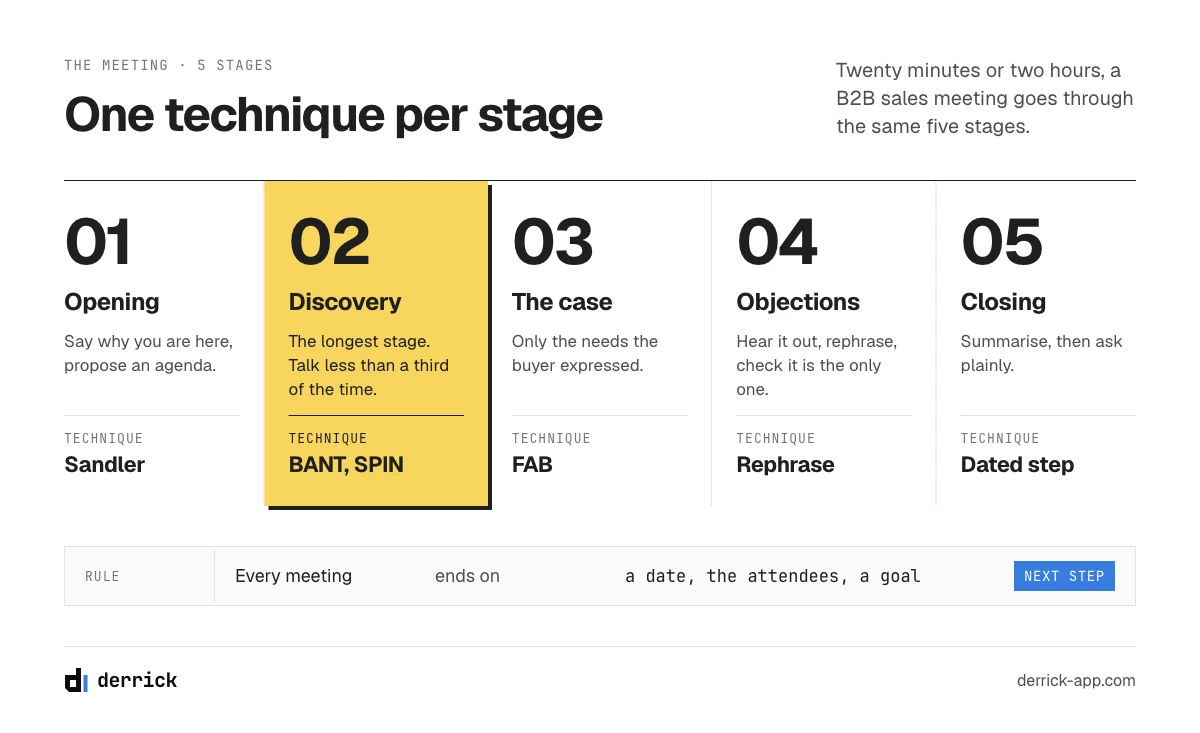The five stages of a B2B sales meeting, and the technique for each.
## Sales techniques at each stage of the conversation
A B2B sales conversation almost always goes through five stages, whether it lasts twenty minutes or two hours. Here is the technique to use at each, and the move that matters most.
1. **Opening.** The first two minutes set the frame. Introduce yourself, say why you are there and propose an agenda ("I suggest we start with where things stand, then I show you what could help, and we decide the next step together"). That is the Sandler up-front contract in a light form.
2. **Discovery.** The longest stage, and the one where you should talk least. BANT or MEDDIC say what to find out; SPIN says how to dig; active listening says how to follow up. A simple rule: if you talk more than a third of the time during discovery, you are pitching too early.
3. **Making the case.** Use only the needs the buyer expressed, in their words. FAB for each argument, the Challenger insight if you have one. Two or three well-chosen arguments beat ten.
4. **Handling objections.** Treat an objection as a sign of what still worries the buyer. Hear it out, rephrase it, check it is the only one, then answer. The full method, objection by objection, is in our guide on [handling sales objections](https://derrick-app.com/b2b-marketing/handle-sales-objections).
5. **Closing.** Never end a meeting without a dated next step. In a short cycle, that is the signature; in a long one, the next meeting, with whom and to decide what.
### A worked example: one deal, five techniques
Here is a deal that is real in shape and made up in names. You sell scheduling software to transport companies. Today's target: a 180-person company running a regional fleet that has just opened a second warehouse.
**First call, a 20-second opener.** "Hi Ms Lee, it is Paul from [company]. I am calling because you just opened a warehouse in Columbus, and scheduling across two sites is usually when spreadsheets give up. I would like ten minutes to see whether that is on your plate. If not, I will leave you alone." The opening fact, the new warehouse, was public. It did all the work.
**Discovery meeting, SPIN and BANT.** You arrive knowing the company's size, industry and your contact's role, so you ask almost no situation questions. You move quickly to problems ("where does scheduling cost you time?") and implications ("when a driver calls in sick, how many deliveries slip to the next day?"). BANT reminds you what to leave with: who signs (the operations director, not her), the budget (none yet, to be built), the timing (before peak season).
**Presentation, FAB and the Challenger insight.** In the second meeting, with the operations director, you open on an insight: companies that add a second site usually see late deliveries rise in the first quarter. Then each argument follows FAB, tied to the number they gave you in discovery. The director talks mostly about risk, a client lost last year over delays, so you stress the no-commitment trial and the easy rollback.
**Objection and negotiation.** "It costs more than hiring another scheduler." You rephrase, check it is the only issue, and answer with their own number: the deliveries that slip to the next day, week after week. You know your walk-away option (another carrier on trial this quarter), so you give one free month, but only against a twelve-month commitment.
**Close and follow-through.** You summarise what is agreed, propose a start date and get the yes. Then you book a check-in three weeks out with both warehouse managers. That last step is already preparing the renewal, and perhaps a third site.
None of these techniques was used alone, and none was announced to the buyer. Each served one stage, and each worked because a fact had been prepared beforehand.
## Negotiating and closing: BATNA, trading concessions and the 3-3-3 rule
Negotiation starts when the buyer agrees in principle and discusses terms: price, length, scope, timing. Two ideas change how you approach it.
**BATNA** (Best Alternative To a Negotiated Agreement) is what you will do if the deal does not happen. Yours, and the buyer's. If you know another prospect is ready to sign this month, you negotiate calmly. If you know the buyer has no credible alternative for six months, you do not need to cut your price at the first request.
**Trade, do not give.** Every concession is exchanged: a discount for a longer commitment, payment terms for a higher volume, a gesture for a case study. A concession with nothing in return teaches the buyer that asking is enough.
**The 3-3-3 rule** comes up often in searches about sales techniques, and there is no single standard version. The most common reading applies to follow-up: three touches, over three days or three weeks, on three different channels (for example a call, an email and a LinkedIn message). It describes a follow-up cadence, and it answers a real problem: many deals stall simply because nobody followed up. Tracking each deal's stage in your [sales pipeline](https://derrick-app.com/b2b-marketing/sales-pipeline-stages) shows you which ones are waiting on a touch.
Three habits for closing:
- **Summarise before you propose.** "We agree on scope, length and start date. Price is what is left." The buyer sees everything already settled.
- **Ask the closing question plainly.** "Shall we start on the 3rd?" is clearer than "what do you think?".
- **Treat a last-minute objection like any other.** Rephrase, check it is the only one, answer, then ask again.
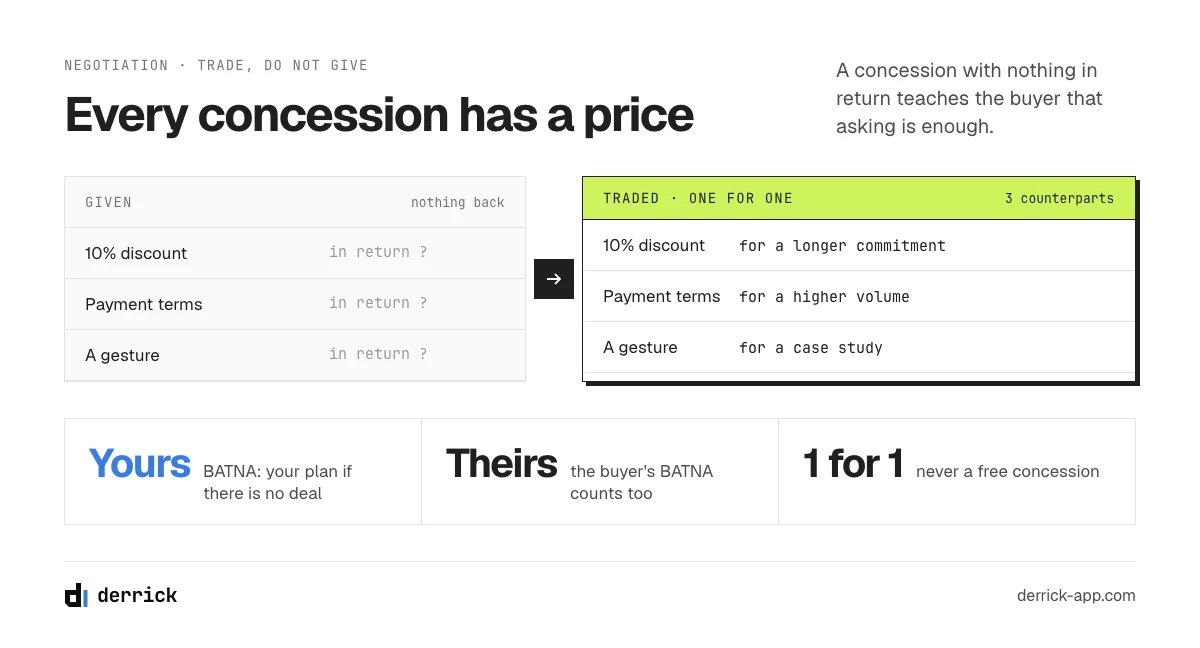Negotiation: every concession is traded for a counterpart.
## Five mistakes that sink a well-chosen technique
When a B2B sales technique fails, the cause is usually when and how it was used. Here are the five mistakes seen most often in B2B.
- **Reciting the framework instead of talking.** A buyer who senses you are running through BANT question by question shuts down. Keep the framework in your head, not in your mouth. Rephrase each question in their words.
- **Asking what you could have known.** "How many people work here?" or "What does your company do?" in a meeting tells the buyer you did not prepare. Every situation question you could have avoided costs a minute of useful discovery.
- **Picking the technique before the stage.** A Challenger insight in the first ten seconds of a cold call, SPIN on a quick quote, MEDDIC on a one-person deal: the technique is fine, the timing is wrong. Go back to the table in part 2.
- **Pulling every lever at once.** Talking about risk, novelty, comfort and price in the same sentence dilutes all of it. One buyer, one main lever, two arguments.
- **Forgetting the next step.** The best discovery in the world is wasted if the meeting ends on "I will send you a proposal". Set the date, the attendees and the goal of the next step before you leave.
Most of these mistakes come from the same place: preparation. A technique is chosen based on what you know about the account and the person. The less you know, the more basic questions you ask, and the less time is left for the part that sells.
**One email every 2 weeks.** Fill Down covers go-to-market and sales data tactics, including how to prepare meetings and pick the right facts about an account. [Subscribe to the Fill Down newsletter →](https://www.linkedin.com/newsletters/fill-down-gtm-sales-news-7480639838598184961/)
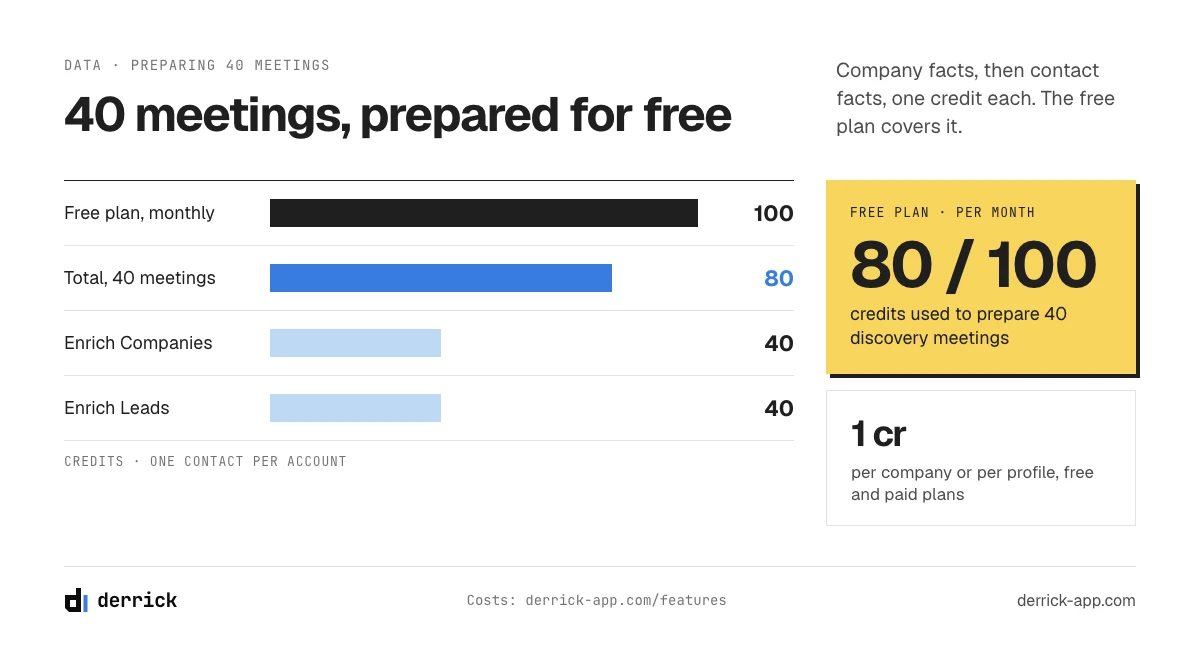Preparing 40 discovery meetings: 80 credits, within the free plan.
## Prepare your meetings with Derrick
The table in part 6 shows it: every technique assumes a fact about the account or the person. Most of those facts are public, and you can gather them for your whole list before the week starts rather than account by account before each call. Three Derrick features cover most of it:
- **[Enrich Companies](https://derrick-app.com/features/enrich-companies)** takes the company's LinkedIn URL and returns its size, industry, location and description: what you need for SPIN, FAB or consultative selling. 1 credit per company, on the free and paid plans.
- **[Enrich Leads](https://derrick-app.com/features/enrich-leads)** takes the profile's LinkedIn URL and returns your contact's title, time in the role and background: what BANT needs (can they decide?) and what tells you which lever to pull. 1 credit per profile, on the free and paid plans.
- **[Find a company's people](https://derrick-app.com/features/find-staff-members)** lists the people at a company from its LinkedIn URL: the starting point for mapping a committee before MEDDIC or account-based selling. 1 credit per person imported, on the paid plans (from the Mini plan).
**A worked example.** For 40 discovery meetings with one contact per account, Enrich Companies (40 credits) then Enrich Leads (40 credits) come to 80 credits in two steps, covered by the free plan's 100 monthly credits. The account-by-account detail of which facts to gather is in our guide to [value-based selling](https://derrick-app.com/b2b-marketing/value-based-selling).
**Where to do it.** The Derrick web app is the front door: import your account list, add one column per fact, nothing to install. You can also use Derrick in the Google Sheets sidebar if your list already lives there, in Claude or any MCP client to prepare one important meeting by asking in plain language, or through the API so your CRM fills itself for every new account. MCP and API access come with the Plus plan and above. On every surface, the three features above need your LinkedIn account connected through the Derrick Chrome extension.
To decide which facts to look for first depending on the deal, and how to check them, start from our guide on [qualifying leads](https://derrick-app.com/b2b-marketing/qualify-sales-leads).
## Where to use Derrick: web app, Google Sheets, Claude (MCP) or API
The same B2B data enrichment is available on four surfaces. The free plan gives 100 credits a month, no card required.
- **Web app** (main entry, nothing to install): import or paste your list and enrich it in the browser. https://app.derrick-app.com
- **Google Sheets**: the sidebar add-on enriches your list in place, inside your spreadsheet. Install: https://workspace.google.com/marketplace/app/linkedin_email_phone_finder_ia_%E2%80%94_derrick/3746789989?flow_type=2
- **Claude / AI agents (MCP)**: connect the Derrick MCP server, then enrich from chat. Setup: /mcp
- **REST API**: call the same enrichment endpoints from your own stack (PLUS plan and up). Docs: https://app.derrick-app.com/api-docs
## FAQ
### What are B2B sales techniques?
B2B sales techniques are methods for one stage of a sale to a business: discovering the need, making the case, handling objections or closing. The best known are SPIN Selling, BANT, MEDDIC, FAB, AIDA, the Challenger Sale, SNAP and Sandler. They differ from the sales process, which covers the whole path from lead to signature, and from methodologies such as consultative selling, which bundle several techniques.
### What are the 5 sales techniques every B2B seller should know?
If you only learn five, take SPIN Selling for in-depth discovery, BANT for quick qualification, active listening for every conversation, FAB to turn features into benefits, and MEDDIC for deals decided by a committee. Together they cover discovery, making the case and complex deals. Add AIDA if you prospect mostly in writing.
### What is the 3-3-3 rule in sales?
There is no single standard version. The most common reading is a follow-up cadence: three touches, over three days or three weeks, on three different channels, such as a call, an email and a LinkedIn message. It is a follow-up cadence, and it addresses a real problem: many deals stall simply because nobody followed up.
### Which sales technique works best for complex B2B deals?
For deals decided by a committee over several months, MEDDIC is the most useful for discovery and deal management, because it forces you to identify the economic buyer, the decision process and an internal champion. For making the case in front of that committee, the Challenger Sale works well when you have a solid insight about the buyer's market. Most teams combine the two.
### What is the difference between a sales technique and a sales process?
A sales technique serves one stage, such as discovery or closing. A sales process runs from the first lead to the signed contract and covers all the stages. You use several techniques inside one process: AIDA for first contact, SPIN for discovery, FAB for the pitch and a dated next step for the close.
## Related
- [The State of B2B Marketing Performance 2026: Benchmarks Report](https://derrick-app.com/b2b-marketing/b2b-marketing-performance-2026)
- [Account-Based Marketing (ABM)](https://derrick-app.com/b2b-marketing/account-based-marketing)
- [Inbound vs Outbound Marketing: the Differences and the 2026 Strategies](https://derrick-app.com/b2b-marketing/inbound-vs-outbound)
- [B2B lead generation: Strategies, tools, tips in 2026](https://derrick-app.com/b2b-marketing/lead-generation)
- [Go-to-market strategy: the B2B framework and 7 steps](https://derrick-app.com/b2b-marketing/go-to-market-strategy)
- [Lead generation company: types, costs, and buy vs build](https://derrick-app.com/b2b-marketing/lead-generation-company)
- [Outbound sales: definition, process, and how to make it work](https://derrick-app.com/b2b-marketing/outbound-sales)
- [How to Build a Prospect List That Survives Contact](https://derrick-app.com/b2b-marketing/build-a-prospect-list)
- [B2B Database Marketing: The Data-First Playbook](https://derrick-app.com/b2b-marketing/b2b-database-marketing)
- [Demand Generation vs Lead Generation](https://derrick-app.com/b2b-marketing/demand-generation-vs-lead-generation)
- [Inbound Lead Management](https://derrick-app.com/b2b-marketing/inbound-lead-management)
- [The 8 B2B Sales Challenges, and How to Tell Which One Is Actually Yours](https://derrick-app.com/b2b-marketing/b2b-sales-challenges)
- [How to sell to decision makers when five people share the decision](https://derrick-app.com/b2b-marketing/sell-to-decision-makers)
- [Inbound sales: how to sell to a buyer who already did the research](https://derrick-app.com/b2b-marketing/inbound-sales)
- [LinkedIn prospecting without Sales Navigator: the free-account workflow](https://derrick-app.com/b2b-marketing/linkedin-prospecting)
- [The 7 sales process steps, and the data each step runs on](https://derrick-app.com/b2b-marketing/sales-process-steps)
- [Social Selling Tools: The Five Jobs a Stack Actually Does](https://derrick-app.com/b2b-marketing/social-selling-tools)
- [LinkedIn Account Based Marketing: The List Problem Nobody Mentions](https://derrick-app.com/b2b-marketing/linkedin-abm)
- [Sales proposal template: the eight sections, and the data each one needs](https://derrick-app.com/b2b-marketing/sales-proposal-template)
- [Lead generation tools sorted by the six jobs they do, and what one qualified lead actually costs](https://derrick-app.com/b2b-marketing/lead-generation-tools)
- [ICP in sales: what it means, and how to build yours from the deals you already won](https://derrick-app.com/b2b-marketing/icp-in-sales)
- [Automated lead generation: the six jobs in the chain, what each one costs, and the one that never automates](https://derrick-app.com/b2b-marketing/automated-lead-generation)
- [Value-based selling: how to build a value case your buyer can actually check](https://derrick-app.com/b2b-marketing/value-based-selling)
- [Sales automation tools: the 5 tasks worth automating once the list is built](https://derrick-app.com/b2b-marketing/sales-automation-tools)
- [Sales pipeline stages: the six stages, and the fact that has to be true to enter each one](https://derrick-app.com/b2b-marketing/sales-pipeline-stages)
- [Manufacturing lead generation: build the account list before the campaign](https://derrick-app.com/b2b-marketing/manufacturing-lead-generation)
- [SaaS lead generation: start with the data you already have](https://derrick-app.com/b2b-marketing/saas-lead-generation)
- [LinkedIn connection request message: 12 templates that fit in 200 characters](https://derrick-app.com/b2b-marketing/linkedin-connection-request-message)
- [Healthcare lead generation: reach the organizations that actually buy](https://derrick-app.com/b2b-marketing/healthcare-lead-generation)
- [Lead qualification: how to qualify a sales lead, verify first then ask](https://derrick-app.com/b2b-marketing/qualify-sales-leads)
- [How to prospect effectively: six sales prospecting decisions and the rate behind each](https://derrick-app.com/b2b-marketing/prospect-effectively)
- [How to handle a sales objection: the 8 you will hear, and the data that pre-empts them](https://derrick-app.com/b2b-marketing/handle-sales-objections)
- [B2B email marketing: 8 campaigns by segment, and the data field that triggers each one](https://derrick-app.com/b2b-marketing/b2b-email-marketing)
- [Sales pitch examples: 7 complete B2B pitches, one per channel, and the fact in line one](https://derrick-app.com/b2b-marketing/sales-pitch-examples)
- [B2B buyer persona: the two-column card for every role in the buying committee](https://derrick-app.com/b2b-marketing/b2b-buyer-persona)
- [Sales funnel management for B2B teams: count every stage, fix the one that loses the most](https://derrick-app.com/b2b-marketing/sales-funnel-management)
- [Lead generation KPIs for B2B teams: 12 metrics, their formulas, and the data that skews them](https://derrick-app.com/b2b-marketing/lead-generation-kpis)
- [B2B Customer Segmentation: 6 Methods, the Columns Each One Needs, and a Worked Example](https://derrick-app.com/b2b-marketing/b2b-customer-segmentation)
- [Sales Pipeline Metrics: 12 to Track, One Worked Quarter, and a Velocity Calculator](https://derrick-app.com/b2b-marketing/sales-pipeline-metrics)