---
title: "Architects Email Addresses: How to Find Them"
description: "Find architects email addresses by resolving the firm first, then the named person: public sources, the roles that matter, verification and the real cost."
canonical: "https://derrick-app.com/email-finder/architects-email-addresses"
category: "Email Finder"
updated: "2026-09-01"
---
# Architects Email Addresses: Firm First, Then the Person
> Architects email addresses are built by resolving the firm first and the named person second, because the licence is public and the inbox is not. Every licensing board publishes who is registered, and none of them publishes an email, so every architect file in existence is a join somebody else ran on a date you cannot see. Headcount decides which of the five buying roles exists inside a practice, and therefore who your message should address. Verify domain, mailbox and catch-all status before the first send, stopping at the first failure.
*Canonical: https://derrick-app.com/email-finder/architects-email-addresses* · *Email Finder*
---
## Architects email addresses: the short answer
**Architects email addresses** are reached by resolving the firm first and the person second, because architecture is one of the few professions where the licence is public and the inbox is not. Every state licensing board in the United States publishes who is licensed, where, and under which registration number. None of them publishes an email. That gap is the whole job: you start from a public roster of names and firms, you resolve each firm to a domain, you resolve the right person inside it, and only then do you find and verify an address.
The other half of the job is deciding who "the architect" is. A search for architects email addresses almost never means "every licensed architect". It means the principal who signs a software contract, or the project architect who writes the specification for a building product, or the person who owns the CAD budget. Those are three different lists pulled from the same profession, and mailing them the same message is why most architect campaigns underperform.
This guide walks the pipeline in order: define which architect you actually want, pull the firms, resolve the named person, find and verify the address, then price the result per usable row. If you are starting from a map rather than a licence roster, our guide on [finding local business email addresses](https://derrick-app.com/email-finder/local-business-emails) covers the geography-first version of the same pipeline.
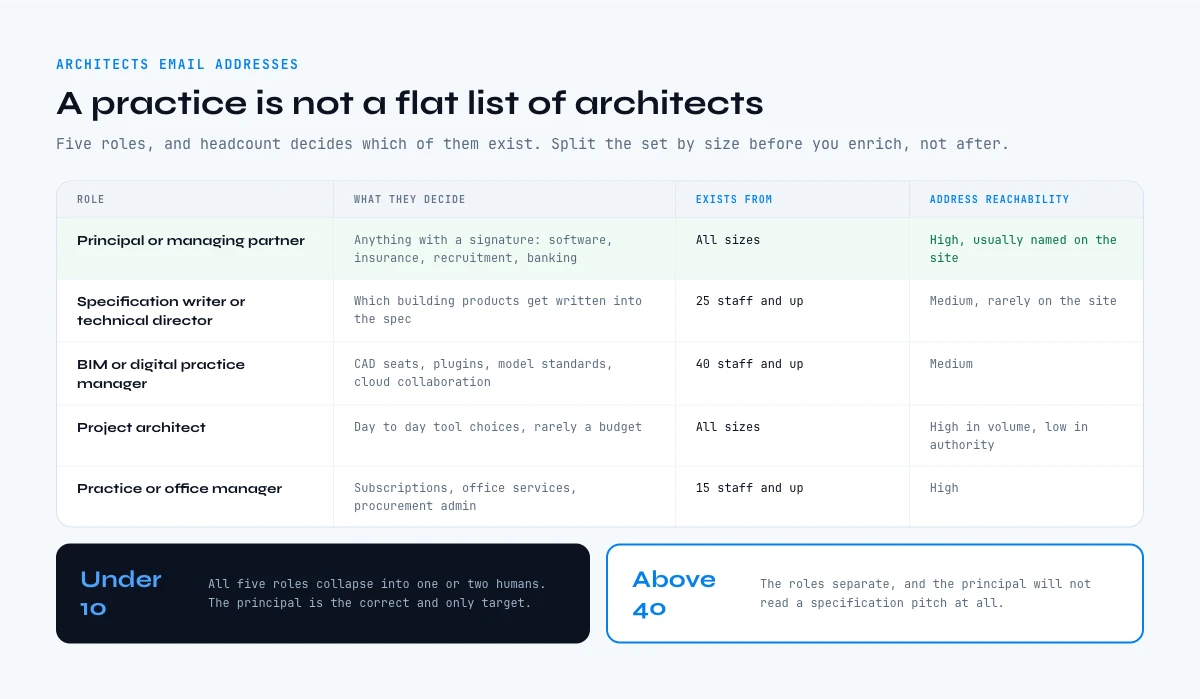Headcount decides which roles exist. Split the set by size before you enrich, not after.
## Who you are actually emailing inside an architecture firm
An architecture practice is not a flat list of architects. It has a commercial layer, a technical layer and a production layer, and each one buys different things. Sending a building product specification pitch to a managing partner, or a practice management software pitch to a junior project architect, wastes the address you just paid to find.
| Role | What they decide | Typical firm size where they exist | How reachable the address is |
| --- | --- | --- | --- |
| Principal or managing partner | Software, insurance, recruitment, banking, anything with a signature | All sizes, and often the only decision maker under 10 staff | High: usually named on the site |
| Specification writer or technical director | Which building products get written into the spec | 25 staff and up | Medium: named internally, rarely on the site |
| BIM or digital practice manager | CAD seats, plugins, model standards, cloud collaboration | 40 staff and up | Medium |
| Project architect | Day to day tool choices, rarely a budget | All sizes | High in volume, low in authority |
| Practice or office manager | Subscriptions, office services, procurement admin | 15 staff and up | High |
The practical consequence is a rule you can apply before you spend a single credit: firms under roughly ten people collapse all five roles into one or two humans, so the principal is the correct and only target. Above about forty people the roles separate, and the principal will not read a specification pitch at all. Split your target set by headcount before you enrich, not after.
This is the same buying committee problem that shows up in every technical sale. Our guide on [selling to decision makers](https://derrick-app.com/b2b-marketing/sell-to-decision-makers) covers how to map the committee before you write the first line.
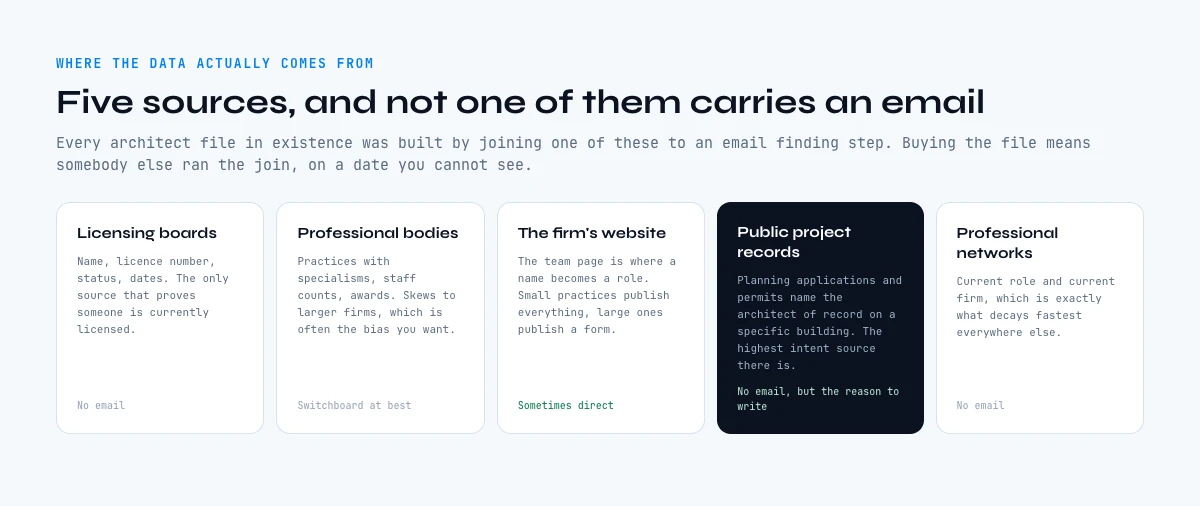Not one of them carries a verified email. Every file was built by joining a source to an email finding step.
## Where architects email addresses actually come from
List vendors present architect data as if it appeared from nowhere. It does not. Every legitimate source is one of five things, and knowing which one a row came from tells you how fresh it is and how much you should trust it.
- **State licensing boards.** In the United States, architecture is a state licensed profession, and each board publishes a searchable roster: name, licence number, status, issue date and expiry. This is the only source that tells you a person is currently licensed, and it is the reason architect data can be verified in a way that, say, marketing manager data cannot.
- **Professional body directories.** Membership directories list practices, often with specialisms, staff counts and awards. They skew towards larger and more established firms, which is exactly the bias you want if you sell something with a real price tag.
- **The firm's own website.** The team page is where a name becomes a role. Small practices publish full team pages with direct addresses. Large ones publish a leadership page and a single contact form.
- **Public project records.** Planning applications, permit filings and award shortlists name the architect of record on a specific building. This is the highest intent source in the whole profession: it tells you what a firm is building right now, which is the only context that makes a cold email about a building product land.
- **Professional networks.** Profiles give you current role and current firm, which is what decays fastest in every other source.
Notice what is missing from that list: nowhere in it does a verified email address appear. Licence rosters do not carry them, planning records do not carry them, and directories carry a firm switchboard at best. Every architects email addresses file in existence was built by joining one of those five sources to an email finding step. Buying the file just means somebody else ran the join, on a date you cannot see.
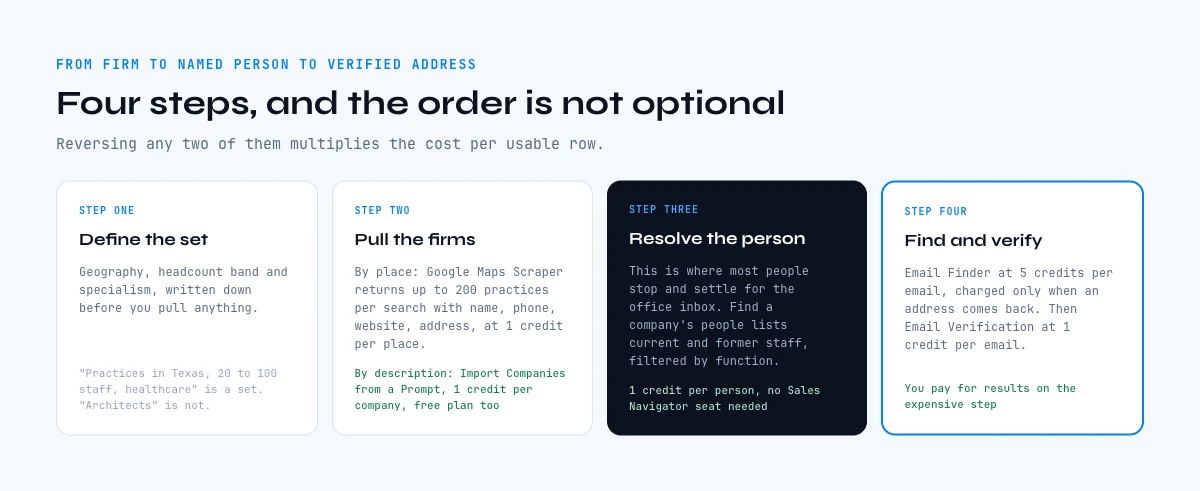From firm to named person to verified address, and the order is not optional.
## Build the list: from firm to named person to verified address
The pipeline has four steps and they have to run in that order. Reversing any two of them multiplies the cost per usable row.
**Step one, define the set.** Write down the geography, the headcount band and the specialism before you pull anything. "Architecture practices in Texas with 20 to 100 staff doing healthcare work" is a set. "Architects" is not, and it is the reason bought files feel enormous and convert like nothing.
**Step two, pull the firms.** Two routes work. A geography and category pull returns every practice with a physical presence in an area, with name, address, phone, website and rating on one row each, which is the fastest way to go from a city to a spreadsheet. A description based import returns practices that match a written definition of what you are looking for, with name, industry, country, website and profile URL. The second route is better when the specialism matters more than the postcode.
**Step three, resolve the person.** This is where most people stop and settle for the office inbox. Listing the people of a firm, current and former staff, optionally filtered by job function, turns a row that says "Studio X, 60 staff" into a row that says "Studio X, technical director, full name". [Find a company's people](https://derrick-app.com/features/find-staff-members) costs 1 credit per person on the paid plans and does not require a Sales Navigator seat.
**Step four, find and verify the address.** With a first name, a last name and a domain, an email finder returns the verified professional address. [Email Finder](https://derrick-app.com/features/email-finder) is 5 credits per email and is only charged when a result actually comes back, which matters on a profession where a meaningful share of small practices use a personal domain. Then run [Email Verification](https://derrick-app.com/features/email-verification) at 1 credit per email over the whole column before the first send.
For the practices whose team page publishes addresses directly, there is a shortcut worth taking first: extracting emails and social profiles from the website costs 2 credits per line and often clears the small firms in one pass, leaving the finder budget for the ones that hide behind a form.
## What architects email addresses really cost, bought or built
Published list prices for professional data sit in the region of a few cents per contact, and the round numbers quoted for architect files are usually a flat fee for tens of thousands of rows. Neither figure is the number you should budget with, because both are quoted per delivered row and you pay in usable rows.
Four gaps sit between the two. Some share of the file is out of scope, because "architect" was resolved from a job title string and swept in draughtsmen, architectural technologists and unrelated software architects. Some share is stale, because the person left the practice. Some share bounces. And some share is the wrong role, which costs nothing at the mailbox and everything at the reply rate.
The build route inverts the risk. You pay per step and you pay for results on the expensive step, so the file cannot be bigger than your definition and you can date every row. On the numbers above, a 300 firm target set costs 300 credits to pull, 300 to 600 credits to resolve one or two named people per firm, 5 credits per email actually found and 1 credit per verification. The whole exercise fits inside a mid tier monthly allowance rather than a procurement cycle.
The full arithmetic of the bought route, gap by gap, is laid out in our guide on [how to buy an email list and what it really costs](https://derrick-app.com/email-finder/buy-email-list).
Free calculator
### Architect list calculator: firms in, verified addresses out
Pick how many architecture practices you want to target and how many named people you want per practice. The output is the realistic number of verified addresses and the credit cost of each step.
Practices in the target set
Named people wanted per practice
Pick a set size and a depth per practice to see the volumes and the credit cost.
Assumes an 80 percent hit rate on email finding, which is a conservative figure for a profession with a high share of small practices on personal domains. Finding is only charged when a result comes back, so a lower hit rate lowers the bill rather than wasting it. Measure your own rate on the first 50 rows and re-run the numbers.
## Verify architects email addresses before the first send
Architecture practices churn their web presence slowly and their staff quickly, which produces a specific failure: the team page is three years old, the address format is still valid, and the person left in 2024. The address will not bounce. It will simply never be read, and your reply rate will silently blame the copy.
Run three checks, in this order, and stop at the first failure.
- **Domain.** Does the domain resolve and accept mail at all? Small practices let domains lapse when they merge, and a merged practice is a different company with a different name.
- **Mailbox.** Does that specific address exist? This is the check that catches the departed technical director.
- **Catch-all status.** Does the domain accept everything? A catch-all cannot confirm a mailbox, which turns a green verification into a guess. Our guide on [catch-all email domains](https://derrick-app.com/email-finder/catch-all) explains how to treat those rows without either deleting them or trusting them.
What each check does and does not prove is covered in detail in our guide on [what makes an email address valid](https://derrick-app.com/email-finder/valid), and the pre-send pass itself in the [bounce checker guide](https://derrick-app.com/email-finder/bounce-checker).
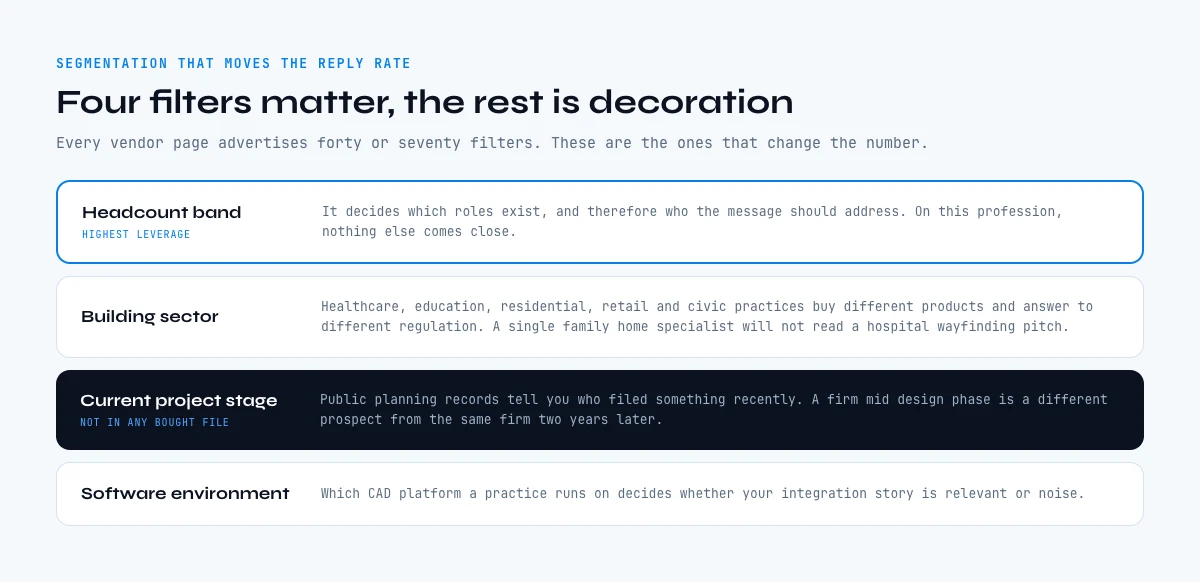Vendor pages advertise seventy filters. Four of them move the number.
## Segmentation that changes the reply rate
Every vendor page advertises forty or seventy data filters. Four of them move the number, and the rest are decoration.
- **Headcount band.** It decides which role exists, as the table above shows, and therefore who the message should address. It is the single highest leverage filter on this profession.
- **Building sector.** Healthcare, education, residential, retail and civic practices buy different products and answer to different regulation. A practice that only does single family homes will not read a hospital wayfinding pitch.
- **Current project stage.** Public planning records tell you which practices filed something recently. A firm in the middle of a design phase is a different prospect from the same firm two years later, and this is the one signal that no bought file contains.
- **Software environment.** Whether a practice runs on one CAD platform or another decides whether a plugin, a content library or an integration is even installable. Treat this as a research signal on the firm, not as a field you can assume.
Two of those four are properties of the firm, not the person, which is another reason the pipeline resolves the firm first. Once the firm row carries headcount, sector and recency, every address you attach to it inherits that context, and personalisation stops being a first name merge tag.
**One email every two weeks.** Fill Down covers go-to-market and sales data tactics, including how teams keep profession-specific lists from rotting. [Subscribe to the Fill Down newsletter →](https://www.linkedin.com/newsletters/fill-down-gtm-sales-news-7480639838598184961/)
## Running the whole pipeline in one sheet
The reason this pipeline is worth building rather than buying is that it lives in one spreadsheet you control, and every column is dated. In practice the sheet has one row per person and roughly ten columns: firm name, website, city, headcount, sector, first name, last name, role, email, verification status.
Each column after "website" is filled by a step in the Derrick sidebar in Google Sheets, one column at a time, over the rows you select. The same steps run from an AI assistant through the Derrick MCP when the question is conversational, and from the REST API when the list is generated by something upstream like your CRM. The surface changes, the data and the credit cost do not.
The practical effect is that re-running the list in six months is a re-run, not a repurchase. You keep the definition, you refresh the volatile columns, and you can measure decay because you have both dates. That is the part a bought file structurally cannot give you.
## Consent and record keeping, briefly
Business to business email to a named professional at their work address is permitted in most markets, with conditions that are easy to meet and worth documenting: identify yourself and your company, describe why you are writing to that specific person, and honour an opt out immediately and permanently.
The practical requirement, whichever market you are in, is record keeping. Keep the source of each row and the date it was collected in the sheet. When somebody asks where you got their address, "your practice publishes it on your team page, collected on this date" is a complete answer, and it is only available to teams who built the list rather than bought it.
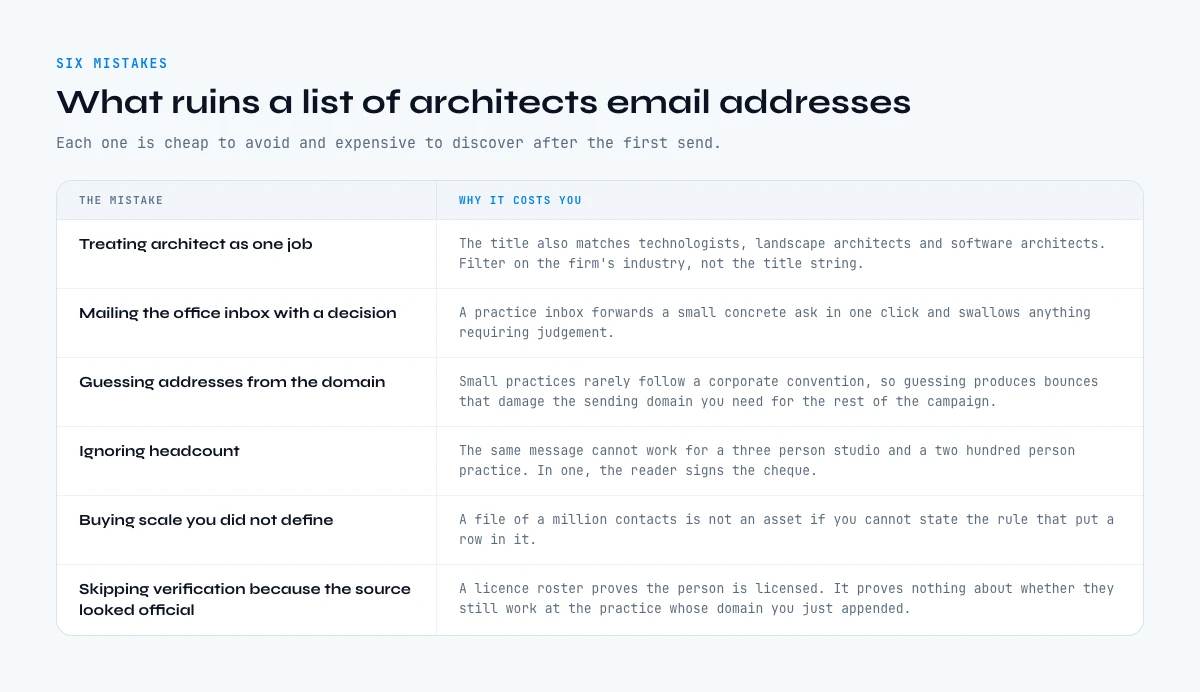Each one is cheap to avoid and expensive to discover after the first send.
## Six mistakes that ruin a list of architects email addresses
**Treating "architect" as one job.** The title matches licensed architects, architectural technologists, landscape architects and software architects. Filter on the firm's industry, not on the title string alone.
**Mailing the office inbox with a decision.** A general practice inbox forwards a small concrete ask in one click and swallows anything that requires judgement. Match the ask to the inbox, or resolve the name.
**Guessing addresses from the domain.** Small practices rarely follow a corporate naming convention, so pattern guessing produces hard bounces at a rate that damages the sending domain you need for the rest of the campaign.
**Ignoring headcount.** The same message cannot work for a three person studio and a two hundred person practice, because in one of them the reader signs the cheque and in the other they have never seen an invoice.
**Buying scale you did not define.** A file of a million professional contacts is not an asset if you cannot state the rule that put a row in it.
**Skipping verification because the source looked official.** A licence roster proves the person is licensed. It proves nothing about whether they still work at the practice whose domain you just appended.
## Key takeaways
- Architects email addresses are built by resolving the firm, then the named person, then the address, in that order.
- The licence is public and the inbox is not, which is why every architect file in existence is a join somebody else ran on a date you cannot see.
- Headcount decides which role exists inside the practice, and therefore who your message should address.
- Public project records are the only high intent signal in the profession, and no bought file contains them.
- Verify domain, mailbox and catch-all status before the first send, and stop at the first failure.
- Building the list costs a few credits per verified address and leaves you a dated, re-runnable definition instead of a static file.
## Use Derrick in Claude (MCP) or via API
Derrick isn't only a Google Sheets add-on. The same B2B data enrichment runs as an MCP server (use it directly inside Claude and other AI agents) and as a REST API:
- **Claude / AI agents (MCP)**: connect the Derrick MCP server, then enrich from chat. Setup: /mcp
- **REST API**: call the same enrichment endpoints from your own stack (PLUS plan and up). Docs: https://app1.derrick-app.com/api/v1/docs/
## FAQ
### How do you find architects email addresses?
Resolve the firm before the person. Pull the practices for your geography and specialism, resolve the named person inside each one using the role that matches your offer, then find the professional address from first name, last name and domain. Verify every row before the first send. Licensing rosters and professional directories give you names and firms, never inboxes, so the email finding step is always the last one.
### Are architect licence records public?
Yes in the markets where architecture is a regulated profession. Licensing boards publish name, registration number, status and expiry, which lets you confirm somebody is currently licensed. What no roster publishes is an email address or a current employer, so a licence record proves the credential and nothing about where the person works today.
### Who should you email inside an architecture firm?
It depends on headcount. Under roughly ten people the principal is the only decision maker and the correct target for anything. Above about forty people the roles separate: the technical director or specification writer owns product specification, the BIM manager owns software seats, and the practice manager owns subscriptions. Segment by headcount before enriching, not after.
### Is it better to buy or build a list of architects email addresses?
Buying removes the collection work and adds two problems you cannot inspect: somebody else defined who counts as an architect, and you cannot see how stale the file is. Building costs a few credits per verified address, caps the list at your own definition, and leaves every row dated so you can measure decay and re-run the same set later.
### What does it cost to build a list of architects email addresses?
With Derrick, pulling practices costs 1 credit per company, listing the people of a firm costs 1 credit per person, Email Finder costs 5 credits per email and is only charged when a result comes back, and Email Verification costs 1 credit per email. The free plan is 100 credits a month at zero euros, Mini is 9 euros a month, and Standard is 20 euros a month.
### Why do architect email campaigns bounce more than expected?
Because architecture practices refresh their websites slowly and their staff quickly. A team page can be three years old with a valid address format and a person who left in 2024, which does not bounce at all: it simply never gets read. Verifying the mailbox itself, not just the domain, is the check that catches this.
### Can you guess an architect email from the firm domain?
It is the least reliable route on this profession, because small practices rarely follow a corporate naming convention and a large share run on personal or shared domains. Guessed addresses on those domains produce hard bounces, and a run of hard bounces damages the sending domain you need for the rest of the campaign.
### What is the highest intent signal on an architecture practice?
Public project records. Planning applications, permit filings and award shortlists name the architect of record on a specific building, which tells you what a practice is working on right now. No purchased file contains that signal, and it is the only context that makes a cold email about a building product land.
## Related
- [Lead Email Finder: The Complete Guide to Finding Your Prospects' Emails](https://derrick-app.com/email-finder/lead)
- [How to Find a Company Website: Complete 2026 Guide](https://derrick-app.com/email-finder/find-from-website)
- [Find Company Name & Website from Email: 4 Methods (2026, Tested)](https://derrick-app.com/email-finder/find-company-from-email)
- [Valid Email Finder: How to Find and Verify Valid Professional Emails](https://derrick-app.com/email-finder/valid)
- [Catch-All Email: How to Detect and Manage Them in B2B Prospecting](https://derrick-app.com/email-finder/catch-all)
- [Email Bounce Checker: Verify Every Address Before You Hit Send](https://derrick-app.com/email-finder/bounce-checker)
- [Real-Time Email Verification: Definition, How It Works, and Why It Matters in 2026](https://derrick-app.com/email-finder/real-time-verification)
- [How to Find a LinkedIn Profile by Email Address](https://derrick-app.com/email-finder/find-linkedin-by-email)
- [Cold Email Benchmarks 2026: What Reply, Open and Bounce Rates Should You Expect?](https://derrick-app.com/email-finder/cold-email-benchmarks-2026)
- [How to Find a Company Founder's or CEO's Email: 5 Methods (2026)](https://derrick-app.com/email-finder/founder-email)
- [How to Find Someone's Email from a LinkedIn Profile](https://derrick-app.com/email-finder/from-linkedin-profile)
- [Email Finder API: find and verify professional emails at scale](https://derrick-app.com/email-finder/api)
- [LinkedIn Email Finder Tools: The Buyer's Guide to Choosing One](https://derrick-app.com/email-finder/linkedin-tools)
- [Email verification API: check every address before you send](https://derrick-app.com/email-finder/verification-api)
- [How to Find CFO Email Addresses for B2B Sales](https://derrick-app.com/email-finder/cfo-email-addresses)
- [Executive Email Addresses](https://derrick-app.com/email-finder/executive-email-addresses)
- [Company Email Address: Generic vs Named](https://derrick-app.com/email-finder/company-email-address)
- [Sales email sequence: how to structure one that gets replies](https://derrick-app.com/email-finder/sales-email-sequence)
- [How to Buy an Email List, and What It Really Costs](https://derrick-app.com/email-finder/buy-email-list)
- [Email Scraper: What It Actually Returns, and Why the List Bounces](https://derrick-app.com/email-finder/email-scraper)
- [Local Business Email Addresses: The Three-Tier Method](https://derrick-app.com/email-finder/local-business-emails)
- [Lawyers Email List: The License Is Public, the Inbox Is Not](https://derrick-app.com/email-finder/lawyers-email-list)