How to Find Phone Numbers: The Complete Guide for B2B Sales Prospecting
You can find a professional phone number for free using LinkedIn, a company website, public directories, or an email signature, but coverage is patchy. For direct dials at scale, bulk phone enrichment in the Derrick web app or in Google Sheets returns verified mobile and office numbers in one pass. This guide compares 8 methods on cost, speed, and accuracy.

Find phone numbers from what you already have
Why this cluster matters
What you'll learn
Phone numbers are the last unfair advantage in outbound. Email saturation is at all-time highs, but the right mobile number puts you ahead of every competitor stuck in inboxes. The catch : sourcing them legally is harder than email, and most providers oversell their coverage. This cluster shows where they really stand.
For who · AEs, Recruiters, Founders, Outbound Teams
Try Derrick's phone finder →- Mobile vs landline vs direct dial - which one moves the needle
- GDPR/CCPA realities of B2B phone enrichment - what's actually allowed
- Provider coverage by region (US, EU, LATAM, APAC) - it's never uniform
- Verifying phones : HLR lookup, carrier mapping, do-not-call list checks
- Workflow : enrich on demand vs bulk pre-enrichment
- Phone finders ranked : cost per verified mobile, by region
All guides · 13
All 13 guides in this cluster
Find12


Mobile vs Landline in B2B 2026: Why the Desk Phone Stopped Working
Free report: why the desk phone no longer connects, mobile as the only reliable channel, and how to prioritize verified mobile. Read the guide →

The State of B2B Phone Data 2026: Decay, the Mobile Shift & What It Costs
Free report: how fast phone numbers decay, the shift to mobile, what a wrong number costs, and the re-verification cadence. Read the guide →

How to Find B2B Phone Numbers: 7 Verified Methods + Tools (2026)
7 reliable methods to find B2B phone numbers - manual research, scraping, tools, APIs. With accuracy benchmarks. Read the guide →

Phone Number Lookup from LinkedIn: How to Find Phone Numbers in 2026
From a LinkedIn profile URL to a verified phone number - workflows, tools, ban risk considerations. Read the guide →

How to Find a Company's Phone Number: 5 Effective Methods in 2026
5 methods to find a company's main phone - website lookup, registries, paid databases, LinkedIn, social. Read the guide →

How to Find a Mobile (Cell) Phone Number for B2B Sales (2026)
A mobile is harder than a landline - the 3 reliable ways to find a cell number, including in bulk from Google Sheets, paid per result. Read the guide →

How to Find a Phone Number for Free (8 Methods, 2026)
Eight free ways to find a phone number, where each one stops working, and when a tool beats manual digging. Read the guide →

How to Find a Decision-Maker's Direct Phone by Company Name (2026)
From a company name to a decision-maker's direct dial: the three-step workflow (resolve the company, find the right person, get the number), the compliance rules, and how to run it at scale in Google Sheets. Read the guide →

How to Find CEO Phone Numbers for B2B Sales (2026)
Why executive direct dials are the hardest tier to source, the realistic workflow from company name to a verified number, and how to run it at scale. Read the guide →

B2B Phone Number List: Buy or Build, and What It Really Costs
The list is the unit of work, not the single lookup. What a bought file really contains, the cost per dialable line rather than per delivered row, how phone data decays, and the method to build the list yourself from your target accounts. Read the guide →

B2B Cold Call Script: The 6 Blocks and the Data Behind Them (2026)
The six blocks written out in full, the five objections you will actually hear, the voicemail, and the connect rate arithmetic that tells you whether your problem is the wording or the file. Read the guide →

Cold Calling Tips: 12 That Work, With the Line to Say
Twelve cold calling tips sorted by the moment a call dies, each with the line to say and the number to watch, how to make a sales call in seven gestures, three openers and a scorecard to rate your own session. Read the guide →

The feature on video
Phone Finder
Find your prospects’ mobile numbers, from the Derrick app, Google Sheets, your AI assistant or the API.
Try Derrick's phone finder →Sound familiar? For sales teams, recruiters, and growth marketers, finding accurate phone numbers remains one of the most frustrating bottlenecks in B2B prospecting. According to recent data, B2B contact data decays at 2.1% per month-that's 22.5% annually-meaning nearly a quarter of your phone numbers become outdated within a year.
The challenge isn't just finding any phone number. It's finding the right number-a direct dial that connects you to the decision-maker, not a gatekeeper or an outdated line. With 62% of organizations reporting 20-40% incomplete or inaccurate contact data, the quality of your phone numbers directly impacts your pipeline.
This guide breaks down 8 proven methods to find phone numbers for B2B prospects, from free manual techniques to automated enrichment tools. You'll learn which approaches work best for different scenarios, how to verify number accuracy, and how to build scalable phone number prospecting workflows.
Why Phone Numbers Still Matter for B2B Sales in 2026
Before diving into the methods, let's address why phone prospecting remains critical despite the rise of email and social selling.
Direct access beats digital noise. While the average B2B professional receives 120+ emails daily, a phone call creates immediate, personal connection. According to industry research, 82% of buyers accept meetings from cold calls, and cold calling remains the second-best deal source for B2B companies.
Speed to lead matters. When a prospect shows buying intent, reaching them within minutes-not hours-can be the difference between closing and losing. Phone calls enable that immediacy in ways email can't match.
Higher conversion rates. Sales teams using phone as part of multi-channel outreach see 44% higher deal closure rates compared to email-only strategies. Phone conversations allow for real-time objection handling, rapport building, and qualification that text-based channels struggle to achieve.
The challenge? Finding accurate, up-to-date phone numbers at scale. Let's solve that.
Understanding Different Types of Phone Numbers
Not all phone numbers are created equal. Understanding what you're looking for impacts which method you'll use.
Company Phone Numbers (Switchboard)
The main business line listed on a company's website or directory. Useful for:
- Initial contact with smaller businesses
- Asking to be transferred to specific departments
- Verifying company is still operational
Limitation: You'll often hit a receptionist or automated menu, adding friction to reaching decision-makers.
Direct Dial Numbers
The holy grail: a phone number that rings directly to your target prospect's desk or mobile. These numbers:
- Bypass gatekeepers completely
- Connect you immediately to decision-makers
- Dramatically increase contact rates
Challenge: Direct dials are rarely published publicly, requiring specialized tools or research to uncover.
Mobile Numbers
Personal mobile numbers of business contacts. Particularly valuable for:
- Reaching executives who work remotely
- SMS outreach campaigns
- Higher pickup rates than office lines
Compliance note: Always verify you have legal grounds to call mobile numbers, especially for SMS. TCPA regulations in the US and GDPR in Europe require explicit consent for certain types of mobile outreach.
With these distinctions clear, let's explore how to find each type.
Method 1: How to Find a Phone Number on a LinkedIn Profile
LinkedIn remains the richest source of B2B contact information, with over 61 million senior-level influencers and 40 million decision-makers on the platform.
How to Find Phone Numbers on LinkedIn
Step 1: Check the contact info section
Navigate to your prospect's LinkedIn profile and click "Contact Info" below their profile picture. Some professionals include:
- Direct phone numbers
- Company phone extensions
- Mobile numbers
Reality check: Only a small percentage of LinkedIn users publicly list phone numbers. According to our research, fewer than 15% of profiles include direct phone numbers in their contact section.
Step 2: Mine the "About" section
Many professionals include contact details in their About/Summary section, especially:
- Founders and entrepreneurs
- Sales professionals
- Consultants and freelancers
Search for patterns like:
- "Reach me at…"
- "(555) 123-4567"
- "Call/Text: [number]"
Step 3: Check LinkedIn posts and comments
Occasionally, professionals share business cards or contact information in posts, especially:
- Job change announcements
- Event promotion posts
- Networking-focused content
Step 4: Review profile media and documents
If they've uploaded presentations, PDFs, or images, these sometimes contain contact information on title slides or footers.
Scaling LinkedIn Phone Number Research
Manual LinkedIn research works for small lists but doesn't scale. For prospecting at volume, you need automation.
Tools like Derrick's Phone Finder can extract phone numbers directly from LinkedIn profiles automatically. Here's how it works:
- You provide a LinkedIn profile URL
- Derrick scrapes publicly available data from the profile
- It cross-references multiple databases to find associated phone numbers
- Returns verified phone numbers directly in the web app or in Google Sheets
This approach combines the reach of LinkedIn with the scale of automation-finding phone numbers for hundreds of prospects in minutes rather than days.
Method 2: How to Find a Phone Number on the Company Website
Company websites often contain more phone number information than you'd expect, if you know where to look.
Where to Find Phone Numbers on Company Websites
Primary locations:
- Contact Us page: The most obvious spot. Look for department-specific numbers (Sales, Support, HR) that might get you closer to your target.
- About Us / Team page: Larger companies sometimes list direct numbers for leadership or department heads.
- Press / Media page: Press contacts often include direct phone numbers for media relations teams.
- Investor Relations: For public companies, IR pages typically list direct dials for investor contacts.
- Footer: Many sites include a primary phone number in the footer on every page.
Advanced technique: Site-specific Google search
Use Google's site search operator to find phone numbers across an entire domain:
site:company.com "phone" OR "call" OR "contact"
This searches every page on the company's website for phone-related terms, potentially uncovering numbers buried in blog posts, case studies, or support documents.
Automated Website Phone Number Extraction
For scale, you can automate website phone extraction. Here's a workflow using Derrick:
- Start with a company website URL
- Use Derrick's workflow to find company phone numbers from website
- The tool extracts:
- Main company phone number
- LinkedIn company URL
- Company address and location
- Employee count
This workflow is particularly powerful when building account-based prospecting lists where you need company-level data before drilling down to individual contacts.
Method 3: How to Find a Phone Number With a Data Enrichment Tool
Data enrichment platforms aggregate phone numbers from multiple sources, offering the most comprehensive and scalable solution for B2B prospecting.
How Data Enrichment Tools Find Phone Numbers
Professional enrichment tools like Derrick maintain massive databases of B2B contact information sourced from:
- Public records and business registries
- Web scraping of company websites
- User-contributed data
- Third-party data providers
- Social media profiles
- Email pattern validation
The key advantage: These tools cross-reference multiple data sources to find phone numbers that don't exist in any single location. They also continuously validate and update numbers to combat the 22.5% annual decay rate.
Using Derrick for Phone Number Enrichment
Derrick offers a unique advantage: it runs in a web app with nothing to install, and natively in Google Sheets, eliminating the need for CSV exports or CRM imports.
Two ways Derrick finds phone numbers:
1. Company phone numbers:
Using Derrick's company enrichment, you can:
- Start with just a company name or website
- Get the main business phone number
- Plus 50+ other company attributes (employee count, industry, location, etc.)
2. Individual prospect phone numbers:
Using Derrick's Phone Finder, you can:
- Start with a LinkedIn profile URL
- Find the prospect's direct dial or mobile number
- Verify the number is currently active
Complete workflow example:
Say you're prospecting sales directors at mid-market SaaS companies. Here's how to build a phone-enriched prospect list:
- Use LinkedIn Sales Navigator to identify target profiles
- Export profile URLs to Google Sheets
- Run Derrick's Phone Finder on the URL column
- Get back verified phone numbers for each prospect
- Continue prospecting-all without leaving Sheets
The same enrichment runs in the Derrick web app, with nothing to install; this walkthrough uses the Google Sheets add-on.
This workflow can process hundreds of profiles in under an hour, with phone verification rates around 85-90% for business numbers.
Method 4: How to Find a Phone Number in Online Business Directories
Traditional business directories have evolved from phone books into searchable online databases.
Top Business Directories for Phone Numbers
Whitepages (US): The digital equivalent of the old Yellow Pages. Search by:
- Name and location
- Company name
- Phone number (reverse lookup)
Crunchbase: Particularly strong for:
- Startup and tech company phone numbers
- Funding and investor contact information
- Executive team contact details
Google My Business: Essential for local businesses. Provides:
- Primary business phone number
- Business hours
- Customer service numbers
Industry-specific directories:
Different verticals have specialized directories:
- Clutch: B2B service providers (agencies, consultancies)
- Capterra: Software companies
- ThomasNet: Manufacturing and industrial suppliers
Limitation: Directory data tends to be less accurate for:
- Fast-growing startups (information lags)
- Recently relocated companies
- Newly appointed executives
Pro tip: Cross-reference numbers found in directories against company websites to verify accuracy before calling.
Method 5: How to Find a Phone Number on Social Media
Beyond LinkedIn, other social platforms occasionally yield phone number gold.
Where to Look on Social Media
Facebook Business Pages:
Many B2B companies maintain Facebook pages with business phone numbers listed in the About section. Particularly common for:
- Local and regional businesses
- B2C companies with B2B divisions
- Service-based businesses (agencies, consultancies)
Twitter/X Profiles:
Check the bio and pinned tweets. Founders and solopreneurs often include contact information like:
- DM for inquiries
- Business phone numbers
- Links to Calendly or booking pages with phone collection
Instagram Business Accounts:
The Contact button on business profiles sometimes includes phone numbers, especially for:
- E-commerce brands
- Consumer brands with B2B arms
- Creative agencies
YouTube Channels:
Business channels often include contact information in:
- Channel About page
- Video descriptions
- Pinned comments
Reality check: Social media phone number hunting is more art than science. It works best for:
- Smaller businesses and solopreneurs
- Consumer-facing brands
- Creative and service industries
For enterprise B2B prospecting, LinkedIn and dedicated data tools remain more reliable.
Method 6: How to Find a Phone Number in an Email Signature
Email signatures are an underutilized phone number source-if you can get access to them.
How to Mine Phone Numbers from Email Signatures
Scenario 1: You already have email contact
If you've previously communicated with anyone at the target company:
- Search your email for messages from that domain
- Check email signatures at the bottom
- Many professionals include:
- Direct dial numbers
- Mobile numbers
- Office extensions
Scenario 2: Using out-of-office replies
This clever tactic works during holidays and vacation seasons:
- Send emails to common addresses at target companies
- If you hit an out-of-office auto-reply, it often includes:
- Alternative contact person with phone number
- General office number
- Emergency contact information
Best periods to try this:
- Late December (holiday season)
- July-August (summer vacation)
- Around major conferences in your industry
Scenario 3: Combining with email finding
If you have a professional email finder tool, you can:
- Find the prospect's email address
- Send a brief, professional outreach email
- If they reply, extract phone number from their signature
This multi-touch approach works because professionals who respond positively to initial email outreach are more likely to take your call.
Method 7: How to Find a Phone Number Through the Company Switchboard
Sometimes the old-fashioned approach still works: just call the main number and ask.
How to Navigate Company Switchboards Effectively
Step 1: Call the main company number
Find it via:
- Company website
- Google search
- Business directories
Step 2: Prepare your ask
Be specific and confident:
"Hi, I'm trying to reach [Full Name] in [Department/Title]. Could you please connect me or provide their direct extension?"
Step 3: Strategies for better results
- Call during odd hours: Early morning (7-8 AM) or late afternoon (5-6 PM) when you're more likely to bypass the main receptionist
- Be friendly and professional: Receptionists respond better to courteous requests
- Have backup questions ready: If they won't transfer you, ask for the department general number
- Use the "callback" angle: "I'm returning their call from earlier" (only if true!)
When this method works best:
- Small to mid-sized companies (under 500 employees)
- Industries with more personal touch (professional services, healthcare)
- When you have a warm introduction or referral to mention
When to skip this approach:
- Large enterprises with complex phone systems
- Tech companies with strict gatekeeper protocols
- When you need to reach dozens of prospects at scale
Two neighbouring guides go deeper than this overview: our walkthrough on how to find B2B phone numbers covers the full sourcing sequence, and finding a decision maker's phone number by company covers the case where you know the account but not the person.
Method 8: Leveraging Your Network for Warm Introductions
The highest-quality phone numbers often come from personal referrals.
How to Get Phone Numbers Through Networking
LinkedIn "How You're Connected" feature:
When viewing a prospect's profile, LinkedIn shows shared connections. Reach out to mutual contacts:
"Hi [Connection], I see you're connected with [Prospect] at [Company]. I'm hoping to discuss [relevant topic] with them. Would you be comfortable sharing their contact info or making an introduction?"
Industry events and conferences:
Collect business cards at:
- Trade shows
- Industry conferences
- Networking events
- Webinars with networking components
Modern business cards often include:
- Direct dial numbers
- Mobile numbers
- Multiple contact methods
Professional association directories:
Many industry associations maintain member directories with contact information. Examples:
- Chamber of Commerce listings
- Trade association member portals
- Alumni networks from universities
Former colleagues and customers:
If you've worked in the industry, former colleagues likely have contact details for prospects at other companies. Similarly, existing customers often know decision-makers at prospect companies.
The referral advantage:
Phone numbers obtained through warm introductions have significantly higher answer rates because:
- Your mutual connection may mention they shared your info
- The prospect feels social obligation to respond
- You can reference the introducer in your first conversation
This method doesn't scale easily, but for high-value accounts, it's worth the investment.
How to Verify a Phone Number Is Accurate Before Calling
Finding a phone number is only half the battle. Verification prevents wasted time on disconnected lines, wrong numbers, or outdated information.
Manual Verification Methods
Google the number:
Paste the phone number into Google to check:
- Does it appear on the company website?
- Are there complaints about it being spam/wrong number?
- Does it match the expected geographic location?
Reverse phone lookup:
Tools like TrueCaller, Whitepages, or Spokeo let you:
- Input a phone number
- See who it's registered to
- Check if it's a mobile, landline, or VoIP number
Call during non-business hours:
If it goes to an automated voicemail, you can verify:
- The company name matches
- The person's name matches (for direct dials)
- The voicemail sounds professional/legitimate
Automated Phone Verification
For large lists, manual verification doesn't scale. Professional phone verification services check:
- Line type: Mobile, landline, or VoIP
- Carrier information: Which telecom provider
- Connection status: Is the line currently active?
- Do Not Call registry: Is this number on DNC lists?
Industry benchmark: Phone-verified mobile numbers achieve 87% accuracy, while AI-powered verification pushes accuracy to 98%, according to recent cold calling research.
Derrick's Phone Finder includes built-in verification, so phone numbers returned are already checked for:
- Current active status
- Match to the LinkedIn profile provided
- Geographic consistency with profile location
If your target is the switchboard rather than an individual, our guide to the company phone number lists the sources in order of yield. For list building at volume, see building a B2B phone number list.
The Complete Phone Number Prospecting Workflow
Let's tie everything together into a scalable, repeatable workflow for building phone-enriched prospect lists.
Workflow: Building a List of 500 Verified Phone Numbers
Week 1: List Building
- Define your ICP and buyer personas
- Company size, industry, location
- Job titles, seniority levels
- Geographic focus
- Source initial prospect list
- Use LinkedIn Sales Navigator to search for target profiles
- Export 500 profile URLs to Google Sheets
- Include columns: Name, Title, Company, LinkedIn URL
Week 2: Phone Number Enrichment
- Company-level enrichment
- Use Derrick to find company phone numbers from websites
- This gives you switchboard numbers as a fallback
- Individual phone number enrichment
- Run Derrick's Phone Finder on LinkedIn profile URLs
- Extract direct dial/mobile numbers
- Expected match rate: 70-85% for business numbers
- Fill gaps with manual research
- For high-value prospects without numbers, use manual methods:
- Check LinkedIn contact info
- Visit company websites
- Call company switchboard
- For high-value prospects without numbers, use manual methods:
Week 3: Verification and Preparation
- Verify and clean data
- Remove duplicate numbers
- Flag suspicious numbers (wrong format, clearly incorrect)
- Cross-reference with public sources
- Segment your list
- Priority tiers (based on account value)
- Call lists by geographic region (for timezone management)
- Separate direct dials from switchboard numbers
- Prepare calling scripts
- Customize messaging based on:
- Whether you have direct dial vs switchboard
- Industry/role-specific pain points
- Relevant triggers (funding, hiring, tech stack)
- Customize messaging based on:
Week 4: Execute and Optimize
- Begin outreach
- Start with highest-priority accounts
- Track connection rates by source
- Note which phone types perform best
- Continuous improvement
- Update numbers based on call feedback
- Flag wrong/disconnected numbers
- Document which sources yield highest accuracy
Expected Results
With this workflow, expect:
- Phone number match rate: 70-85% (depending on target persona)
- Connection rate: 15-20% for verified direct dials
- Conversation rate: 4-8% (prospects who have meaningful conversation)
- Meeting booking rate: 2-4% of initial list
These benchmarks assume quality data and skilled cold calling.
Legal Compliance: What You Must Know About Calling Phone Numbers
Before dialing, understand the legal landscape to avoid fines and protect your brand reputation.
US Regulations (TCPA)
The Telephone Consumer Protection Act (TCPA) regulates:
Restrictions:
- Cannot call cell phones using autodialers without prior express written consent
- Must honor Do Not Call (DNC) registry
- Cannot call before 8 AM or after 9 PM local time
- Must maintain your own DNC list
Penalties:
- $500-$1,500 per violation
- Can quickly add up with scaled calling
B2B exemption:
- TCPA primarily targets B2C calls
- Business-to-business calls have more flexibility
- BUT: still cannot violate DNC or time restrictions
European Regulations (GDPR)
For prospects in the EU:
Consent requirements:
- Generally need explicit consent to cold call
- "Legitimate interest" may apply for existing business relationships
- Must be able to prove lawful basis for having the number
Right to object:
- Prospects can object to processing of their data
- Must remove from lists immediately upon request
Data protection:
- Phone numbers are personal data under GDPR
- Must have lawful basis, security measures, and retention policies
Best Practices for Compliance
To stay compliant across jurisdictions:
- Check DNC registries before calling
- Maintain detailed records of consent and call attempts
- Respect time zones (don't call outside 8 AM-9 PM local time)
- Honor opt-out requests immediately
- Only use business phone numbers for cold outreach when possible
- Document your data sources in case of audits
When in doubt: Consult with legal counsel familiar with telecommunications law in your jurisdictions.
Common Mistakes When Finding Phone Numbers (And How to Avoid Them)
Based on analyzing thousands of prospecting campaigns, here are the most common phone number mistakes.
Mistake 1: Focusing Only on Quantity Over Quality
The problem:
Buying large lists of phone numbers from data brokers often results in:
- 40-60% wrong numbers
- Outdated contacts who've changed companies
- Gatekeeper numbers, not direct dials
- Wasted calling time and burned leads
The solution:
Build smaller lists with higher accuracy:
- 500 verified phone numbers beats 5,000 unverified contacts
- Focus on enrichment tools with real-time verification
- Test data quality on small batches before scaling
- Track accuracy rates by source
Statistical reality: Poor data quality costs organizations an average of $12.9 million per year, according to industry research.
Mistake 2: Not Maintaining Data Hygiene
The problem:
Phone numbers decay at 2.1% per month. If you build a list and don't update it:
- Month 6: ~12% of numbers are wrong
- Month 12: ~25% are disconnected or changed
- Your connection rates plummet over time
The solution:
Implement quarterly data refresh cycles:
- Re-verify phone numbers every 90 days
- Flag numbers that bounce or disconnect
- Update when prospects change companies
- Use tools with automatic data refreshment
Mistake 3: Calling Without Context
The problem:
Calling phone numbers with zero context about the prospect leads to:
- Generic, ineffective pitches
- Annoyed prospects who feel you didn't do homework
- Low conversation-to-meeting rates
The solution:
Before calling, gather:
- Recent LinkedIn activity (posts, job changes)
- Company news (funding, product launches, hiring)
- Common connections or touchpoints
- Relevant pain points based on their tech stack
Time investment: 2-3 minutes of research per prospect dramatically increases call effectiveness.
Mistake 4: Giving Up Too Quickly
The problem:
Statistics show it takes 8 call attempts on average to reach a prospect, yet 48% of sales reps give up after just one attempt.
The solution:
Build a systematic follow-up cadence:
- Attempt 1: Tuesday or Wednesday, 10-11 AM
- Attempt 2: Thursday, 4-5 PM (highest connect rates)
- Attempt 3: Following Tuesday, 8-9 AM
- Continue spacing attempts 2-3 days apart
- Mix channels (call + email + LinkedIn)
Remember: 80% of prospects say "no" four times before saying "yes." Persistence (not pestering) wins.
Mistake 5: Ignoring Mobile vs Landline Differences
The problem:
Treating all phone numbers the same ignores important differences:
- Mobile numbers have higher pickup rates but legal restrictions
- Landlines may require navigating phone trees
- VoIP numbers might indicate remote/distributed teams
The solution:
Tag numbers by type and adjust approach:
- Direct mobile: Call during commute times (7-9 AM, 5-7 PM)
- Office landline: Call mid-morning or early afternoon
- Company switchboard: Have your gatekeeper bypass script ready
Many phone enrichment tools identify line type automatically.
Scaling Phone Number Prospecting: From 10 to 10,000 Prospects
Once you've mastered finding phone numbers for small lists, scaling to enterprise-level prospecting requires new strategies.
Automation and Integration
Connect your prospecting stack:
Modern prospecting workflows integrate multiple tools:
- LinkedIn Sales Navigator for prospect identification
- Derrick for phone and email enrichment
- Google Sheets as your central data hub
- CRM (HubSpot, Salesforce) for relationship management
- Sales engagement platform for calling sequences
Example integration workflow:
- Export prospects from Sales Navigator to Sheets
- Derrick automatically enriches with phone numbers
- Sync enriched data to your CRM via Zapier/Make
- Load into calling sequence in Outreach or SalesLoft
- Sales reps start calling with full context
This automation reduces manual work from hours to minutes per list.
Team Collaboration
At scale, phone prospecting becomes a team sport:
SDR team approach:
- List building team uses Sales Navigator daily
- Data enrichment specialist manages Derrick workflows
- Calling SDRs focus purely on conversations
- Each person plays to their strengths
Quality metrics to track:
- Phone number match rate (by source)
- Connection rate (answered calls)
- Conversation rate (qualified discussions)
- Meeting booking rate
Regular reviews identify which data sources and calling approaches work best.
Balancing Automation with Personalization
The paradox: You need automation to scale, but prospects respond to personalization.
The solution: Automate research, personalize execution.
Automate:
- Finding phone numbers
- Initial data enrichment
- Scheduling and cadence management
- Basic prospect research
Personalize:
- Opening lines based on recent trigger events
- Objection handling based on industry
- Follow-up messaging based on previous conversations
- Account-based strategies for high-value targets
Industry benchmark: Top-performing sales teams using data enrichment close 38% more deals than teams relying on manual research alone.
When You Cannot Find a Phone Number: Alternative Approaches
Sometimes, despite your best efforts, you simply can't find a phone number. What then?
Multi-Channel Prospecting Strategy
Rather than viewing phone as the only channel, build omni-channel sequences:
Sequence example for no-phone prospects:
- Day 1: LinkedIn connection request (personalized note)
- Day 3: Professional email to work address
- Day 7: LinkedIn message (if connected)
- Day 10: Second email with different value prop
- Day 14: Engage with their LinkedIn content
- Day 17: Third email referencing their recent post/activity
- Day 21: Final email with case study/resource
This approach keeps you top-of-mind even without phone access.
Leveraging Video and Voice Messages
Modern sales tools let you send personalized videos or voice notes:
Vidyard or Loom for video:
- Record 30-second personalized video
- Mention specific details about their company
- Send via email or LinkedIn message
BombBomb for video email:
- Combines video with traditional email
- Higher open rates than text-only emails
- Creates personal connection without live call
The "Reply to Get My Number" Technique
In your outreach, offer your phone number as next step:
"If this sounds relevant, reply to this email and I'll send you my direct line-we can discuss how [your solution] helped [similar company] achieve [specific result]."
This qualifying step ensures calls happen with interested prospects, improving efficiency even if you don't have their number initially.
Tools Comparison: Finding the Right Phone Number Solution
Different tools excel at different aspects of phone number finding. Here's how to choose.
Criteria for Evaluation
Data accuracy:
- What's the verified match rate?
- How often is data refreshed?
- What verification methods are used?
Coverage:
- Geographic focus (US, Europe, APAC)
- Industry specialization
- Seniority levels available
Integration:
- Does it work with your existing stack?
- API availability for custom workflows
- Native integrations with CRM/sales tools
Cost structure:
- Per-contact pricing
- Monthly subscriptions
- Credit rollover policies
Why Derrick Stands Out for Phone Number Finding
Derrick offers unique advantages for B2B teams:
1. A web app with nothing to install, plus native Google Sheets integration
- No CSV exports or imports
- Work where your data already lives
- Familiar interface for non-technical users
2. Dual phone enrichment capabilities
- Find company switchboard numbers from websites
- Extract individual direct dials from LinkedIn profiles
- Both capabilities in one tool
3. Workflow automation
- Chain multiple enrichment steps
- Find company phone numbers from just a website URL
- Then drill down to individual contacts
4. Credit rollover
- Unused credits roll to next month
- No "use it or lose it" pressure
- Better ROI for variable prospecting needs
5. Affordable for growing teams
- Free tier with 100 credits/month
- Paid plans start at €20/month
- Significantly cheaper than enterprise alternatives
Use case fit:
- Perfect for: SMB sales teams, startups, agencies, freelance recruiters
- Less ideal for: Enterprises needing 50,000+ enrichments/month with dedicated support
Measuring Success: Phone Number Prospecting Metrics
You can't improve what you don't measure. Track these KPIs to optimize your phone finding workflows.
Data Quality Metrics
Phone number match rate:
- Percentage of prospects where you successfully find a number
- Target: 70-85% for B2B contacts
- Track by source to identify best providers
Number accuracy rate:
- Percentage of numbers that actually connect
- Target: 85-90% for professional enrichment tools
- Test with small samples before committing to large lists
Direct dial vs switchboard ratio:
- How many numbers bypass gatekeepers?
- Direct dials have 3-5x higher connection rates
- Aim for 60%+ direct dials in your lists
Calling Performance Metrics
Connection rate:
- Calls answered / total dial attempts
- Benchmark: 15-20% for quality direct dials
- Indicates data quality and calling timing
Conversation rate:
- Meaningful conversations / calls answered
- Benchmark: 25-40% for well-targeted lists
- Reflects fit of your ICP and messaging
Meeting booking rate:
- Meetings scheduled / total prospects called
- Benchmark: 2-4% for cold calling
- Your ultimate success metric
Cost per acquired number:
- Total cost / successfully enriched numbers
- Compare across tools and methods
- Include time costs for manual research
Time to 100 enriched numbers:
- How long to build a call-ready list?
- Manual methods: 8-12 hours
- Automated tools: 30-60 minutes
- Efficiency metric for scaling
Optimization Framework
Monthly review process:
- Calculate metrics by source
- Which tools/methods yield highest accuracy?
- Where do you get most direct dials?
- Analyze calling performance
- Which number types convert best?
- What times/days have highest connect rates?
- Test and iterate
- Try new data sources on small samples
- A/B test calling scripts
- Adjust targeting based on conversation quality
- Update processes
- Double down on highest-ROI sources
- Eliminate low-performing methods
- Train team on winning approaches
This continuous improvement cycle compounds over time, dramatically improving efficiency.
Your Phone-Finding Toolkit, by Data Type and Method
The eight methods above come together into a small toolkit. Here is where to go deeper depending on who you need to reach and how you want to work.
By who you are calling
The target shapes the tactic. When you need a personal cell, learn to find a prospect's mobile number. When budget is tight, start with the ways to find a phone number for free. And when the deal hangs on one person, focus on how to reach a decision-maker's direct line instead of a general queue.
By where the number lives
Numbers hide in different places. You can find a phone number from a LinkedIn profile, or step up a level and find a company's main phone number when the switchboard is your fastest way in. For the end-to-end sequence, the full B2B phone-finding playbook ties every source together.
Quality before you dial
A wrong number costs more than a missing one, so it pays to validate phone numbers before calling. It also helps to know what you are collecting: our guide on mobile vs landline data in B2B explains why cell coverage matters, and the 2026 B2B phone data report benchmarks how reliable each source really is.
Doing it at scale with Derrick
Finding one number by hand is fine, finding a thousand is not. Derrick runs in its web app, and also as a Google Sheets sidebar, so you paste a column of names or LinkedIn URLs and it returns direct dials in place. The Phone Finder action is billed at 200 credits per number and, because it is charged per result, you only pay for the numbers it actually finds. Pair it with validation so every dial you make is a number that rings.
Staying compliant on the phone
Phone outreach is more regulated than email in many regions. Before you run a list, check local rules on cold calling and do-not-call registries, keep a clear record of why you hold each number, and respect opt-outs the first time. A clean, validated, well-documented list is not just more compliant, it also connects at a far higher rate than a scraped pile of unverified digits.
À retenir
- Phone numbers remain critical for B2B sales, with 82% of buyers accepting cold calls and phone prospecting yielding 44% higher close rates than email-only approaches
- B2B contact data decays at 2.1% monthly, meaning nearly 25% of your phone numbers become outdated within a year-regular verification is essential
- Free methods like LinkedIn profile mining and company website research work for small lists but don't scale beyond 20-50 prospects
- Professional data enrichment tools can achieve 87-98% phone number accuracy when combining multiple data sources with AI-powered verification
- The most effective approach uses both company-level numbers as fallbacks and individual direct dials to bypass gatekeepers
- Always verify legal compliance with TCPA and GDPR before calling, especially when using mobile numbers for outreach
Conclusion: Building Your Phone Number Prospecting System
Finding phone numbers doesn't have to be the bottleneck in your prospecting workflow. With the right combination of manual techniques and automated tools, you can build reliable, scalable systems for phone-enriched prospecting.
Start with these three actions:
- Audit your current data sources: Calculate your actual phone number match and accuracy rates. Identify which sources work best for your ICP.
- Choose your scalability method: For under 50 prospects/month, manual research works. Beyond that, invest in automation to preserve your team's time for actual conversations.
- Implement verification workflows: Test phone numbers in small batches before committing to large-scale calling. Track which sources consistently deliver quality.
The teams that win in B2B sales aren't necessarily the ones working hardest-they're the ones working smartest with better data, better tools, and better systems.
Ready to stop wasting time hunting for phone numbers manually?
Every way to find phone numbers
Pick the value you already have on the left, and the one you need on the right.
Phone Finder
Start enriching your list in 30 seconds
Free for 100 credits/month. No credit card.
Install the add-on and enrich your lists without leaving your spreadsheet.
Install in Google Sheets →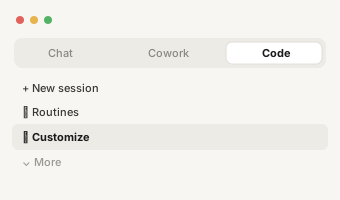
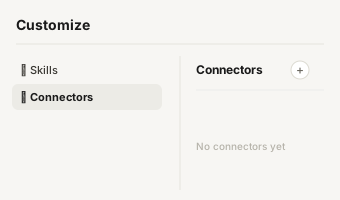
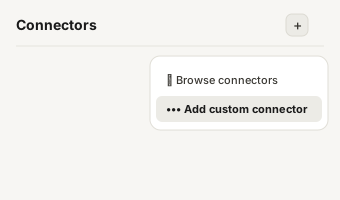
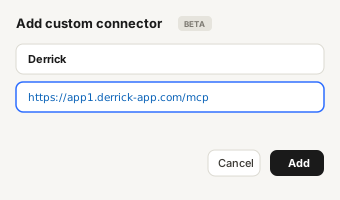
https://app1.derrick-app.com/mcp Call the same enrichment endpoints straight from your own stack or workflow.
Read the API docs →FAQs about this cluster
How do I find a phone number for a business?
Start with the company website contact page and legal notices, then the Google Business Profile panel, then a business directory. These give you the switchboard in minutes. Getting a named person's direct dial at scale needs an enrichment tool rather than manual lookup.
Can I find someone's phone number for free?
Free sources reliably return company switchboards and listed landlines. They rarely return a specific person's direct dial or mobile, because those numbers are not in public directories. Free methods are a good first pass, not a prospecting system.
How do I find a company phone number in bulk?
Bulk lookup means running one enrichment pass over a list instead of searching row by row. Derrick's Phone Finder returns mobiles and landlines from a column in the web app or in Google Sheets and bills 200 credits per number actually found, nothing when it comes back empty.
What is the difference between a switchboard number and a direct dial?
A switchboard is the company's public number and routes through a receptionist or an automated menu. A direct dial reaches one person's desk or mobile. Direct dials convert far better on outbound calls, which is why they are the harder data point to source.
How do I check a phone number is valid before calling it?
Normalise it to E.164 format first, which forces a country code and strips local formatting, then check the line type. Our guide on international phone number validation covers the full check.
Is it legal to call a business phone number I found online?
B2B calling is permitted under conditions: a legitimate interest basis, a purpose connected to the person's professional role, disclosure of where the data came from on request, and immediate respect for an opt-out. Consumer do-not-call registers apply to individuals, not to business lines. The compliance section of this guide covers the practice.