
You've found a new B2B data enrichment or prospecting tool. The demo was impressive, the pricing fits your budget, and the features check all the right boxes. You're ready to sign.
But have you read the SLA?
This document - usually buried in the contract appendix - defines what a vendor is actually committing to. A poorly negotiated SLA means your cold email campaign stalls on a Monday morning, your leads go unenriched the night before a big pitch, or worse: you lose data with no legal recourse.
This guide explains exactly what an SLA is, what "99.9% uptime" really means in practice, and which clauses to verify before adding any B2B tool to your sales stack.
What Is an SLA? Definition and Why It Matters for Sales Teams
SLA stands for Service Level Agreement. It's the contractual document in which a service provider - a SaaS vendor, cloud host, or telecom operator - formally commits to delivering a defined level of service quality. It sets the rules before the service goes live.
An SLA typically covers three dimensions:
- Availability: how long the service must be accessible, expressed as a percentage
- Responsiveness: how quickly the vendor responds to incidents
- Compensation: what you're entitled to when those commitments aren't met
For an SDR or Growth Marketer who relies daily on a data enrichment tool or email sequencing platform, the SLA isn't a technical footnote. It's the guarantee that your sales stack holds up when you need it most - during a high-volume outbound push, a product launch, or the final stretch before a quarter closes.
SLAs originated in the network services industry to measure transmission quality. They gradually became standard across the entire IT sector - from SaaS platforms to data centers - and are now a core component of every serious B2B cloud contract.
Key SLA Metrics: What Each Term Actually Means
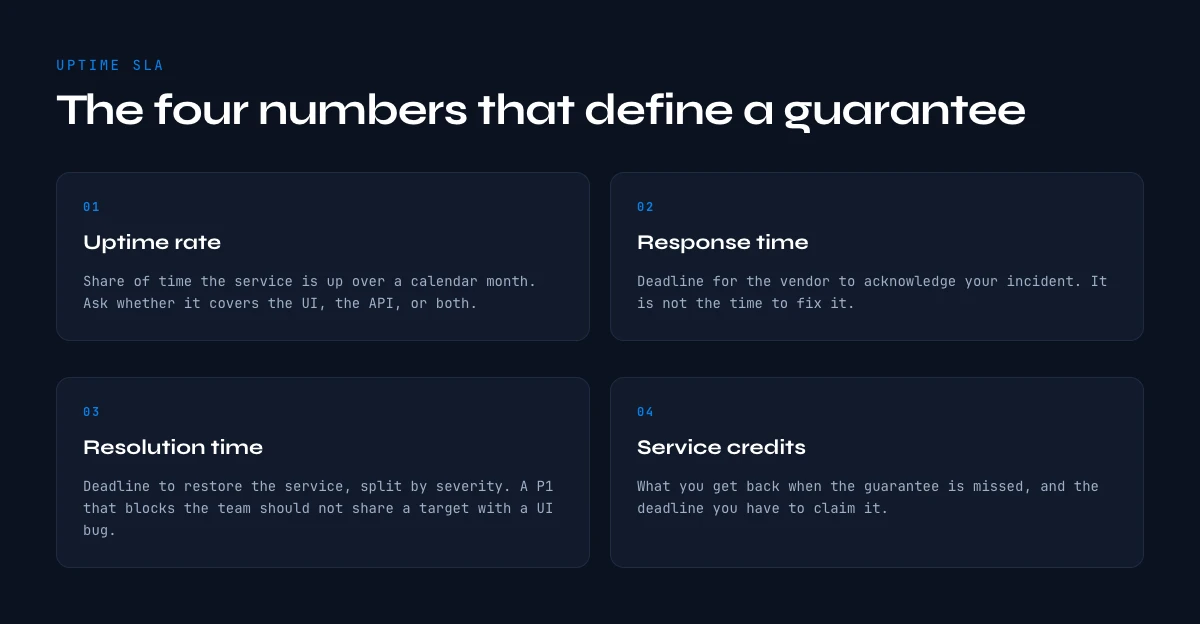
Before comparing contracts, you need to speak the language. Here are the four indicators you'll find in most SaaS SLAs.
1. Uptime Rate (Availability)
This is the most visible SLA metric. It expresses, as a percentage, the time a service is operational and accessible over a given period - typically a calendar month.
The standard formula:
Uptime (%) = (Total time − Unplanned downtime) / Total time × 100
99.9% sounds impressive. But translated into actual time, the difference between SLA tiers becomes significant.
2. Response Time Guarantee (RTG)
The RTG specifies the maximum time in which the vendor's technical team commits to acknowledge your incident after you've reported it. This is not the resolution time - it's a confirmation that someone is looking at it.
Example: a 4-hour business hours RTG means that if your ticket hasn't been acknowledged after 4 hours, the vendor is in contractual breach.
3. Resolution Time Guarantee
The resolution commitment goes further: it defines the maximum time to fix the incident and restore the service. This is the metric that matters most to end users.
A robust SLA distinguishes between criticality levels (P1, P2, P3) with different resolution times depending on severity. A critical incident blocking the entire team gets a resolution target of a few hours; a minor UI bug may allow several business days.
4. SLA Credits (Service Penalties)
When commitments aren't met, most SLAs provide service credits - typically applied as a discount on your next invoice or as a credit balance. Cash refunds are rare.
These credits almost always come with conditions: you must claim them within a defined window, provide evidence of the outage, and sometimes demonstrate business impact. Read these conditions carefully before signing.
The "Nines" Table: What 99.9% Uptime Actually Means
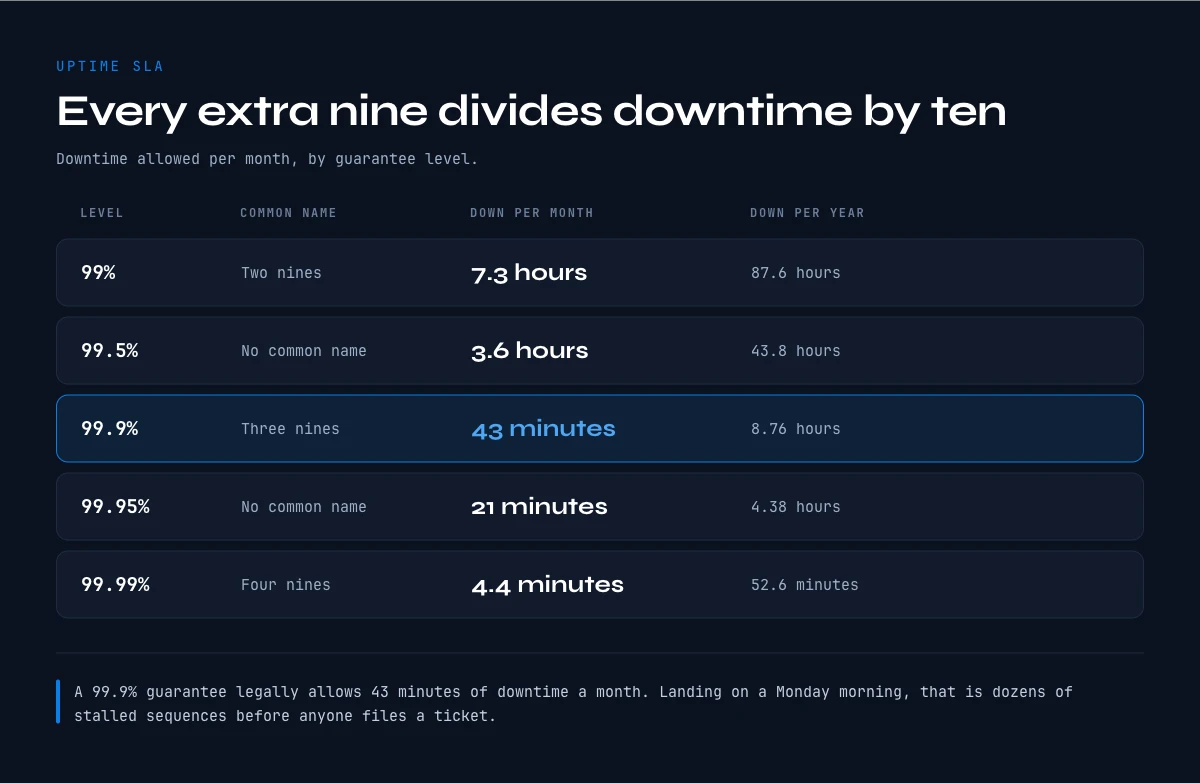
This is the most misunderstood aspect of SLAs. Sales teams see "99.9% uptime guaranteed" and assume near-perfect service. In reality, each additional "nine" reduces allowed downtime by a factor of 10.
| SLA Level | Common Name | Max downtime / year | Max downtime / month |
|---|---|---|---|
| 99% | "Two nines" | 87.6 hours | ~7.3 hours |
| 99.5% | - | 43.8 hours | ~3.6 hours |
| 99.9% | "Three nines" | 8.76 hours | ~43 minutes |
| 99.95% | - | 4.38 hours | ~21 minutes |
| 99.99% | "Four nines" | 52.6 minutes | ~4.4 minutes |
| 99.999% | "Five nines" | 5.26 minutes | ~26 seconds |
What this means for your sales team:
A 99.9% SLA legally allows up to 43 minutes of downtime per month. If your enrichment tool goes down on a Monday morning - the highest-activity day for most SDRs - those 43 minutes can translate into dozens of stalled sequences, unenriched leads, and a pipeline delay that's hard to recover from.
A 99.99% SLA reduces that tolerance to under 5 minutes per month. The difference is substantial for teams that depend on continuous availability.
No SaaS vendor can guarantee 100% uptime. Planned maintenance, infrastructure updates, and unpredictable incidents are operational realities. Be wary of vendors who don't mention an SLA at all - the absence of contractual guarantees leaves you without recourse if something goes wrong.
Uptime SLA Calculator: What Your Guarantee Allows, Period by Period
The table above gives the yearly and monthly figures. The number that decides whether an incident is a breach is usually neither: it is the downtime allowed over the window your contract actually measures. Some vendors report monthly, some quarterly, and a quarterly window lets three bad days hide inside an otherwise green quarter.
The formula is one line. Allowed downtime equals the total minutes in the reporting window multiplied by one minus the uptime percentage. A 30 day month contains 43,200 minutes, so a 99.9% uptime SLA allows 43,200 x 0.001 = 43.2 minutes. The same 99.9% over a 90 day quarter allows 129,600 x 0.001 = 129.6 minutes, or roughly two hours and ten minutes in a single stretch.
Uptime SLA calculator: allowed downtime by reporting period
Pick the level written in the contract. The output is the downtime the vendor is contractually allowed, per day, week, month, quarter and year.
Pick an SLA level, or type your own, to see the downtime it allows.
Assumes a 24/7 service and a strict reading of the percentage. A real contract also excludes planned maintenance windows, so the downtime you can actually experience is higher than the figure above.
Two readings of the same percentage are worth keeping in mind when you negotiate. First, a monthly window is stricter than a quarterly one at an identical percentage, so ask which window the credits are computed on before you argue about the number of nines. Second, the allowance is cumulative, not per incident: a vendor who is down for 40 minutes once has used almost the entire month of a 99.9% uptime SLA, and the next 4 minute blip is already a breach.
If your workflow depends on an API rather than a dashboard, run the same calculation against the API availability figure specifically, and read our notes on rate limits and retry behaviour: a call that is throttled rather than refused often does not count as downtime at all, while it is indistinguishable from downtime for your pipeline.
SLAs for B2B Tools: Specific Considerations for Prospecting and Enrichment
SLAs for prospecting and data enrichment tools have quirks you won't find in a standard hosting agreement. Here's what to watch for in your specific context.
API Availability vs. UI Availability
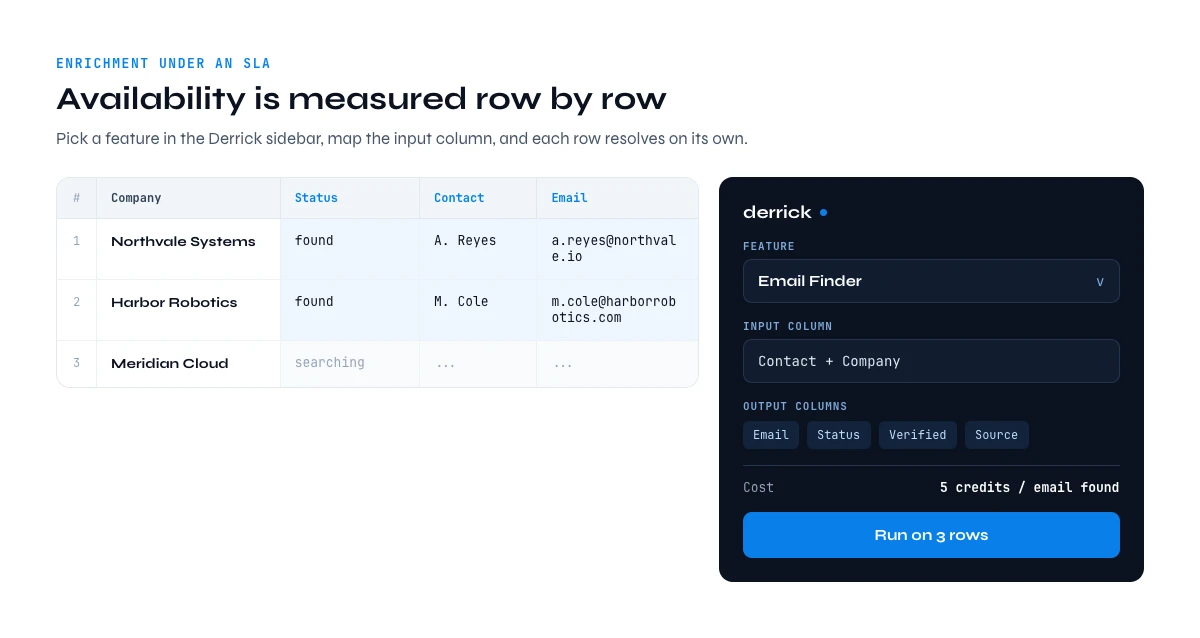
Most B2B tools expose two surfaces: a user interface (UI) and an API for automated integrations, and the two are rarely covered on the same terms (the trade-offs are laid out in our data enrichment API guide). The SLA may cover one without the other, or offer different levels for each.
For Mike, a Sales Ops manager at a growth-stage B2B company syncing his enrichment tool with HubSpot via Zapier, the graphical interface barely matters - it's API availability that drives his workflows. If the SLA doesn't explicitly mention the API, ask before signing.
Match Rate and Enriched Data Quality
Some enrichment tool SLAs go beyond technical availability to include data quality commitments: minimum match rates, email validity rates, and data freshness guarantees. These aren't yet universal, but they're becoming more common among premium vendors.
If your tool promises an 80% match rate but consistently delivers 50%, you have a performance problem. Without a contractual clause, you have no leverage. During negotiation, ask whether these metrics can be formalized in the SLA or in a performance annex.
Planned Maintenance Exclusions
SLAs almost universally exclude scheduled downtime (updates, nightly maintenance windows) from the availability calculation. These planned outages don't count against the uptime percentage.
Two things to verify: how frequently maintenance occurs, and during which hours. A tool that takes downtime on Saturday at 2 AM has far less impact than one that cuts out on Tuesday at 9 AM. Some vendors let you configure preferred maintenance windows based on your time zone or peak activity periods.
Data Portability and Exit Clauses
Often overlooked in B2B SLAs: the reversibility clause. If you cancel the contract or the vendor shuts down, how quickly can you retrieve your data, and in what format?
For your prospecting data - enriched emails, phone numbers, LinkedIn profiles - portability is a critical business concern. Make sure the contract specifies a reasonable retrieval timeline and a usable export format.
How to Evaluate a B2B Enrichment Tool's SLA: Your Checklist
Read the checklist below against the vendor's actual setup rather than its marketing page. Knowing how an enrichment API is put together tells you which of these commitments are cheap for the vendor to make and which ones cost it real engineering.
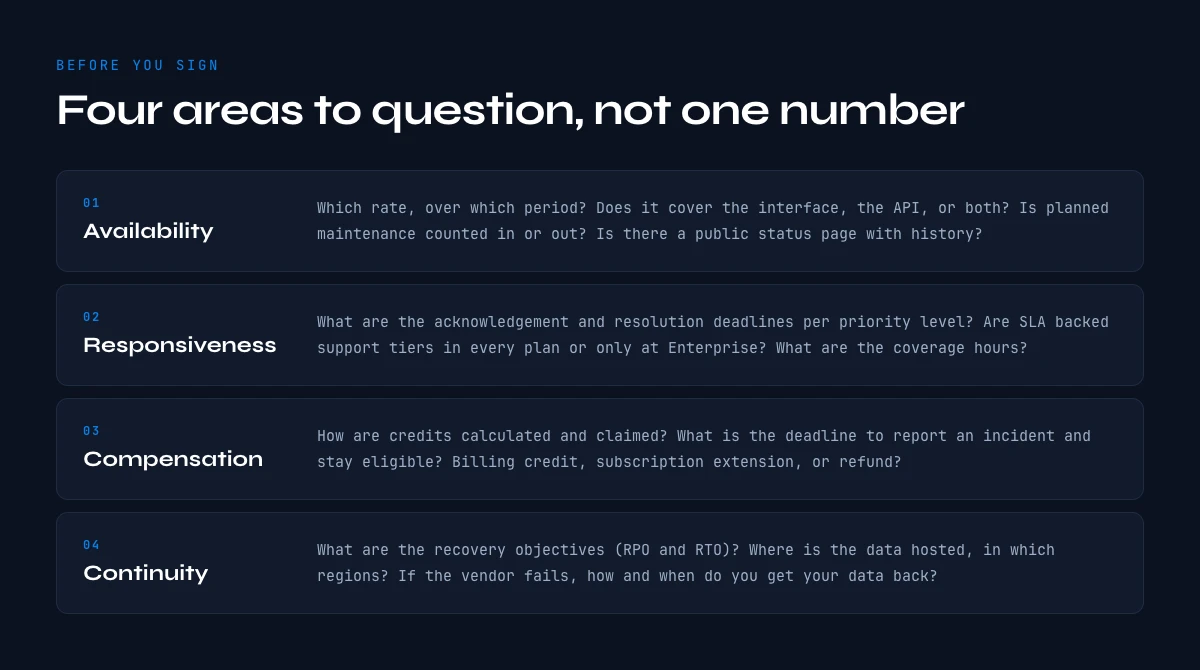
Before signing up for a B2B lead generation or database enrichment tool, ask your sales rep these questions.
On Availability
- What is the guaranteed uptime rate, and over what calculation period (calendar month or rolling)?
- Does that rate apply to the UI, the API, or both?
- Are planned maintenance windows included or excluded from the calculation?
- Is there a public status page with historical availability data?
On Responsiveness
- What are the response time and resolution time commitments by incident priority level?
- Are SLA-backed support tiers included in all plans, or only at Enterprise level?
- What are the support coverage hours? Is English-language support available around the clock?
On Compensation
- How are SLA credits calculated and claimed?
- What's the deadline for reporting an incident to be eligible for credits?
- What form does compensation take: billing credit, subscription extension, cash refund?
On Continuity
- What is the disaster recovery mechanism (RPO/RTO)?
- Where is data hosted? Which cloud regions (AWS, Azure, GCP)?
- In the event of vendor insolvency, how and when can you retrieve your data?
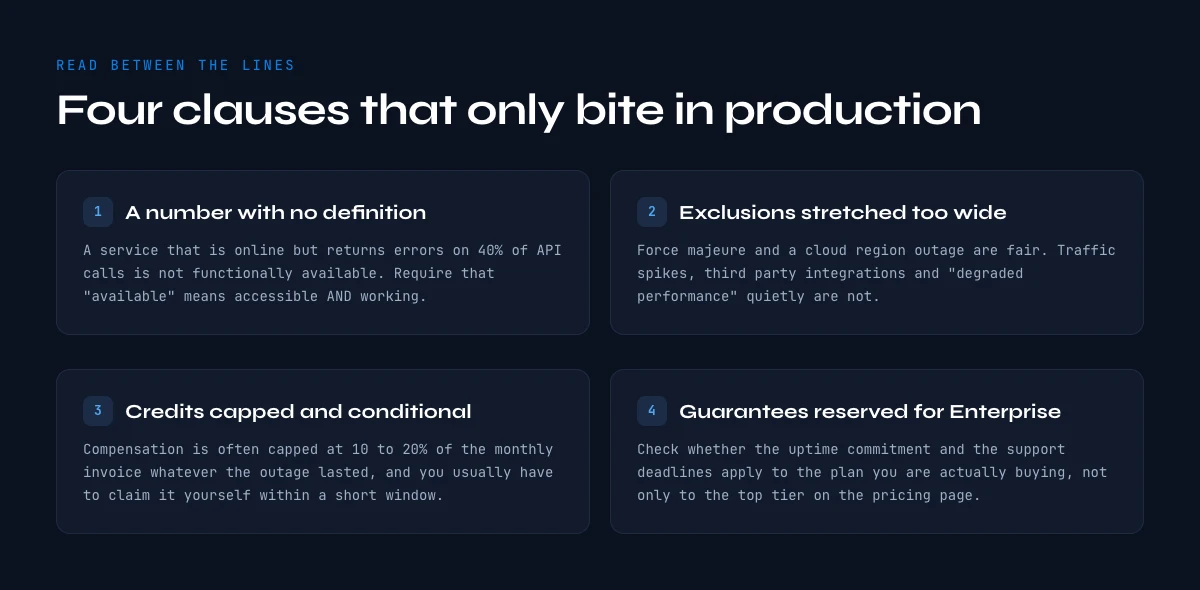
Common SLA Pitfalls: What to Read Between the Lines
Most of these clauses only bite once you are in production, which is why they are easier to spot if you already know how the vendor bills you: the pricing model behind an enrichment API and the guarantee it comes with are written by the same team, and they rarely contradict each other by accident.
A well-written SLA is a trust document. A poorly written one - or a strategically vague one - can leave you without recourse when it matters most. Here are the four most common traps.
Trap 1: An Uptime Number Without a Definition of "Available"
Some contracts display 99.9% without defining what "availability" actually covers. A service that is "technically online" but returning 500 errors on 40% of API requests is not functionally available. Require a precise definition: availability means the service is accessible AND functional for all critical features.
Trap 2: Overly Broad Exclusions
Exclusion clauses are legitimate for genuine force majeure events and third-party infrastructure outages (e.g., AWS region failures). But some vendors extend them to cover traffic spikes, third-party integration errors, or even "performance degradation" short of full outage. Read this section carefully.
Trap 3: Capped and Conditional SLA Credits
Compensation is often capped at 10-20% of your monthly invoice regardless of outage duration. And you typically need to claim credits manually - within a short window, often 30 days - with supporting evidence. If you don't act, nothing happens, even in the case of a clear breach.
Trap 4: No SLA on Entry-Level Plans
Many SaaS vendors reserve contractual SLAs for Enterprise plans. Small teams on Starter or Growth plans often have no formal guarantees. That's not necessarily disqualifying - but you need to factor this into how heavily you depend on the tool.
SLAs and GDPR: The Inseparable Link for Teams Handling Contact Data
For B2B tools that process personal data - which covers every prospecting, email enrichment, or phone finder tool - the SLA can't be read in isolation. It must be accompanied by a DPA (Data Processing Agreement), the contractual framework governing how the vendor handles data on your behalf under GDPR.
The DPA clarifies roles: your company is the data controller; the SaaS vendor acts as a data processor. As such, the vendor must commit to:
- Data location (EU hosting or equivalent safeguards for transfers outside the EEA)
- Security measures protecting enriched contact data
- Breach notification within GDPR-mandated timelines (72 hours to notify the ICO or relevant supervisory authority)
- Data deletion at contract end or upon request
A tool that collects professional email addresses or phone numbers without a clear DPA creates compliance exposure. Before deploying an email verification or phone enrichment workflow at scale, confirm that the SLA and DPA are consistent and properly documented.
For a deeper dive into GDPR and cold emailing compliance, check out our dedicated guide.
How SLAs Are Evolving in 2025-2026
One trend matters more than the rest for teams weighing their options: the stronger the guarantee you need, the more the build versus buy arbitration tilts, because an SLA you sign is a liability someone else carries and an SLA you build is one you carry yourself.
SLAs are no longer static legal documents. Several trends are reshaping their content and use across the B2B SaaS landscape.
Dynamic SLAs: some vendors are experimenting with commitments that adapt in real time based on usage patterns and application criticality. A real-time enrichment workflow during a live campaign might carry a reinforced SLA compared to an overnight batch job.
Cybersecurity integration: after years of attacks targeting SaaS vendors, SLAs now increasingly include security metrics - detection time, containment time, customer notification timelines. This matters especially for tools storing B2B contact data at scale.
Real-time transparency: public status pages (like those of Stripe, Notion, or HubSpot) have become table stakes. They allow users to monitor availability live, without waiting for a support email. When evaluating a new tool, check whether a status page exists - it's often a reliable signal of operational maturity.
Sustainability commitments: hyperscalers are beginning to include energy efficiency metrics in their SLAs. Still niche, but indicative of how these agreements are expanding well beyond pure technical availability.
Key Takeaways
- An SLA is a contractual commitment from your SaaS vendor on availability, response times, and compensation - not a marketing promise
- 99.9% uptime allows up to 43 minutes of downtime per month, which can have real impact on your prospecting campaigns
- Verify that the SLA explicitly covers the API, not just the UI - especially if you rely on Zapier, Make, or n8n integrations
- SLA credits are often capped and conditional: read the claim process before signing
- For tools handling contact data (emails, phone numbers, LinkedIn profiles), require a GDPR-compliant DPA alongside the SLA
- No SLA on entry-level plans is common - calibrate your dependency accordingly
Conclusion: A Well-Negotiated SLA Is a Competitive Advantage
An SLA isn't paperwork. For a sales team that depends on its tools to enrich contacts, automate sequences, and qualify leads, it's the guarantee that what was promised actually holds when the pressure is on.
Take the time to read the availability appendix before deploying a new tool in your stack. Ask the right questions before you sign. Build your commercial infrastructure on vendors who commit contractually to their performance - not just on their demo slides.
Through the Derrick API
What you commit to before you commit
Before negotiating uptime, check the commercial exposure. Derrick's API is included from a published plan and consumes the same credits as the rest of the catalogue, with no separate contract to sign to run a first integration.
- Feature
- Derrick API
- Credit cost
- Included
- Availability
- From PLUS
Continue exploring this cluster
 Data Enrichment API
 Data Enrichment API: Architecture and How It Works
How a real enrichment API works under the hood - request flow, caching, sources, response shape.
Read the guide → Data Enrichment API
 Webhooks and Data Enrichment: How to Trigger Enrichment from Events
Event-driven enrichment - when a webhook fires, when polling is better, retry strategies that don't lose data.
Read the guide → Data Enrichment API
 API Rate Limits and Quota Management: Everything You Need to Know
Rate limits per provider in 2026 - burst vs sustained, retry-after handling, distributed quota tracking.
Read the guide → Data Enrichment API
 API Security: Authentication & Encryption - Full Guide 2026
OAuth2, API keys, JWT, mTLS - when each fits. Plus encryption at rest, at transit, key rotation.
Read the guide → Data Enrichment API
 Custom Integrations: Build vs Buy - How to Make the Right Call
The framework to decide - engineering cost, maintenance, business specificity. When build wins, when buy does.
Read the guide → Data Enrichment API
 Top 7 Best Screenshot APIs to Automate Web Page Captures in 2026
7 screenshot APIs benchmarked - pricing, render quality, anti-bot, when each shines for B2B workflows.
Read the guide → Data Enrichment API
 Data Enrichment API Pricing: How the Models and Costs Really Work
Per-record vs credit-based pricing, the hidden costs, and how to estimate your true cost per usable record.
Read the guide → Data Enrichment API
 Contact Enrichment API: Fields, Match Rates and Real Costs
What a person record actually contains, why your input key decides the fill rate, what a published match rate hides, and what per attempt versus per result billing costs on 1,000 rows.
Read the guide → Data Enrichment API
 Company Data API: Which Input Returns Which Field (2026)
Which field a company data API can actually return depends on the key you send. The input to field map, honest coverage, the registry layer, and cost per usable row.
Read the guide →Start enriching your sheet in 30 seconds
Free for 100 credits/month. No credit card.