The State of B2B Outreach Agencies 2026: Cost, Performance and What Separates Winners
B2B outreach agencies report 2026: retainers $3-12k, meetings $300-700, in-house vs outsourced, and the factor that truly separates the winning agencies.


Last updated: 2026-06-18
Hiring a B2B outreach agency is one of the least transparent purchases in sales. Pricing is opaque, performance claims are unverifiable before you sign, and the variable that actually decides results is rarely the one buyers compare on. This report lays out what agencies cost in 2026, how in-house and outsourced really compare, and the single factor that separates the agencies that book meetings from the ones that burn retainers, without naming a single vendor.
The short version: agencies do not win on tactics, channels, or clever copy, those converge fast. They win on the quality of the data they run campaigns on. And that same variable is the one you control whether you hire an agency or build the function in-house.
The outsourcing landscape in 2026
Outsourced sales development is a large and growing market: industry estimates put the outsourced SDR market around 4.4 billion dollars in 2026, growing toward 7 billion by the early 2030s at roughly 8% a year. Companies outsource for speed and access to infrastructure they would otherwise spend months building, a team, the tooling, and a data pipeline ready on day one.
But the growth hides a wide quality spread. The same category contains agencies that consistently book qualified meetings and agencies that recycle generic sequences against stale lists and bill for the activity rather than the outcome. The market average tells you almost nothing about the agency you are about to hire, which is why buyers need a framework rather than a leaderboard.
The reason the average is so misleading is that outreach has low barriers to entry and high variance in execution. Anyone can stand up an agency, buy a list, and run a sequence; far fewer maintain the data discipline that makes those sequences land. So the category spans from genuine revenue partners to activity shops that look identical in a pitch deck. The deck is exactly where you cannot tell them apart, which is why the rest of this report focuses on the questions and the one variable that actually separate them.
It also helps to know why companies reach for an agency in the first place, because the reason shapes what good looks like. Most hire for speed and infrastructure, not for a secret tactic, they want pipeline now without spending two quarters hiring, training, and tooling a team. That is a sound reason, but it means the agency's value is operational leverage on a process you could in principle run yourself, which is exactly why the data layer underneath matters more than any proprietary trick they claim.
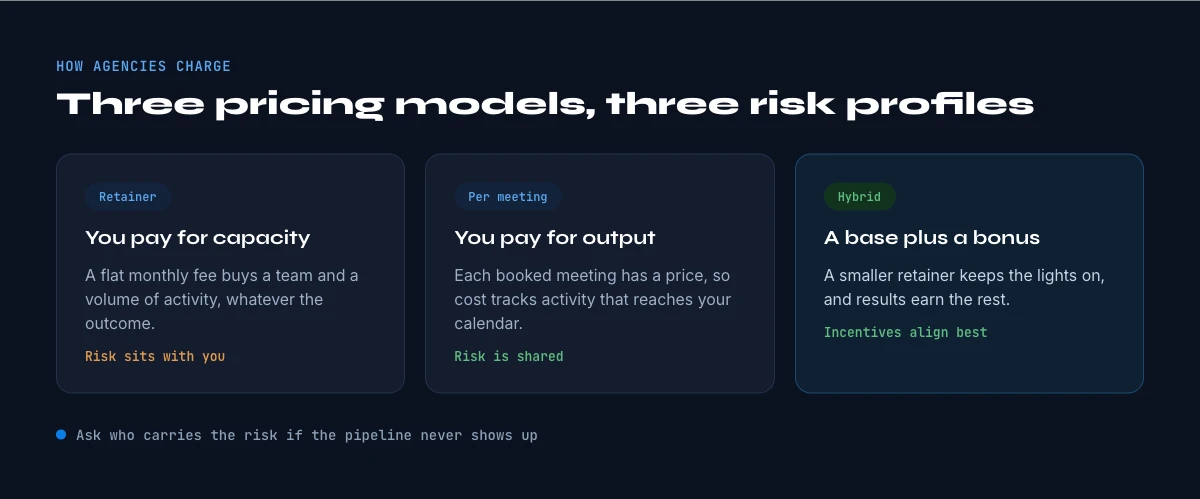
What B2B outreach agencies actually cost
Pricing in 2026 clusters into three models. Retainers most commonly run 3,000 to 12,000 dollars per month, with premium, senior-led agencies charging 8,000 to 15,000 or more. Per-meeting pricing varies by segment: roughly 150 to 500 dollars for SMB meetings, 300 to 900 for mid-market, and 800 to 2,500 or more for enterprise, with the average qualified meeting landing around 300 to 700 dollars. Performance models run roughly 150 to 800 dollars per qualified lead, and hybrid retainer-plus-bonus deals are increasingly the norm.
The number that matters is not the sticker, it is the cost per qualified, real meeting after you subtract no-shows, unqualified bookings, and meetings with people the data got wrong. A 400 dollar meeting that was booked on a stale contact who is no longer in the role is not a 400 dollar meeting, it is a wasted slot plus the opportunity cost. Always divide the price by what actually converts, not by what was delivered.
This reframes the cheap-versus-premium debate. A lower retainer that produces meetings with the wrong people is more expensive per real opportunity than a higher one that books qualified, current contacts, and the gap usually traces back to data, not effort. Agencies that bill for activity have an incentive to send more, even to a decaying list; agencies that bill for outcomes have an incentive to verify before they send. Reading the pricing model tells you which incentive you are buying.
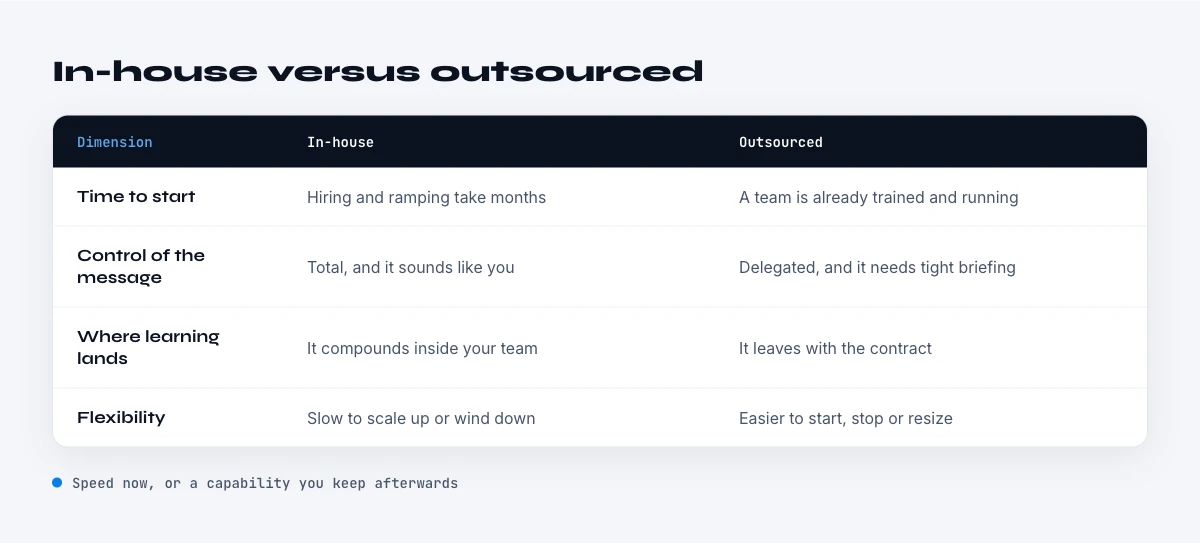
In-house versus outsourced
On paper the math favors outsourcing. A fully loaded in-house SDR realistically costs 110,000 to 150,000 dollars a year once you count salary, tooling, management, and ramp, while an outsourced SDR runs closer to 42,000 to 96,000 per rep, and well-run outsourced programs report 2 to 6 times ROI on spend. The case for outsourcing is real: speed, lower fixed cost, and immediate access to infrastructure.
But the comparison misleads if you treat the agency as a black box. An outsourced team running on a clean, verified data layer outperforms an in-house team running on a stale one, and vice versa. The cost advantage of outsourcing only materializes if the data underneath is good, because a cheaper rep working a wrong list just produces wrong outreach faster. Whether you keep it in-house or outsource, you are really choosing who owns the data quality, not just who sends the emails. For market-specific options, see cold email agencies in the US, the UK, and France.
There is also a hidden asset question in the build-versus-buy decision: who keeps the data. When you build in-house, the verified contact data, the learnings, and the playbook stay with you and compound. When you outsource, that asset often lives with the agency, so leaving means starting over. The strongest setups, in-house or hybrid, treat the data layer as owned infrastructure regardless of who operates the outreach, so the value accrues to you rather than walking out the door with a contract.
The pragmatic answer for many teams is hybrid: keep ownership of the data and the ICP in-house, and outsource execution capacity on top of it. That way the cost advantage of an agency is real, but it is not undermined by a black-box list you cannot inspect. The decision stops being agency-or-team and becomes who runs the sends on top of a data layer you control either way.
One more factor rarely priced in: ramp and switching cost. An in-house team takes months to reach full productivity and is expensive to unwind; an agency can start in weeks but may take its data and process with it when the contract ends. Neither is genuinely cheap to change. Anchoring the data layer on your side reduces both risks at once, because the most valuable and slowest-to-rebuild asset, a verified, current contact base, stays with you regardless of which way the execution decision goes, and a switch becomes a change of operator rather than a restart from zero.
The app works through your list row by row. 100 free credits every month.
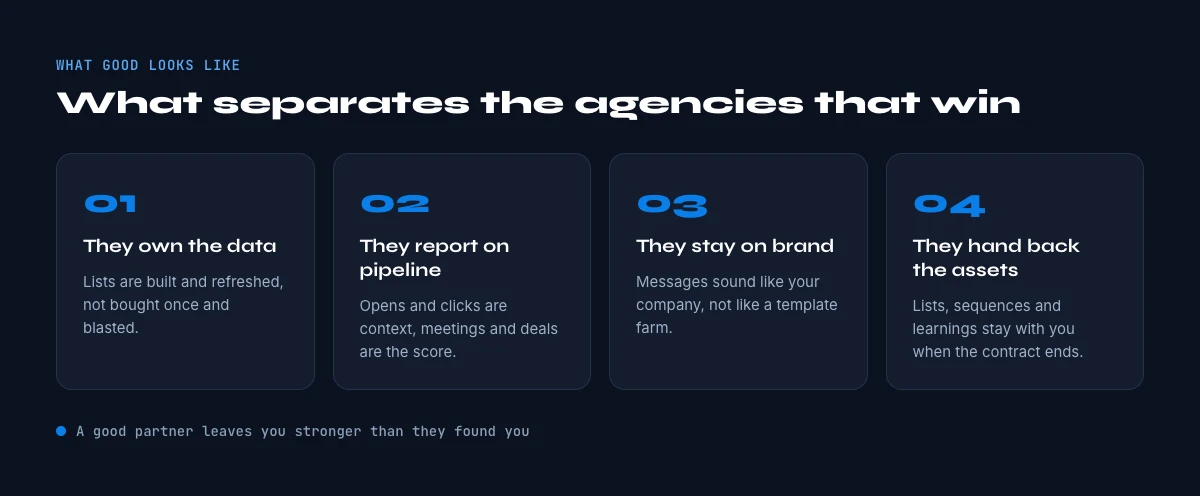
What separates winning agencies
Strip away the branding and the winning agencies share one thing: they run campaigns on data that is verified close to the moment of send, not on a list bought or scraped months earlier. Tactics, channels, and sequence structure converge across the market, anyone can copy a playbook. What does not converge is the freshness and accuracy of the contact data, and that is what shows up in reply rates and booked meetings.
This is why two agencies with identical processes can post opposite results. One verifies and enriches the list at the point of use, so the sequence reaches real, current people; the other runs the same sequence against a decaying database and blames the channel when it underperforms. Same playbook, opposite outcomes, decided by the data layer. When you evaluate an agency, the most revealing question is not which channels they use, it is how and when they verify the data they send to.
You can see this in the metrics that survive scrutiny. Agencies running clean data report reply and meeting rates several times higher than those running stale lists, not because their writers are better, but because a larger share of their sends reach a real, current person who can actually say yes. Deliverability compounds it: a verified list keeps bounce low, which protects sender reputation, which keeps even more of the campaign landing. Stale data does the reverse, quietly throttling the whole program from underneath.
This is also why agency results are so hard to copy from a case study. The visible part, the sequence, the channels, the cadence, is replicable in an afternoon. The invisible part, a pipeline that verifies contacts at the moment of send, is the actual moat, and it never appears in the deck. When an agency posts a great result, the right question is what their data layer looked like, not what their subject line was.
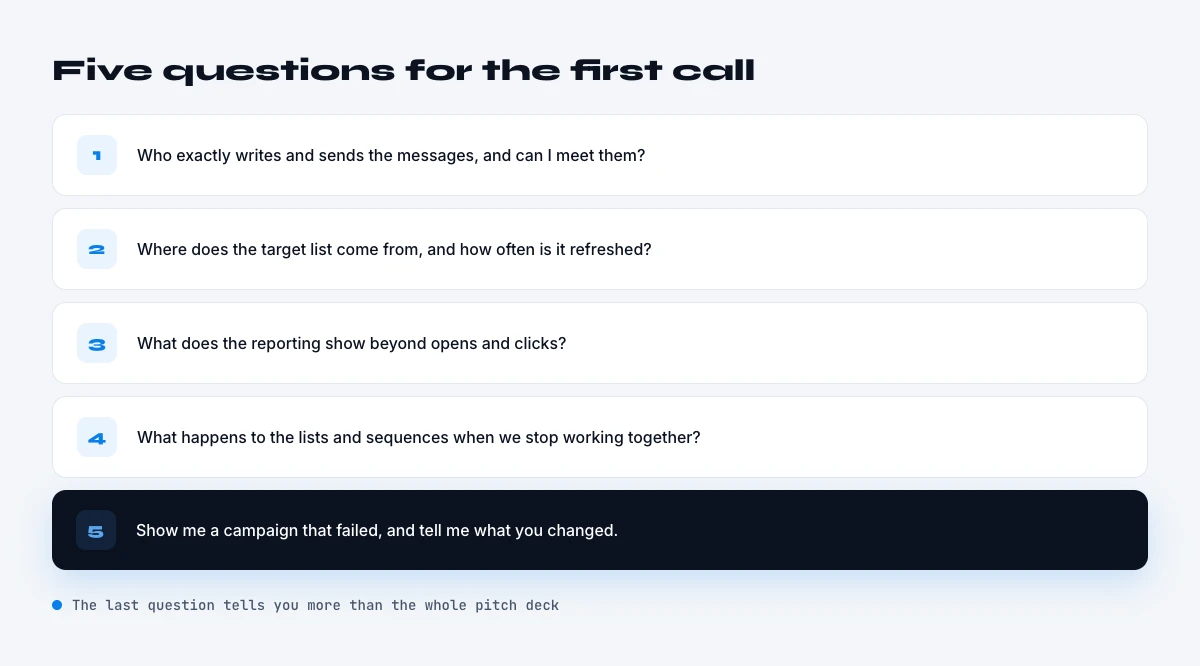
How to evaluate an agency in 2026
Judge an agency on five questions, before the retainer starts. How do they source and verify contact data, and how recently is it confirmed before a send. What does pricing look like per qualified, attended meeting, not per activity. What are their reply and show-up rates on accounts like yours, with evidence. Who actually runs the account, senior operators or junior overflow. And what happens to the data and the playbook if you leave, do you keep anything. Ask for a small paid pilot measured on booked, qualified meetings, because the only benchmark that matters is performance on your market, not a case study from someone else's.
Beware two common evaluation traps. The first is judging on logos and testimonials, which select for marketing, not for performance on your specific market. The second is comparing headline reply rates without asking on what data they were achieved, since a high rate on a tiny, hand-verified list says nothing about performance at your volume. A short paid pilot on your accounts, measured on qualified meetings booked and attended, cuts through both, because it tests the agency on the only data set that matters: yours.
However you decide, treat the contact data as the part you should never fully outsource the standards on. Ask whether the agency verifies at the point of use, and if you run outreach in-house, hold yourself to the same bar. Multichannel programs raise the stakes further, since stale data wastes effort across every channel at once, as the comparison of multichannel outreach agencies shows. Verify and enrich your outreach data on demand with Derrick, free for 100 credits per month, in the web app or in Google Sheets, so agency or in-house, your campaigns run on data confirmed at the moment of send.
Methodology and sources
This report aggregates 2026 pricing and market data for B2B outreach agencies and outsourced sales development, normalized into comparable ranges, alongside the canonical B2B data-decay baseline. We deliberately do not name agencies: rankings shift constantly, a case study rarely generalizes to your market, and the only number that should drive a hiring decision is the one you measure in a pilot on your own accounts. Where a figure could only be traced to an agency's own marketing, we treated it as a claim. Treat the ranges as the shape of the market, then run a measured pilot before you commit a retainer.
A closing thought for buyers. The agency decision feels like choosing a vendor, but it is really choosing how much of your data quality you are willing to hand to someone else. The execution, the sending, the copy, the cadence, is safe to outsource and easy to switch. The data layer is the part that compounds, and the part that, if you let it decay or lock it inside an agency, quietly caps every result no matter who runs the campaign. Own that, measure on your own pilot, and the choice between agencies, or between agency and in-house, becomes a low-stakes, reversible decision instead of a bet. That is the position every data buyer should aim for, and it starts with owning the inputs and verifying them at the point of use rather than renting both inside a retainer. The agencies worth keeping will welcome that standard; the ones that resist it are quietly telling you what they are really selling.
Frequently asked questions
How much does a B2B outreach agency cost in 2026?
In-house or outsourced: which should I choose?
What separates winning agencies?
How do I evaluate an outreach agency?
Should I outsource or keep data in-house?
Keep reading
Continue exploring this cluster


Best Cold Email Agencies in the US (2026)
Read →

Best Cold Email Agencies in the UK (2026)
Read →

Best Cold Email Agencies in France (2026)
Read →

Best Multichannel Outreach Agencies in France (2026)
Read →