B2B Marketing: Strategies, Channels and Metrics That Move Pipeline
B2B marketing is the set of strategies and channels a company uses to generate demand, pipeline and revenue from other businesses rather than from consumers..

Why this cluster matters
What you'll learn
B2B marketing in 2026 isn't lead gen anymore - it's intent capture, demand creation, and account choreography. The frameworks that worked in 2020 (MQLs, lead scoring, MA platforms) are quietly being replaced. This cluster covers what's actually moving pipeline and what's just dashboard theater.
For who · Marketing Leaders, Demand Gen, Heads of ABM, Growth
See Derrick's B2B data features →- Account-Based Marketing : how 200-person companies run real ABM without €100k stacks
- Lead generation patterns that survived the iOS 14.5 / GDPR / cookie shifts
- Intent data : 1st-party vs 2nd-party vs 3rd-party - what each one is good for
- Marketing-sales alignment : the 4 rituals that close the friction
- Content distribution vs creation : where the leverage actually lives now
- Reporting that doesn't lie : MQL is dead, what replaces it
All guides · 42
All 42 guides in this cluster
Strategy12

The State of B2B Marketing Performance 2026: Benchmarks Report
Free report: 2026 CPL, conversion, MQL-to-SQL, budget and speed-to-lead benchmarks, and why clean data multiplies every KPI. Read the guide →

Account-Based Marketing (ABM): Definition, Techniques, Examples
What ABM is, who it's for, the 4 plays that actually work, and how to build your target account list in Sheets. Read the guide →

Inbound vs Outbound Marketing: Differences, When to Pick Each
Side-by-side breakdown of inbound vs outbound. Costs, time-to-pipeline, ICP fit. Decision framework included. Read the guide →

Go-to-Market Strategy: B2B Framework & 7 Steps (2026)
What a go-to-market strategy is, when you need one, and the 7-step B2B GTM framework: ICP, motion, messaging, target list, channels, metrics. Read the guide →

Outbound sales
What outbound sales is, how the process works, the main channels, the metrics that matter, and how clean data makes it convert. Read the guide →

B2B Database Marketing: The Data-First Playbook (2026)
Why the database, not the channel, decides B2B marketing: the fields that enable targeting, how to enrich in Sheets, and the segmentation it unlocks. Read the guide →

Demand Generation vs Lead Generation: The 2026 Difference
Demand gen creates awareness at the top of the funnel; lead gen converts that interest into contactable, sales-ready records. What each is for, how they hand off, and where the data layer decides. Read the guide →

Lead Generation KPIs: 12 Metrics and What Breaks Each One
Twelve lead generation KPIs grouped by stage (volume, cost, quality, speed, outcome), each with its formula, one running example and the data field that skews it, plus a diagnostic table and the three numbers to show leadership. Read the guide →

B2B Customer Segmentation: 6 Methods and the Columns Each Needs
The six B2B segmentation methods in one table with the data columns each one needs and where they come from, the fill-rate test, a worked example of 1,000 accounts cut into four segments, and the four tests of a usable segment. Read the guide →

Sales Pipeline Metrics: 12 to Track on One Worked Quarter
Twelve sales pipeline metrics in three families (volume, conversion, open pipeline), all computed on the same illustrative quarter, with what skews each one, a leading vs lagging table, a two-question diagnosis and a free sales velocity calculator. Read the guide →

Sales Tracking Software: What It Tracks and How to Choose
What sales tracking software tracks in four families, the features to check with the question to ask in a demo, tool types with examples, how to choose by team profile, when a spreadsheet is enough, and the empty account fields that make tracking reports wrong. Read the guide →

B2B Influencer Marketing: Pick Creators by ICP Reach
What B2B influencer marketing is and when it works, influencer types by motion, a four-step method to measure the share of your ICP in a creator's active audience before you sign, a worked example with a calculator, payment models and measurement without vanity metrics. Read the guide →Playbooks30

B2B Lead Generation: Strategies, Tools, Tips in 2026
The 7 lead gen channels that work in 2026, ranked by CAC and time-to-conversion. Tool stack included. Read the guide →

Lead generation company
What a lead generation company does, the main types, real costs, how to choose one, and when it is smarter to build your pipeline in-house. Read the guide →

How to Build a Prospect List: 6 Steps and the Real Cost per 1,000 Rows
A list of names is not a prospect list. The fit gate, the twelve columns that matter, four sourcing paths, why deduplication comes before any spend, and what 1,000 rows actually cost. Read the guide →

Inbound Lead Management: The 5-Stage Playbook (2026)
An inbound lead arrives as an email address and nothing else. The five stages that turn it into a routed, scored, workable record, and why the enrichment step is the one everybody skips. Read the guide →

The 8 B2B Sales Challenges, and the Number That Tells You Which Is Yours
Eight B2B sales challenges, each with the metric that confirms it and the lever that moves it, split between the structural ones you adapt to and the self-inflicted ones you fix. Read the guide →

How to Sell to Decision Makers: The Buying Committee Playbook
The five seats on a B2B buying committee, what each one buys on, the order to approach them, and the coverage number that tells you it is working. Read the guide →

What Is Inbound Sales? Process, Qualification and Metrics
Inbound sales explained: the four stages, how to qualify a lead that is not your ICP, the data a rep needs before the call, and the metrics that prove it works. Read the guide →

LinkedIn Prospecting on a Free Account: Workflow and 4 Ceilings
A free LinkedIn account is a real constraint, not a crippled demo. The workflow that fits inside it, the four ceilings in the order you hit them, and when a paid tier is actually the answer. Read the guide →

Sales Process Steps: The 7 Stages and the Data Behind Each One
The seven sales process steps walked in order, with the specific data each step depends on, the symptom that shows when it is missing, and a diagnostic to find the earliest leak. Read the guide →

Social Selling Tools: The 5 Jobs and the Order to Buy Them
Social selling tools do five separate jobs. Which one gates the others, what LinkedIn already gives you free, the buying order, and what a stack costs per rep. Read the guide →

LinkedIn Account Based Marketing: The 2026 Execution Playbook
The tiers are free everywhere. The list is the hard part: match rate, buying committee coverage and the contact layer that decides whether the programme is staffable. Read the guide →

Sales Proposal Template: The 8 Sections and the Data Each Needs
A sales proposal template is 80 percent boilerplate. The 20 percent that converts is variables, and five of the eight sections depend on facts about the buyer that no template supplies. Read the guide →

Lead generation tools: the six jobs and the cost per lead
The six jobs a lead generation stack does, which tools cover each one, and what a qualified lead actually costs step by step rather than per month. Read the guide →

ICP in sales: what it means and how to build yours
What ICP means in sales, how it differs from a buyer persona, and a five-step method to derive yours from won deals, with the cost of the run measured. Read the guide →

Automated lead generation: the workflow and what a run costs
The six jobs an automated chain does, the gate that decides which plan you need, and what one run costs per usable contact rather than per month. Read the guide →

Value-based selling: the account research that makes it work
What value-based selling is, the six account facts a value case is built on, where each one comes from, and what the research costs per account. Read the guide →

Sales Automation Tools: The 5 Tasks Worth Automating
The five tasks that stay manual after the list is built, what removes each one, what the price meter runs on, and an hours-saved calculator. Read the guide →

Sales Pipeline Stages: The 6 Stages and Their Entry Criteria
Six stages defined by a verifiable fact rather than an activity, with the CRM fields each one needs, a worked example, and the pipeline math that sizes the top. Read the guide →

Manufacturing Lead Generation: Accounts, Buying Committee, Triggers
How to find the plants that fit, map the engineer, buyer and budget owner inside each one, spot the triggers that open a supplier change, and measure RFQs instead of leads. Read the guide →

SaaS Lead Generation: Signups, Integrations and Buying Signals
The three data sources a software company already has (signups, integration ecosystem, buying signals), the channels that fit each price point, and the metrics to track per account. Read the guide →

LinkedIn Connection Request Message: 12 Templates Under 200 Characters
The current rules (200 characters, 3 personalized notes a month on a free account), when to send a request blank, 12 templates with their character count, and a note checker. Read the guide →

Healthcare Lead Generation: Segments, Buyers and Triggers
How to split healthcare into four segments that buy differently, list hospitals, practices, labs and care facilities by code, map who champions, blocks and signs, and act on the events that open a budget. Read the guide →

Lead Qualification: How to Qualify a Sales Lead in 6 Decisions
Compare BANT, CHAMP and MEDDIC by what the data can verify and what only a call can answer, then define, verify, score, ask, route and disqualify with an exit criterion at each step. Read the guide →

How to Prospect Effectively: A Sales Prospecting Method in 6 Decisions
Sales prospecting as six decisions (who, where, what to verify, channel, message, cadence), each judged by one rate, with a channel rule, six scripted channels, a prospecting week, six templates and a volume planner. Read the guide →

How to Handle a Sales Objection: 8 Objections and a 5-Step Method
The 8 sales objections of B2B discovery and demo calls, with a reply and the public data that pre-empts each, the four types plus authority, a 5-step method, objections vs obstructions and a pre-call checklist with its credit cost. Read the guide →

B2B Email Marketing: 8 Campaigns by Segment and the Data Behind Each
B2B email marketing for opt-in lists: why it still pays, what changes from B2C, which data field triggers which campaign, 8 examples by segment, 10 strategies, a 90-day plan, cadence, KPIs and a segment planner. Read the guide →

Sales Pitch Examples: 7 B2B Pitches and the Fact That Opens Each
Seven complete B2B sales pitch examples, one per channel (email, LinkedIn, voice note, phone, demo follow-up, elevator pitch), a four-line template, where the fact in line one comes from and a pitch builder with its credit cost. Read the guide →

B2B Sales Techniques: 12 Methods, and Which One to Use When
Twelve B2B sales techniques on the same card (stage, what the name stands for, an example line, when not to use it), a table to pick one by stage, cycle and channel, the fact each one assumes, and a technique picker. Read the guide →

B2B buyer persona: what to verify, what to ask
A B2B buyer persona in two columns (what you can verify in the data, what only an interview tells you), one card per role of the buying committee, 7 interview questions, three examples, a template and a persona builder. Read the guide →

Sales Funnel Management: Find the Stage That Leaks
What a B2B sales funnel is, the stages you can count, how it differs from a pipeline, and a free calculator that shows which stage leaks and whether the loss comes from your list or your message. Read the guide →B2B marketing is the set of strategies and channels a company uses to generate demand, pipeline and revenue from other businesses rather than from consumers. It differs from B2C on every axis that matters: longer sales cycles, buying committees instead of single buyers, rational ROI-driven decisions, and a much smaller, more precisely defined addressable market. Winning at B2B marketing in 2026 is less about reach and more about reaching the right accounts with the right message at the right moment.
This guide defines the discipline, maps the modern B2B buyer journey, and breaks down the strategies and metrics that still move pipeline - so you can pick what fits your stage instead of chasing whatever is trendy.
What is B2B marketing? Definition and how it differs from B2C
B2B (business-to-business) marketing targets organizations and the people who buy on their behalf. Unlike B2C, where a purchase is often emotional and immediate, a B2B purchase is evaluated by a committee of 6 to 10 stakeholders on average (Gartner), over weeks or months, against a budget and a business case. That single fact reshapes everything: your content has to educate multiple roles, your timing has to match a buying window, and your targeting has to be account-precise.
The modern B2B buyer journey in 2026
The biggest shift: buyers self-educate before they ever talk to sales. Gartner finds B2B buyers spend only 17% of the journey meeting potential suppliers, and far more time researching independently. By the time a prospect raises their hand, they have already formed an opinion. B2B marketing in 2026 therefore wins by being present and credible during that silent research phase - through SEO, comparison content, and increasingly through being cited by AI answer engines (GEO).
The strategies that still move pipeline
Most teams pick a strategy based on what is trendy, not on what fits their stage and ICP. The result: outbound at SMB scale (too expensive per deal), inbound at enterprise scale (too slow), ABM with no AE coverage (no follow-through). The fit matters more than the tactic:
| Strategy | Best fit | Core motion |
|---|---|---|
| ABM (account-based) | Enterprise ICP, high ACV | Few accounts, multi-thread, personalized |
| Inbound | SMB / product-led | SEO, content, free tier, self-serve |
| Outbound | Defined ICP, mid-market | Targeted lists + multichannel sequences |
| Demand generation | Category creation | Education + 1st-party data capture |
| Product-led growth | Self-serve product | Free usage to paid conversion |
Concrete picks by stage: Pre-seed + enterprise ICP → founder-led ABM Light (20 accounts, multi-thread). Seed + SMB ICP → product-led inbound (SEO + free tier + activation). Series A + mid-market → tiered ABM plus targeted inbound.
The channels, ranked by what actually converts
Channel performance in B2B is remarkably stable: the channels closest to intent convert best. Referral and email convert higher than paid social; organic search compounds over time while paid stops the moment you stop paying. The winning mix is almost always organic search + targeted outbound + a credibility layer (LinkedIn presence, comparison content), with paid used to accelerate, not to substitute.
The metrics that matter (and the ones that lie)
The MQL is dying as a primary metric because it rewards volume over quality. The metrics that survive board scrutiny in 2026 are pipeline created, pipeline velocity, cost per opportunity (not per lead), and revenue attributed by source. Track the journey from account to opportunity to closed-won, not vanity counts of form fills.
Common B2B marketing mistakes
- Strategy-stage mismatch - running enterprise ABM at seed, or SMB inbound for a $100k ACV product.
- Spray-and-pray outbound - sending the same message to a list that was never qualified against an ICP.
- Content with no distribution - publishing without an SEO or syndication plan.
- Measuring leads, not pipeline - optimizing the top of funnel while the bottom leaks.
Where Derrick fits in your B2B marketing stack
Every strategy in this cluster shares one prerequisite: an enriched, ICP-accurate prospect list. ABM needs the right accounts; outbound needs verified emails; demand gen needs clean 1st-party data. Derrick is the data layer for that, in its web app or natively in Sheets: 100+ data points per lead, 10+ premium providers cross-referenced, pay only for verified matches. The free tier covers 100 credits per month, enough to validate any of the strategies above before scaling spend.
Pick a guide to start
The three guides below cover the strategies referenced above - each built around real plays and a recommended tool stack, not theory.
- Account-Based Marketing (ABM) - definition, the plays that work, and the target account list workflow in the web app or in Sheets.
- Inbound vs Outbound - side-by-side breakdown and a decision framework for your stage.
- B2B Lead Generation 2026 - channels ranked by CAC and time-to-conversion.
B2B Marketing
Start enriching your list in 30 seconds
Free for 100 credits/month. No credit card.
Install the add-on and enrich your lists without leaving your spreadsheet.
Install in Google Sheets →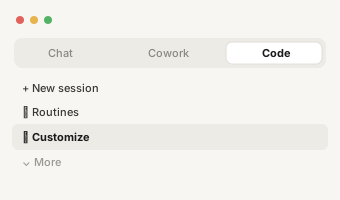
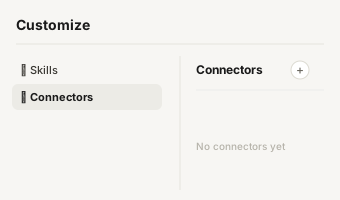
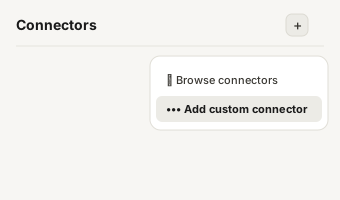
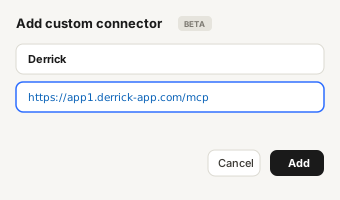
https://app1.derrick-app.com/mcp Call the same enrichment endpoints straight from your own stack or workflow.
Read the API docs →