
Demand Generation vs Lead Generation
Demand generation vs lead generation: learn what demand generation marketing is, which to fund first, how the handoff works and how to measure each.


Demand generation vs lead generation usually gets framed as a contest, as if a team has to pick one. It is not a contest. They are two stages of the same revenue engine, and confusing them is how B2B teams end up either generating interest they never capture or chasing leads before anyone knows who they are. The distinction is simple once you place each one in the funnel: demand generation creates awareness and interest across your market; lead generation converts the interested slice into named, contactable records a salesperson can work.
This guide draws the line cleanly: what demand gen is for, what lead gen is for, how they differ in goal, funnel position and metric, why you need both, how the handoff between them works, and where the data layer quietly decides whether lead generation pays off at all.
What is demand generation?
Demand generation is the work of creating awareness and interest in your category and your brand across your whole addressable market, including the large majority who are not ready to buy today. It sits at the top of the funnel and its job is to make buyers know you, trust you, and think of you first when a need eventually surfaces.
Demand gen is not measured by how many forms get filled. It is measured by reach, brand recall, engagement, and the share of your market that recognizes you before they ever raise a hand. Content, thought leadership, podcasts, community, organic social and educational campaigns are its typical vehicles. The point is not to extract a contact today; it is to be the name a buyer already trusts when they start evaluating in six months.
A useful way to frame it: demand gen invests in the market's memory. When a buyer finally has a problem your product solves, the question is whether your brand is already in their consideration set or whether you have to buy your way in cold. Every piece of educational content, every helpful answer published where your buyers look, every reason to remember you deposits into that memory. It rarely converts on the day it is published, which is exactly why it gets underfunded and why the teams that keep investing pull ahead as their competitors keep chasing quarterly capture.
What is demand generation marketing?
Demand generation marketing is the set of marketing programs that make a market want what you sell before anyone fills in a form. It reaches buyers who are not shopping yet, teaches them the problem, and makes your brand the obvious name when they start looking. In B2B it runs mostly on content people can use without handing over an email, and it is judged on attention and recall first, pipeline later.
In practice, demand generation marketing rests on five tactics:
- Ungated content. Guides and benchmarks anyone can read without giving an email.
- Social. Founder and employee posts, mostly on LinkedIn, in the feed of people who will buy later.
- Podcasts and events. Where buyers spend real time with your ideas.
- Community. A Slack group, a meetup or a newsletter where practitioners talk to each other, and to you.
- Awareness advertising. Paid reach on your target accounts, judged on recall, not on form clicks.
A demand generation strategy is mostly picking two or three of these and keeping them up long enough to compound. None of them asks for contact details, which is the whole difference with what comes next.
What is lead generation?
Lead generation is the work of converting interested people into identified, contactable records your sales team can act on. It sits below demand gen in the funnel and its output is concrete: a named person, at a known company, with a verified way to reach them and enough context to qualify them.
Where demand gen is measured by awareness, lead gen is measured by volume and quality of captured contacts, conversion rate, and eventually pipeline and revenue. Its vehicles are the capture and qualification mechanisms: gated content, demo requests, sign-ups, outbound prospecting, and the enrichment that turns a thin form-fill into a record a rep can actually work. For the full playbook on the capture side, see our guide to B2B lead generation strategies.
Lead gen also has an inbound and an outbound face. Inbound lead gen captures people who came to you, usually because demand gen made them aware; outbound lead gen goes and finds the accounts that fit before they have raised a hand at all. Both produce the same output, a named and contactable record, and both live or die on whether that record is enriched enough to qualify. The difference is only who initiates: inbound waits for the signal, outbound manufactures it, and in most B2B teams the two run side by side against the same target market.
Demand generation vs lead generation: the core difference
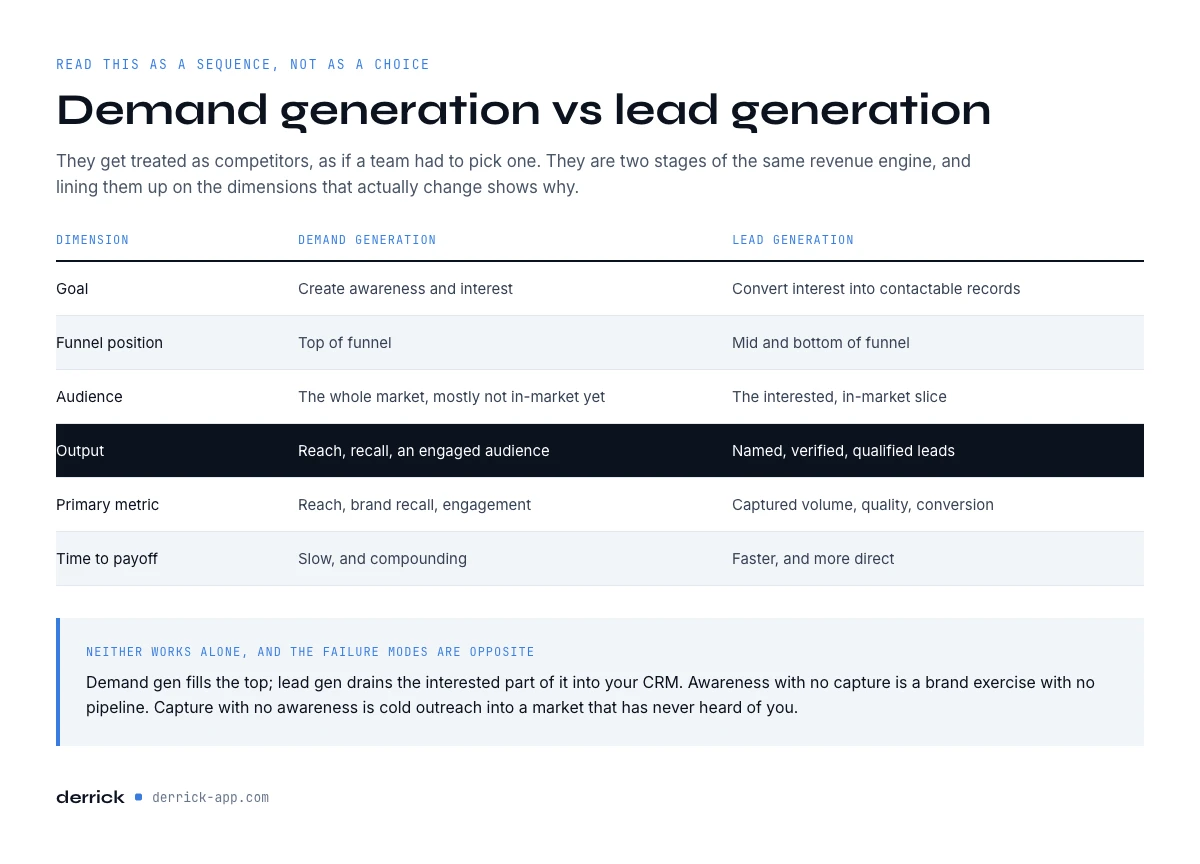
The clearest way to see the difference is to line them up on the dimensions that actually change between them: what they are for, where they sit, and how you judge them.
| Dimension | Demand generation | Lead generation |
|---|---|---|
| Goal | Create awareness and interest | Convert interest into contactable records |
| Funnel position | Top of funnel | Mid and bottom of funnel |
| Audience | Whole market, mostly not in-market yet | The interested, in-market slice |
| Tactics | Ungated content, social, podcasts, events, community, awareness ads | Forms, gated content, direct response ads, outbound to a defined list |
| Output | Reach, recall, engaged audience | Named, verified, qualified leads |
| Primary metric | Reach, brand recall, engagement | Captured volume, quality, conversion |
| Time to payoff | Slow, compounding | Faster, more direct |
Read the table as a sequence, not a choice. Demand gen fills the top; lead gen drains the interested part of it into your CRM. Neither works alone: awareness with no capture is a brand exercise with no pipeline, and capture with no awareness is cold outreach into a market that has never heard of you.
Demand generation vs lead generation: which is better?
For most B2B teams selling into a category buyers already know, lead generation is the better first bet, because people already search for what you sell and capture pays back this quarter. Demand generation is the better bet when your category is new or your sales cycle is long, because there is not yet enough intent to capture.
Demand gen vs lead gen: a quick decision rule
- Prioritize demand gen when your category is new, buyers do not search for your problem by name, your sales cycle runs beyond a quarter, or your branded search has been flat for months.
- Prioritize lead gen when you have a defined list of target accounts, buyers already search for your category, and you need pipeline this quarter.
- Run both on purpose once cost per lead starts climbing. That is usually the sign you are fighting over the same small in-market slice as everyone else, and demand gen is what makes the next capture cheaper.
The 95/5 rule: why you need both
At any given moment only a small share of your market is actively looking to buy. The widely cited estimate is that roughly 5% of B2B accounts are in-market at a time, which leaves about 95% who will buy eventually but are not shopping today. That single fact explains why demand gen and lead gen both have to exist.
Lead generation works the 5%: it captures and qualifies the people showing intent now. But if you only ever run lead gen, you compete for that thin slice against everyone else, and you have no relationship with the 95% who will enter the market later. Demand generation is how you reach that 95% so that when they do become the 5%, they already know your name. Skip demand gen and every lead you capture is a cold, expensive fight; skip lead gen and all that awareness never turns into pipeline. The teams that grow durably run both, aimed at different parts of the same market.
The 95/5 split also explains why the two disciplines feel like they are in tension over budget. Lead gen shows results this quarter, so it wins the argument for spend; demand gen pays off in future quarters, so it is the first thing cut under pressure. But cutting demand gen only makes lead gen more expensive, because you are left competing for the same 5% with none of the brand advantage that makes those buyers pick you. The right framing is not either-or but a portfolio: fund the capture that pays now and the awareness that makes the next capture cheaper.
How demand gen and lead gen hand off
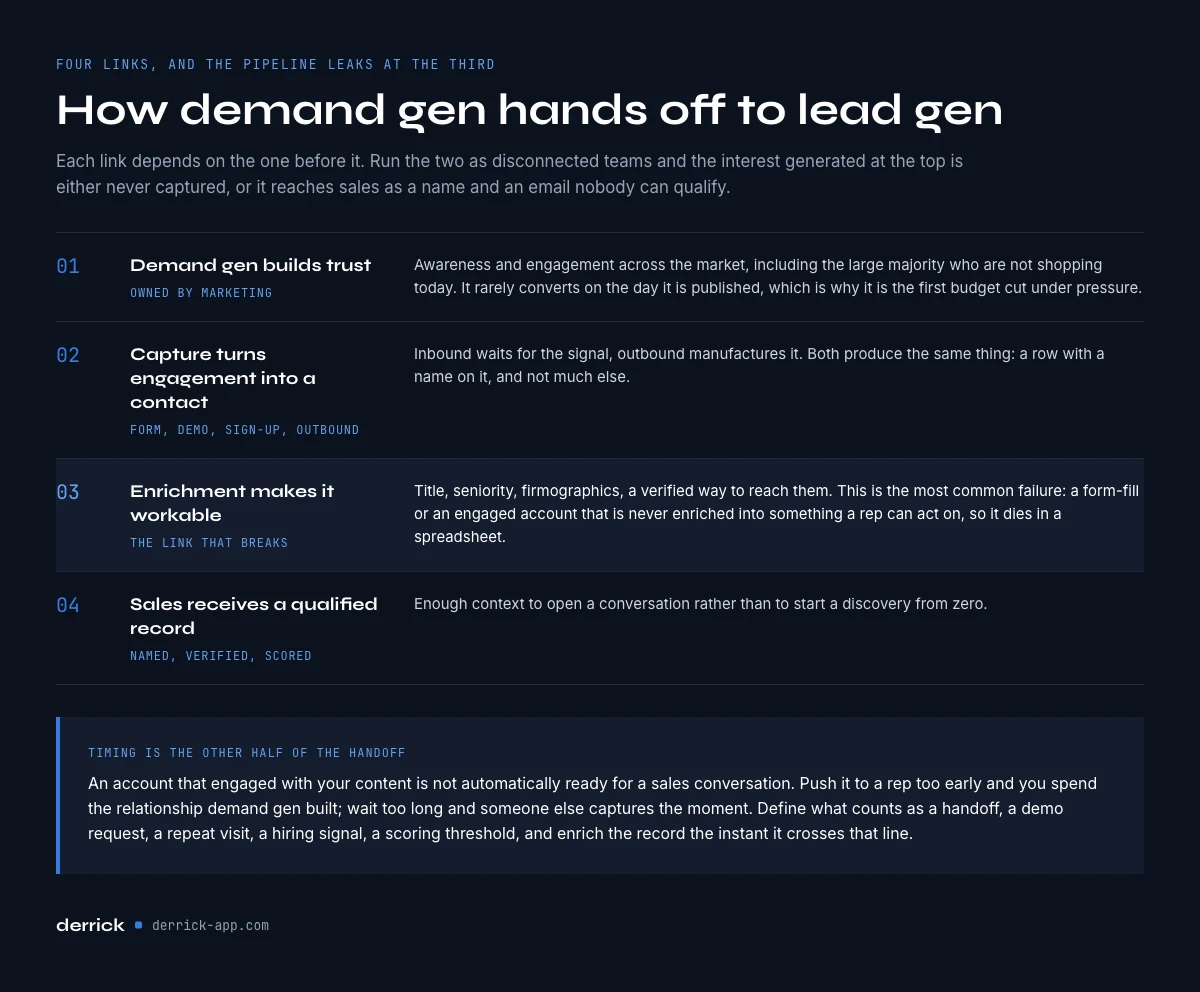
The place B2B pipelines leak is the handoff. Demand gen builds an audience that trusts you; lead gen has to capture that audience at the right moment and pass it to sales with enough context to act. When the two are run as disconnected teams, interest generated at the top never gets captured, or captured leads arrive with nothing but a name and an email.
A clean handoff looks like this: demand gen creates awareness and engagement; capture mechanisms turn engaged accounts into contacts; enrichment and qualification fill in who they are and whether they fit; and sales receives a record that is named, verified and scored. Each link depends on the one before it. The most common failure is the third link, where a form-fill or an engaged account is never enriched into something a rep can actually work, so it dies in a spreadsheet. That is the seam where a strong account-based motion either compounds or falls apart.
Timing is the other half of the handoff. An account that engaged with your content is not automatically ready for a sales conversation; pushing it to a rep too early wastes the relationship demand gen built, while waiting too long lets a competitor capture the moment. The teams that get this right define what qualifies as a handoff, a demo request, a repeat visit, a hiring signal, a scoring threshold, and enrich the record the instant it crosses that line, so the contact reaches sales while the interest is still warm and with the context needed to open a relevant conversation rather than a generic one.
A worked example: from a warm account to a sequence
An illustrative example, not a study. People at 40 of your target accounts read your content three or more times this month. Nobody raised a hand, so there is no form-fill to route. The handoff is deciding who to contact inside each account:
- Find the decision-makers. Pick three roles per account, say the head of marketing, the head of sales ops and the CRO: 120 people. Import Leads from Target Companies crosses your account list with your Sales Navigator criteria at 1 credit per lead, so 120 credits.
- Qualify them. Enrich Leads adds current title and seniority at 1 credit per profile, 120 more credits. Both steps read LinkedIn, so your LinkedIn account has to be connected through the Derrick Chrome extension.
- Get a way to reach them. If the Email Finder returns 80 emails out of the 120, that is 400 credits at 5 credits per email found. Email Finder runs on paid plans only.
- Sequence. The 80 contacts get a first message that refers to the content their team was reading.
Total: 640 credits, which the Standard plan (20 euros a month, 10,000 credits) covers. Your numbers will differ; the order will not. Size your own handoff below.
Which one gets your next euro, and what does the handoff cost?
Tick what is true for you, then enter your warm accounts to cost the handoff. The result updates as you go.
Tick at least one statement to get a verdict.
Estimate only. The email share is an input, not a benchmark: measure it on your first 100 rows. Import Leads from Target Companies crosses your account list with your Sales Navigator criteria; it and Enrich Leads read LinkedIn and need your LinkedIn account connected through the Derrick Chrome extension. Email Finder runs on paid plans only.
Demand generation vs lead generation: where the data layer decides
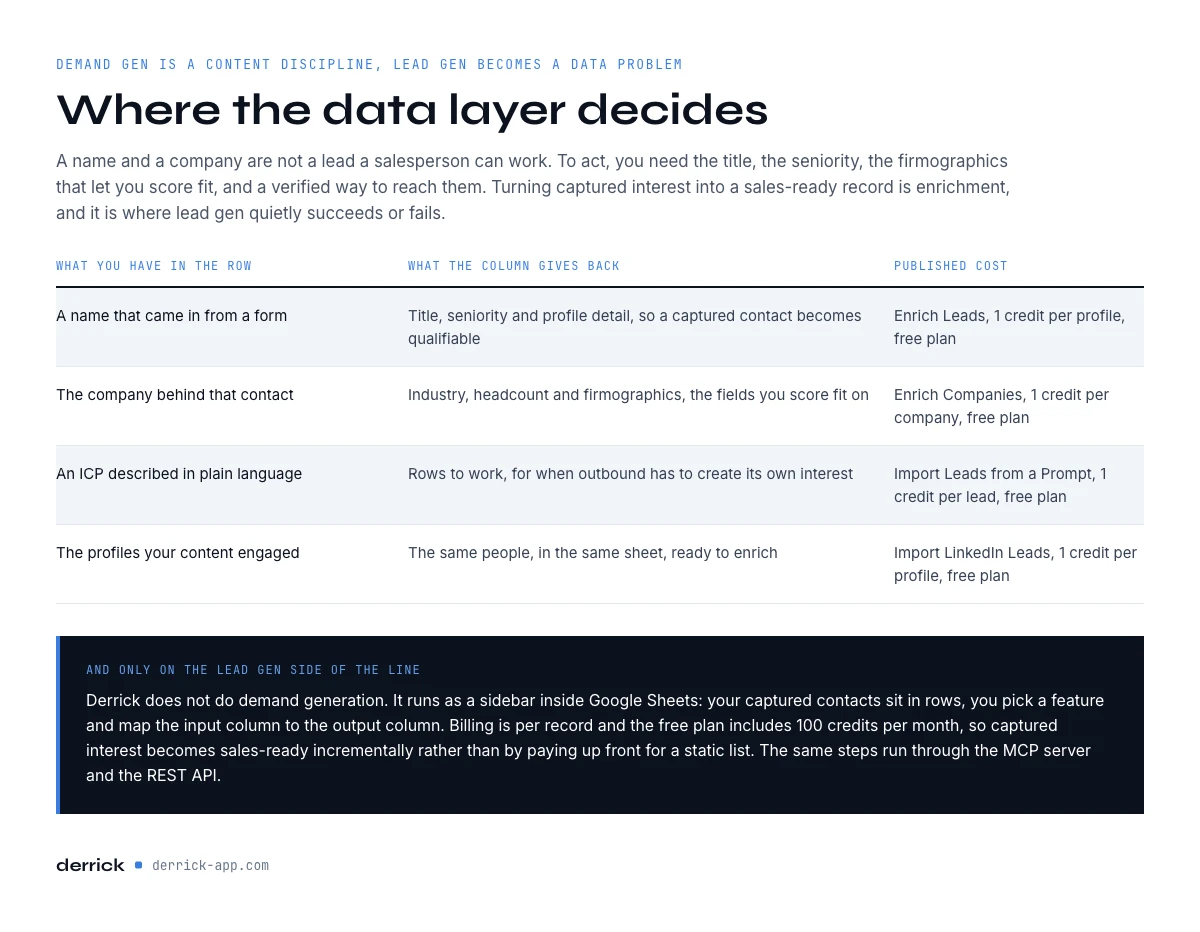
Demand generation is a content and brand discipline. Lead generation, once someone shows interest, becomes a data problem: a name and a company are not a lead a salesperson can work. To act, you need the verified email, the direct line, the title and seniority, the firmographics that let you qualify fit. Turning captured interest into a sales-ready record is enrichment, and it is where lead gen quietly succeeds or fails.
This is where Derrick fits, and only on the lead gen side of the line. Derrick runs in its web app, and also as a Google Sheets sidebar, not as a formula you wire up: your captured contacts sit in rows, and you enrich the columns from the sidebar.
- Turn a name into a full profile. Enrich Leads (1 credit per profile, with your LinkedIn account connected through the Derrick Chrome extension) adds title, seniority and profile detail so a captured contact becomes qualifiable.
- Fill in the company. Enrich Companies (1 credit per company) adds industry, headcount and firmographics, the fields you score fit on.
- Build a list from a description. Import Leads from a Prompt (1 credit per lead with your LinkedIn account connected, 10 without) turns an ICP described in plain language into rows to work, useful when outbound lead gen has to create its own interest.
- Bring in the people you engaged. Import LinkedIn Leads (1 credit per profile) pulls the profiles your demand gen engaged into the same list to enrich.
Because each enrichment is billed per record and the free plan includes 100 credits per month, you can turn captured interest into sales-ready leads incrementally, without paying up front for a static list. Demand gen created the interest; the data layer is what makes it convert.
The web app is the default place to run this. The same features work from a Google Sheets sidebar when the list already lives in a spreadsheet, from Claude or any MCP client for one account in a chat, and through the REST API inside a CRM workflow (MCP and API from the Plus plan).
Metrics that judge demand generation vs lead generation
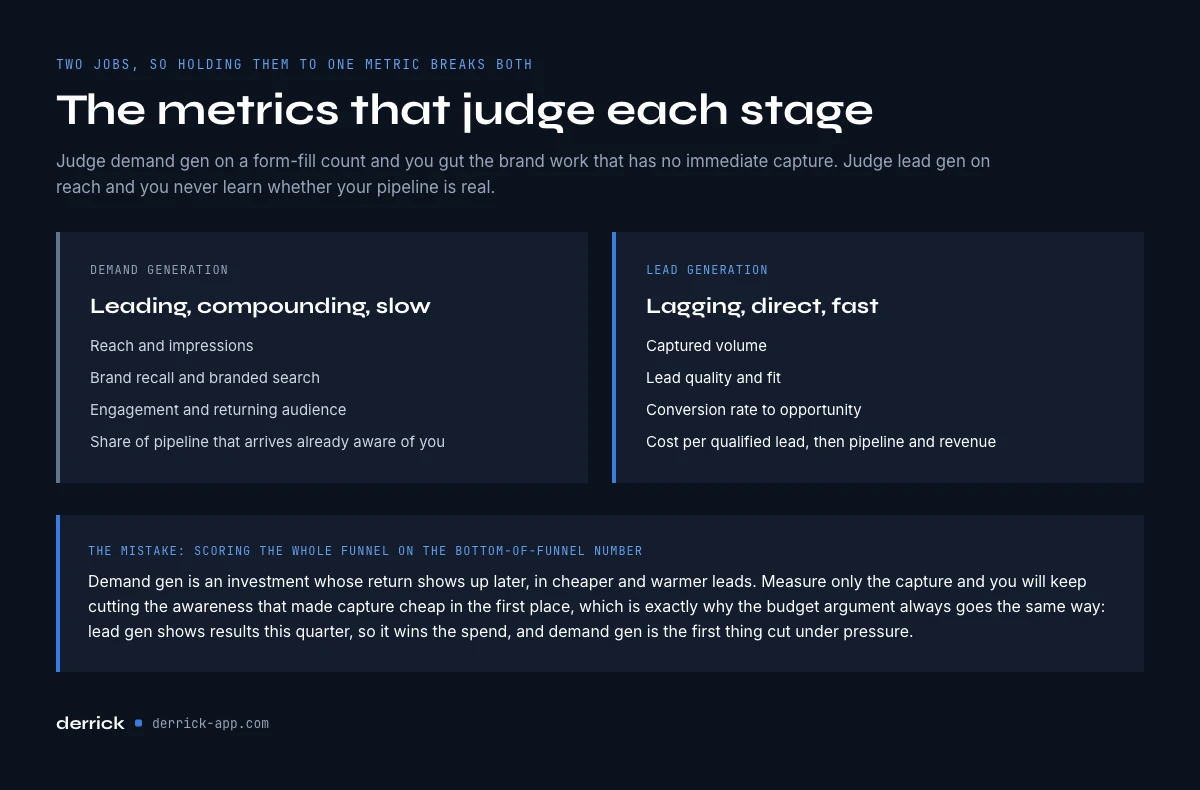
Because demand gen and lead gen have different jobs, holding them to the same metric breaks both. Judge demand gen on a form-fill count and you will gut the brand work that has no immediate capture. Judge lead gen on reach and you will never know if your pipeline is real.
- Demand generation: reach and impressions, brand recall and branded search, engagement and returning audience, and the share of pipeline that arrives already aware of you. These are leading, compounding, and slow.
- Lead generation: captured volume, lead quality and fit, conversion rate to opportunity, cost per qualified lead, and ultimately pipeline and revenue. These are lagging, direct, and fast.
The mistake to avoid is scoring the whole funnel on the bottom-of-funnel number. Demand gen is an investment whose return shows up later, in cheaper, warmer leads. If you only measure the capture, you will keep cutting the awareness that makes capture cheap in the first place.
How to measure demand generation without a form
Most demand gen never touches a form, so form-based attribution will always say it did nothing. Three signals fill the gap. Self-reported attribution: add a free-text "How did you hear about us?" field to your demo and sign-up forms and read the answers every month; podcasts and LinkedIn posts show up there long before analytics sees them. Branded search: how many people type your brand name into Google, which Google Search Console reports for free. Direct traffic and returning visitors: people who come straight to your site because they remembered it. None of the three is precise. Read together over a quarter, they tell you whether the market is learning your name.
Common mistakes teams make
Three errors show up again and again. The first is running only lead gen, mistaking capture for growth, and wondering why leads stay cold and expensive, because there is no demand gen making the market aware first. The second is running demand gen with no capture, generating attention that never converts because nothing turns engaged accounts into contactable records. The third, and most fixable, is capturing leads and never enriching them, so a form-fill sits in a sheet as a name and an email that no rep can qualify or reach.
All three come from treating the two as separate ideas rather than stages of one engine. Run demand gen to build the market, run lead gen to capture the interested slice, enrich what you capture so it is workable, and measure each on its own job. For a broader view of how these fit a full acquisition plan, our go-to-market strategy guide places both in the wider motion, and the outbound sales guide covers the capture side when you have to generate the demand yourself.
Frequently asked questions
What is the difference between demand generation and lead generation?
What is demand generation marketing?
Do I need both demand generation and lead generation?
Which comes first, demand gen or lead gen?
How do you measure demand generation vs lead generation?
Where does data enrichment fit in lead generation?
Can you do lead generation without demand generation?
Keep reading
Continue exploring this cluster


The State of B2B Marketing Performance 2026: Benchmarks Report
Read →

Account-Based Marketing (ABM): Definition, Techniques, Examples
Read →

Inbound vs Outbound Marketing: Differences, When to Pick Each
Read →

B2B Lead Generation: Strategies, Tools, Tips in 2026
Read →