Inbound sales: how to sell to a buyer who already did the research
Understand inbound sales: the four stages, how to qualify leads outside your ICP, the data a rep needs before calling, and the metrics that prove it works.


A form gets submitted at 09:14. The record says jane@acme.io, and nothing else. No company size, no role, no idea whether Acme is a 12-person studio or a 4,000-person group. A rep will open that record around 11:00, spend six minutes on LinkedIn trying to work out who Jane is, and send a message that opens with "I saw you downloaded our guide".
That is the gap between inbound sales as it is described and inbound sales as it is practised. The methodology is well documented and every guide repeats the same four stages. What almost none of them address is the part that actually decides the outcome: the buyer on the other end has already read everything, already formed an opinion, and is comparing you to two other options, while your rep opens the conversation knowing an email address. This guide covers the process, the qualification call, the data the rep needs before dialling, and the numbers that say whether any of it is working.
What is inbound sales?
Inbound sales is the practice of selling to buyers who came to you first, and who arrived already informed. The rep's job is not to create awareness or interest, both already exist. It is to work out whether this particular buyer is a fit, understand a problem they believe they have already diagnosed, and guide a decision that is further along than it looks.
The defining constraint is asymmetry of information, and it runs against the seller. In outbound, you choose the account, you time the approach, and the buyer starts from zero. In inbound, the buyer chose the moment, has read your pricing page, has probably read two competitors' pages as well, and knows more about the comparison than the rep does. Opening with a discovery script written for a cold prospect is the single most common way to lose an inbound lead in the first two minutes.
The practical definition: inbound sales is consultative selling under time pressure, to a self-educated buyer, with an information deficit on your side that you close with data rather than with questions.
Inbound sales vs inbound marketing vs inbound lead management
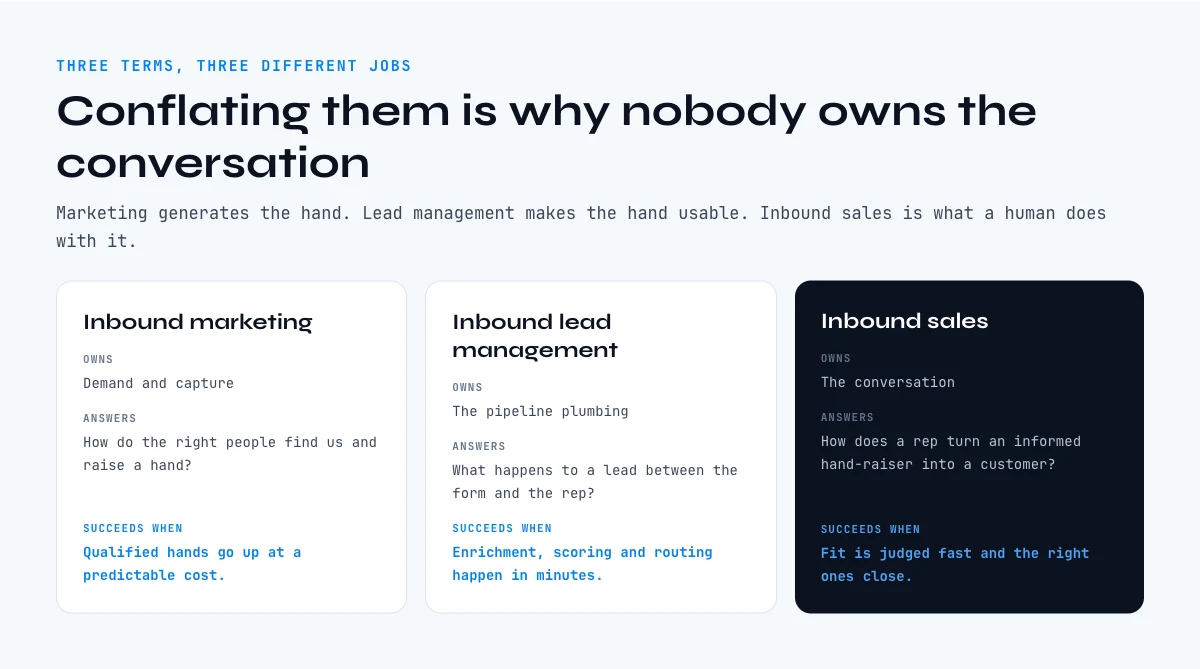
Three terms describe three different jobs, and conflating them is why so many teams think they "do inbound" while nobody owns the conversation.
| Discipline | Owns | Question it answers | Succeeds when |
|---|---|---|---|
| Inbound marketing | Demand and capture | How do the right people find us and raise a hand? | Qualified hands go up at a predictable cost |
| Inbound lead management | The pipeline plumbing | What happens to a lead between form and rep? | Enrichment, scoring and routing happen in minutes |
| Inbound sales | The conversation | How does a rep turn an informed hand-raiser into a customer? | Fit is judged fast and the right ones close |
Marketing generates the hand. Lead management makes the hand usable. Inbound sales is what a human does with it. If you want the channel-level view of where inbound sits against outbound, that belongs to the inbound versus outbound comparison; the routing and scoring layer is covered in inbound lead management. This page is about the third job.
The four stages of the inbound sales process
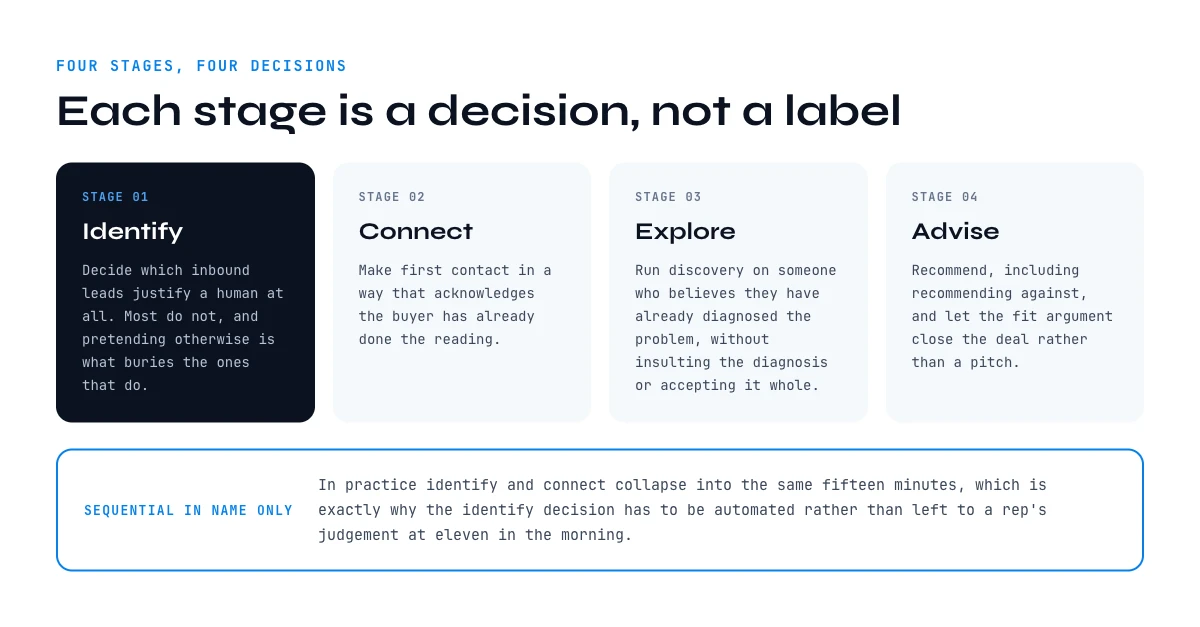
The four-stage frame, identify, connect, explore, advise, has become the standard vocabulary, and it holds up. What follows is each stage with the decision that actually has to be made in it, rather than the label alone.
- Identify. Decide which inbound leads justify a human at all. Most do not, and pretending otherwise is what buries the ones that do.
- Connect. Make first contact in a way that acknowledges the buyer has already done the reading.
- Explore. Run discovery on someone who believes they have already diagnosed the problem, without insulting the diagnosis or accepting it whole.
- Advise. Recommend, including recommending against, and let the fit argument close the deal rather than a pitch.
The stages are sequential in name only. In practice identify and connect collapse into the same fifteen minutes, which is exactly why the identify decision has to be automated rather than left to the rep's judgement at 11:00.
Stage 1, Identify: which leads deserve a rep at all
Inbound volume is a mix. A free-guide download from a student, a pricing-page request from a 300-person company, and a competitor doing research all arrive in the same queue looking identical. Treating them identically is the core inefficiency of most inbound motions: the reps who are supposed to be consultative spend their morning doing manual research on records that were never going to convert.
The identify decision needs three facts that the form almost never collects: what company this is, how big it is, and what the person actually does there. Asking for them on the form costs you conversions. Deriving them afterwards costs almost nothing.
Where that leaves a rep in practice: the queue should arrive pre-sorted, with fit already computed, so the first human minute goes to the conversation rather than to reconstructing who submitted the form.
In the web app or Google Sheets
Give the qualification step something to read
Inbound qualification fails when the rep opens a record with three fields. Derrick enriches the inbound list in the web app or in Google Sheets with current title, company and headcount, so the qualification criteria in this article can be applied the same way on every lead.
- Feature
- LinkedIn Leads Profile Enrichment
- Credit cost
- 1 credit per lead enriched
The first button opens the web app (nothing to install): 1 credit per lead enriched, 100 free credits every month. The second details the feature and its cost per plan.
Stage 2, Connect: the first touch on a buyer who already read everything
The opening line of an inbound follow-up is doing more work than any other sentence in the process. "I saw you downloaded our guide" tells the buyer two things, both bad: that you have nothing to add beyond what they already took, and that this is an automated sequence wearing a person's name.
What works instead is an opening that demonstrates you know something about their situation that they did not tell you. Not a trick, just competence: their company's size, their stack, the fact that they are hiring for a role your product touches. The buyer's internal reaction should be that this person understood the context before making contact, which is precisely what they expect from a consultant and never get from a rep.
Channel matters less than speed here, and both matter less than relevance. An email that lands in twenty minutes with one accurate observation about the account beats a phone call in five minutes with none.
Stage 3, Explore: discovery with a buyer who already diagnosed themselves
Classic discovery assumes the prospect has not yet named their problem. In inbound, they have. They arrived with a diagnosis, a shortlist and often a preferred answer. Running the standard question set against that produces visible impatience, because you are asking them to re-derive conclusions they reached last week.
The adjustment is to start one level down. Instead of asking what problem they are trying to solve, confirm the diagnosis quickly and interrogate the reasoning underneath it: what made this urgent now, what they have already tried, what the internal alternative is, and who else has to agree. The last of those is the one reps skip, and it is the one that decides whether the deal survives, because an inbound hand-raiser is very often not the person who signs. That is a committee problem, and it is worth reading the guide on how to sell to decision makers before the second call.
The app works through your list row by row: 1 credit per lead enriched.
Stage 4, Advise: closing without pitching
By this point the buyer does not need a demo of features they read about three weeks ago. They need someone to tell them, with reasons, whether this is the right choice for their specific situation, and what happens if they are wrong.
Three moves carry this stage. Recommend a specific configuration rather than presenting options, because choosing is the work they came to outsource. Name the case where you are not the right answer, which costs you a small number of bad-fit deals and buys credibility on every good-fit one. Make the first step small and reversible, since the risk of the decision, not the price, is usually what delays it.
The counter-intuitive part is that disqualifying out loud accelerates the deals that remain. A rep who has said "this would not work for you" once is believed the next time they say "this will".
What the rep needs to know before an inbound call
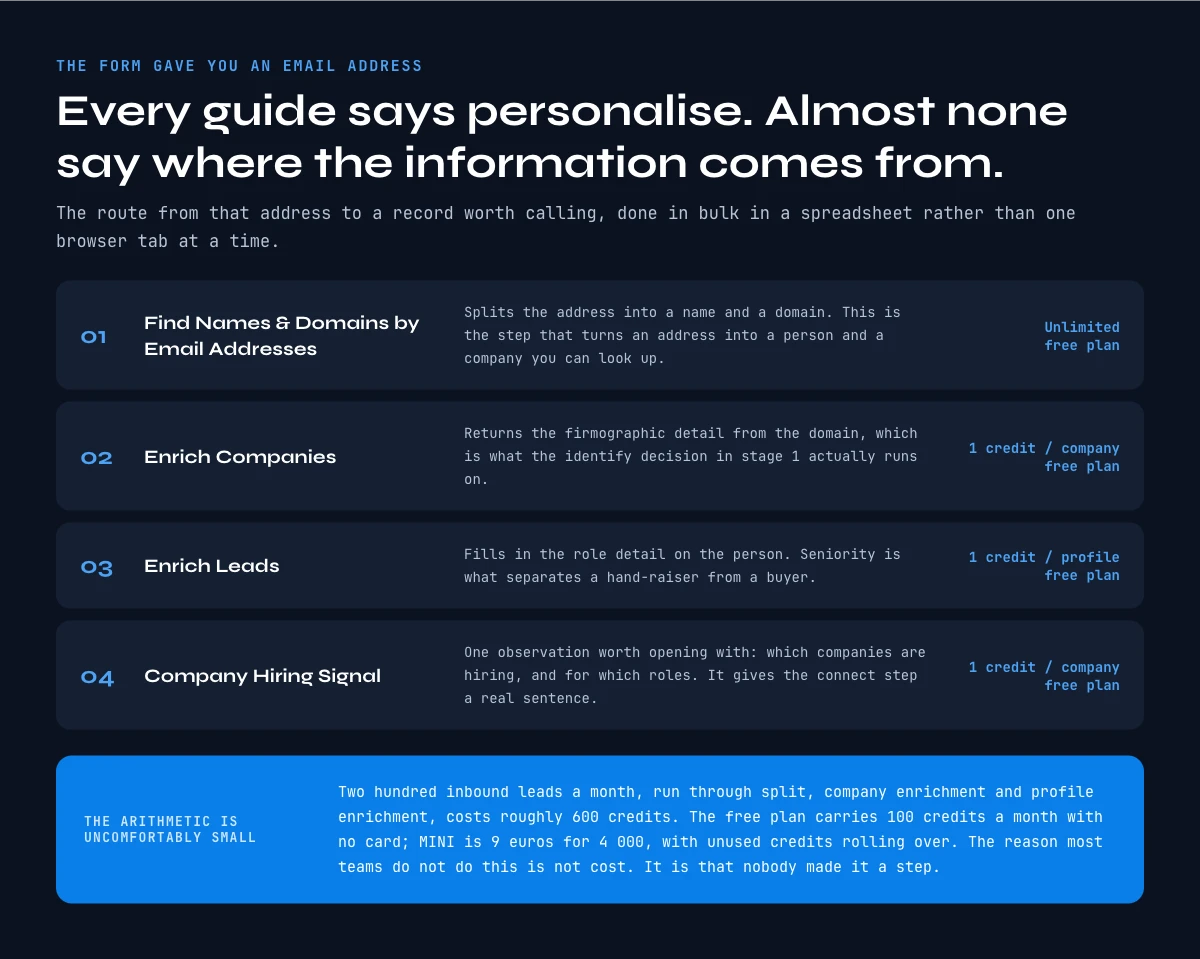
Every guide on this topic says personalise. Almost none say where the information comes from. The form gave you an email address. Here is the practical route from that address to a record worth calling, done in bulk in the web app or a spreadsheet rather than one tab at a time:
- Split the address into a name and a domain. Find Names and Domains by Email Addresses does exactly this, and it is free and unlimited, on the free plan included. This is the step that turns jane@acme.io into a person and a company you can look up.
- Enrich the company from the domain. Enrich Companies returns the firmographic detail at 1 credit per company, on free and paid plans, which is what the identify decision in stage 1 actually runs on.
- Resolve the person. Search Leads finds the LinkedIn profile from a first and last name at 1 credit per profile, and Enrich Leads fills in the role detail at 1 credit per profile on free and paid plans. Seniority is what separates a hand-raiser from a buyer.
- Add one observation worth opening with. Company Hiring Signal shows which companies are hiring and for which roles at 1 credit per company on free and paid plans. Website Technologies identifies the stack at 2 credits per website. Either gives the connect step a real sentence.
The arithmetic is small enough to be uncomfortable. Two hundred inbound leads a month, run through split, company enrichment and profile enrichment, costs roughly 600 credits. The free plan carries 100 credits per month with no card, and the Standard plan at 20 euros per month carries 10,000 with unused credits rolling over. The reason most teams do not do this is not cost. It is that nobody made it a step.
Derrick runs in its web app, and also as a Google Sheets sidebar: pick a feature, map the input column, and it fills the output columns row by row. If the inbound queue should be enriched automatically instead of in batches, the same enrichment is available through the REST API from the Plus plan at 47.50 euros per month, through Zapier, Make and N8N, and through the Derrick MCP server for asking from Claude, ChatGPT or any MCP-compatible assistant. It works the same on 20 leads a week or 20,000.
Qualifying the inbound lead that is not your ICP
Most inbound is out of profile, and this is normal rather than a failure of marketing. The mistake is the binary: either a rep works the lead or it disappears into a nurture list nobody reads.
A three-way split works better. In profile and senior goes to a rep immediately. In profile but junior gets a reply that treats them as a future champion rather than a decision maker, because in two years they often are. Out of profile gets a genuinely useful self-serve answer and no rep time at all, which is the respectful option for both sides.
One thing worth doing with the out-of-profile pile before you forget about it: when an inbound lead does convert well, feed that company back into sourcing. Find Similar Companies turns one good customer into an ICP-matched list at 1 credit per matched company and is free to start, which is how an inbound win becomes an outbound target list. That handover is described in more detail in the guide to building a prospect list.
Speed to lead: the number that decides inbound sales
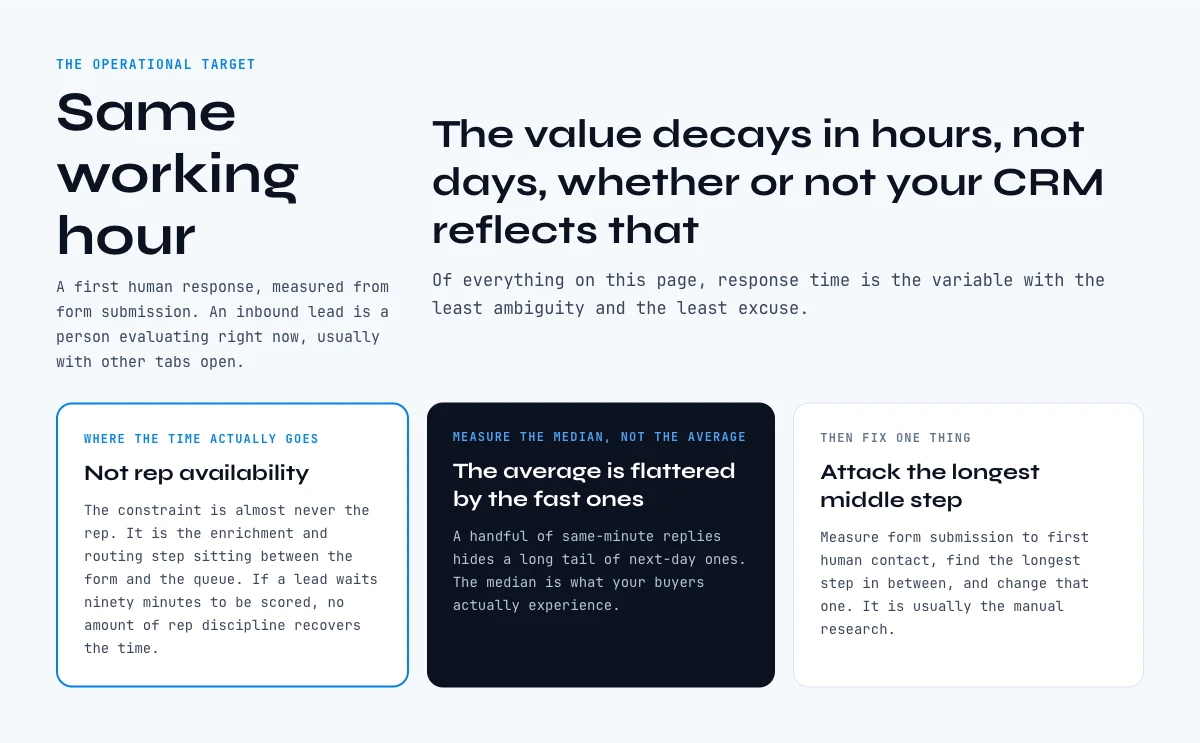
Of everything on this page, response time is the variable with the least ambiguity and the least excuse. An inbound lead is a person who is actively evaluating right now, usually with other tabs open. The value of the lead decays in hours, not days, and it decays whether or not your CRM reflects that.
The operational target is a first human response inside the same working hour, and the constraint is almost never rep availability. It is the enrichment and routing step sitting between the form and the queue. If a lead waits ninety minutes to be scored, no amount of rep discipline recovers the time.
What to do about it: measure median time from form submission to first human contact, not average, because a handful of same-minute replies will hide a long tail of next-day ones. Then attack whichever step in the middle is longest. It is usually the manual research described in part 08.
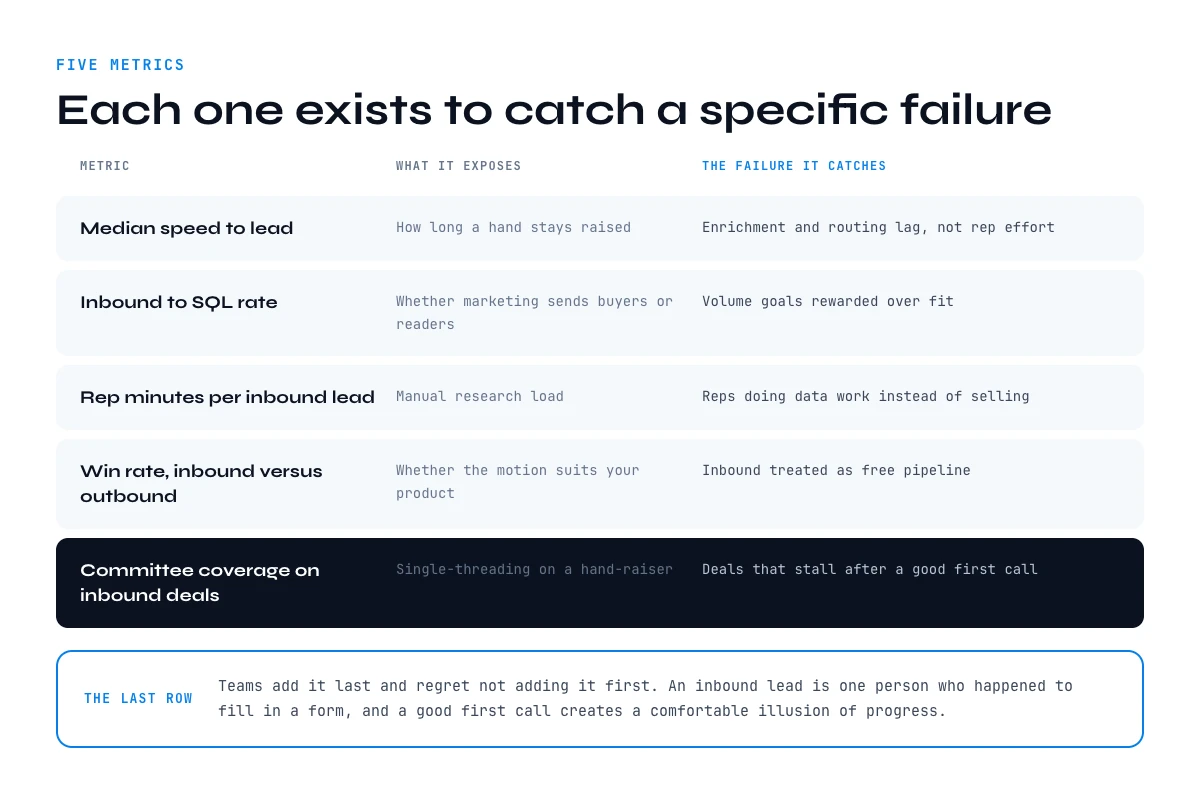
The metrics that tell you inbound sales is working
| Metric | What it exposes | The failure it catches |
|---|---|---|
| Median speed to lead | How long a hand stays raised | Enrichment and routing lag, not rep effort |
| Inbound to SQL rate | Whether marketing sends buyers or readers | Volume goals rewarded over fit |
| Rep minutes per inbound lead | Manual research load | Reps doing data work instead of selling |
| Win rate, inbound versus outbound | Whether the motion suits your product | Inbound treated as free pipeline |
| Committee coverage on inbound deals | Single-threading on a hand-raiser | Deals that stall after a good first call |
The last row is the one teams add last and regret not adding first. An inbound lead is one person who happened to fill in a form, and a good first call creates a comfortable illusion of progress. If your database cannot support the multi-threading that follows, the underlying issue is a B2B database marketing problem rather than a selling one.
Five mistakes that leak inbound pipeline
- Running a cold-outbound script on a warm lead. The buyer has read your site. Asking whether they have heard of you signals you did not notice.
- Letting reps do the research manually. Six minutes per lead across 200 leads is twenty hours a month of a salesperson not selling.
- Treating every hand-raiser as a buyer. The person who downloads the guide is frequently not the person with budget, and often not even in the same function.
- Optimising conversion rate on the form by asking more questions. Every extra field costs submissions to collect data you could derive from the email address for free.
- Measuring average response time. The average is flattered by the fast ones. The median is what your buyers experience.
None of these require a new tool to fix. Four of the five require deciding that enrichment is a step in the process rather than something a rep does when they have a moment. Start on the free plan and run one week of inbound through the workflow before changing anything else.
We publish one email every 2 weeks with playbooks like this one and the data behind them. The capture form below this article is where it goes out.
Frequently asked questions
What is inbound sales in simple terms?
What is the difference between inbound sales and inbound marketing?
What are the four stages of the inbound sales process?
How fast should you respond to an inbound lead?
How do you qualify an inbound lead that is not your ICP?
What data does a rep need before an inbound call?
What does it cost to enrich an inbound lead queue?
Which metrics show that inbound sales is working?
Keep reading
Continue exploring this cluster


The State of B2B Marketing Performance 2026: Benchmarks Report
Read →

Account-Based Marketing (ABM): Definition, Techniques, Examples
Read →

Inbound vs Outbound Marketing: Differences, When to Pick Each
Read →

B2B Lead Generation: Strategies, Tools, Tips in 2026
Read →