
Inbound vs Outbound: Marketing, Leads and Sales, the Differences That Decide
Compare inbound vs outbound marketing, leads and sales in one table: who starts, cost, speed, targeting. See how to combine both and split the budget.


Inbound vs outbound is one comparison that people search at three levels: marketing (how you create demand), leads (where a contact comes from and how warm it is) and sales (who opens the conversation and how the rep works it). This guide covers all three, with a table at each level, then shows how to combine the two motions and how to split the budget.
Inbound and outbound marketing are both complementary strategies to win new customers. Let's understand the stakes and see together the strategies to implement for 2026.
Looking for inbound vs outbound call centers? That is a different buyer: in a contact center, inbound means agents taking incoming calls (support, orders) and outbound means agents placing calls (sales, collections, surveys), which is a staffing and telephony question. This guide is about how a B2B company wins customers, so if you are sizing a call center, the tables below answer another question.
Inbound vs outbound marketing at a glance: the 8 differences that decide
Before the definitions, here is the whole comparison on one screen. Eight axes, and on every one of them inbound and outbound answer differently. Neither column is the good one: they buy different things with the same euro.
| Axis | Inbound | Outbound |
|---|---|---|
| Who starts the conversation | The prospect, when the need appears | You, when you decide |
| Time to first result | Slow. Three to nine months before organic traffic converts | Fast. A list sent on Monday produces replies the same week |
| Cost structure | Fixed and front-loaded. Production cost amortises over years | Variable and linear. More volume means more spend, every month |
| Targeting precision | Indirect. You choose a topic, the topic chooses the audience | Direct. You name the accounts and the job titles yourself |
| Lead quality | High intent, low control over who shows up | Perfect fit on paper, unproven intent |
| Control over volume | Weak. You cannot decide to get 200 more leads next week | Strong. Volume is a function of list size and sending capacity |
| Scalability | Compounds, then plateaus with the size of the search demand | Scales with data quality and deliverability, not with demand |
| What it decays into | Content that ages and slides down the results page | A contact list that rots at roughly 25 to 30 percent a year |
Read the last row twice, because it is where most budgets leak. Inbound decays by losing position; outbound decays by losing accuracy. The first is fixed by refreshing pages, the second by refreshing data. A team that runs outbound on an eighteen-month-old list is not doing outbound badly, it is doing outbound on a list where roughly a third of the people have moved on, and no amount of copywriting recovers that.
Inbound vs outbound leads: a lead who asks vs a lead you pick
An inbound lead raised their hand. They filled a form, booked a demo, replied to an email or started a trial. An outbound lead is someone you chose: they match your ideal customer profile and you reached out first. So the gap between inbound vs outbound leads is not quality in the abstract. It is what you already know about each one. With an inbound lead you know the intent and still have to check the fit. With an outbound lead you know the fit and still have to create the intent.
| Axis | Inbound leads | Outbound leads |
|---|---|---|
| Definition | A contact who came to you through content, search, a form or a referral | A contact you selected from a list built on your ICP, and approached first |
| Qualification | Check the fit: company size, role, budget. Plenty of forms come from students, job seekers or accounts far too small | Check the timing: the fit is known from the list, the open question is whether there is a need right now |
| Speed | The clock runs on your side. A form answered within the hour gets a conversation, one answered three days later often gets silence | The clock runs on theirs. You choose when to send, then wait for a reply across several touches |
| Conversion | Higher from lead to meeting, because the person asked | Lower from contact to reply, but you control how many conversations you start |
| Cost | Mostly fixed: content, SEO and tooling, paid before the first lead shows up | Mostly variable: data, sending capacity and rep time, paid per contact |
| Main risk | Good leads cooling down in a queue nobody works | A list that is out of date or off-profile |
The practical takeaway. Inbound leads are lost through slowness, outbound leads through bad data. If inbound is your weak spot, the fix is routing and response time, and our guide to inbound lead management walks through it step by step. A form usually hands you a name and an email, not the company size or the job title, so enriching it before routing is what makes a fast yes or no possible. If outbound is the weak spot, the fix starts before the first email: a list where every row has the right company, the right role and an address that works. Derrick's Email Finder is billed 5 credits per email actually found, from the STANDARD plan, so a row with no result costs nothing.
Inbound vs outbound sales: who opens the conversation changes the job
On the sales side, the comparison is about the rep's day more than the channel. Four axes separate inbound vs outbound sales.
- Who initiates. Inbound: the buyer, and the rep answers a request that already has context. Outbound: the rep, who contacts someone who did not ask and has to earn a conversation in the first two lines.
- Difficulty. Inbound meetings are easy to get. The hard part is saying no to the wrong fits and keeping pace when volume spikes. In outbound every meeting is won against indifference, so rejection is the daily routine and persistence over several touches is the actual skill.
- The conversation. An inbound call starts from the buyer's question, and discovery confirms a need they already stated. An outbound call starts from your guess about their problem, and discovery has to prove that problem exists before any pitch.
- Targeting. Inbound targeting is indirect: you talk to whoever your content pulled in. Outbound lets you name your dream accounts and go after them this week.
That is why most teams split the roles. SDRs often qualify the inbound queue, BDRs prospect outbound, and AEs take over once a meeting is booked. Our sales process steps guide has a section on who owns which step. For the playbook of each motion, read how inbound sales works and how to run outbound sales.
Outbound reps lose the most hours on list building, not on calls. In the Derrick web app you import the accounts, enrich them and get a clean list ready to send, with nothing to install. The same features run from Google Sheets, from Claude through MCP, or from the API if your stack is automated.
Inbound marketing: definition and mechanism
Inbound marketing is defined as a very effective marketing strategy to attract new customers. It is no longer you as a professional who go looking for customers, they come to you. What is inbound marketing and how to implement it in your company?
Definition of inbound marketing
Inbound marketing is different from outbound marketing. Here, it is not a question of going out and looking for a prospect but rather of letting them come to us. How does it work? By implementing a content strategy specifically designed for your targets. You'll generate interest based on their needs and the evolution of the buying journey. Once the attention is captured, it's a matter of converting these prospects into leads and turning them into customers. This strategy is not only for B2C customers.
In the B2B sector, many professionals are looking for service providers on the web. Inbound marketing makes sense and allows you to develop your leads and sales by reducing your paid acquisition costs (Facebook Ads, Adwords…).
Mechanism of inbound marketing
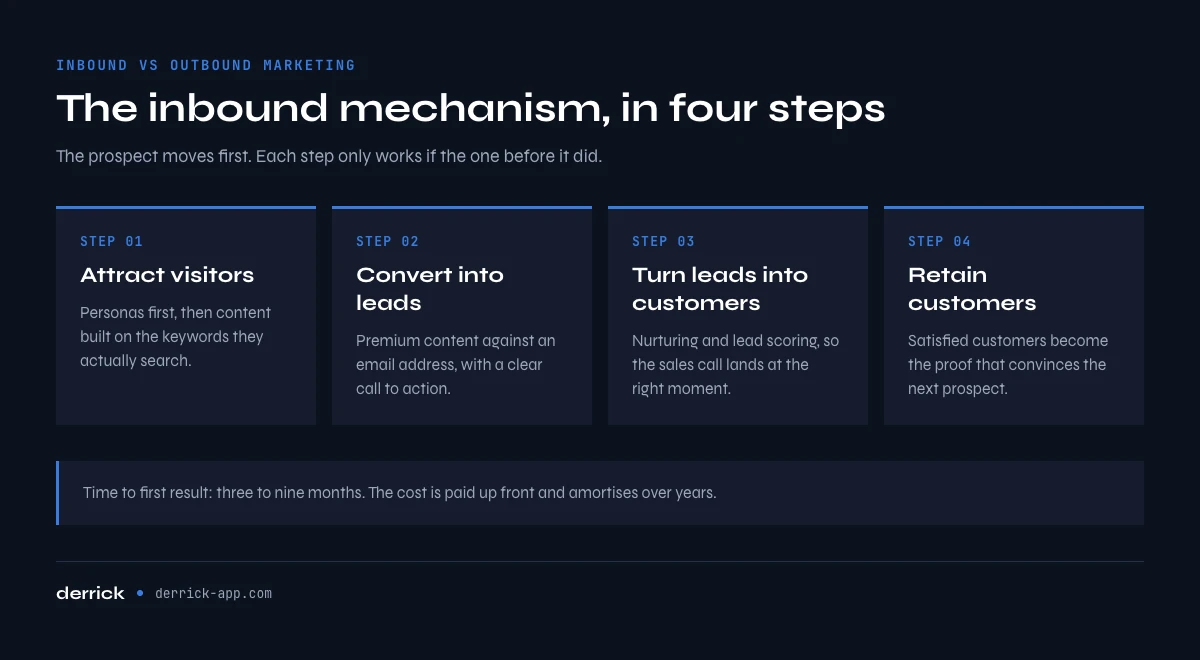
There are 4 key steps in the inbound marketing strategy:
- Attracting visitors: start by defining your buyers personas and target your potential visitors with content that directly concerns them. Consider a keyword strategy to improve your SEO. This will allow you to generate quality traffic with visitors who have a definite interest in your business.
- Convert visitors into leads: offer premium and quality content to your visitors (white paper, free audit, webinair…) in order to get contact information such as an email address. Put in place on your website and your platforms many CTA (Call To Action) inviting them to take action. They can be present on landing pages, contact forms, a pop-up..
- Turn leads into customers: it is now time to pamper your new leads to turn them into customers. To do this, you will distribute personalized content highlighting your expertise, while guiding them through their buying journey. Inbound marketing relies on marketing automation, lead scoring and lead nurturing.
- Retain new customers: acquiring new customers takes time and has a certain cost, which is why it is important to turn your satisfied customers into ambassadors of your brand. Their opinions and recommendations will convince prospects to use your services.
In the web app or Google Sheets
The outbound half, without the list-building week
The comparison usually ends on the same objection: outbound costs too much time upfront. Describe the target in a sentence and Derrick imports the leads into your list with the fields to qualify them, which moves the cost from sourcing to messaging.
- Feature
- Import Leads from a Prompt
- Credit cost
- 1 credit per lead imported
The first button opens the web app (nothing to install): 1 credit per lead imported, 100 free credits every month. The second details the feature and its cost per plan.
Outbound marketing: definition and mechanism
Outbound marketing is one of the traditional forms of marketing. It is you who goes directly to the customer unlike inbound marketing.
Definition of outbound marketing
It is a strategy that pushes the consumer to buy your products or services. Outbound marketing is part of the traditional marketing methods. You solicit visitors through traditional media such as canvassing, mailing, press, SMS or billboard advertising.
Outbound marketing is completely different from inbound marketing which requires you to create content to attract prospects.
Mechanism of outbound marketing
Outbound marketing is a very effective tool, here are its main mechanisms:
- Sales prospecting: this first phase is designed to attract new visitors and guide them through a buying journey. Social networks are an excellent entry point to contact your prospects.
- Paid advertisements : tools like Facebook Ads or Google Ads allow you to broadcast ads on different locations.
- E-mailing or prospecting on LinkedIn: in B2B marketing, using direct mail to contact your prospects within an organization is a great way to stand out. Use personalized messages to capture the attention of recipients.
- Trade events: Attending trade shows or conferences is a great way to find qualified prospects. Prepare the necessary tools that will set you apart from your competitors.
Which levers belong to inbound marketing, and which to outbound
Inbound and outbound marketing are complementary and can be very effective when used in synergy.
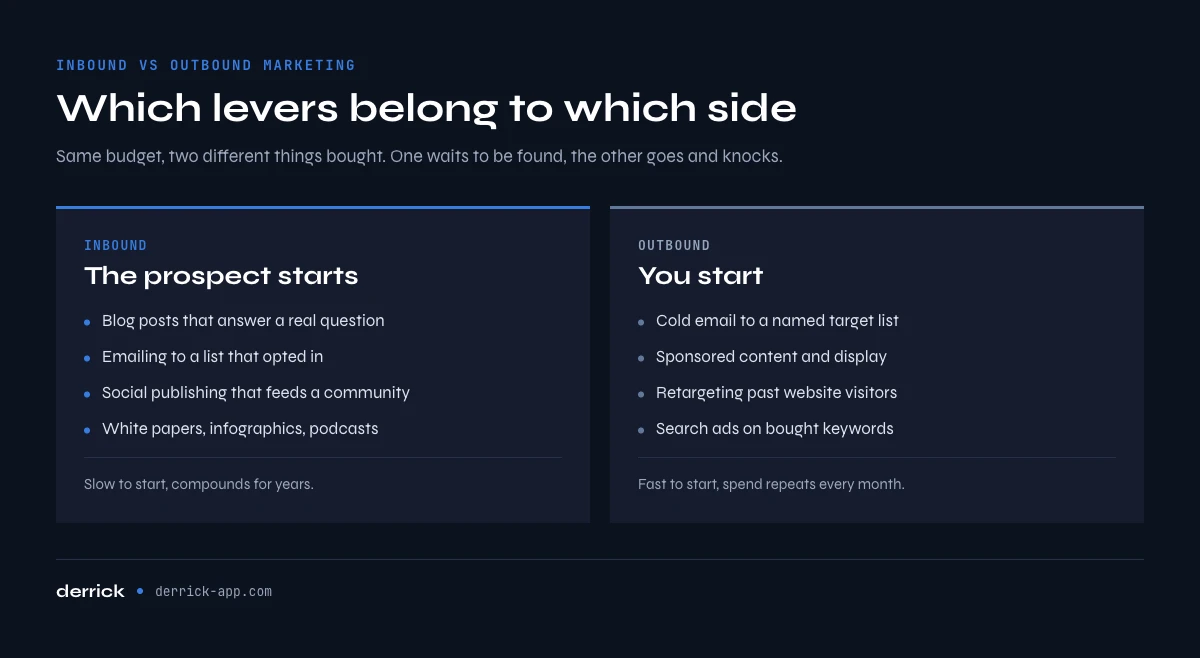
The levers of inbound marketing
- Blog posts: they give you the opportunity to communicate about your products, your brand, your offers by highlighting your expertise.
- Emailing: once you have your prospect's email address, send personalized emails in line with your customers' expectations.
- Social networks: regularly publish relevant content to engage your community and attract new customers.
- Content: your content must be of high quality and informative to attract the attention of your prospects and establish your expertise. This can be white papers, infographics, podcasts..
The levers of outbound marketing
- Sponsored content: this includes all advertisements on advertising spaces such as display or social networks.
- Advertising inserts: these are used in both print and digital media. They appear on websites or social networks.
- Retargeting: this technique allows you to send advertising content to prospects who have visited your website.
- cold email: this involves sending emails to highly identified targets to encourage prospects to contact you to talk about how your product/service can meet their needs.
- Google Ads campaigns: by buying specific keywords related to your activity, you can appear at the top of the list of Google ads.
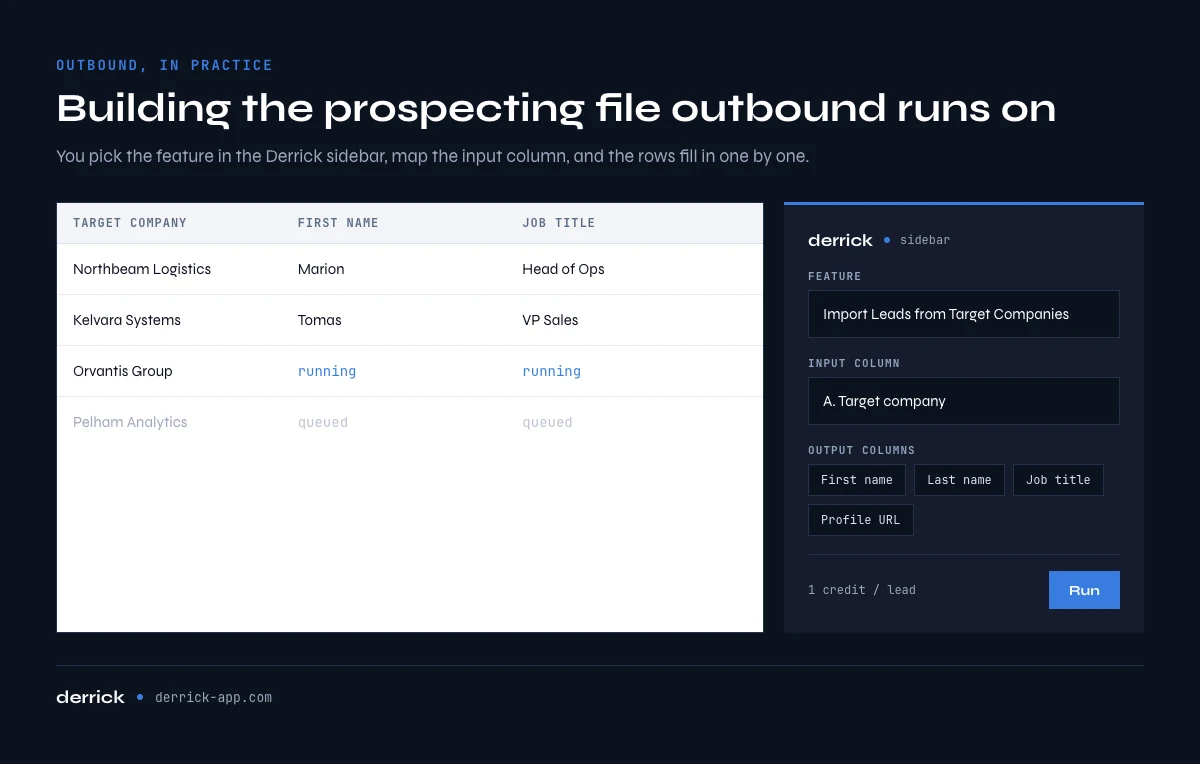
The app works through your list row by row: 1 credit per lead imported.
Advantages and disadvantages: what each approach really costs you
These two strategies have both advantages and disadvantages, let's see them together.
Advantages and disadvantages of inbound marketing
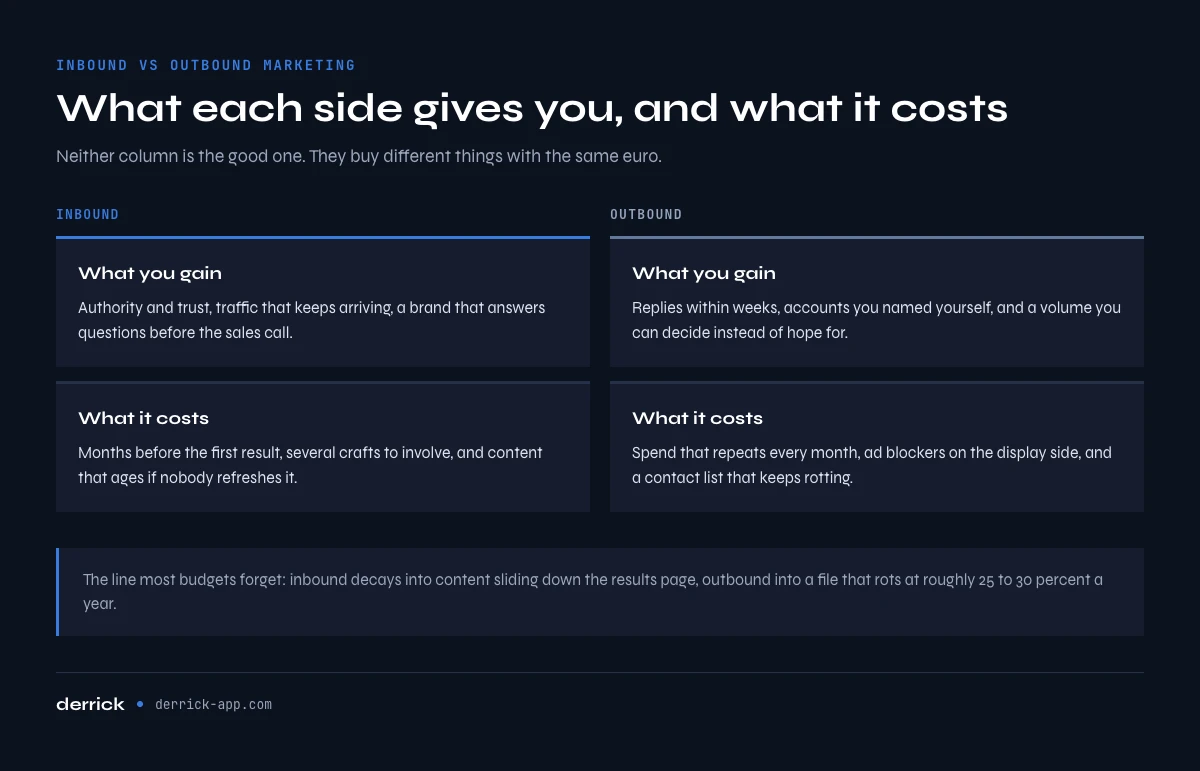
- Advantages: you provide your visitors with useful and quality content that highlights your expertise. You gain notoriety and build trust with your customers by answering their questions. SEO optimized content brings traffic to your website and social networks. You create a brand by showing your identity and expertise.
- Disadvantages: an inbound content strategy requires a large investment in time and money to be of high quality. The benefits of this strategy can only be seen after several months. It is also necessary to involve various professions to optimize your overall strategy: website designer, editor, SEO expert, community manager, copywriter, graphic designer..
Advantages and disadvantages of outbound marketing
- Advantages: it allows you to increase your notoriety and to have a much larger target to gain new customers. You target visitors who do not know your company and who are likely to be interested in your products and services. It is rather simple to set up and the results are relatively fast to allow you to bounce back.
- Disadvantages: the return on investment is generally good and fast. For display ads, adblockers make it difficult to contact customers. It is necessary to know your typical customer if you want to have a good return on investment.
Inbound allows you to work on the long term, your brand, your product and to enlarge your addressable universe. On the other hand, outbound allows you to move forward quickly. The results of one and the other are multiplied tenfold when you work on both at the same time. Indeed, the more you are known, the more your target will respond to your emails (inbound to outbound). On the other hand, having quality content allows you to break the ice more easily in outbound by sharing this content.
Some examples of inbound marketing strategies
Inbound marketing is used in many companies to optimize their presence on the web. Let's take a look at Hubpost and Saleforce.
The Hubspot strategy
Hubspot is a company that develops inbound solutions for marketing, sales and customer support teams. The company uses a professional blog to distribute informative content to their visitors. It also offers ebooks, free training, methodologies and support services.
Hubspot's strategy is based on good customer knowledge and a clear content funnel:
- Attract: highlighting products and services, and working on brand awareness. Hubspot identifies the problems of its readers and proposes content that answers their questions.
- Convert : implementation of various levers to convert prospects (content, social media, emailing, landing pages, seo, sea, …) with the presence of CTA and call to action.
- Close: email marketing communication with product and service promotion. These offers encourage prospects to take the plunge.
- Delight : development of loyalty through a presence on social media and regular content publications on the blog. Live chat to answer live questions
Salesforce's Strategy
Saleforce is a software company based in San Francisco, California. They distribute software and application hosting solutions for businesses. To attract new customers, Saleforce offers innovative and search engine optimized content, but also social media and blogging. Their strategy is to offer content that is 90% customer-focused and only 10% product-focused. The company has seen an increase in traffic and leads.
Salesforce bases its strategy on the customer experience:
- Attract: with a strong knowledge of its customers, Salesforce anticipates the needs of businesses by offering various products adapted to different strategies Create targeted content for prospects
- Convert : Implement various conversion levers with free virtual events, blog posts, demo videos, online courses, and more
- Close : 30-day free trial offer for potential customers and email communication.
- Delight: development of solutions for businesses to maximize their sales. Fast communication via online chat.
Some examples of outbound marketing strategies
The outbound prospecting strategy becomes the sinews of war during the sales cycle to grow your list of leads. It is used to contact "cold" prospects or those who need to be warmed up. However, it requires sales resources to be effective. Know that prospecting is one of the channels that can be partly optimized and automated through cold emailing or automated prospecting on LinkedIn.
Build a prospecting file with Derrick to reach growing companies
The Derrick application offers you the possibility to create a customer file to contact specific companies related to your business sector. There are several methods to retrieve reliable and quality data from LinkedIn:
- Import and extraction: pull the data you need to build a prospecting file. From a first and last name, the tool resolves the person you are looking for.
- Data enrichment it is possible to update a prospect file in order to optimize your processes within the marketing and sales departments. This allows you to carry out effective prospecting campaigns afterwards.
- Account based marketing b2B strategy: the above methods are used to implement this form of B2B strategy by creating personalized digital campaigns on high value-added prospects.
How inbound and outbound work together: the loop that feeds both
The question is almost never inbound or outbound. Teams that get results run a loop where each side pays for the weakness of the other, and the handoffs are concrete rather than philosophical.
| Handoff | What crosses over | Why it works |
|---|---|---|
| Inbound feeds outbound targeting | The pages your visitors actually read, and the companies behind them | Your content tells you which problems your market has right now. That is a targeting brief nobody had to invent. |
| Outbound feeds inbound content | The objections that come back in replies | Every recurring objection is a page you have not written. Outbound is the cheapest keyword research there is. |
| Inbound warms outbound | Brand recognition at the moment of the first email | A cold email from a name the reader has seen before is not really cold, and reply rates show it. |
| Outbound accelerates inbound proof | Customers, case studies, quotes | Inbound needs proof to convert. Outbound produces the first customers who become that proof. |
Two publicly documented examples show each direction. Dropbox turned existing users into an acquisition channel with a two-sided referral programme, and reported growing from around 100 000 to 4 million users in roughly fifteen months. That is inbound mechanics: the product and its users do the reaching. Airbnb, in its early years, grew the supply side by contacting people who had already posted listings elsewhere, one by one. That is outbound mechanics: a named list, a direct approach, no waiting for anyone to search.
The practical version for a B2B team is smaller than either. Take the twenty companies that read your three best pages this month, name the two roles you sell to in each, enrich the forty resulting contacts, and send. That is inbound targeting an outbound sequence, and it costs a fixed number of credits rather than a media budget. Enrich Leads returns the full professional profile at 1 credit, with your LinkedIn account connected through the Derrick Chrome extension, so the whole list above is priced before you start, and the free plan covers it with 100 credits a month.
If you want the outbound half of that loop in detail, our guide to B2B buying signals covers which signals are detectable before any contact happens, and which ones only exist once someone is already in your funnel.
Inbound vs Outbound: Which Strategy for Which Customer
Everything opposes them, yet by learning how to use them effectively, inbound and outbound marketing are an ultimate weapon for your business. What is the best strategy for B2B and B2C customers?
- B2B customers: for this type of profile, the two strategies are complementary. First, your sales teams contact prospects by implementing outbound marketing through direct contact by email, phone or by prospecting on linkedin. This technique is much faster and less expensive to start with. Once the outbound strategy is in place you can start developing your inbound strategy by positioning yourself as an expert in your field. Create exclusive, quality and attractive content, while using SEO techniques to appear in the top SERP results.
- B2C customers: subject to aggressive advertising on a daily basis, this type of customer does not appreciate outbound marketing. It is therefore more interesting to implement an inbound strategy that will bring the customer directly to you. The process is longer to set up but it is very effective in the long term. Nevertheless, it is possible to recontact your users via transactional marketing emails, nurturing to spread your brand or allow them to take advantage of special offers, events,..
Deal size and sales cycle tilt the answer too. A high ticket sold to a few hundred named accounts favours outbound, often in an account-based form, because you can afford to research each one. A low ticket sold to a wide market where buyers self-serve favours inbound, because no team can contact that many companies one by one. Most B2B companies sit in between and run both.
By implementing a global strategy, you can mix these two types of strategy to maximize your distribution. Outbound marketing offers quick results and inbound marketing makes your results last. Do not hesitate to test and optimize if necessary to find the right balance.
One practical note on cost, because it decides how far you can test: enriching a LinkedIn profile or company costs 1 credit per row and works on the free plan, which opens 100 credits per month with no card required. The finders (email, phone) are paid features from the STANDARD plan at 20 EUR per month, and they are billed per result actually found, so a row that returns nothing costs nothing.
Inbound vs Outbound: How to Split the Budget
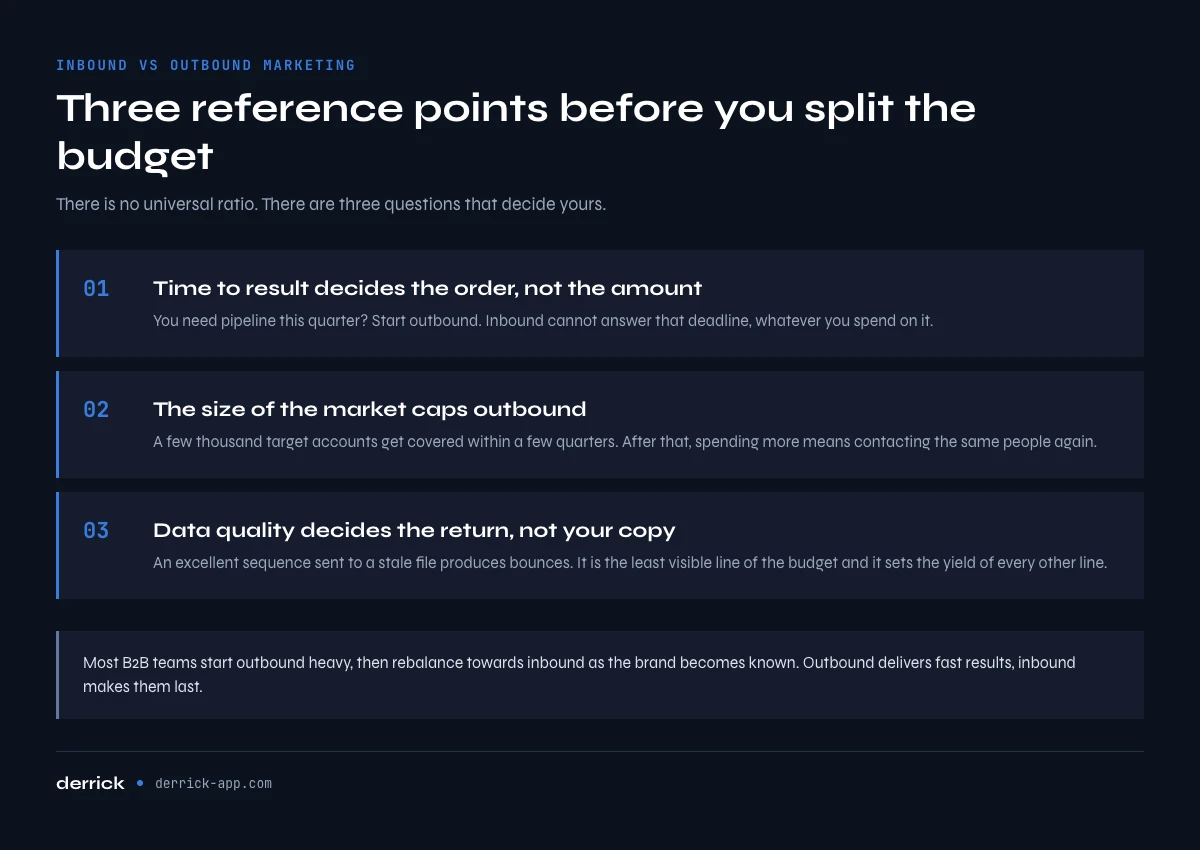
The question that always follows the theory: how much goes where. There is no universal ratio, but three reference points prevent the expensive mistakes.
Time to result decides the order, not the amount. Outbound produces replies in weeks, inbound in months. A company that needs pipeline this quarter therefore starts with outbound, not because it is superior but because inbound cannot answer that deadline. Reversing the order is the single most common reason a marketing budget is judged ineffective six months in.
The size of the addressable market caps outbound. If your target is a few thousand companies, outbound covers it entirely within a few quarters, and continuing to invest means contacting the same accounts again. If it is hundreds of thousands, that ceiling never arrives and the trade-off is decided elsewhere.
Data quality decides outbound's return, not your copy. An excellent sequence sent to a stale file produces bounces and damages your sending reputation. It is the least visible line in an outbound budget and the one that determines the yield of every other line.
In practice, most B2B teams start outbound-heavy and rebalance towards inbound as the brand becomes known and paid acquisition costs rise. Outbound delivers fast results, inbound makes them last. Test, measure and adjust to find your own balance.
Frequently asked questions
What is the difference between inbound and outbound marketing?
What are the advantages and disadvantages of inbound marketing?
What are the advantages and disadvantages of outbound marketing?
Should a B2B company choose inbound or outbound marketing?
Can inbound and outbound marketing work together?
How do you measure inbound vs outbound results?
Can a small team run both inbound and outbound?
Keep reading
Continue exploring this cluster


Account-Based Marketing (ABM): Definition, Techniques, Examples
Read →

B2B Lead Generation: Strategies, Tools, Tips in 2026
Read →

Go-to-Market Strategy: B2B Framework & 7 Steps (2026)
Read →

Lead generation company
Read →