
B2B Buying Signals You Can Detect Before First Contact
B2B buying signals split in two: the ones you can see on a cold account and the ones that need the prospect in your funnel. Costs and decay for each.


B2B buying signals: the split that decides whether your list is usable
B2B buying signals are observable events that indicate an account is moving toward a purchase. Every guide on the subject hands you a list of seven, ten or forty of them. Almost none of them tells you the one thing that changes what you can do on Monday morning: on our reading of the guides that rank for this query, a large share of those signals can only be seen once the prospect is already talking to you.
A pricing page visit, a demo request, an email reply, a question about integrations: these are real signals, and they are useless for building a list, because they require the account to already be in your funnel. The signals that work on a cold list are a much shorter set, and they have one thing in common: they are published somewhere public, by the company itself or by a third party, whether or not you exist.
This guide sorts the signals into those two families, names the ones you can detect on an account you have never contacted, prices each one per company, and says how long each stays worth acting on. The wider picture, including how signals rank against each other in strength, sits on our B2B intent data hub. If what you actually want is bought intent data rather than observable events, our comparison of the six families of third party intent data sources covers that side.
If you track only three B2B buying signals
The short version, for teams that want to start this week rather than read forty entries:
- Hiring for the role that owns your problem. The cheapest of the seven and the most specific. An open role names the department and dates itself.
- Leadership and job changes. A new decision-maker tends to rebuild the stack, and a former champion carries your product into a new company.
- Funding. Budget that did not exist last quarter. Everyone sees it, so it sets the timing more than the message.
Those three cover timing and budget. Add technology stack as a fourth column when fit depends on what the account already runs.
The two families, and why blending them makes a list unusable
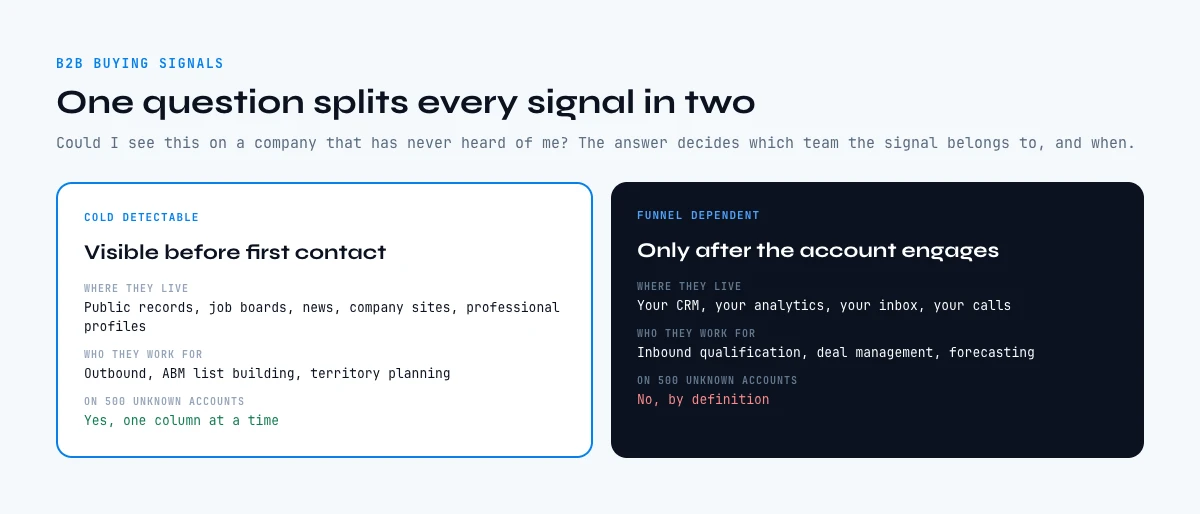
Sort every signal you have ever been told to track by one question: could I see this on a company that has never heard of me? The answer splits the list cleanly in two, and the two halves belong to different teams at different moments.
| Cold-detectable signals | Funnel-dependent signals | |
|---|---|---|
| Where they live | Public records, job boards, news, company websites, professional profiles | Your CRM, your website analytics, your inbox, your calls |
| Who they work for | Outbound, ABM list building, territory planning | Inbound qualification, deal management, forecasting |
| When you get them | Before first contact | After the account has engaged |
| Can you run them on 500 unknown accounts | Yes, one column at a time | No, by definition |
| Typical examples | Funding, hiring spike, tech stack change, leadership change, expansion, news mention, review activity | Pricing page visit, demo request, trial signup, integration question, timeline mention |
The reason this matters is not taxonomy. A catalogue that mixes both families reads as one long menu of options, and a rep who tries to act on it discovers that most of the entries need somebody to have already raised their hand. Seven of them do not. Those seven are the entire outbound toolkit, and they deserve to be treated as such rather than buried in a longer list.
The seven B2B buying signals you can detect on a cold account
These are the signals that exist independently of your funnel. Each one is published, each one can be resolved for a whole list, and each one tells you something specific rather than "this account is warm". Here they are, numbered 1 to 7, in the order every table in this guide reuses.
- Funding and financial events
- Hiring for the role that owns your problem
- Leadership and job changes
- Technology stack changes
- Headcount and geographic expansion
- News and public announcements
- Review and comparison activity
1. Funding and financial events
A raise, an acquisition or a stated expansion means budget that did not exist last quarter. It is the signal that travels furthest, which is also its weakness: everyone selling anything sees the same announcement on the same day. Its value is not the event but the timing window it opens, and the specificity of what you say about how the money will be spent in your category.
Cost to detect: 1 credit per article. Warm for: one to two quarters. Source: public announcements.
2. Hiring for the role that owns your problem
An open role is a problem somebody has been authorized to spend on. It is more precise than funding, and it is the one teams most often leave on the table: a company hiring three SDRs is buying prospecting infrastructure, whichever way it phrases the job description. The signal is public, it names the department, and it dates itself.
Cost to detect: 1 credit per company. Warm for: as long as the role is open. Source: public job listings.
3. Leadership and job changes
A new executive tends to rebuild the stack they inherited, and a champion who moves takes their preference to the new company. Treat the window as short and verify it on your own data rather than on a rule of thumb. Both directions are actionable, and both are visible on professional profiles. The related move, tracking your own former customers into new companies, is the version of this signal worth building first, because the relationship already exists.
Cost to detect: 1 credit per profile. Warm for: the first months in the new seat. Source: professional profiles.
4. Technology stack changes
Adding, removing or replacing a tool on a public website is a decision that has already been made about an adjacent budget. It qualifies compatibility, not just intent: if your product plugs into one platform and not another, the stack tells you whether the conversation is even possible before you spend a credit on a contact.
Cost to detect: 2 credits per website. Warm for: until the next stack change. Source: the company website.
5. Headcount and geographic expansion
A company that grew from forty to ninety people, or that opened a second office, has crossed thresholds where manual processes break. This is a slower signal than funding and a more reliable one, because it reflects what actually happened rather than what was announced.
Cost to detect: 1 credit per company. Warm for: about a quarter. Source: company profiles and registries.
6. News and public announcements
Product launches, partnerships, regulatory changes and leadership commentary give you the one thing every cold email lacks: a reason to be writing this week rather than any other week. News is the weakest signal on relevance and the strongest on timing.
Cost to detect: 1 credit per article. Warm for: days. Source: public news.
7. Review and comparison activity
A company writing or collecting reviews on a software category is evaluating that category. It is the closest a public source gets to declared intent, and it is the only cold signal that names the specific product being considered.
Cost to detect: 2 credits per line. Warm for: weeks. Source: public review sites.
Notice what is not on this list: nothing that depends on your website, your emails or your calls. That is the point. Our guide on reading review data as an intent signal covers the seventh one in detail.
What each signal costs to detect, and how long it stays warm
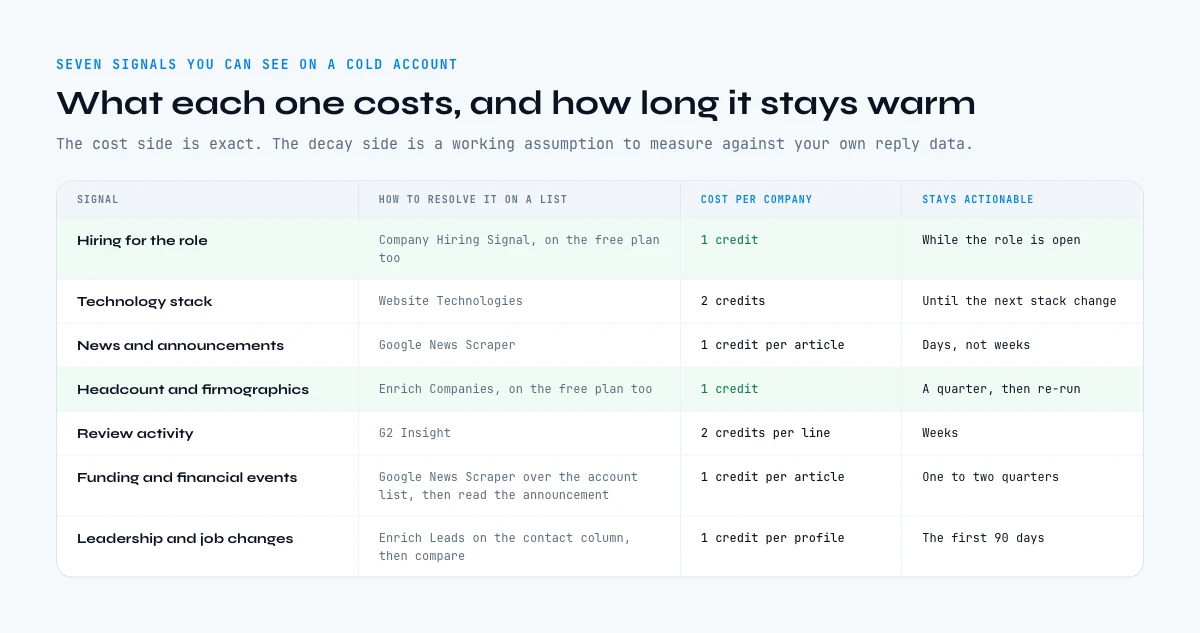
The question nobody answers is the operational one: what does it cost to put each of these signals on a list, and how long is the row still worth acting on afterwards. The cost side is exact. The decay side is a working assumption you should measure against your own reply data rather than trust.
| Signal | How to resolve it on a list | Cost per company | Stays actionable for |
|---|---|---|---|
| Hiring for a role | Company Hiring Signal, on the free plan too | 1 credit | While the role is open |
| Technology stack | Website Technologies | 2 credits | Until the next stack change |
| News and announcements | Google News Scraper | 1 credit per article | Days, not weeks |
| Headcount and firmographics | Enrich Companies, on the free plan too | 1 credit | A quarter, then re-run |
| Review activity | G2 Insight | 2 credits per line | Weeks |
| Funding and financial events | Google News Scraper over the account list, then read the announcement | 1 credit per article | One to two quarters, shorter if the round was small |
| Leadership and job changes | Enrich Leads on the contact column, re-run and compare current company | 1 credit per profile, on the free plan too | The first months in the new seat |
| Job changes, funding, hiring sprees, stack moves, as they happen | Signal, tracked continuously | From 20 euros a month | Alert fires at the event |
Two readings are worth taking from that table. First, the cheapest signals are not the weakest ones: hiring costs a single credit and is more specific than a funding round everyone else also saw. Second, there is a real difference between resolving a signal once, on a list you already have, and being told the moment it fires. Batch detection answers "who should I contact this month". Continuous tracking answers "who changed today", and only the second one catches a champion the week they move.
One practical note on two rows. Enrich Companies and Enrich Leads read LinkedIn data, so they run with your LinkedIn account connected through the Derrick Chrome extension. The other columns do not need it.
How to identify buying signals on your own accounts, in five steps
Knowing the seven is not the same as watching them. To identify buying signals on the accounts you actually sell to, you need five decisions made once, before anyone opens a list. This is a selection and action procedure. How a timing attribute is collected and stored is a separate topic, covered on our page about timing data as a B2B attribute.
- Pick three signals, not seven. Look at your last ten to twenty won deals and write down which public event came before the first meeting. Keep the three that show up most. No history yet? Start with the three in the short list at the top of this guide.
- Name one source per signal. Hiring lives on job listings, funding and launches in the news, job changes on professional profiles, stack on the company website. One source per signal keeps the column consistent from one month to the next.
- Set a check cadence that matches the decay. News goes stale within days, so check it weekly. Hiring every two weeks. Headcount once a quarter. Job changes either continuously or with a monthly re-run of the contact column.
- Write the action threshold in advance. For example: fit confirmed plus one timing signal younger than a month means the account gets contacted this week. Once it is written down, reps stop debating each row.
- Decide who acts on what. Signals on new accounts go to whoever prospects. Signals on accounts already in a deal go to the account owner. The watch list stays with marketing until a timing signal fires.
The fifth step is the one teams skip, and it is why buying signals and intent signals pile up in a dashboard nobody opens. A signal without an owner is a report. Not a trigger.
Score the signals you already have
Pick the signals you can genuinely see on your target accounts today, and the tool tells you what that combination supports and what it does not.
Buying signal stack scorer
Select every signal you can currently resolve for a cold account. The verdict is about what the stack can carry, not a number out of ten.
Select the signals you can actually resolve today.
Multi-select: click a signal again to remove it. The verdict reflects two properties of a stack, its timing and its qualification, because a stack can be strong on one and empty on the other.
From stack to priority: three tiers, no invented score
The tool above tells you what your stack can carry. On the list itself, the same two axes, fit and timing, sort every account into one of three tiers. No weighting, no number out of a hundred.
| Tier | What the row shows | What to do |
|---|---|---|
| Act today | Fit confirmed, plus a timing signal from the last few weeks: a role posted, a new decision-maker, a round just announced | Find the contact and write, with the signal in the first line |
| This week | Fit confirmed, with an older or weaker timing signal, such as a news mention or a stack change from last quarter | Queue it for the week, and check the signal is still true before sending |
| Watch | Timing without fit, or fit without any timing signal | No outreach. Re-run the timing columns at the next check and promote the row when one fires |
Tiers move. A watch account that hires a new head of sales jumps to act today the morning the change shows up, which is exactly why the cadence in step three matters.
Funnel-dependent signals: real, and too late for outbound
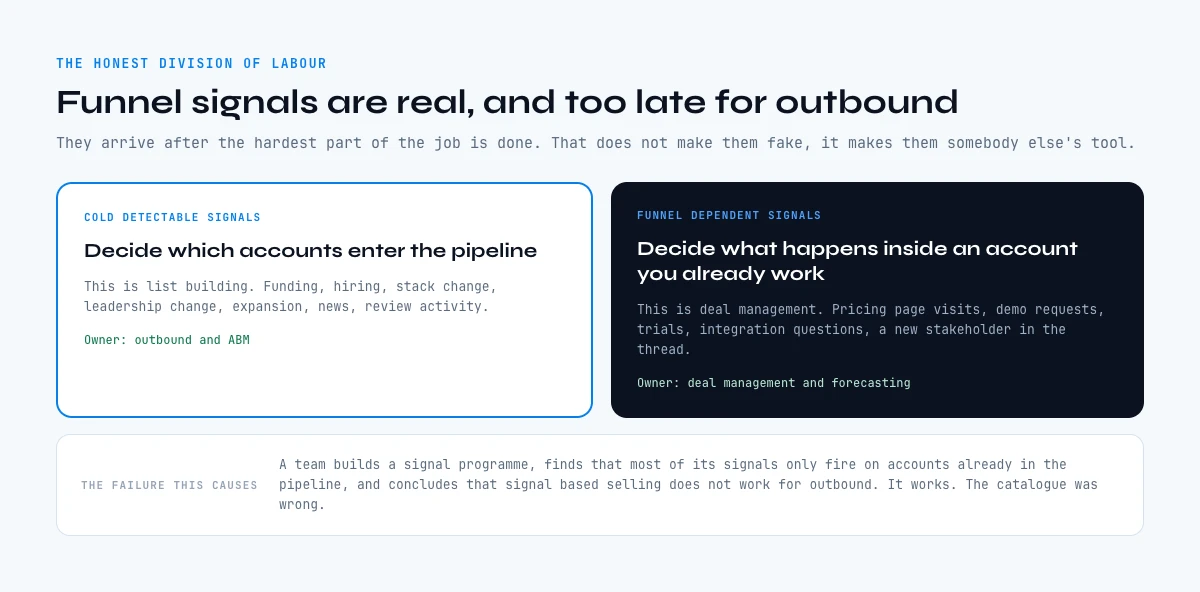
The second family is not fake. A prospect asking about integrations, requesting a trial, bringing a new stakeholder into a thread or going quiet after a proposal all tell you something precise. They simply arrive after the hardest part of the job is done.
Treating them as buying signals in the same breath as funding or hiring causes a specific and common failure: a team builds a signal program, finds that most of its signals only fire on accounts already in the pipeline, and concludes that signal-based selling does not work for outbound. It works. The catalogue was wrong.
The honest division of labour is this. Funnel-dependent signals belong to deal management: they decide sequencing, urgency and who else to involve inside an account you are already working. Cold-detectable signals belong to list building: they decide which accounts enter the pipeline in the first place. Our guide on how many people really sign off on a B2B decision covers the stakeholder side of the first job.
Buying signals in sales conversations: what the prospect actually says
Buying signals in sales calls and email threads are the funnel-dependent family seen up close. None of them helps you choose which accounts to contact. All of them help you decide what to do next with an account that already answered. They are verbal intent signals, and they tend to sound like this:
- Price question. "What would this cost for a team of twelve?" They are sizing it against a real budget, not browsing.
- Timeline. "We'd need something running before next quarter starts." There is a date, so there is a reason to move now.
- Integration. "Does it connect to our CRM?" They are picturing it inside their own setup.
- A new person in the loop. "I've copied our head of RevOps." The deal is reaching the people who sign it or will run it.
- Onboarding. "How long does it take to get a new rep set up?" They are past "if" and into "how".
- Comparison. "How is this different from what we use today?" Something in place is about to be replaced. Ask what is not working.
- Pilot scoping. "If we started with one team, what would that look like?" They want a low-risk first step, so offer one.
- Paperwork. "Can you send the order form so I can pass it to procurement?" The decision is made and the process has started.
Two things tie this list to the rest of the guide. First, these signals only exist because someone replied, which is the whole definition of funnel-dependent: they decide sequencing and urgency, not who enters the list. Second, the cold signal that opened the account tells you which of them to listen for. An account you contacted because of a new head of sales often raises the comparison question early. An account you contacted because of an open SDR role asks about onboarding. Our list of questions that reveal buyer intent goes further on what to ask once the conversation has started.
B2B buying signals by buyer: which committee role each one points to
Intent signals fire at the account level, but someone inside the account caused them. Mapping each signal to the buying committee role behind it tells you who to write to and what goes in the first line. The roles are the usual three: the economic buyer who owns the budget, the champion who pushes the project, and the users or evaluators who will live with the tool.
| Signal | Committee role it points to | How to detect it | First message angle |
|---|---|---|---|
| 1. Funding | Economic buyer: the founder, CEO or CFO deciding where the new budget goes | Google News Scraper over the account list, 1 credit per article | Where a round usually gets spent first in your category, and the decision it forces |
| 2. Hiring | Champion: the manager who is hiring and needs the new people productive fast | Company Hiring Signal, 1 credit per company | How new hires in that role get to useful work in their first weeks |
| 3. Leadership or job change | A new economic buyer, or a former champion in a new seat | Enrich Leads re-run on the contact column, or Signal for an alert when it happens | The new role, and the one thing worth checking in the stack they inherited |
| 4. Tech stack change | Evaluator: RevOps, ops or IT, who own the tools around yours | Website Technologies, 2 credits per website | What the new tool needs upstream to work, and where you fit in that picture |
| 5. Headcount growth | The department head whose manual process just broke | Enrich Companies, 1 credit per company | The step that stops scaling somewhere between 40 and 90 people |
| 6. News | The executive quoted in the announcement | Google News Scraper | The announcement itself, and what it changes for the team you sell to |
| 7. Review activity | Users and evaluators comparing tools in the category | Public review sites, read for the accounts on your list | The criterion that comparisons usually miss |
Treat the table as a starting point. In a forty-person company the founder can be economic buyer, champion and user at once. In a large account the same funding round can reach five people. Our B2B buying committee report looks at how many people really sign off.
Stacking B2B buying signals without inventing a score
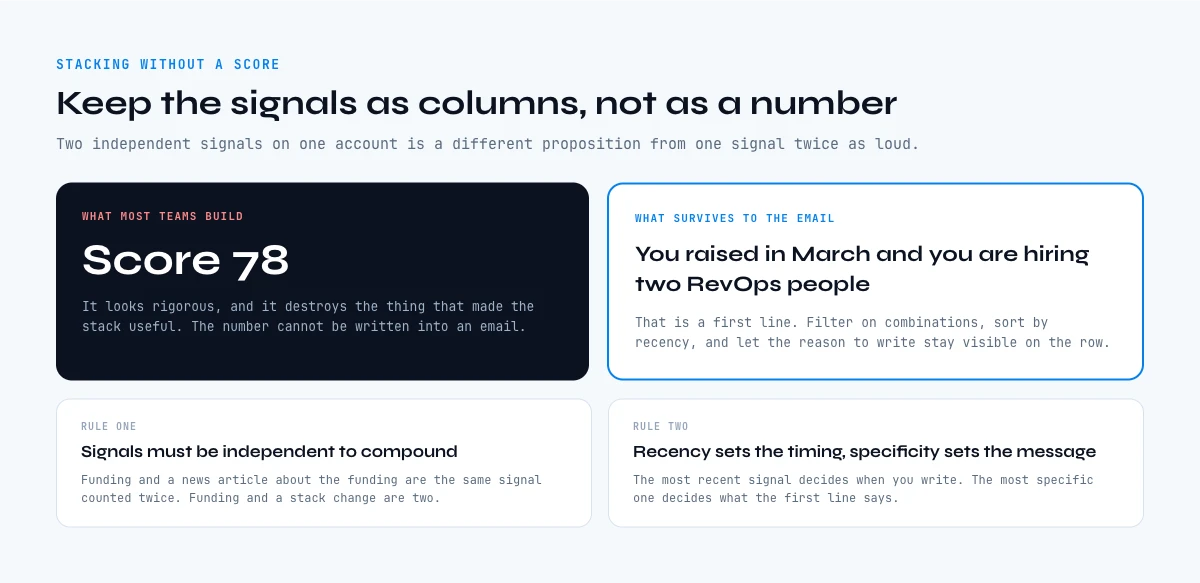
Two independent signals on the same account is a genuinely different proposition from one signal twice as loud. A company that raised money is a company with budget. A company that raised money and is hiring for the function you sell into has told you the budget's destination.
The trap is what teams build next: a weighted score that turns several signals into a single number between zero and one hundred. It looks rigorous and it destroys the thing that made the stack useful, because the number cannot be written into an email. "You raised in March and you are hiring two RevOps people" is a first line. "Account score 78" is not.
Keep the signals as columns, not as a score. Filter on combinations, sort by recency, and let the reason to write stay visible on the row. Two rules keep this honest.
- Signals must be independent to compound. Funding and a news article about the funding are the same signal counted twice. Funding and a tech stack change are two.
- The most recent signal sets the timing, the most specific sets the message. A funding round from last week decides that you write now; the open role decides what you write about.
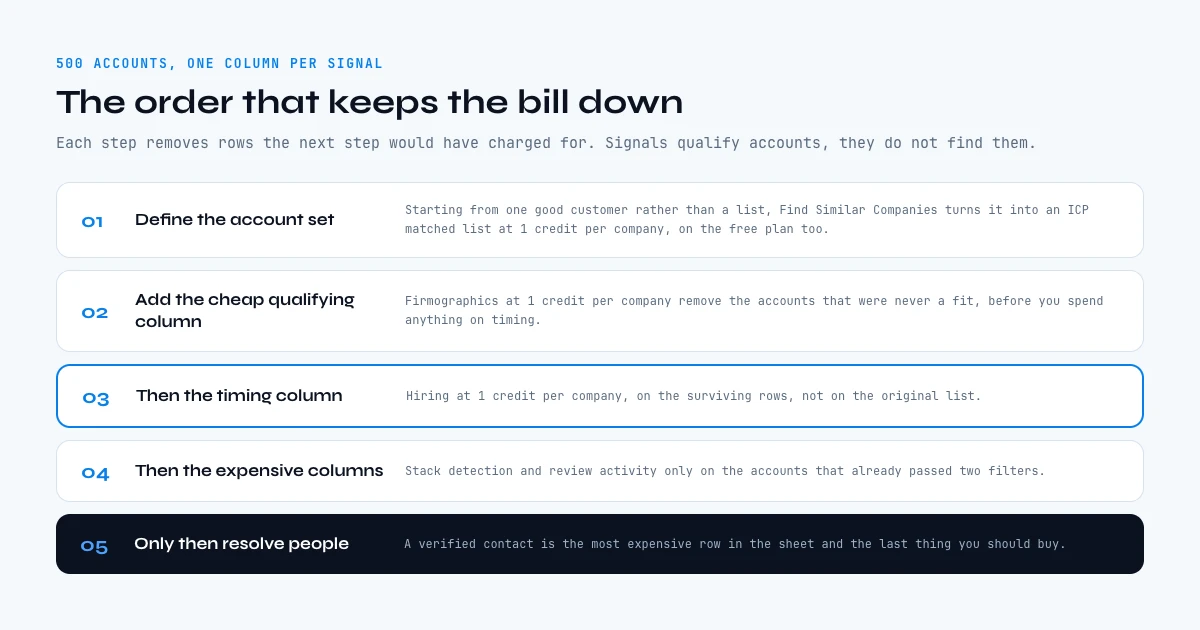
Running B2B buying signals on a list of 500 accounts
The whole method fits in one spreadsheet with one row per account and one column per signal. What follows is the order that keeps the bill down, because each step removes rows the next step would have charged for.
- Define the account set first. Signals qualify accounts, they do not find them. If you are starting from one good customer rather than a list, Find Similar Companies turns it into an ICP-matched list at 1 credit per company, on the free plan too.
- Add the cheap qualifying column next. Firmographics at 1 credit per company remove the accounts that were never a fit, before you spend anything on timing.
- Then the timing column. Hiring at 1 credit per company on the surviving rows, not on the original list.
- Then the expensive, specific columns. Stack detection and review activity only on the accounts that already passed two filters.
- Only then resolve people. A verified contact is the most expensive row in the sheet and the last thing you should buy.
The same steps run from the Derrick web app, from the Derrick sidebar in Google Sheets, from an AI assistant through the Derrick MCP when you would rather ask the question than build the column, and from the REST API when the account list is generated upstream by your CRM. The surface changes, the credit cost does not. And the whole pipeline works at 50 accounts as well as at 5,000: the ordering above matters more at small volume, not less, because a wasted credit is a larger share of the budget.
For the accounts that survive, our note on turning intent into a marketing motion covers what happens after the list is scored.
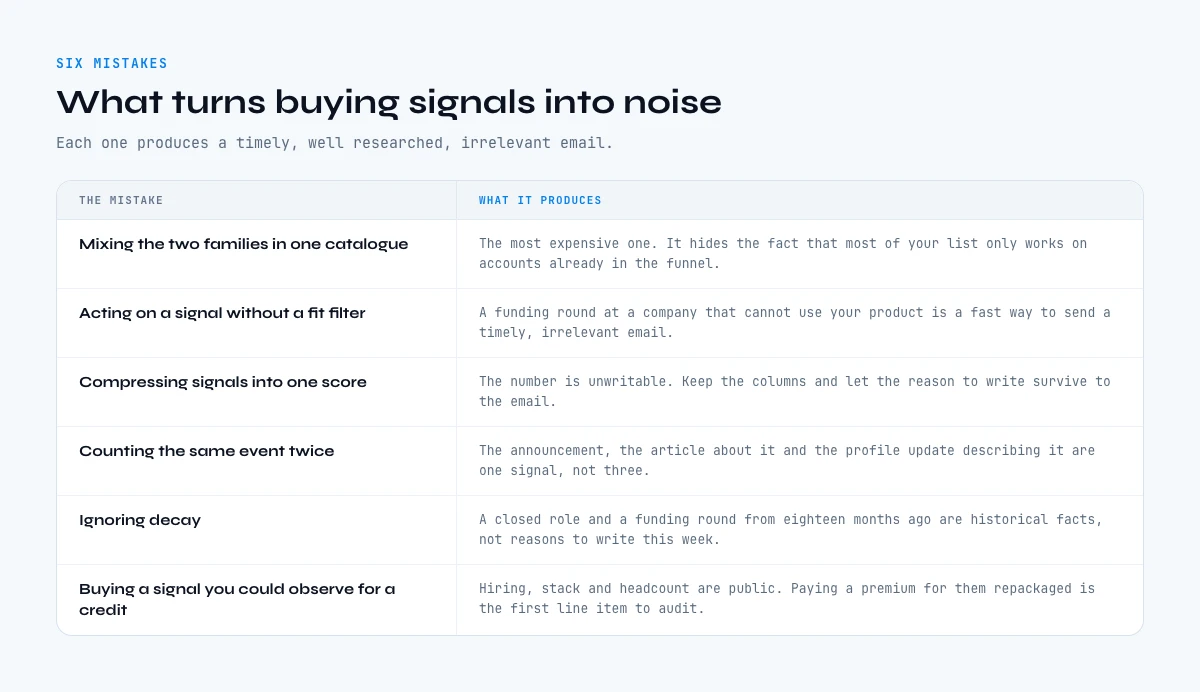
Six mistakes that turn buying signals into noise
Mixing the two families in one catalogue
The single most expensive mistake, because it hides the fact that most of your list only works on accounts already in the funnel.
Acting on a signal without a fit filter
A funding round at a company that cannot use your product is a fast way to send a timely, well-researched, irrelevant email.
Compressing signals into one score
The number is unwritable. Keep the columns, filter on combinations, and let the reason to write survive to the email.
Counting the same event twice
The announcement, the news article about the announcement and the profile update describing the announcement are one signal, not three.
Ignoring decay
A signal has a half-life. A hiring post that closed and a funding round from eighteen months ago are both historical facts, not reasons to write this week.
Buying a signal you could observe for a credit
Hiring, stack and headcount are public. Paying a premium for them repackaged is the line item worth auditing first in an intent budget. Our page on checking a prospect's tech stack through reviews covers one cheap way to do it yourself.
Key takeaways
- Sort every signal by one question: could you see it on a company that has never heard of you?
- Seven signals survive that test, and they are the entire outbound toolkit: funding, hiring, job changes, tech stack, expansion, news and review activity.
- Funnel-dependent signals are real but arrive after the account is already yours to work.
- The cheapest signal is not the weakest: hiring costs one credit per company and is more specific than a funding round everyone else also saw.
- Two independent signals compound; the same event counted twice does not.
- Keep signals as columns rather than a score, because a score cannot be written into a first line.
Frequently asked questions
What are B2B buying signals?
Which buying signals work for cold outbound?
What is the difference between buying signals and intent data?
What are affordable ways to detect buying signals?
Should you combine several buying signals into a score?
How do you run buying signals on a list of 500 accounts?
How do I track funding rounds, hiring and job changes?
How do I combine buying signals with cold email?
Keep reading
Continue exploring this cluster


The B2B Buying Committee Report 2026: How Many People Really Sign Off
Read →

The State of B2B Intent Data 2026: The Signal-to-Pipeline Gap
Read →

Intent Marketing: How to Harness Data Intelligently?
Read →

Product Rating Checker: How to Identify Your Prospects' Tech Stack via Reviews
Read →