
Intent Marketing: How to Harness Data Intelligently?
Intent marketing means reaching prospects when their need peaks, using buying signals like funding, job changes, and hiring. Workflow and examples inside.


Intent marketing is the difference between reaching a prospect who has no need at all and reaching one whose need is peaking right now, at the exact moment they are most likely to respond. This guide defines intent marketing, breaks down the signals that reveal buying intent, walks through a practical B2B workflow with worked examples, and covers first-party versus third-party signals, how to measure it, how to keep the underlying data accurate, and the mistakes to avoid.
What intent marketing is
Intent marketing is the practice of understanding a prospect's need and reaching out at the exact moment that need peaks: the right need at the right moment. The need is often always there in the background, but timing is what turns it into a conversation. You will always need to eat, but you are far more likely to order at 12:30 than at 3pm, and the same logic applies to B2B buying.
It works in B2B and B2C alike, and it runs on data. The more you know about a prospect and their situation, the more precise your segments and your timing become. Done well, intent marketing means you stop being perceived as a spammer, because you reach people when your offer is genuinely relevant, rather than blasting a list that has no current need.
The signals that reveal buying intent
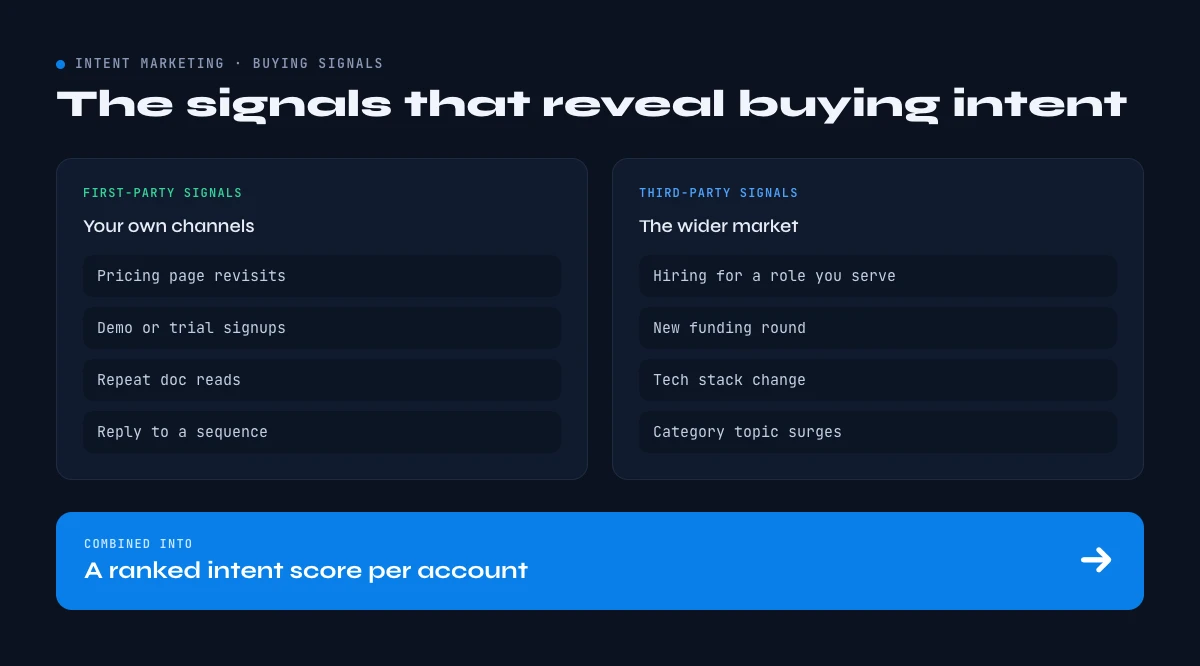
Intent shows up as signals, which fall into two broad groups.
- First-party signals are interactions with you: website visits, content downloads, pricing-page views, email replies, demo requests. They are the strongest because they come straight from the prospect.
- Third-party signals happen away from your site: research activity across the web, review-site visits, or public events that suggest a company is entering your category.
In B2B, some of the most reliable signals are concrete company events you can detect from an enriched lead list:
- Fundraising. A company that just raised is often hiring and buying to fuel growth.
- Job changes. A new decision-maker in a relevant role frequently re-evaluates tools in their first months.
- Hiring activity. Open roles reveal where a company is investing.
- Work anniversaries. A useful, low-pressure reason to reach a hard-to-access contact.
- Technology adoption. Adopting a complementary tool can signal readiness for yours.
Each of these is detectable at scale when your prospect data is enriched and current, which is what turns a raw list into a set of timed, relevant moments to act on.
How to do intent marketing: a B2B workflow
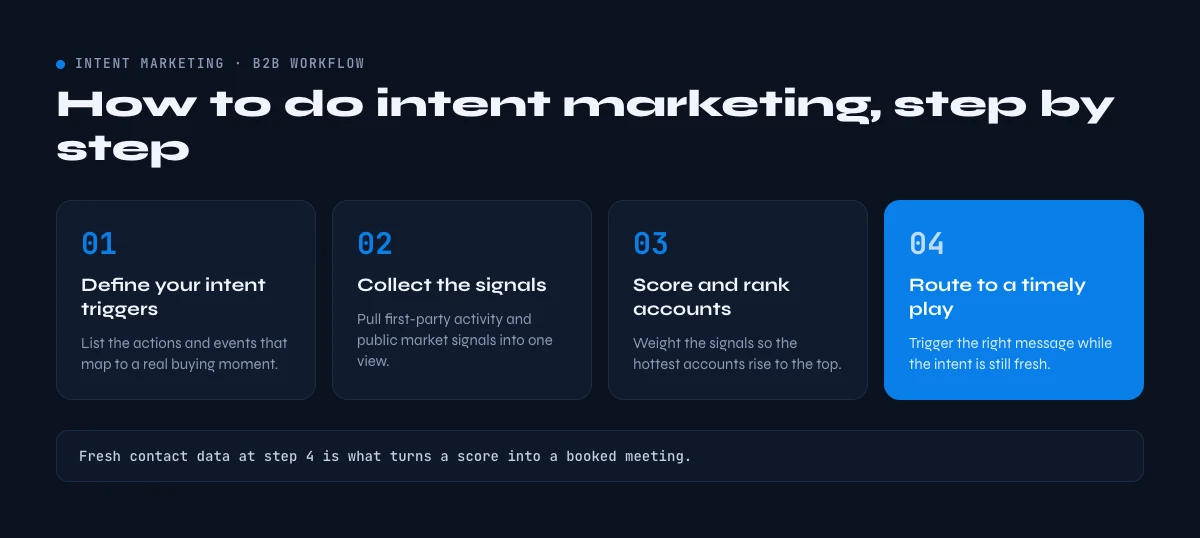
The practical loop is the same whatever signal you use:
- Detect the signal. Identify the trigger (a funding round, a job change) across your target accounts.
- Segment. Group prospects who share the signal so the message fits the moment, not just the persona.
- Enrich. Fill in the missing data (verified email, direct phone, role, company details) so you can actually reach the right person.
- Personalise. Open on the moment, not a generic pitch, so the outreach earns attention.
- Reach at the right time. Act while the signal is fresh; intent decays quickly.
The enrichment step is where most teams stall, because a list of names with a signal but no verified contact details cannot be actioned. This is where Derrick fits: from its web app or a Google Sheets sidebar you enrich a signal-matched list with verified emails, phone numbers, and company data, refreshed at lookup time, so a column of triggers becomes a column of people you can actually contact. You start from your prospect list, point Derrick at it, and it fills the data row by row, no manual research per lead.
In the web app or Google Sheets
Start intent with a signal you own
Intent marketing usually begins with a purchased feed. It can also begin with your own account list: Derrick checks each company for open roles from your list, which gives you a timing signal you can explain to a prospect.
- Feature
- Company Hiring Signal (LinkedIn Jobs)
- Credit cost
- 1 credit per company checked
The first button opens the web app (nothing to install): 1 credit per company checked, 100 free credits every month. The second details the feature and its cost per plan.
A worked B2B example
Say a start-up has just announced a funding round. It is reasonable to expect an active recruitment and investment phase, because the company has fresh capital to accelerate growth. If you sell recruitment software or headhunting services, that funding announcement is your moment: the need (hiring) and the trigger (new money) line up.
The workflow in practice: you build a list of recently funded companies in your target segment, enrich each with the relevant decision-maker and their verified contact details, and reach out referencing the raise and what it usually means for hiring. Compare that to a cold blast to the same companies with no timing and no personalisation. The first feels like relevant help; the second feels like spam. Same companies, opposite reception, and the only difference is intent.
For account-level signals, see how this connects to the B2B buying committee and the broader state of B2B intent data.
A second example shows the same logic with a different trigger. A prospect changes jobs and becomes, say, the new Head of RevOps at a target account. In their first ninety days they audit the stack and look for quick wins, which is exactly when a relevant tool gets a hearing it would never get from a settled-in buyer. Detect the job change, enrich the new contact with a verified email and direct line, and reach out with a message built around their first-quarter priorities. The trigger is different from a funding round, but the pattern is identical: a moment, the right person, accurate data, and a message that fits the moment rather than your quota.
Why intent marketing works (and how to measure it)
Intent marketing works because it aligns your outreach with the prospect's reality instead of your quota. Reaching someone when their need is live lifts reply and meeting rates, shortens cycles, and protects your sender reputation, since relevant messages get fewer spam complaints than generic blasts.
Measure it by comparing intent-triggered outreach against your baseline: reply rate, meeting-booked rate, and conversion to pipeline on signal-based campaigns versus untargeted ones. Track which signals produce the best response, then double down on those. The goal is not more volume; it is better timing, and the metrics should reward relevance, not raw send count.
It also helps to separate the signal from the outcome when you report. A leading indicator is how many target accounts showed a usable signal and how many you reached in time; a lagging indicator is the pipeline and revenue those touches produced. Watching both stops two failure modes: a program that detects plenty of signals but acts on none, and one that acts fast but on signals that never convert. Over a few cycles, the pattern of which signals reliably lead to meetings becomes your playbook, and you can quietly drop the triggers that look interesting but never turn into pipeline.
The app works through your list row by row: 1 credit per company checked.
Common intent marketing mistakes
- Acting too late. Intent decays fast; a funding signal worked two months later has lost most of its edge.
- Signal without enrichment. Knowing a company is in-market is useless if you cannot reach the right person with verified contact data.
- Generic personalisation. Referencing the signal in name only, then pitching generically, defeats the purpose.
- One signal for everything. Different triggers fit different offers; match the signal to a genuinely relevant message.
- Chasing volume over timing. Intent marketing is about reaching fewer people at better moments, not sending more.
First-party versus third-party intent data
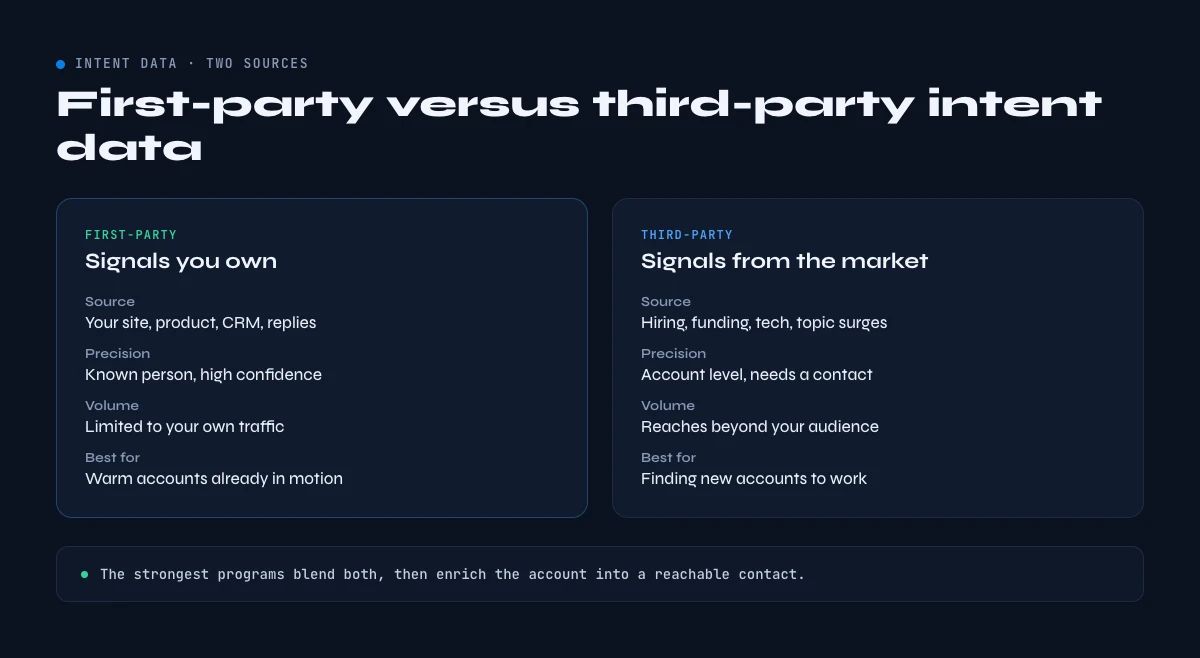
The two kinds of intent signal behave differently, and knowing which you are working with changes how you act. First-party intent comes from your own properties: someone visits your pricing page, opens three emails in a week, downloads a comparison guide, or starts a trial. It is the highest-confidence signal because the person is interacting with you directly, and it is fully yours to use. The downside is reach: first-party intent only covers people who already found you, so it misses accounts that are in-market but have never visited.
Third-party intent fills that gap. It infers interest from activity across the wider web, for example a company researching your category on review sites or publishing content about a problem you solve. It widens the net to accounts that do not yet know you, but it is noisier and lower-confidence, because the signal is inferred rather than observed. The strongest programs combine the two: third-party signals to discover in-market accounts you would otherwise miss, first-party signals to prioritise the ones already engaging with you. In both cases the signal is only the trigger. You still have to enrich the account with the right contact and reach out, which is the step that converts a data point into a conversation.
Intent marketing versus spray-and-pray outbound
Traditional outbound often works on volume: build the biggest list possible, send the same message to everyone, and accept a tiny response rate. Intent marketing inverts that. It sends fewer messages, to people whose need is live, with copy built around the moment rather than a generic pitch. The volume goes down; the relevance, and the response, goes up.
The difference matters beyond reply rates. High-volume, low-relevance sending damages your sender reputation, burns through your list, and trains prospects to ignore you. Mailbox providers increasingly penalise senders with high complaint and bounce rates, so spray-and-pray is not just less effective, it is actively risky. Intent-based outreach protects the channel: relevant messages to engaged, well-targeted contacts earn fewer complaints and keep deliverability healthy. The trade-off is effort. Intent marketing asks you to detect a signal, enrich the list, and personalise, which is more work per contact than blasting. But the work pays back in reply rate, pipeline quality, and a channel that keeps working instead of degrading. For most B2B teams in 2026, with inboxes more crowded and filters stricter than ever, that trade is firmly worth making.
Keeping intent data accurate
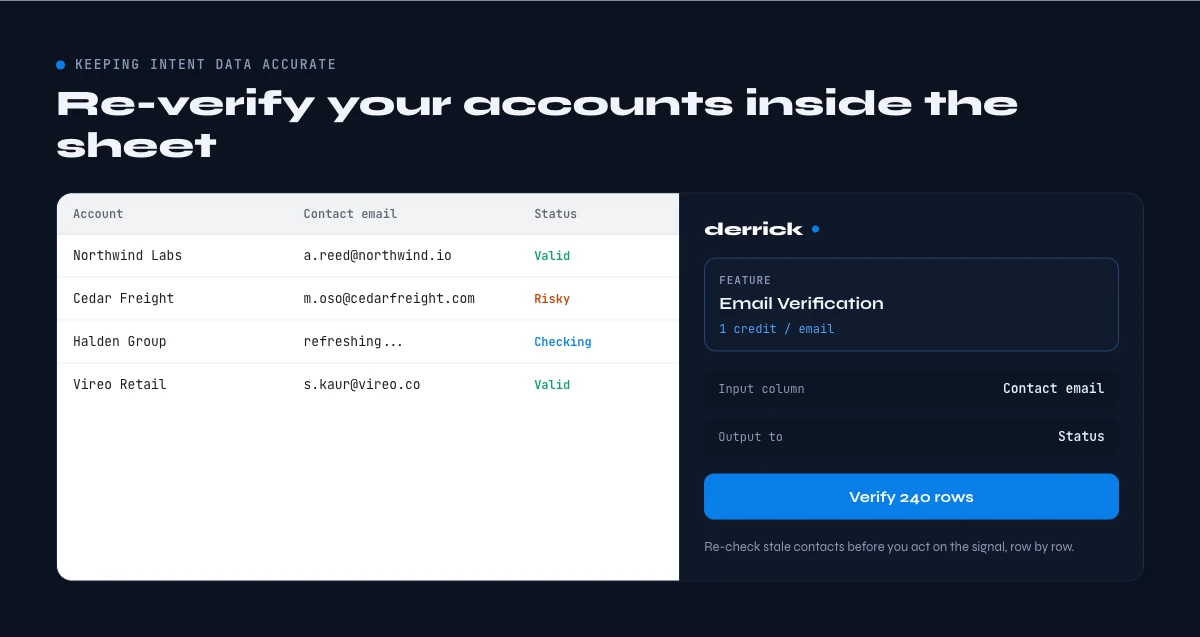
Intent marketing depends on data that is both timely and correct, and B2B data decays fast. People change jobs, companies merge, phone numbers and emails go stale, so a signal-matched list built last quarter is partly wrong today. Acting on a great signal with an outdated contact wastes the moment: the email bounces, the call reaches a number that has moved on, and the timing advantage is lost.
That is why enrichment for intent marketing is not a one-time export but an ongoing habit. The practical pattern is to enrich the list at the moment you act on the signal, rather than relying on data captured weeks earlier, so the contact details are as fresh as the trigger. Verifying emails and direct phones before you send keeps bounce rates low, which protects the sender reputation that intent marketing is supposed to safeguard. Live, verified data and timely signals are two halves of the same discipline: the signal tells you when, and accurate enrichment makes sure you can actually reach the right person when that moment arrives.
Getting started with intent marketing
You do not need an enterprise budget to start. Pick one signal you can detect reliably (a funding round, a job change, a work anniversary), build a small list of accounts showing it, enrich that list with verified contacts, and run a focused, personalised campaign timed to the signal. Measure the response against your usual outreach, then expand to the signals that worked.
Intent marketing is something most teams already do intuitively when they notice a trigger and reach out. Formalising it, detecting signals deliberately, enriching the list, and acting while the moment is fresh, is what turns an occasional good instinct into a repeatable engine. To go deeper on the data behind it, browse the B2B intent data hub and the guide to product ratings as a buying signal.
Frequently asked questions
What is intent marketing?
What are intent signals?
What is the difference between intent marketing and intent data?
How do you start with intent marketing on a small budget?
Why does intent marketing improve reply rates?
Keep reading
Continue exploring this cluster


Product Rating Checker: How to Identify Your Prospects' Tech Stack via Reviews
Read →

How to Score, Segment, and Personalize Your Outreach Using G2 Insights
Read →

Product Review Finder: How to Mine Reviews for B2B Prospecting Intent
Read →

Third Party Intent Data Sources: The Six Families, Compared
Read →