Free lead generation tools
Small, fast tools that each remove one manual step in your prospecting, for free. Run them one lookup at a time, then scale the ones that work across a whole list with Derrick.

The tools
Website lookup
Scan any website for its tech stack, meta-tag preview, sitemap and public contacts. No signup for the first scan.
Open tool →WHOIS domain search
Look up any domain's registrar, creation and expiry dates, status, nameservers and DNSSEC. Powered by RDAP.
Open tool →NAF 2025 code converter
Convert a French NAF rev. 2 activity code to NAF 2025, which takes effect on 1 January 2027. Official INSEE mapping, splits shown.
Open tool →Colorado business entity search
Look up any Colorado company in the state register: legal status, entity type, formation date and registered agent. Live, free, no account.
Open tool →Sales conversion rate calculator
Enter the count at each funnel stage and see every stage-to-stage conversion rate, the end-to-end rate and the step that leaks.
Open tool →Email address checker
Test an email address in your browser: format, typo, disposable or role address, and what the test does not prove.
Open tool →Sales velocity calculator
Enter opportunities, deal size, win rate and cycle length to get revenue per day, what each lever is worth and the coverage your target needs.
Open tool →Email format finder
Guess a company's email pattern (first.last@, f.last@, etc.) from its domain so you can reach anyone there.
Coming soonLinkedIn company finder
Get the official LinkedIn company page from a brand name or a website domain.
Coming soon
At scale
derrick •
Do it for a thousand companies
The free tools answer one question for one company. Derrick builds the list for you from a plain-English brief, then fills it with emails, phones, tech stacks and firmographics, one click per column.
- Web app: nothing to install, no credit card
- Free plan: 100 credits every month
- API and MCP from the Plus plan (€47.50/month)
Install the add-on and enrich your lists without leaving your spreadsheet.
Install in Google Sheets →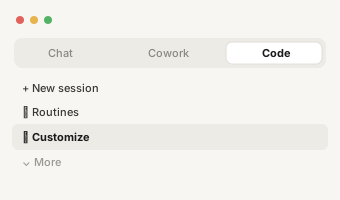
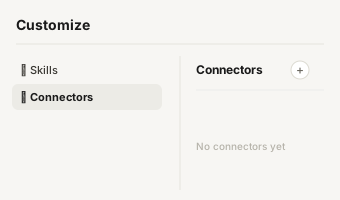
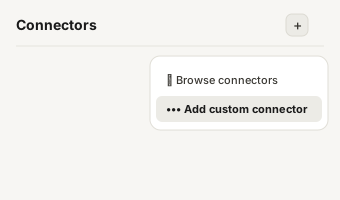
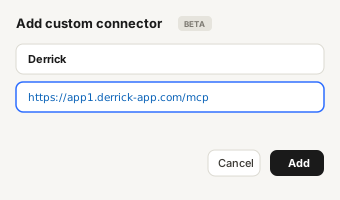
https://app1.derrick-app.com/mcp Call the same enrichment endpoints straight from your own stack or workflow.
Read the API docs →
Overview
What are free lead generation tools?
Free lead generation tools are small utilities that help you find, qualify or reach prospects without paying for a seat. Some answer a research question (what is a company built with, which LinkedIn page is theirs, when does their domain expire). Some help with data (an email pattern, a lookalike list). Some prep outreach. What they share is a single job, done in seconds, in the browser, with no contract attached. They are the cheapest possible way to remove one manual step from prospecting and see if it moves the needle before you commit budget to it.
Most articles titled "free lead generation tools" are affiliate roundups that send you to a signup form. This page is the opposite. Everything listed above runs right here, with no credit card and no demo call, and the first run of each tool needs no account at all. The goal is honest utility: try the thing, get a real answer, and only go deeper if it earns it.

In this hub
The free lead generation tools in this hub
We add tools as we build them rather than padding the list. Each one is a focused single-purpose utility, and each is the free, one-at-a-time version of something Derrick also does in bulk.
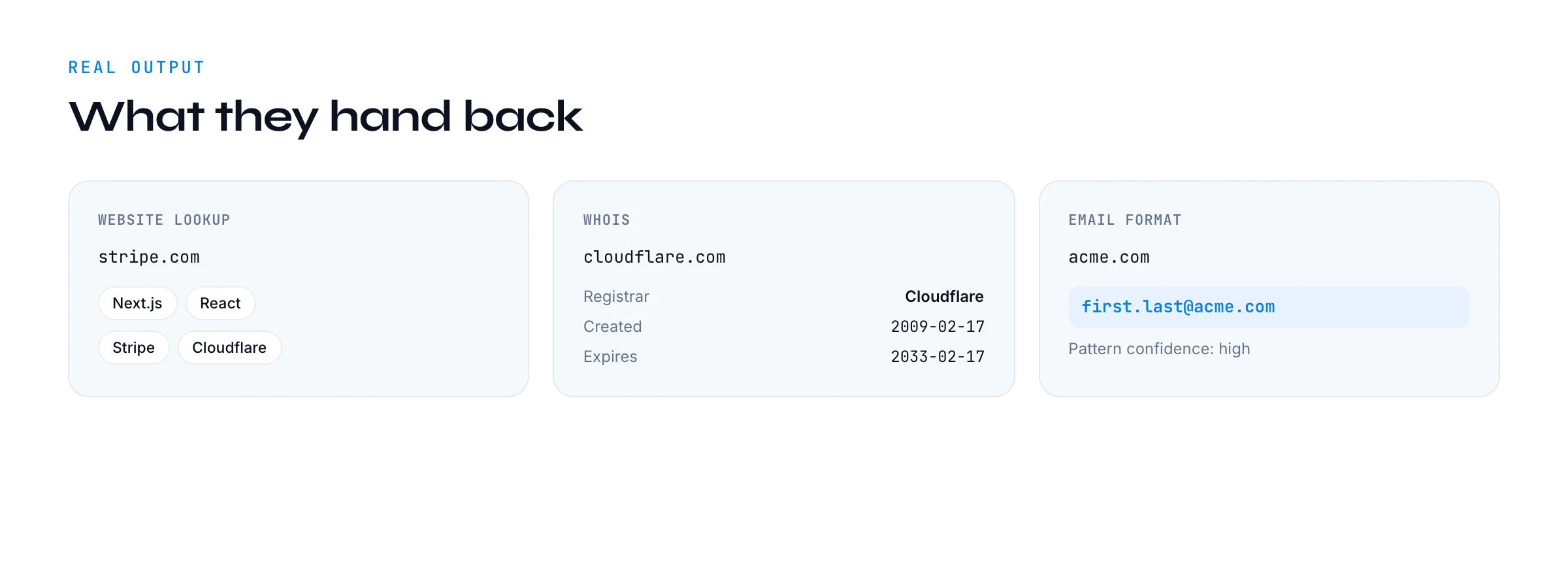
- Free website lookup tool scans any site and returns its tech stack (CMS, framework, analytics, payment, hosting), its meta and social preview, its public contacts and its sitemap. Use it to qualify a prospect or personalise an opener around the software they already run.
- WHOIS domain search tool looks up a domain's registrar, creation and expiry dates, status, nameservers and DNSSEC. Domain age and registrar are quiet signals of how established and how technical a company is.
- NAF 2025 code converter maps a French activity code from NAF rev. 2 to the NAF 2025 nomenclature that takes effect on 1 January 2027. 212 of the 732 sub-classes split into several new codes, so any segmentation or CRM rule built on hardcoded French activity codes breaks silently at the switch. The tool reads the official INSEE mapping and shows every target.
- Colorado business entity search looks up any Colorado company in the state register: legal status, entity type, formation date and registered agent.
- Email format finder (coming soon) will infer a company's email pattern from its domain so you can construct the right address for anyone there.
- LinkedIn company finder (coming soon) will resolve a brand name or domain to its official LinkedIn company page.

Build a stack
How to build a free lead generation stack that actually works
A pile of free tools is not a workflow. The teams that get value from them follow a simple order: find, qualify, reach, then record. Find the accounts that fit your ideal customer profile. Qualify each one quickly so you are not pouring effort into bad fits. Reach the right person with a message that proves you did your homework. Then record what you learned so the next touch is sharper.
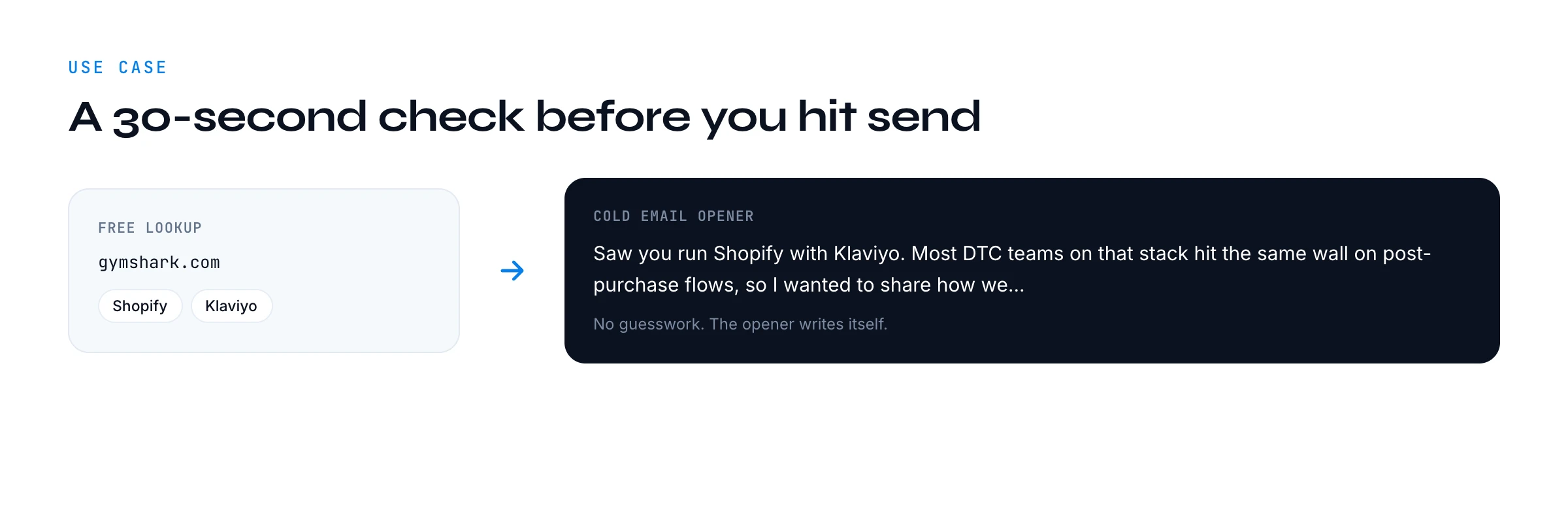
Free tools slot into the middle of that loop. Before you write to a company, a thirty second check on its tech stack tells you whether your product even fits, and gives you a concrete hook ("saw you run Shopify and Klaviyo") that beats any generic opener. A WHOIS lookup tells you how old and how established the domain is. An email pattern tells you how to reach the person you found. None of these are glamorous, but each removes a guess, and removing guesses is the entire job of lead generation.
The discipline that matters is to stop collecting tools and start collecting answers. Pick the one free tool that maps to your single biggest bottleneck this quarter and make it a habit. If you personalise by tech, live in the website lookup. If you struggle to reach decision makers, an email pattern tool earns its place first. Add the next tool only when the first one is part of your routine.

Where free stops
Where free tools stop and a real workflow begins
Every free tool has the same ceiling: volume. A free tool answers one question for one company. That is exactly right for a single check before a single message. It quietly falls apart the moment you have a list of two hundred accounts and need the same answer for every row, because no human is going to paste two hundred domains into a box one at a time and copy the results back into a spreadsheet.
This is the honest line between a free lead generation tool and a real prospecting workflow. The logic does not change when you scale; only the volume does. So the natural move is to take the exact lookup you proved on one company and run it across the whole list at once. That is what Derrick does in its web app, with nothing to install: import or paste your domains or LinkedIn URLs and get tech stacks, emails, phone numbers, firmographics and SIRET back, one click per column, with no per-record copy and paste. Unused credits never expire as long as you stay on a paid plan.
Free vs paid
Free vs paid lead generation tools: the honest trade-off
Free tools win on three things: zero cost, zero commitment, and speed for a single lookup. They are perfect for trying an idea, doing occasional research, or working a handful of named accounts by hand. They lose on volume, on data depth (public sources only), and on staying in one place (you are tab-hopping between separate tools).
Paid tools win on volume, depth and integration. They run across thousands of rows, pull from more data sources, and live where your list already is. They cost money and usually a contract. The pragmatic answer for most teams is not one or the other. Start free to validate the workflow, then pay only for the step that you now run often enough to justify it. If you want the full landscape, our best tools for sales hub reviews the paid platforms category by category, and the data enrichment guides explain the workflows behind them.
Day to day
How sales teams use these free tools day to day
SDRs use the website lookup right before an outbound message, so the first line names the exact stack the prospect runs instead of a generic compliment. Account executives use it to qualify inbound leads in seconds, deciding whether a demo is worth booking. Founders doing their own prospecting use WHOIS and tech checks to size up a company before a conversation. Agencies use them to audit a prospect's site during a pitch. Recruiters use them to understand a target company's stack before reaching out to its engineers.
In every one of those cases the pattern is identical: a quick, free lookup turns a cold name into a warm, specific reason to reach out. The free tool is the cheap experiment. When the experiment works often enough that you want it on every account, you graduate it into a repeatable workflow.
Criteria
What makes a free lead generation tool worth your time
Not every free tool deserves a spot in your workflow. The web is full of "free" tools that are really just lead-capture forms with a thin demo behind them, or scrapers that hand you stale, low-accuracy data you then have to clean by hand. A few simple criteria separate a genuinely useful free tool from a time sink.
- It works before it asks for anything. You should get a real answer on the first try, not a paywall after you type your query. Our tools give you the first run with no account at all.
- It does one thing clearly. A focused tool that returns a clean tech stack or a clean WHOIS record beats a bloated dashboard that does ten things badly.
- The data is current and sourced. A website lookup should read the live site right now; a WHOIS lookup should hit the registry, not a months-old cache.
- It respects privacy and the law. Surfacing a company's public tech stack is fair game. Scraping personal data you have no basis to process is not, and a good free tool stays on the right side of that line.
- There is an honest path to scale. The best free tools are upfront that they work one record at a time, and they show you a clean way to do it in bulk when you are ready, instead of pretending free covers every case.
Hold any "free lead generation tools" list to those five tests, including this one, and the roundups that exist only to collect your email fall away fast. What is left is a short list of utilities that actually move your prospecting forward.
One to a thousand
From one lookup to a thousand
That graduation is the whole point of this hub. Use the free tools to learn what data actually changes your reply rate. Then run that same data across your full list with Derrick, in its web app or in Google Sheets, so the workflow that worked on one account works on a thousand without you doing the copy and paste. Start with the free tools above, and scale only the steps that earn it.
We will keep adding tools to this hub as we build them, and each one will follow the same rule: free and useful on the first run, honest about where one-at-a-time stops, and wired to a clean way to scale when you are ready. Bookmark this page, use whichever tool maps to your bottleneck today, and come back as the set grows. The fastest way to understand what these free lead generation tools can do is to run one right now on a company you care about and read what comes back.
The free tools answer one question for one company. Derrick answers all of them for your entire list, in its web app, one click per column.
Install the add-on and enrich your lists without leaving your spreadsheet.
Install in Google Sheets → https://app1.derrick-app.com/mcp Call the same enrichment endpoints straight from your own stack or workflow.
Read the API docs →