
B2B Intent Data: How to Identify Prospects Who Are Ready to Buy
B2B intent data is the set of behavioral signals showing that a company is actively researching a solution right now: topic searches, comparison-page visits, review reading, hiring or stack changes. It comes in three types: first-party (your own channels), second-party (a partner platform such as G2) and third-party (publisher networks). It tells you when to reach out, not whom.

Why this cluster matters
What you'll learn
Intent data sold the dream of knowing who's ready to buy before they raise their hand. The reality is messier : 1st-party signals are gold, 3rd-party signals are noisy, and most teams blow their budget on the wrong layer. This cluster maps which intent sources actually predict deals.
For who · ABM Marketers, RevOps, Demand Gen, GTM Strategists
Try Signal, Derrick's intent alerts →- 1st-party intent : your own site, your CRM, your product - the layer most teams underuse
- 3rd-party intent providers (Bombora, G2, 6sense) - what they measure and what they don't
- Building an intent score that survives quarterly auditing
- Surge alerts : the SLA between marketing seeing intent and sales actioning it
- Tying intent to outbound : the workflow that turns signals into meetings
- ROI : the intent budget allocation framework that defends itself
All guides · 10
All 10 guides in this cluster
Strategy6


The B2B Buying Committee Report 2026: How Many People Really Sign Off
Free report: 6-10 stakeholders per decision, why one contact per account is never enough, and how many verified contacts you really need. Read the guide →

The State of B2B Intent Data 2026: The Signal-to-Pipeline Gap
Free report: 91% buy intent data, 24% see ROI. The broken link is activation, not the signal, and the verified-contact layer that fixes it. Read the guide →

Intent Marketing: How to Harness Data Intelligently?
Intent marketing strategy - how to plug intent signals into your existing playbook without burning your team. Read the guide →

How to Score, Segment, and Personalize Your Outreach Using G2 Insights
Pull G2 reviews into the web app or Sheets, score by intent, segment hot/warm/cold, personalize emails at scale. Read the guide →

Intent Data Providers: The Matrix by Signal Family
Who sells which family of intent signal, at what granularity, with what delay, and which signals you can verify yourself. The vendor matrix the brand-by-brand lists do not have. Read the guide →

Buyer Intent Questions: The Twenty That Actually Qualify
Twenty questions sorted by what they reveal, how to read the answer, and how to cross what a prospect says with what their company visibly does. Read the guide →Signals4


Product Rating Checker: How to Identify Your Prospects' Tech Stack via Reviews
Use G2/Capterra ratings as a tech stack signal - find which tools your prospects already use, when, why. Read the guide →

Product Review Finder: How to Mine Reviews for B2B Prospecting Intent
Reviews = 10x richer than topic intent. Named buyer, exact pain, stage signal - find + work them at scale. Read the guide →

Third Party Intent Data Sources: The Six Families, Compared
Where each third-party intent signal really comes from, family by family, and the constraint nobody prices in: it resolves to a company, not a person, days after the fact. Read the guide →

B2B Buying Signals: The 7 You Can See on a Cold Account
Half the signals every guide lists only fire once the prospect is already in your funnel. The seven that work on a cold account, what each costs per company, and how long each stays warm. Read the guide →The feature on video
Signal
Track leads + accounts for job changes, funding rounds, hiring sprees and tech-stack moves. Get the alert the moment a buying signal fires.
Try Signal, Derrick's intent alerts →You're sending dozens of cold emails every day, but your reply rates barely move. The problem isn't always your copy or your offer - it's often the timing. In B2B sales, reaching the right prospect at the right moment changes everything.
That's exactly what B2B intent data does: it identifies companies that are right now actively researching a solution like yours, before they've ever raised their hand or filled out a form. This guide covers what it is, the three types and what each one costs, what it can and cannot tell you, and how to observe the strongest signals yourself for a few credits per account.
What Is B2B Intent Data? Definition and Core Principles
B2B intent data refers to the digital behavioral signals that indicate a company or decision-maker is actively researching a topic, solution category, or specific product.
In practice: every time a prospect runs a Google search, reads a comparison article, visits a pricing page, downloads a whitepaper, or browses reviews on G2, they leave a digital trace. These traces, aggregated and analyzed, form intent data.
For an SDR working through 150 prospects a week, the difference between a "cold" lead and an "in-market" lead can mean a 65% gap in response rates. Intent data is precisely the information that lets you focus your energy on the 3 to 5% of your total addressable market that's ready to buy right now.
You will also see it called buyer intent data or purchase intent data. The three names describe the same thing: evidence that an account is in a buying cycle, measured at the level of the company rather than the person.
Now that the concept is clear, let's look at how these signals are collected and classified.
The 3 Types of B2B Intent Data: Source, Cost and Freshness
1. First-Party Intent Data: Your Own Signals
This is behavioral data collected directly from your own channels - your website, emails, webinars, and product.
Examples of first-party signals:
- A company visits your pricing page 3 times in one week
- A prospect downloads your case study
- A lead opens 4 nurture emails in a row and clicks through
These signals are the most reliable because they relate directly to your solution. They're also the easiest to collect via Google Analytics, HubSpot, or an anonymous visitor identification tool.
Limitation: You only see prospects who have already found you. For everyone still searching without visiting your site, you're flying blind.
2. Second-Party Intent Data: Review Platforms
This is behavioral data collected by third-party platforms that you can purchase access to. The most relevant ones in B2B SaaS are G2, Capterra, and TrustRadius.
What it means concretely: if a company is reading competitor comparisons in your software category on G2, it's a strong signal they're in an evaluation phase - roughly halfway through their buying process.
Derrick's G2 Company Insights feature lets you pull information on companies consulting reviews on G2 and integrate those insights into the web app or directly into Google Sheets to enrich your prospecting lists.
3. Third-Party Intent Data: Data Co-ops
This is behavioral data aggregated by specialized platforms from a network of thousands of partner sites (blogs, trade media, analyst sites), sometimes completed by bidstream data bought from ad exchanges.
How it works: These platforms track the topics companies are researching across the web (e.g., "best CRM software," "sales automation," "data enrichment") and provide you with a list of companies "surging" on those subjects.
Key limitations:
- Cost is high: entry contracts start around $25,000 a year, and full account-based suites go past $100,000 a year
- Accuracy varies: a topic search signal doesn't guarantee the company is truly in a buying phase
- Small teams (startups, SMBs) rarely have the budget for these platforms
For a deeper look at where third-party signals come from, read our breakdown of the six families of third-party intent data sources.
The three types side by side
The split between first, second and third party is only useful once you know what each one costs you and how fast it goes stale. Here is the comparison, with the public price ranges seen on the market in 2026.
| Type | Where the signal comes from | Typical cost | Freshness | Who it covers |
|---|---|---|---|---|
| First-party | Your site, emails, product, webinars | Your existing analytics and CRM stack | Real time | Only accounts that already know you |
| Second-party | A partner's own audience (review sites, publishers) | Paid access per category or per seat | Daily to weekly | Buyers reading your category on that platform |
| Third-party | Publisher co-ops and bidstream, aggregated by topic | About $15,000 to $150,000 a year | Weekly "surge" scores | The whole market, at topic level |
| Public signals you observe | Job posts, company news, website tech stack | 1 to 2 credits per company with Derrick | The day you run it | Any company on your list |
The last row is not a fourth type in the textbook sense. It is the part of third-party intent that is already public, and it is the part a small team can afford to watch on every account.
B2B Intent Data vs Contact Data vs Firmographics
Buyers of intent data usually already have a list. What they lack is the when. Each data layer answers a different question, and they only pay off when stacked in the right order.
| Data layer | The question it answers | Example |
|---|---|---|
| Firmographic | Is this company a fit? | SaaS, 50-200 employees, US-based |
| Technographic | Which tools does the company use? | HubSpot CRM, Sales Navigator |
| Intent data | Is the company in-market right now? | Researching "alternative to X" in the last 30 days |
| Contact data | Who do I talk to, and how do I reach them? | Head of Sales, verified work email |
Firmographics qualify relevance, intent data qualifies timing, contact data makes the call possible. An intent signal on an account with no reachable decision-maker is a dead end: that is why the order matters. Filter by fit, rank by intent, then resolve the people.
This is where Derrick sits. It does not sell topic surge scores. It supplies the two layers around them: company data (Enrich Companies, 1 credit per company) and contact data (Email Finder at 5 credits per email found, from the Standard plan), plus the public signals from the table above.
What Intent Data Can and Cannot Tell You
Most pages on the topic list what intent data reveals. Few list its blind spots, and the blind spots are where budgets get wasted.
What it can tell you:
- That an account is researching a topic more than usual (a "surge" against its own baseline)
- Which topics are rising, which hints at the problem being solved
- Roughly where the account sits in its journey: generic reading, comparison, pricing
- When the activity started, so you can act inside the window instead of after it
What it cannot tell you:
- The person. Third-party intent is resolved to the company, not to the individual reader. Someone still has to find the buyer.
- The budget. Research is not money. A student, a consultant or an employee writing an internal memo produce the same reading pattern as a buyer.
- The vendor. A surge on "sales engagement" says the category is hot, not that you are on the shortlist.
- The reason. The same topic can mean "we are buying", "we are renewing" or "we are leaving". Only a conversation, or a second signal, tells them apart.
Read intent data as a reason to look closer, never as proof of a deal. The next sections show which signals hold up and how to cross-check them.
Why Intent Data Changes Outbound Timing
The Timing Problem in Outbound
Industry research published in 2025 found that 94% of B2B buying groups have already ranked their preferred vendors before ever speaking to a sales rep. They consume an average of 13 pieces of content throughout their journey - almost entirely anonymously.
The direct consequence for your sales team: if you're not detecting these research signals, you're not even making the shortlist for most of your target accounts.
Intent data flips this dynamic. Instead of waiting for prospects to fill out a form, you identify companies while they're searching and engage when your message has the highest chance of landing.
Measurable Results
Teams that integrate intent signals into their prospecting consistently see strong outcomes:
- +30% lead conversion rate for teams prioritizing based on intent (industry benchmark, 2025)
- -40% sales cycle length for companies reaching out during active research phases
- +65% email response rate through intent-based personalization
The explanation is simple: when a prospect receives a message that directly addresses the question they're currently trying to answer, perceived relevance is at its peak.
The B2B Buying Signals to Track
Not all signals carry the same weight. Here's how to rank them by increasing strength:
Weak Signals (Awareness)
- Generic searches on your solution category
- LinkedIn engagement with thematic content
- Newsletter or industry webinar signups
- Internal change signals: hiring, funding rounds, leadership changes
Medium Signals (Consideration)
- Visiting your website (blog posts, resources)
- Browsing a G2 or Capterra listing in your category
- Following your competitors on LinkedIn
- A key decision-maker changing roles at a target account
Strong Signals (Active Evaluation)
- Repeated visits to your pricing or demo page
- Reading reviews across multiple tools in your category
- Searching for "alternative to [competitor]"
- Multiple nurture email opens + link clicks
Very Strong Signals (Imminent Decision)
- Demo or trial request
- Reaching out to your sales team
- Downloading your technical documentation
The golden rule of intent data: one signal alone is not enough. It's the combination of several aligned signals on the same account that reliably indicates buying intent.
Why Intent Signals Are Weak, and How to Cross-Check Them
A topic surge is a noisy measure. Four reasons come up again and again when teams audit the accounts their intent feed flagged:
- The baseline is small. A 40-person company that reads three articles instead of one "surges" by 200%. The percentage looks strong, the volume is anecdotal.
- The topic is too broad. "Marketing automation" catches every marketer on earth. The narrower the topic, the fewer false positives.
- There is no time window. A surge from six weeks ago is history. Act on signals less than two weeks old, or drop them.
- The ICP is vague. Intent on a company outside your fit is still noise. Filter by firmographics first, always.
The fix is to cross-check a said signal with an observed one. If an account surges on "sales prospecting" and posts two SDR jobs the same month, you have two independent sources pointing the same way. That is worth a call. For the questions that separate real buyers from curious readers once you get the meeting, see our list of twenty buyer intent questions that actually qualify.
How to Use B2B Intent Data in Sales and Marketing
Sales and marketing read the same signals, but they act on them at different speeds. Splitting the work avoids the classic failure where both teams chase the same surging account in the same week.
Sales intent data: act on the account within days
Sales intent data is the subset of signals strong enough to justify a direct touch: pricing-page visits, "alternative to" searches, a new sales leader, a hiring spree in the team you sell to. SDRs work these accounts inside a one to two week window, with a message that names the trigger. The goal is a meeting, not awareness.
Marketing intent data: warm the account over weeks
Weaker, earlier signals (category reading, webinar signups, content engagement) belong to marketing. They feed ad audiences, nurture tracks and account-based campaigns until the account crosses the sales threshold. For the campaign side, read our guide to intent-based marketing.
The handoff is a score. Here is how to build it in four steps.
Step 1: Define Your ICP and Priority Signals
Before hunting for signals, define your Ideal Customer Profile (ICP) precisely: industry, company size, tech stack, geography.
Then list the 3 to 5 signals that have the highest predictive value for your business. For a data enrichment tool, this might be:
- The company uses HubSpot or Salesforce (existing CRM stack)
- The company uses LinkedIn Sales Navigator (active prospecting)
- The company is browsing reviews for enrichment tools on G2
These signals serve as both targeting criteria and personalization hooks for your outreach.
Step 2: Enrich Your Lists with Contextual Data
To score intent, you need rich data on your prospects. This is where data enrichment becomes the central building block.
Take Mike, an SDR at a B2B SaaS startup. He exports a list of 300 companies from LinkedIn Sales Navigator. Without enrichment, he has company names and job titles. With Derrick, he can automatically enrich every row, in the web app or in Google Sheets, with:
- Tech stack (Website Tech Lookup) → identify companies already using compatible tools or direct competitors
- G2 data (G2 Company Insights) → surface companies evaluating solutions in his category
- SimilarWeb data (SimilarWeb Insights) → understand the company's digital behavior, traffic sources, and audience size
- Full firmographic data → industry, headcount, location, founded year
In 20 minutes, Mike has a list enriched with 15 to 20 contextual attributes per account - a solid foundation for a homegrown intent scoring model.
Step 3: Build Your Intent Score
Intent scoring assigns points to each signal to calculate an overall score per account. The higher the score, the higher the priority.
Example of a simple scoring grid:
| Signal | Points |
|---|---|
| Uses a CRM (HubSpot, Salesforce, Pipedrive) | +15 |
| Uses LinkedIn Sales Navigator | +20 |
| Browsed G2 in your category | +25 |
| Visited your pricing page | +30 |
| 3+ site visits this week | +25 |
| Hiring an SDR or Sales Manager | +20 |
| Recent funding round | +15 |
| Visited your demo page | +35 |
Accounts scoring above 60 deserve immediate attention; 30-60 is an active nurture play; below 30 is standard cold outreach.
Step 4: Prioritize and Personalize Your Outreach
Once your accounts are scored, intent data becomes your best personalization tool. Here's how Sarah, Head of Growth at a B2B agency, uses this data:
"I noticed this company runs HubSpot and has been comparing data providers on G2 for two weeks. My opening email names that pain directly: You're on HubSpot and looking to enrich your contact data without switching your stack? Here's how…"
This level of personalization is only possible if you've enriched your data upfront. And with Derrick's built-in AI features (Ask AI, with Claude or GPT), you can automate scoring and segmentation from a plain-language prompt in the web app or directly inside Google Sheets, no complex setup required.
Buy the Signal or Observe It Yourself: What B2B Intent Data Costs
There are two ways to get intent signals. You can buy topic surge scores from a platform, or you can observe the public signals yourself on the accounts you already target. The first covers the whole market at topic level; the second covers your list, at the level of a concrete event.
| Option | What you get | Cost |
|---|---|---|
| Third-party intent platform | Weekly topic surge scores across the market | About $15,000 to $150,000 a year, annual contract |
| Hiring check (Derrick) | Is the company hiring on LinkedIn, and for which roles | 1 credit per company, free plan included |
| Tech stack check (Derrick) | The technologies detected on the company's website | 2 credits per website, from the Standard plan |
| Company news (Derrick) | The most relevant recent news article per company | 1 credit per news, from the Standard plan |
On the free plan, 100 credits a month cover a hiring check on 100 companies, or 50 companies if you enrich each one first (two steps, one credit each). Website Technologies and Google News Scraper open from Standard, at €20 a month for 10,000 credits.
Where to run it depends on how you work:
- The web app is the default: upload or import a list, add the signal columns, nothing to install.
- Google Sheets suits a list that already lives in a spreadsheet you want to sort and filter by hand.
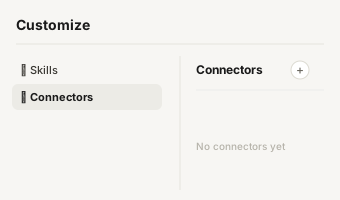
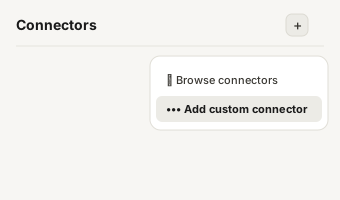
- Claude or ChatGPT via MCP suits a one-off question such as "is this account hiring SDRs and what does its stack look like?".
- The REST API suits a CRM or a scheduled job that re-checks your accounts every week (API and MCP from the Plus plan).
One practical rule: stick to company-level signals (jobs, news, stack) rather than tracking individuals. It keeps the data clean and the outreach relevant.
For SMBs and Startups: Building Your Own Intent Scoring
If you don't have the budget for enterprise platforms, the most effective approach combines:
- Enriched data (firmographic + technographic + G2 insights) via a tool like Derrick, in its web app or in Google Sheets
- First-party data from your website (Google Analytics + visitor deanonymization)
- LinkedIn signals: hiring activity, role changes, content engagement from target accounts
- Manual or AI-based scoring to rank accounts by priority
This approach delivers 80% of the value of intent data at a fraction of the enterprise cost.
To enrich your base data and capture technographic and behavioral signals, Derrick's data enrichment workflows run in the web app and natively inside Google Sheets, and let you pull tech stack data, G2 insights, and SimilarWeb metrics for your prospects in a few clicks - no developer needed.
How to Evaluate an Intent Data Provider
If you do buy, three criteria separate a useful feed from an expensive dashboard:
- Signal specificity. Can you choose narrow topics that match your product, or only broad categories? Ask for the list of topics and test five of yours.
- Source transparency. Does the vendor say where the signal comes from (publisher co-op, bidstream, review site, its own network) and how a surge is computed? A score you cannot explain is a score you cannot defend to sales.
- Contact resolution. Once an account surges, can you get from the company to the right person and a working email in the same flow? If not, budget for a contact data layer on top.
Freshness, geographic coverage and price come next. For a side-by-side view of the providers by signal family and price, see our intent data providers matrix.
Key Takeaways
- B2B intent data captures the behavioral signals that show a prospect is in an active research phase - the optimal moment to reach out.
- There are 3 types: first-party (your site), second-party (review platforms) and third-party (publisher co-ops). They differ in cost, freshness and coverage far more than in definition.
- Intent data tells you the account and the timing. It does not tell you the person, the budget or the vendor: pair it with contact data and a second signal.
- A single signal is never enough - it's the convergence of multiple signals on the same account that indicates real buying intent.
- Enterprise platforms cost about $15,000 to $150,000 a year - SMBs can observe hiring, news and stack signals themselves for 1 to 2 credits per company.
- Intent data isn't reserved for large companies with six-figure marketing budgets. Even a team of 3 SDRs can build a buying signal detection system by combining enriched data and simple scoring.
Intent Data
Start enriching your list in 30 seconds
Free for 100 credits/month. No credit card.
Install the add-on and enrich your lists without leaving your spreadsheet.
Install in Google Sheets →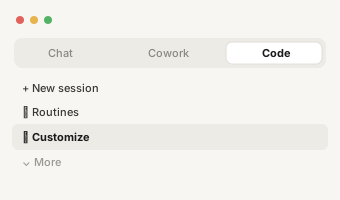
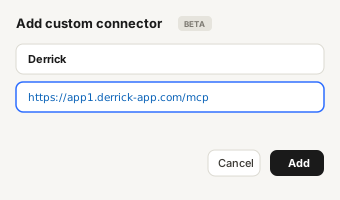
https://app1.derrick-app.com/mcp Call the same enrichment endpoints straight from your own stack or workflow.
Read the API docs →