
The State of B2B Intent Data 2026: The Signal-to-Pipeline Gap
B2B intent data report 2026: the $4.5B market, 91% use it but only 24% see ROI, the 70% dark funnel, and the activation layer most stacks are missing.


Last updated: 2026-06-18
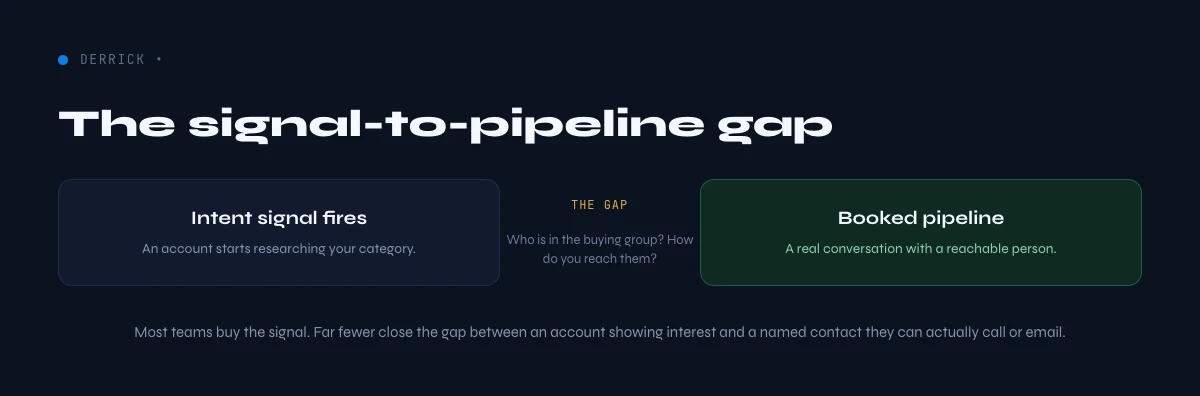
Almost every B2B revenue team now buys intent data, and almost none of them turn it into pipeline at the rate the category promised. That gap, between the signal you pay for and the meetings you book, is the real story of intent data in 2026. This report documents the size of the market, the adoption-versus-ROI paradox, and the part of the funnel where most signals quietly die: the handoff from an in-market account to a reachable, verified contact.
The thesis is simple. Intent data tells you who is in-market. It does not tell you the right person to call or whether their email and phone number still work. The teams winning with intent are not the ones with the most signals, they are the ones who can act on a signal immediately, against current, verified contact data, before the window closes.
The intent data market in 2026
Buyer intent data has gone from an experimental edge to standard equipment. Market-research estimates put the B2B buyer intent data tools market around 4.5 billion dollars in 2026, growing at roughly 16 to 17 percent a year toward the early 2030s. Adoption mirrors that: surveys of B2B marketers consistently report that around 9 in 10 now use some form of intent data to prioritize accounts.
That near-universal adoption is exactly why intent data is no longer a differentiator on its own. When everyone buys from the same signal providers, the signal itself becomes a commodity. The advantage shifts downstream, to what you do in the hours after a signal fires, and whether the contact data you act on is good enough to turn an in-market account into a real conversation. The market grew up; the execution layer did not keep pace.
It helps to be precise about what intent data is and is not. Topic and account-level intent tells you that an organization is researching a problem you solve. It rarely tells you which of the six-to-ten people in the buying group is driving it, and it almost never carries a verified, current email and direct phone for that person. That missing layer, the named, reachable contact, is where the signal becomes actionable or dies, and it is the through-line of this entire report. If you are new to the topic, our intent marketing strategy guide covers how to fit signals into an existing playbook.
The adoption-versus-ROI paradox
Here is the paradox at the center of the category. Roughly 91 percent of B2B marketers use intent data, yet only about a quarter report getting exceptional ROI from it. In one widely cited survey, around 87 percent of users said they did not fully trust the reliability of their signals, and only a minority felt they were converting that intent into revenue. Adoption is near-total; satisfaction is not.
The instinctive explanation is that the signals are bad. Sometimes they are. But the more common failure is downstream: the signal is fine, and the team simply cannot act on it well. An account shows intent, the data on its decision-makers is months old, the obvious contact has changed roles, the email bounces, and the lead ages while someone re-researches it by hand. The intent was real; the activation failed. The category sold a prediction, not a path to the person.
This is why two teams buying the same intent feed get opposite results. One treats the signal as the start of a fast, data-rich workflow: identify the buying group, verify and enrich the contacts, reach out the same day. The other treats it as a lead to be queued, researched, and eventually worked, by which point the window has closed. Same signal, opposite ROI, decided almost entirely by the speed and quality of the contact data layer underneath. The same scoring discipline that separates winners is covered in our guide to scoring and segmenting with review insights.
In the web app or Google Sheets
Close the signal-to-pipeline gap with a checkable signal
The gap in the report comes from signals nobody can verify. Hiring can be: Derrick checks each account against LinkedIn Jobs from your list and returns whether it is currently recruiting, on your list, dated today.
- Feature
- Company Hiring Signal (LinkedIn Jobs)
- Credit cost
- 1 credit per company checked
The first button opens the web app (nothing to install): 1 credit per company checked, 100 free credits every month. The second details the feature and its cost per plan.
The dark funnel and the buying group
Intent data exists because of a structural shift in how B2B buying works. Research from Gartner and others shows buyers now spend only about 17 percent of their total buying time meeting with potential suppliers, and that time is split across every vendor they consider. The majority of the journey happens before any vendor knows it is underway. Independent research puts roughly 70 percent of the B2B buying journey in this anonymous, self-directed phase, with around 83 percent of buyers having largely defined their requirements before they ever speak to sales.
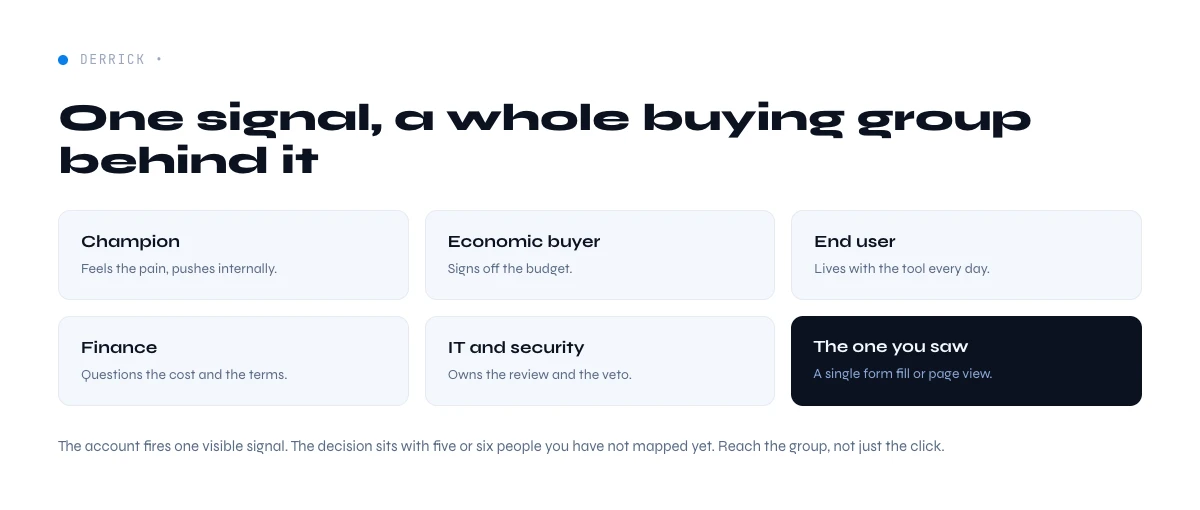
This is the dark funnel: most of the decision is made while you are invisible to it. Intent data is the attempt to see into that phase, to detect research before a hand goes up. But detection alone changes nothing if you cannot then reach the right human. And there is rarely just one human: Gartner's research describes buying groups of roughly six to ten stakeholders, spanning multiple functions, each with their own questions and veto power. A signal at the account level points at an organization; pipeline requires reaching the specific people inside it.
So the dark funnel reframes the job. The win is not just earlier detection, it is the ability to convert an anonymous, in-market account into a mapped buying group with verified contacts you can actually reach, fast, before the buyer has finished deciding without you. Detection is the easy, commoditized half. Activation, identifying and reaching the right people on current data, is the half that still separates teams, and it is covered in depth in the companion report on the buying committee.
The buying-group dimension is what makes account-level intent so easy to waste. A signal tells you the company is researching; it does not tell you whether to reach the economic buyer, the technical evaluator, or the champion who will actually carry the deal internally. Reaching one stakeholder out of eight, and the wrong one, looks like you acted on the signal while the deal quietly forms around people you never contacted. Converting account intent into pipeline therefore means mapping the group and reaching several of the right people on current data, not firing a single email at whoever the list happened to surface.
The real bottleneck: from signal to reachable contact
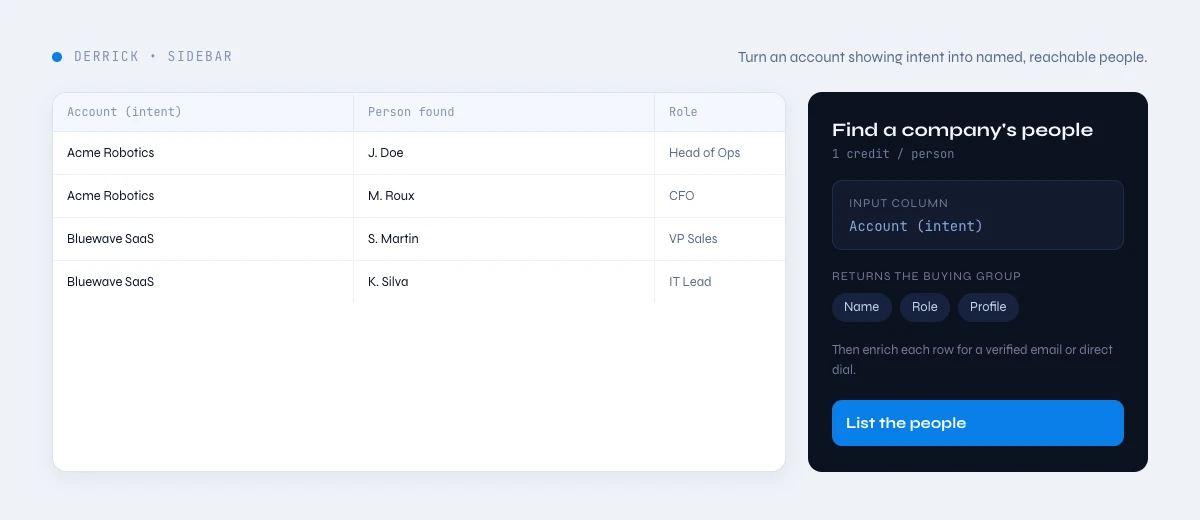
If the signal is rarely the problem, what is? In practice, the bottleneck is the gap between an account-level signal and a named, reachable, verified contact. An intent platform tells you a company is in-market for what you sell. It typically does not hand you the right decision-maker with a confirmed email and a direct phone number that still works today. That last mile is where most signals stall.
And it is a moving target. B2B contact data decays continuously as people change roles, companies reorganize, and direct lines are reassigned, so a contact that was accurate when the list was built may be wrong by the time the signal fires. A signal acted on against stale contact data produces a bounced email or a dead number, which reads as a weak signal when it is really a data-freshness failure. The intent was correct; the contact layer let it rot.
The economics make this expensive at scale. If you pay for intent across thousands of accounts but can only convert the fraction where the contact data happens to still be accurate, you are effectively paying full price for a signal and capturing a fraction of its value. The waste is invisible in the dashboard, because a bounced send or an unworked account does not show up as "the data was stale," it shows up as a weak channel or a soft quarter. Pricing the intent feed without pricing the activation layer underneath is how teams conclude, wrongly, that intent data does not work for them.
This is precisely the layer Derrick is built for, and why it complements an intent strategy rather than competing with it. Derrick is not an intent source; it is the activation layer that sits after the signal. When an account shows intent, you can find and verify the decision-maker's email, find a direct phone number, and enrich the company and LinkedIn profile on demand, in real time, in the Derrick web app or directly inside Google Sheets, so the contact you act on is confirmed at the moment you act, not when the list was bought. The signal says who is in-market; verified, current contact data is what turns that into a conversation. You can pull review-based signals the same way, as the product review mining guide shows.
None of this argues against buying intent data. It argues for treating it as the first step of a workflow rather than the whole answer. The signal earns its price only when it is paired with an activation layer fast and accurate enough to reach the right people while they are still deciding. Buy the signal, then invest at least as much attention in what happens in the hours after it fires.
The 48-hour activation window
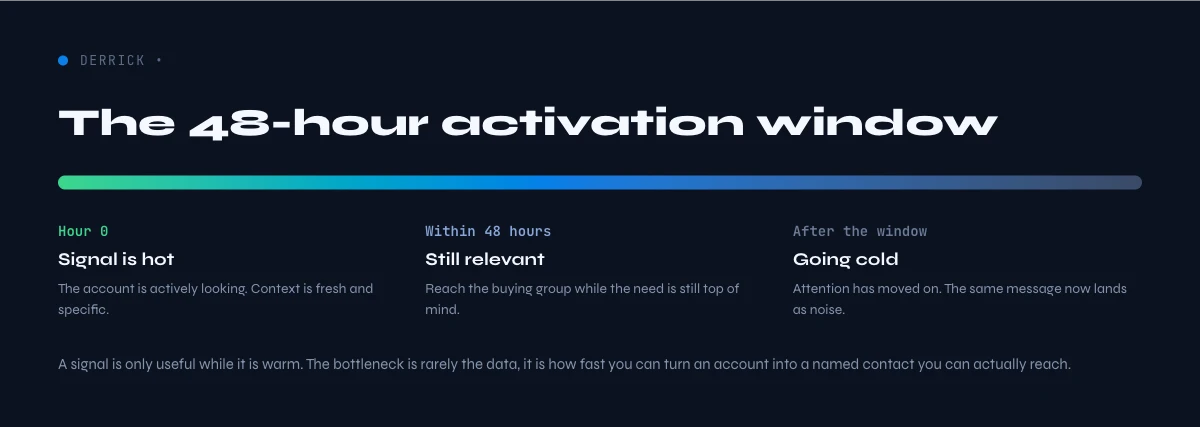
Intent has a half-life. The value of a buying signal decays fast, because the buyer is, by definition, actively researching and will talk to whoever reaches them first with something relevant. Speed-to-lead research has long shown that acting in the first minutes and hours multiplies conversion; applied to intent, teams that act on a fresh signal within roughly the first 48 hours convert at several times the rate of teams that let it sit. After that, the buyer has moved on, often to a competitor who was simply faster to the right person.
This is what makes the contact data layer decisive rather than incidental. A 48-hour window only matters if you can fill it. If acting on a signal requires a day of manual research to find the right contact and confirm their details, the window is gone before you reach anyone. The teams that win the window are the ones for whom going from signal to verified contact to first touch is minutes, not days, because the data work happens on demand rather than as a separate project.
So a signal-ready go-to-market motion comes down to three capabilities working together. First, detect intent at the account level, the part the market has commoditized. Second, identify the buying group, the specific people who decide, not just the company. Third, verify and enrich those contacts on demand so you can reach them inside the window, on data confirmed today. Most teams have the first and are weakest on the third, which is exactly why so much intent spend underperforms. Turn your intent signals into verified contacts with Derrick, free for 100 credits per month, in the web app or in Google Sheets, so every signal you pay for reaches a real, current person before the window closes. Pair it with the tech-stack signals from product ratings to prioritize the hottest accounts first.
Methodology and sources
This report draws on neutral, primary research into B2B buying behavior and the intent data market: Gartner on the buying journey, buying-group size, and time spent with suppliers; independent research on the anonymous, self-directed share of the journey and on when buyers define requirements; market-research estimates for the size and growth of the buyer intent data tools market; and published survey data on intent data adoption, trust, and ROI. Where a figure could only be traced to a vendor's own marketing, we treated it as a claim rather than a benchmark and did not rely on it.
A closing thought. The intent data category is mature, well-funded, and nearly universally adopted, and that is exactly why the signal alone no longer wins. The durable advantage has moved one layer down, to whether you can act on a signal immediately against verified, current contact data. Detection has been commoditized; activation has not. Teams that treat the contact data layer as core infrastructure, kept fresh and verified at the point of use rather than bought once and left to decay, are the ones who convert intent into pipeline while everyone else wonders why their signals underperform. Buy the signal if you like, but win on what you do in the 48 hours after it fires.
Frequently asked questions
How big is the B2B intent data market in 2026?
Why does intent data often disappoint?
What is the dark funnel in B2B?
Why does the 48-hour window matter?
Is Derrick an intent data provider?
Keep reading
Continue exploring this cluster


Intent Marketing: How to Harness Data Intelligently?
Read →

How to Score, Segment, and Personalize Your Outreach Using G2 Insights
Read →

Product Review Finder: How to Mine Reviews for B2B Prospecting Intent
Read →

Product Rating Checker: How to Identify Your Prospects' Tech Stack via Reviews
Read →