
B2B Data Providers: 51 Compared, Ranked and Explained
51 providers benchmarked across coverage, match rate, region, and price. The honest map of who actually delivers - and where they fall short - so you can stop testing in the dark.

Why this cluster matters
What you'll learn
B2B data is the input quality of every outbound, every routing rule, every ABM play. A 10-point match rate drop turns a 30% reply rate into 21%. Yet most teams pick a provider on a Friday demo and discover the actual coverage 4 weeks later, when it's too late to switch without burning budget. The cluster fixes that: benchmark before you sign, plan the migration before you need it, know which 3-4 providers your stack actually needs.
For who · RevOps, Founders, Heads of Growth/Sales who own the data vendor budget - usually $1k-50k/year stakes per decision.
- How to benchmark a provider on YOUR data in under 2 hours (not their canned demo).
- Which providers are strong in which region - and where 'global' is a marketing claim.
- The 6-step migration playbook to swap a vendor without losing pipeline continuity.
- Real pricing per buyer, not the public list (multipliers included).
- When to stop stacking vendors and write your own enrichment pipeline.
All guides · 12
All 12 guides in this cluster


B2B Data Sources: Primary, Secondary, and Aggregated
Primary, secondary, aggregated - the 3 source types every B2B prospecting stack blends, ranked by freshness, cost and legal risk. Read the guide →

How to Choose a B2B Data Enrichment Provider: 8 Key Criteria
The 8 criteria that decide whether a provider fits your stack - data quality, geographic coverage, integration, pricing, support. Read the guide →

Switching Data Enrichment Providers: A Complete Guide
The 4-phase migration playbook : audit current, evaluate new, run parallel, switch fully - without losing pipeline continuity. Read the guide →

B2B Data Enrichment Tools Pricing: What You Actually Pay in 2026
The 5 pricing models (credits, per seat, flat, pay-as-you-go, enterprise) compared, with real buyer numbers - not landing-page prices. Read the guide →

Third-Party API Enrichment: How It Works (and How to Make It Work for You)
When the vendor API beats the UI - break-even math + 3 reference architectures (sync trigger, async queue, batch nightly). Read the guide →

Database Enrichment: Tools, Best Practices, Mechanism
Enrich your B2B database in place - Postgres, MySQL, BigQuery patterns with rate-limit math, dedup logic, and refresh cadences. Read the guide →

Geographic Coverage in B2B Data Enrichment: Why Match Rates Vary
Per-region match rate reality (US, EU, UK, APAC) and the truth about 'global' providers that are 80% US data. Read the guide →

B2B Data Providers Benchmark 2026: Accuracy, Coverage & the Real Cost
Real provider accuracy (63-91%) and coverage (26-92%), vendor-neutral, plus why verification at the point of use beats the accuracy claim. Read the guide →

Company Contact Database: Build Your Own Instead of Renting One
Rent an index or assemble your own? The five layer workflow to build a company contact database in Sheets, with the real credit cost of 320 verified contacts. Read the guide →

Lead Enrichment Tools: 51 Compared by Job, Free Plan and Price
51 lead enrichment tools sorted by the job they do, not ranked. Which have a real free plan, which publish a price, and how to build a stack without paying twice for the same record. Read the guide →

B2B Data for Marketing: Which Fields Each Play Actually Needs
Marketing performance is capped by the least complete field a play depends on. The field matrix per play, the real cost per record, and the decay maths that decides your refresh cadence. Read the guide →

Sales Intelligence Tools: The 5 Layers, and Which You Need
Five layers are sold as one category and they fix five different leaks. Diagnose yours in 4 numbers before you compare a single scored ranking. Read the guide →The 12 categories of B2B data providers, and which one you actually need
Most comparisons put every vendor in one list and call it a ranking. That hides the only thing that matters: two providers in different categories are not substitutes, and two providers in the same category rarely both deserve a line in your budget. Here is how the 51 providers in the matrix split up.
- All-in-one platforms - one contract for contacts, companies and often sequences. Broadest, most expensive, most likely to be under-used. This is where Derrick sits, minus the seat-based pricing.
- Email finders - a domain or a name in, a deliverable address out. Cheap, narrow, easy to benchmark in an afternoon.
- Email verification - they do not find addresses, they tell you which ones will bounce. Always a second tool, never a first one.
- Phone data - mobile and direct dials, the field where coverage claims diverge most from reality.
- LinkedIn-based tools - extensions and exporters that read what is on the profile in front of you. Strong signal, hard ceiling: no LinkedIn, no data.
- Intent data - who is researching your category right now. Expensive, probabilistic, worth it only when your sales motion can act on an account-level signal.
- Buying signals - hiring, funding, partnerships, tech changes. Cheaper than intent and far more concrete.
- Tech stack detection - what a company runs on the web. The sharpest filter that exists for technical ICPs.
- Data APIs and bulk datasets - raw records for a team that has a data engineer. Powerful, and useless without one.
- Local business data - Maps listings, storefronts, opening hours. The right source for local B2B, the wrong one for enterprise decision-makers.
- Public registries - official, free or near-free, and traceable. Underused by almost every GTM team.
- Europe-focused providers - built for EU coverage and EU compliance rather than retro-fitted for it.
Derrick covers several of these categories from one place, which is the point: company enrichment, email finding, phone finding, LinkedIn imports, technology lookups, Google Maps imports and French public registry data (SIRET, SIREN, NAF/APE) all run in the same Google Sheet, on the same credits. Check what each one costs before you commit: the full feature list shows the credit cost per operation, and the free plan includes 100 credits per month at no cost.
How to read the comparison matrix without fooling yourself
Three columns in the table below are routinely misread, and each misreading costs money.
Record count is a claim, not a measurement. A vendor announcing 1.3 billion records and one announcing 100 million are not describing the same object: one counts every row it has ever seen, the other counts what it will stand behind. Record count tells you almost nothing about whether your 500 accounts are in there. Treat it as marketing until your own test says otherwise.
Entry price is not your price. The figure in the matrix is the public entry tier at the time of writing. What you pay depends on seats, on annual commitment, and on how much of your credit balance you burn on rows that return nothing. That last one is the silent cost: on a seat-based contract, a failed lookup costs the same as a successful one. On Derrick, it does not - you are billed per verified match, which is why the honest comparison is cost per usable row, not price per month.
Match rate depends on the list, not the vendor. The rates shown are indicative on a mixed US/EU tech dataset. Run the same 500 contacts through two providers and the ranking can invert - that is normal, and it is the entire argument for benchmarking before signing. Two hours of testing beats twelve months of regret.
Want this breakdown as it gets updated? Get the new Data Providers guides by email - one email per release, nothing else.
The 4 dimensions that actually predict provider fit
- Region match. A provider with 320M US records won't help your EU expansion. Look at your ICP region distribution first, then filter providers.
- Field strength. Each provider is strong at 1-2 fields (email, phone, firmographic, intent). Match this to where you need lift, not where you have surplus.
- Match rate on YOUR data. Vendor-reported match rates are theatre. Always benchmark on 500-1000 of your own contacts before signing.
- Compliance posture. Opt-out and opt-in models change whether you can email cold in the EU, and every vendor documents its own posture: read that page, do not take a sales answer for it. Derrick's own answer is the simplest one to audit, because official registries are a first-class source in the product: SIRENE and NAF/APE data comes straight from the French public registry, with the identifiers you can trace back yourself.
Those four dimensions are why this page lists 51 B2B data providers in twelve categories rather than a shortlist of five. A shortlist assumes everyone has the same ICP. The matrix below assumes you don't, and lets you filter on the axis that actually constrains you.
What is a B2B data provider?
A B2B data provider is a company that sells business contact and company information: names, job titles, work emails, phone numbers, firmographics, technologies, and buying signals. You query it by domain, by person, or by filter, and it returns records you use for prospecting, routing, or CRM enrichment.
The label covers four very different businesses, and confusing them is the most common buying mistake. Some providers own a static database they resell. Some query live sources at the moment you ask. Some only verify data you already have. Some are marketplaces that resell other vendors' datasets. A static database is fast and ages badly; a live lookup is fresher and slower. Neither is universally better, but they fail differently, and your renewal will hinge on which failure mode you can tolerate.
Derrick belongs to the second family: it queries sources at the moment you ask, from the Google Sheet where your list already lives, and bills a credit only when a result comes back.
The 5 types of B2B data, and what each one is actually for
Providers are compared as if they sold the same product. They do not. There are five distinct data types, and most vendors are genuinely good at one or two.
- Contact data - the person: name, title, work email, mobile. The most perishable data on this list, because people change jobs. Anything older than 6 months is a guess.
- Firmographic data - the company: size, revenue, industry, location, legal identifiers. Slow-moving, cheap to keep current, and the base layer of any segmentation.
- Technographic data - the stack: what a company runs on its website and in its tooling. The sharpest filter for technical ICPs, and useless for everyone else.
- Intent data - the research: which accounts are reading about your category right now. Probabilistic by nature, and only actionable if your team can work an account-level signal.
- Signal data - the event: hiring, funding, a new office, a technology swap, a leadership change. Cheaper than intent and far more concrete, because the event either happened or it did not.
Write down which of these five you are actually missing before you look at a single vendor page. Most teams discover they have plenty of firmographics and no usable contact data, then buy another firmographic-heavy platform. Derrick covers contact, firmographic, technographic and signal data from one place - and the free plan gives you 100 credits per month to check which of them your list actually needs.
Why the provider you pick today won't be the one you need in 18 months
The B2B data market moves faster than your stack does. Coverage shifts as sources open and close, match rates drift, and multi-year contracts are priced on a snapshot of a market that no longer exists by renewal. If you signed a two-year deal on price-per-seat math, the assumptions behind that price have almost certainly changed.
The right answer is not picking one best provider, it is ordering the ones you use: cheapest first, expensive ones only on the rows still missing. That is how Derrick is built. You enrich in Google Sheets, pay per verified match rather than per seat, and only spend a credit when a result comes back. A row that resolves on the first pass never touches an expensive source.
Build vs buy: when to stop adding providers and write your own
For most teams, the provider math breaks at ~150K enriched records/month. Below that, vendor stacking is cheaper than building. Above, the per-record cost makes hiring a junior data engineer competitive - especially if your ICP is narrow (a few EU sectors, a few US industries) and you can scrape + enrich from 2-3 high-quality public sources yourself.
Derrick is built for that break point, and it removes most of the reason to build. You get the pipeline without the engineer: sources chained in order, official registries included, results landing in the Google Sheet your team already works in. You pay per verified match instead of per seat, so an unmatched row costs nothing and a matched one costs the same whether you run 500 rows or 500,000. The feature catalogue covers company enrichment, email finding, phone finding, LinkedIn imports and French registry lookups from a single sidebar, and the same operations are available through the API and the MCP server when you do want to script them.
That is the honest answer to build vs buy at scale: you build when you need a pipeline nobody sells you. Derrick sells you the pipeline. Start free with 100 credits per month and benchmark it on your own list before you budget a single engineer-day.
51 B2B data providers compared (2026)
Match rate observed on 1000-contact tech US/EU dataset. Entry price /month. Regions = strong coverage (not exhaustiveness).
| Provider | Category | Regions | Price /mo | Records | Match rate | Best for | Free offer | Strengths |
|---|---|---|---|---|---|---|---|---|
| DerrickOur tool | All-in-one | GLOBAL | €20 | - | 83% | Enriching lists in its web app or in Google Sheets, billed per verified match | Free plan |
|
| Apollo | All-in-one | US · GLOBAL | $49 | 275M | 72% | US volume plus native sequences in one seat | Free plan |
|
| ZoomInfo | All-in-one | US | Quote | 320M | 85% | US enterprise accounts with a matching budget | None |
|
| Cognism | All-in-one | EU · UK | Quote | 200M | 78% | EU and UK outbound teams | None |
|
| Hunter | Email finder | GLOBAL | $34 | - | 65% | Finding a work email from a domain, fast | Free plan |
|
| Findymail | Email finder | GLOBAL | $49 | - | 81% | Clean emails out of Sales Navigator lists | Trial only |
|
| Kaspr | EU | $65 | - | 72% | Grabbing a mobile number from a LinkedIn profile | Free plan |
| |
| Datagma | Email finder | EU · GLOBAL | $30 | - | 74% | EU phone lookups paid per call | Free plan |
|
| RocketReach | All-in-one | US · APAC | $39 | 700M | 68% | Wide catalogues including APAC | Trial only |
|
| Clearbit | All-in-one | US · GLOBAL | Quote | 250M | 76% | Turning website traffic into company records | None |
|
| Bombora | Intent data | US · GLOBAL | Quote | - | 55% | Account-level intent for enterprise ABM | None |
|
| BuiltWith | Tech stack | GLOBAL | $295 | 670M | 92% | Building lists from the technology a site runs | Trial only |
|
| Pappers | Europe focus | EU | $19 | 12M | 96% | Official French legal and registry data | Free plan |
|
| Lusha | US · EU | $36 | 100M | 70% | Quick lookups from the browser | Free plan |
| |
| Seamless.AI | All-in-one | US | $147 | 1300M | 60% | Teams that value raw volume over precision | Trial only |
|
| UpLead | All-in-one | US · GLOBAL | $99 | 160M | 75% | Verified US contacts with clear filters | Trial only |
|
| Lead411 | All-in-one | US | $99 | 450M | 69% | US mid-market with growth triggers | Trial only |
|
| Clay | All-in-one | GLOBAL | $149 | - | 75% | Engineering-minded teams chaining many sources | Free plan |
|
| Dropcontact | Email finder | EU | $27 | - | 77% | French emails without a stored database | Trial only |
|
| Prospeo | Email finder | GLOBAL | $39 | - | 79% | Verified emails at a low cost per credit | Free plan |
|
| Anymail Finder | Email finder | GLOBAL | $14 | - | 70% | Paying only for emails that check out | Free plan |
|
| Snov.io | Email finder | GLOBAL | $39 | - | 66% | Finding and sending from a single tool | Free plan |
|
| NeverBounce | Email verification | GLOBAL | $8 | - | 97% | Cleaning a list before a big send | Free plan |
|
| ZeroBounce | Email verification | GLOBAL | $18 | - | 97% | Deliverability checks with activity scoring | Free plan |
|
| Bouncer | Email verification | EU · GLOBAL | $12 | - | 97% | EU-hosted verification | Free plan |
|
| LeadMagic | Phone data | US · GLOBAL | $99 | - | 74% | Mobile numbers billed per match | Trial only |
|
| Surfe | EU | $29 | - | 71% | Pushing LinkedIn contacts into the CRM | Free plan |
| |
| Wiza | US · GLOBAL | $50 | - | 73% | Exporting a Sales Navigator list in one go | Free plan |
| |
| PhantomBuster | GLOBAL | $69 | - | 60% | Automating repetitive scraping workflows | Trial only |
| |
| People Data Labs | Data API / bulk | GLOBAL | Quote | 1500M | 64% | Teams with a data engineer and bulk needs | Trial only |
|
| Coresignal | Data API / bulk | GLOBAL | Quote | 700M | 62% | Historical firmographic and headcount datasets | Trial only |
|
| PredictLeads | Buying signals | GLOBAL | Quote | - | 60% | Hiring, funding and partnership signals | None |
|
| Crunchbase | Buying signals | US · GLOBAL | $49 | 4M | 82% | Funding rounds and company profiles | Trial only |
|
| HG Insights | Tech stack | US · GLOBAL | Quote | - | 80% | Estimating IT spend on large accounts | None |
|
| Wappalyzer | Tech stack | GLOBAL | $250 | 100M | 88% | Reliable technology detection at scale | Free plan |
|
| 6sense | Intent data | US · GLOBAL | Quote | - | 58% | Predictive ABM with a full enterprise stack | None |
|
| G2 Buyer Intent | Intent data | GLOBAL | Quote | - | 52% | Signals from buyers comparing products | None |
|
| Creditsafe | Europe focus | EU · UK · GLOBAL | Quote | 430M | 90% | Financial health and credit scoring in Europe | None |
|
| Ocean.io | Europe focus | EU · GLOBAL | Quote | 40M | 66% | Finding lookalikes of your best accounts | Trial only |
|
| Dun & Bradstreet | All-in-one | US · GLOBAL | Quote | 500M | 87% | Group hierarchies and a universal company ID | None |
|
| Outscraper | Local business data | GLOBAL | $30 | - | 85% | Google Maps listings in volume | Free plan |
|
| Google Places API | Local business data | GLOBAL | Quote | 200M | 90% | Authoritative local business information | Trial only |
|
| SIRENE (INSEE) | Public registry | EU | $0 | 32M | 99% | Free official French company identifiers | Free plan |
|
| Companies House | Public registry | UK | $0 | 5M | 99% | Free official UK company filings | Free plan |
|
| OpenCorporates | Public registry | GLOBAL | Quote | 200M | 85% | Cross-border legal entity identifiers | Trial only |
|
| Dealfront | Europe focus | EU · UK | Quote | 40M | 73% | DACH and Nordics coverage with web visitor data | Trial only |
|
| LeadIQ | US · GLOBAL | $45 | - | 71% | Capturing prospects into the CRM while browsing | Free plan |
| |
| Adapt | All-in-one | US · APAC | Quote | 200M | 66% | Budget-conscious US and APAC prospecting | Trial only |
|
| Datarade | Data API / bulk | GLOBAL | Quote | - | 50% | Sourcing a niche dataset from many vendors at once | Free plan |
|
| Bureau van Dijk | Europe focus | EU · GLOBAL | Quote | 490M | 88% | Corporate ownership structures and financials | None |
|
| LinkedIn Sales Navigator | GLOBAL | $99 | 900M | 80% | Building and filtering the account and lead list itself | Trial only |
|
Data Providers
Start enriching your list in 30 seconds
Free for 100 credits/month. No credit card.
Install the add-on and enrich your lists without leaving your spreadsheet.
Install in Google Sheets →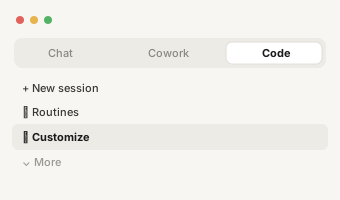
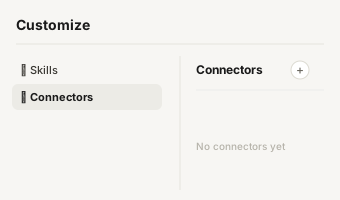
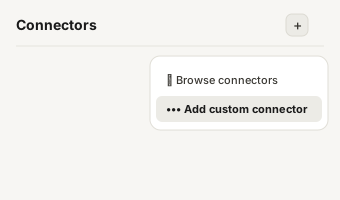
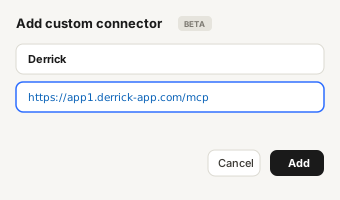
https://app1.derrick-app.com/mcp Call the same enrichment endpoints straight from your own stack or workflow.
Read the API docs →