
Cold Email in 2026: What Decides Whether You Reach the Inbox
Cold email is a first unsolicited business email to someone who does not know you. In 2026 three layers decide the outcome, in order: technical trust (SPF, DKIM, DMARC, complaint rate), list quality (real, current addresses), and only then the message itself. Most teams work that list backwards. Fix delivery, then the list, then the writing.

Why this cluster matters
What you'll learn
Cold email did not stop working, it stopped forgiving. Google and Microsoft now enforce authentication and complaint thresholds, mailbox providers score sender reputation continuously, and a single list of stale addresses can take a domain out of the inbox for months. The volume era is over: what decides a campaign today is who you write to, whether the address is real, and whether your domain is trusted enough to be delivered at all. This cluster covers the three in that order.
For who · Founders, SDR and BDR teams, RevOps, Growth - anyone whose pipeline depends on a first email landing
Find verified emails with Derrick →- Deliverability : SPF, DKIM, DMARC and the complaint rate that quietly decides everything
- Domain and mailbox warmup : what it actually does, how long it takes, when it is theater
- List quality : why bounce rate is a sender reputation problem before it is a data problem
- Sequences : how many steps, what spacing, and when a follow-up starts costing you
- Subject lines and first lines : what survives a 2-second glance on mobile
- Spam filters : the words, the patterns and the technical signals that get you filtered
All guides · 10
All 10 guides in this cluster
Copy5


Cold Email Template: 6 B2B Formats and the Data Each One Needs
Six cold email templates organised by the trigger you have, each with the exact variables it needs, where that data comes from, and what it costs per row. Read the guide →
Cold Email Subject Lines: 20 Formats and the Data Each Needs
Twenty cold email subject lines grouped by the trigger you actually hold, with the truncation limits per inbox, the data each format needs, and why open rate stopped being a valid test. Read the guide →

How to Sign Off an Email: 70 Email Sign Offs by Tone
The four rules that decide the formula, 65 sign offs by tone and situation, the ones to avoid, and the plain text signature block a first cold email needs. Read the guide →
How Long Should a Cold Email Be? A Word Budget per Line
50 to 125 words, and why: the phone screen, reading time and weight, a word budget per line, a length checker, and how long follow-ups should be. Read the guide →

Free Cold Email Generator: Write It From a Real Signal
A free, rule-based cold email generator that starts from a signal on the account (hiring, stack, news) and writes three variants, plus where to find each signal and how to get it for a whole list. Read the guide →Deliverability3

Email Deliverability Checklist: 15 Controls, Sorted by Cadence
An email deliverability checklist ordered by when each control happens: once per domain, once per list, once per send, every week. With the bounce rate thresholds explained. Read the guide →
SPF Record Check: Read Yours and Count the Lookups (2026)
Paste your SPF record and see what breaks it: the ten DNS lookup ceiling, a policy that authorises everyone, and the includes an outreach stack accumulates one tool at a time. Read the guide →
Email Deliverability Tools: 6 Categories, and What Each One Answers
The six categories of deliverability instrument, the question each one answers, and the one nobody ranks: list quality. Read the guide →Sending2


Best Time to Send Cold Emails: What the Data Says (2026)
Tuesday to Thursday, 8am to 11am, in the recipient's timezone. Why published tables disagree, why send time is only the fourth lever, and how to put a timezone on a list that does not have one. Read the guide →

Cold Email Software: The 4 Layers Behind the Seat Price
Every platform bundles 4 jobs into one seat price. Separate them, ignore the self-declared database sizes, and work out the cost per reply before you sign. Read the guide →The feature on video
Email Finder
Find your prospects’ verified emails, from the Derrick app, Google Sheets, your AI assistant or the API.
Find verified emails with Derrick →Cold email is the practice of sending a first, unsolicited business email to someone who has never heard of you. It still works in 2026, and it has stopped forgiving. Mailbox providers now enforce authentication, measure complaint rates continuously, and score the reputation of your domain the way a bank scores credit. One campaign sent to a stale list can take a domain out of the inbox for months, and no amount of copywriting repairs that.
This cluster is organised in the order that actually decides an outcome: can you be delivered, are you writing to real people, and only then, is the message any good. Most teams work that list backwards and spend weeks on subject lines while their DMARC record is missing.
Why cold email results collapsed for teams that changed nothing
Nothing was taken away from you. The floor was raised. Google and Microsoft moved authentication from a recommendation to a requirement for bulk senders, and they publish a complaint threshold you are expected to stay under. Below it you are invisible in the good way. Above it, your messages go to spam quietly, without a bounce, without an error, without anything in your dashboard telling you.
That silence is the trap. A cold email campaign that fails technically looks exactly like a cold email campaign that fails commercially: no replies. Teams read it as a copy problem, rewrite the sequence, send again to the same broken setup, and add another few points of complaint rate. Two months later the domain is burned and the diagnosis was never made.
The order of operations matters more than any individual tactic. Fix delivery, then fix the list, then fix the writing. A great message to a real person from an untrusted domain gets filtered. A great message from a trusted domain to an address that no longer exists gets bounced. Only the third case is a copy problem.
The three layers of cold email, and the one most teams skip
Every campaign rests on three layers, and they fail in a fixed order.
- Technical trust. SPF, DKIM and DMARC on the sending domain, a subdomain that is not your main one, a warmed mailbox, and a complaint rate you actually watch. This is binary: either mailbox providers trust the sender or they do not.
- List quality. Whether the addresses are real, current and belong to people who plausibly have the problem you solve. Bounce rate is the visible symptom, but the real cost is that bounces feed straight back into layer one and damage the domain.
- Message relevance. The subject, the first line, the ask. This is the layer everyone works on, and it is the only one that cannot compensate for the two below it.
Layer two is the one that gets skipped, because it looks like admin rather than strategy. It is also where the compounding happens: a clean list protects the domain, and a protected domain makes every future campaign cheaper. Derrick's Email Finder is built for that layer specifically. It finds and verifies professional addresses inside the Google Sheet where your list already lives, and it charges per verified match, so a row that returns nothing costs you nothing.
A word on where Derrick stops, because it matters for how you build your stack. Derrick finds, verifies and enriches, then pushes the result to your sending tool. It does not send your campaigns and it does not track your open rates. That is deliberate: the sending layer is a different job with different constraints, and pretending otherwise would make both worse.
Cold email deliverability: the part that is not negotiable
Deliverability is the probability that a message you send reaches the inbox rather than the spam folder or nowhere at all. It is not a setting. It is a reputation, rebuilt continuously from your last few thousand sends.
Four things drive it, in decreasing order of how often they are wrong:
- Authentication. SPF says which servers may send for your domain, DKIM signs the message so it cannot be altered, DMARC tells receivers what to do when the first two disagree. Missing DMARC alone is enough to be treated as untrusted at volume.
- Complaint rate. The share of recipients who mark you as spam. The thresholds published by the major providers are low enough that a few hundred irritated recipients on a large campaign are sufficient to cross them.
- Bounce rate. Sending to addresses that do not exist is read as a signal that you bought a list. It is the fastest way to lose a domain, and it is entirely preventable at the list stage.
- Volume shape. A new mailbox that sends five messages on Monday and eight hundred on Tuesday looks like a compromised account, because that is what compromised accounts do.
Two habits protect all four at once: send from a dedicated subdomain rather than the domain that carries your invoices and your recruiting, and verify every address before it enters a sequence. The first limits the blast radius when something goes wrong. The second stops most of the things that go wrong.
Check any domain's SPF record
Authentication is the one layer above that you can verify in ten seconds rather than argue about. Enter a domain and our SPF record lookup below reads the SPF record actually published on it, counts the mechanisms that cost a DNS lookup against the ceiling of ten, and says whether the policy decides anything. You can also paste a record to check it before publishing.
A record that exceeds ten lookups makes receivers return permerror and treat your SPF as absent, with no bounce and no warning, which is the failure this cluster sees most often on domains that added one sending tool too many. The full reading, and the four ways to get back under the ceiling, are on the SPF record check page.
Warmup, sequences and the diminishing return of follow-ups
Warmup is the practice of ramping a new mailbox slowly, with real-looking exchanges, so that its first campaign is not also its first activity. It is genuinely useful for a new domain or a new mailbox, and it is genuinely theater when it is used to rehabilitate a domain whose complaint rate is the actual problem. Warmup builds a reputation. It does not repair one.
On sequences, the honest answer is that the value of a follow-up decays fast and turns negative sooner than most playbooks admit. The first two messages carry most of the replies. Beyond four, you are mostly harvesting complaints from people who had already decided, and each one costs you at layer one. Spacing matters more than count: a follow-up two days later reads as automation, the same message a week later reads as persistence.
Subject lines and first lines: what survives two seconds
Your subject is read on a phone, in a list, next to forty other messages, by someone who is deciding in about two seconds whether you are a person or a broadcast. Short and specific beats clever. A subject that could have been sent to ten thousand people will be treated as though it was.
The first line is where most cold email dies, because it is visible in the preview and it is almost always about the sender. "I wanted to reach out" tells the reader nothing except that a template was involved. A first line that names something true and specific about their company earns the next sentence, and specificity is a data problem before it is a writing problem. You cannot personalise at scale what you did not enrich at scale.
That is the practical bridge between the three layers: the same enrichment pass that protects your domain by removing dead addresses is what gives you the detail that makes the first line worth reading. Start free with 100 credits per month and run your next list through it before you write a single subject line.
What to read next in this cold email cluster
The guides below go deep on one layer each. If you are starting from a domain that has never sent cold email, read the deliverability guides first and treat everything else as premature. If your domain is healthy and your replies are still flat, the problem is almost certainly your list, not your copy.
For the numbers behind all of this, our 2026 cold email benchmarks report collects reply, open and bounce rates by industry and company size, so you can tell whether your campaign is underperforming or whether your expectations were never realistic.
Cold Email
Start enriching your list in 30 seconds
Free for 100 credits/month. No credit card.
Install the add-on and enrich your lists without leaving your spreadsheet.
Install in Google Sheets →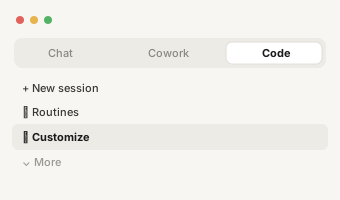
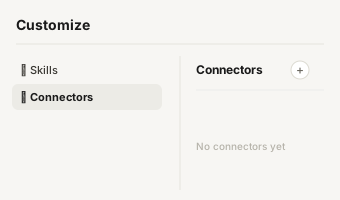
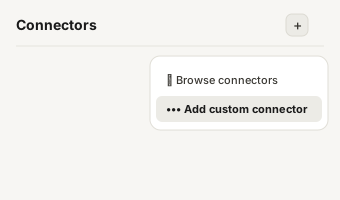
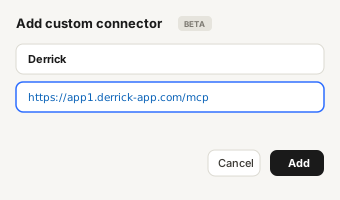
https://app1.derrick-app.com/mcp Call the same enrichment endpoints straight from your own stack or workflow.
Read the API docs →