
 Data Enrichment
 Clay Review: Is It Still Worth It in 2026?
Clay is a multi-source data enrichment platform with AI workflows, built for GTM ops and technical SDR teams running waterfall enrichment and AI research at scale. A free plan with limited credits exists, and paid plans start at $134/mo billed annually. Skip it if you are a solo founder without ops bandwidth, need predictable per-seat pricing, or rely on phone numbers.
Waterfall enrichment platform with AI (Claygent) and 150+ data providers. Built for technical GTM ops teams, but the credit model and learning curve put it out of reach for solo founders or non-technical SDRs.
- Running an ops-driven GTM motion with at least one technical operator
- Need waterfall enrichment across 5+ providers (Apollo, Clearbit, Lusha, Hunter, etc.)
- Want AI-driven research at scale (e.g. company news + funding signals + custom scoring)
- Solo founder or 1–2 person team without ops bandwidth
- Need predictable per-seat pricing rather than usage-based credits
- Phone number coverage matters (Clay is weak here ~30-35% match)
Install the add-on and enrich your lists without leaving your spreadsheet.
Install in Google Sheets →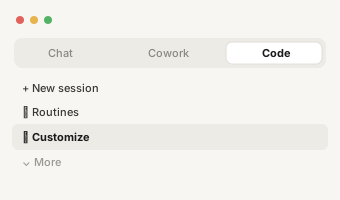
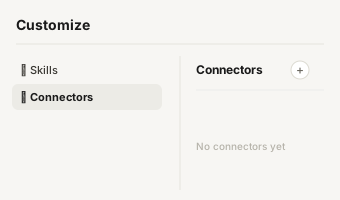
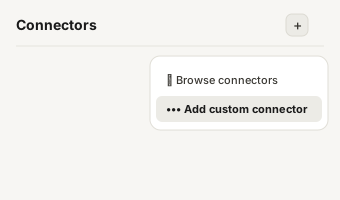
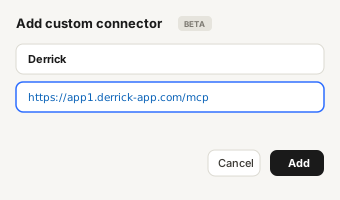
https://app1.derrick-app.com/mcp Call the same enrichment endpoints straight from your own stack or workflow.
Read the API docs →

Overview
What is Clay?
Clay is a multi-source data enrichment with AI workflows platform built for B2B revenue teams. Founded in 2017 and headquartered in New York's Flatiron district, the company hit $100M ARR and a $5B valuation by 2026, with 10,000+ customers (per Series C announcement Aug 2025).
Clay works like a smart spreadsheet - each column can pull data from a different provider (LinkedIn, Clearbit, Hunter, Lusha, etc.) via waterfalls, and Claygent (the built-in AI agent) can research, summarize and write at scale. It's closer to a low-code data platform than a traditional sales tool.

Pricing
Clay Plans & Pricing
Clay publishes prices upfront. Annual billing gets a ~10% discount. Credits start at $0.05 each and decrease with volume. Failed enrichments still consume credits.
| Plan | Price | Typical use | Key limits |
|---|---|---|---|
| Free | Free | Learning + experimentation | 500 actions/mo, 100 credits/mo, 200 rows per table |
| Launch | $134/mo (annual) or $167/mo | Small ops teams | 15K actions/mo, 2.5K credits/mo, no CRM auto-sync |
| Growth | $401/mo (annual) or $446/mo | CRM-based growth campaigns | 40K actions/mo, 6K credits/mo, 1 ads audience |
| Enterprise | Custom (annual only) | GTM systems at scale | 200K+ actions, 100K+ credits, SSO, RBAC, dedicated strategist |
Hidden costs to know about
Credits burn even on failed enrichments - teams routinely blow through monthly limits earlier than expected. Phone enrichment is a paid add-on with weak match rates (30-35%). Most providers Clay calls (Apollo, Lusha, Hunter) require their own paid accounts on top of Clay's seat fee.
Is Clay fair value?
For ops-mature teams running 10K+ enrichments/month with custom scoring + AI research, Clay's flexibility is what the price buys. For lean teams just enriching contact lists, the credit math + learning curve pushes total cost-of-ownership above simpler tools like Derrick.

Verdict in detail
Clay Pros & Cons - Summary That Actually Helps You Decide
Based on 200+ verified G2 reviews and analysis of 100+ Clay user reports across G2, Reddit, and independent reviewers in 2025-2026.
Waterfall enrichment
If provider A misses, Clay automatically tries B, then C. This typically yields 20-40% more contact data coverage than any single source - measurable on email-finding accuracy especially.
Claygent AI for research at scale
Built-in AI agent that can browse the web, read LinkedIn profiles, summarize company news, score accounts, and write personalized first-line snippets.
Open architecture (HTTP API + custom functions)
You can call any provider via API key and write custom JavaScript functions inline. That flexibility is also why it requires a technical operator.
150+ provider integration library
Native connectors to Apollo, ZoomInfo, Clearbit, Lusha, Hunter, Bouncer, NeverBounce, Salesforce, HubSpot, etc.
Credit model is the #1 frustration
Failed enrichments still consume credits. Teams routinely burn through monthly limits in week 2. Cost is hard to forecast - credit-based pricing makes budgeting an exercise in guesswork compared to per-seat tools.
Steep learning curve - not for SDRs
Clay is closer to a low-code platform than a traditional sales tool. If your SDR team expects to sign up and start prospecting day one, Clay will frustrate them. Plan for an ops owner.
Weak phone-number coverage
Mobile-number match rates hover around 30-35%. Clay is built for email + firmographic enrichment, not phone-first prospecting.
Stack-on-top costs
Most providers Clay orchestrates (Apollo, Lusha, ZoomInfo, etc.) require their own paid accounts. Clay is the orchestration layer, not the data - the total bill stacks fast.

The honest comparison
Clay vs Derrick - Side by Side
We're biased - Derrick is our product. So this table is the version we'd want our prospects to see before they sign elsewhere.
| ClayData Enrichment | DerrickWeb app · Sheets · Claude · API | |
|---|---|---|
| Pricing entry | $134/mo (Free tier limited) | Free forever, 100 credits/mo |
| Where it lives | Standalone web app (smart spreadsheet) | Web app, plus Google Sheets, Claude (MCP) and API |
| Setup time | 2–4 weeks for ops to learn | 30 seconds |
| LinkedIn / Sales Nav import | Via Apollo or 3rd-party | Native Sales Nav import |
| Cost predictability | Credit-based (variable) | Fixed monthly credits |
| MCP / AI integration | Claygent built-in | Claude + ChatGPT MCP-ready |
| Stack-on-top providers | Apollo/ZoomInfo/Lusha all extra | All-included data sources |

Decision tree
Should You Use Clay?
A short, opinionated guide. We'll tell you when Clay is the right pick - and when it isn't.

Alternatives
Data Enrichment alternatives to Clay
Tools we'd recommend instead, depending on your stack and budget. Derrick first because it's the only one that lives where you actually prospect.
| Tool | Typical use | Starting price | What it does differently | |
|---|---|---|---|---|
| D Derrick Recommended | Web app enrichment, no learning curve | Free | Web app, nothing to install · Native LinkedIn import · No credit guesswork | → |
 Apollo Apollo | All-in-one data + sequencing | $49/mo | Public pricing, single-source data, much shorter learning curve | → |
 Cognism Cognism | EU/EMEA & GDPR | Custom | Better phone-number coverage in Europe than Clay's waterfalls | → |
 BetterContact BetterContact | Email-only waterfall | $29/mo | Cheaper alternative if you only need email waterfalls (no AI / no orchestration) | → |
Head-to-head: Clay vs 1 competitor
Three-way: Clay vs 2 competitors


The verdict
Where Clay earns its price
Clay holds a 4.9/5 G2 rating. It is built for technical GTM ops teams running multi-provider waterfalls + AI research at scale, with a 150+ provider library, Claygent AI and an open HTTP architecture.
For everyone else - and that's a much larger group - the credit model, learning curve, and stack-on-top provider costs add up to a real total cost of ownership that's hard to forecast. Derrick delivers the same enrichment without the ops bench, the credit guesswork, or the per-provider account stack.
Score breakdown
- Ease of use3.0/5Closer to a low-code platform than a sales tool, so plan for an ops owner before SDRs use it.
- Data quality4.5/5Waterfall enrichment typically adds 20-40% more coverage than one source, but phone match sits near 30-35%.
- Pricing value4.0/5Prices are public with a free plan, but failed enrichments still burn credits and costs are hard to forecast.
- Support & reliability4.5/5Rated 4.9/5 on G2 and 4.7/5 on Capterra, with 150+ native provider connectors.
derrick •
Switch from Clay to Derrick
- Web app: import a list or paste LinkedIn URLs, nothing to install
- Free plan: 100 credits every month, no credit card
- Also in Google Sheets, in Claude (MCP) and via the API
- Native LinkedIn and Sales Navigator import
Install the add-on and enrich your lists without leaving your spreadsheet.
Install in Google Sheets → https://app1.derrick-app.com/mcp Call the same enrichment endpoints straight from your own stack or workflow.
Read the API docs →No credit card · No contract
How we review
We read Clay's public pricing page and documentation, analyse verified user reviews on G2 and Capterra, and compare it with Derrick on the same criteria. Derrick is our product, and we say so in every comparison.
Compare

Best Clay alternatives, ranked
10 picks compared by use case - Google Sheets native, Sales Nav export, deliverability, enterprise compliance.
See the ranking → Curated stackAll B2B sales tools we reviewed in depth
Skip the noise - our hand-picked shortlist of email + phone finder tools and the rest of the sales stack.
See the full curation → Stack builderCompare any two tools side-by-side
Pick the right combo in 2 minutes - every multi-tool comparison in one hub.
Browse comparisons →Keep exploring
Other Email + Phone Finder tools reviewed
Comparing options? These are the other tools in the same category we've reviewed in depth.
All-in-one data + sequencing + dialer at SMB price. Easier than Clay, less flexible.
Read review → Email-only waterfall enrichment at 1/5 the price of Clay. No AI, no orchestration.
Read review →
Email finder + LinkedIn extension. Simpler, single-source enrichment.
Read review → EU mobile data + GDPR. Better phone coverage than Clay waterfalls in Europe.
Read review →