
Business Data: The Complete B2B Guide (Categories, Sources, Enrichment)
Business data is the structured information that describes a company - its identity, size, industry, location, finances, technology and digital footprint..

Find company data from what you already have
Why this cluster matters
What you'll learn
Company-level data drives ICP definition, account scoring, and territory planning - but the headline numbers most providers quote (revenue, employee count) are wrong 40% of the time at any given moment. This cluster maps what's actually reliable, what's estimated, and where to source the rest.
For who · ABM Marketers, RevOps, SDR Managers, GTM Strategists
Enrich company data with Derrick →- Firmographics that hold up : industry, location, founding year, parent company
- Headcount tracking : provider methods compared, accuracy by region
- Revenue estimates : when to trust them, when to red-flag
- Tech stack detection : BuiltWith, Wappalyzer, internal scraping - tradeoffs
- Funding data : Crunchbase, PitchBook, SEC filings - what's free, what's worth paying for
- Company headquarters lookup at scale - the cleanest workflow
All guides · 15
All 15 guides in this cluster
Lookup13


The State of B2B Company Data 2026: Firmographic Decay & What Stale Records Cost
Free report: how fast firmographics decay, the 4 drivers (M&A $4.7T), coverage vs accuracy, and why living data beats a frozen stock. Read the guide →

How to Find a Company's Founding Year (5 Methods, 2026)
5 ways to find a B2B company's founding year - sirene, LinkedIn, Crunchbase, Wayback, and the API workflow. Read the guide →

How to Find Company Headquarters Country: Complete Guide
Find any B2B company's HQ country fast - official registries, LinkedIn, scrapers + the Derrick enrichment shortcut. Read the guide →

Company Industry Lookup: How to Find Any Business Industry Instantly
Match any company to its industry/NAICS code - APIs, sources, and edge cases that break naive lookups. Read the guide →

How to Find a Company's Revenue: 6 Methods (2026)
Find or estimate any company's revenue: filings, French SIRENE accounts, and the revenue-per-employee model, plus the Google Sheets workflow to do it at scale. Read the guide →

How to Find a Company Name from a Domain: 5 Methods (2026)
Turn a bare domain into the real company behind it: read the website, WHOIS, LinkedIn, and official registries, plus the Google Sheets workflow to resolve a whole list at scale. Read the guide →

How to Find a Company's CEO from Its Name or Domain
Go from a company name or domain to a confirmed CEO name: free manual methods (website, LinkedIn, filings) plus automated enrichment for lists at scale. Read the guide →

How to Find a Company's Description and Location from Its Website
Pull a company's description and location from a single domain: read the website, cross-check LinkedIn, confirm the legal address in registries, or enrich a whole column at scale in Google Sheets. Read the guide →

How to Research a Company for Sales: 12 Questions, 9 Columns, 3 Judgement Calls
Which facts actually change the call, which nine a spreadsheet column can fetch and at what cost, which three stay human, and how the method holds at 200 accounts. Read the guide →

NAF code: find and use French activity codes
What a NAF code is, how it differs from an APE code, how to read its five characters, what changes in 2027, and how to turn one activity code into a qualified list of French companies. Read the guide →

NAF Code List: All 88 Divisions and 732 Sub-Classes (2026)
The full NAF code list: 21 sections, 88 divisions and 732 sub-classes with official labels, how to read a code, and what changes in January 2027. Read the guide →

SIRET Number: Format, Validation and What It Breaks in a Database
What a SIRET number is, how to read and validate it (Luhn, plus the La Poste exception), SIREN vs SIRET for targeting, and why it goes stale. Read the guide →

Company Enrichment: Which Field Comes From Which Input (2026)
The field-by-field guide to company enrichment: which input resolves which field, by what method, at what cost, and what to do when it comes back empty. Read the guide →Scraping2


Email & Social Extractor Playbook: 3 Sales Moves to Get Both
Pull emails + social profiles from any company website - 3 playbooks (manual, semi-auto, full API workflow). Read the guide →

Scrape Google Business Listings: Fields, Dedup and Real Cost
What a Google business listing actually gives you, the result cap that truncates your list, the deduplication key that works, and the cost per usable row. Read the guide →The feature on video
Enrich Companies
Enrich your target companies with all available information from their LinkedIn pages.
Enrich company data with Derrick →Business data is the structured information that describes a company - its identity, size, industry, location, finances, technology and digital footprint. In B2B, it is the raw material that powers prospecting, lead scoring, territory planning and account research. Clean business data tells you who to target and why; stale business data quietly wastes your team's time on accounts that no longer fit.
This guide defines the categories of business data that matter, where each one comes from, how reliable it is, and how to collect and enrich it at scale, in the Derrick web app or directly in Google Sheets.
What is business data? A clear definition
Business data (also called company data or firmographic data) is any attribute that describes an organization rather than an individual. Where contact data answers "who is this person", business data answers "what is this company, and is it a fit".
It sits at the centre of every go-to-market motion. According to Gartner, organizations lose an average of $12.9M per year to poor data quality - and company-level fields (headcount, industry, location) are among the fastest to decay because companies hire, move, rebrand and get acquired constantly.
The 5 categories of business data
Not all business data is equal. These are the five families that drive 90% of B2B targeting decisions:
| Category | What it covers | Primary use |
|---|---|---|
| Identity | Legal name, domain, LinkedIn URL, registration number (SIRET) | Deduplication, matching, CRM keys |
| Firmographic | Industry, headcount, location, founding year, HQ | ICP fit, segmentation, routing |
| Financial | Revenue, funding rounds, growth rate | Tier-ing, prioritization, buying power |
| Technographic | CRM, CMS, ad pixels, tech stack | Compatibility, displacement plays |
| Digital footprint | Website, social profiles, hiring signals | Recency, intent, account research |
Where business data comes from
Business data is assembled from public registries (company registers, SEC filings), web sources (the company website, LinkedIn company pages, job boards) and commercial providers who license and clean these at scale. The single most reliable seed is the company domain: from a domain you can resolve almost every other field. The second is the LinkedIn company URL, which carries headcount, industry and recent activity.
How to collect and enrich business data at scale
Manually researching one company takes 5 to 10 minutes. Across a list of 1,000 accounts, that is unworkable. Three approaches scale:
- Enrichment from a domain or LinkedIn URL - paste a column of domains, get firmographics back. The fastest path for an existing list.
- Reverse enrichment from an email - derive the company from a contact's work email, then enrich the company.
- API enrichment - wire company lookups into your CRM or product so records fill themselves on creation.
Why business data decays - and how fast
Company data is not static. Headcount changes every quarter, ~30% of B2B records degrade per year through job changes, relocations and acquisitions. A field that was accurate at import is often wrong six months later. This is why a one-time purchase of a static list underperforms a continuous enrichment workflow: the value is in the refresh, not the snapshot.
Business data use cases by team
The same dataset serves very different jobs depending on the team:
- Sales / SDR - filter a raw list to ICP-fit accounts before any outreach, so reps only work accounts worth working.
- Marketing / ABM - segment by industry, size and tech to run account-specific campaigns.
- RevOps - keep the CRM clean and routing accurate as companies change.
- Founders / GTM - size a market and build a target account list from scratch.
Build vs buy: where Derrick fits
You can build business data collection in-house (scrapers, registry APIs, dedup logic) or buy it from a provider. Building gives control but costs months of engineering and constant maintenance. Buying is faster but locks you into one provider's coverage.
Derrick is the middle path: a web app (also available natively in Google Sheets) that cross-references 10+ premium data providers, so you get the coverage of "buy" with the flexibility of "build" - and you only pay for verified matches. Free tier covers 100 credits per month, enough to enrich a first target list before committing.
Start with the right data point
The four guides below cover the highest-value business data points to enrich first - each with free and paid methods, plus the bulk workflow in the web app or in Sheets.
- Find a company's headquarters and country - territory routing and localization.
- Find a company's industry - the backbone of ICP segmentation.
- Find a company's founding year - maturity and timing signals.
- Find social profiles from a website - complete the digital footprint.
Every way to find company data
Pick the value you already have on the left, and the one you need on the right.
Company Data
Start enriching your list in 30 seconds
Free for 100 credits/month. No credit card.
Install the add-on and enrich your lists without leaving your spreadsheet.
Install in Google Sheets →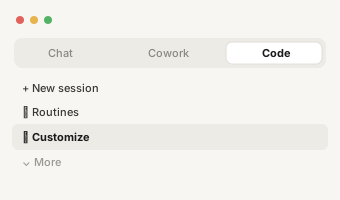
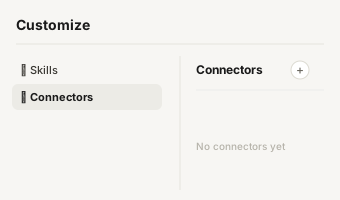
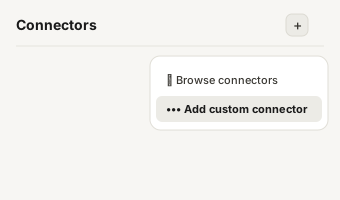
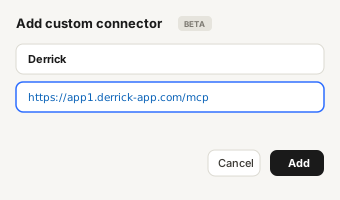
https://app1.derrick-app.com/mcp Call the same enrichment endpoints straight from your own stack or workflow.
Read the API docs →