
How to Research a Company for Sales Without Losing an Hour per Account
How to research a company for sales: the 12 questions that change a call, the 9 a column answers, the cost per account. Start free in the web app or in Google Sheets.


Account research fails in two directions, and most teams live in one of them. Either the rep opens a sequence knowing nothing beyond a company name and a job title, or the rep vanishes for forty minutes into a website, a funding announcement and four profiles, then comes back with a paragraph of colour that changes nothing about what they were going to say anyway.
The cure is not more research. It is deciding, before you start, which facts actually change the conversation, which of those a spreadsheet column can fetch without you, and how much of your attention a given account has earned. Research is a budget, not a virtue.
What follows is the version that survives volume: the twelve questions worth answering, the split between what a column can do and what only a human read can do, a tiering rule so your best accounts get your hours and the rest get your columns, the real credit cost per researched account, and what to do when a company has almost no public surface.
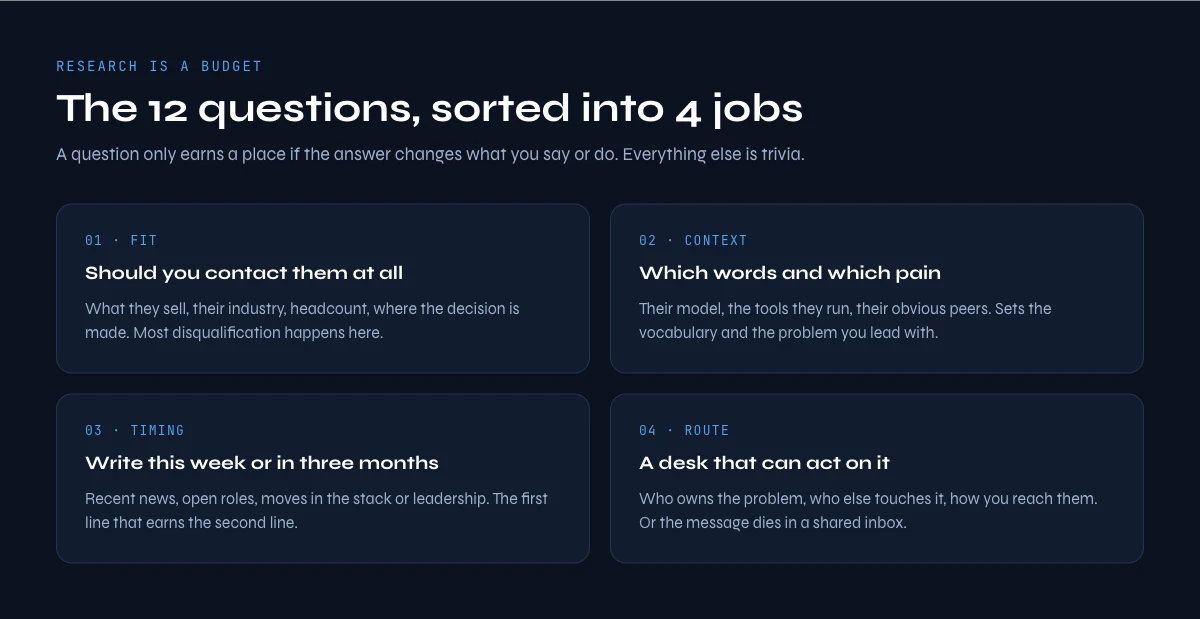
How to research a company for sales: the twelve questions that decide the call
Research is only useful when the answer would change something you say or do. That is the whole filter. If you would open the same way whether the answer is yes or no, the question is trivia. Twelve questions pass that filter, and they fall into four jobs.
| Job | Questions | What the answer changes |
|---|---|---|
| Fit | What do they actually sell, to whom? What industry are they in? How many people work there? Where is the decision made? | Whether you contact them at all, and which of your cases is relevant. Most disqualification should happen here, before a single word is written |
| Context | What is their model: self-serve, sales-led, services? What tools do they already run? Who are their obvious peers? | The vocabulary you use and the problem you lead with. A services company and a product company do not have the same pain behind the same job title |
| Timing | Have they been in the news recently? Are they hiring, and for which roles? Has anything moved in their stack or their leadership? | Whether you write this week or in three months, and the first line that earns the second line |
| Route | Who owns this problem there? Who else touches it? How do you reach them? | Whether the message lands on a desk that can act on it, or dies in a shared inbox |
Notice what is missing. Their mission statement, their values page, the founder's origin story, the design of their logo. Those feel like research. They change nothing, and they are exactly what a rushed rep grabs because they are the easiest things on the page.
Notice also that four of the twelve are pure firmographics: industry, headcount, country, and what the company does. Those are the cheapest facts you will ever buy, and they are the ones most often left blank. Our guide on company industry lookup covers the classification side of that in detail, including why NAICS and SIC codes rarely say what a salesperson needs to hear, and finding the headquarters country covers the one that decides your timezone, your language and often your legal terms.
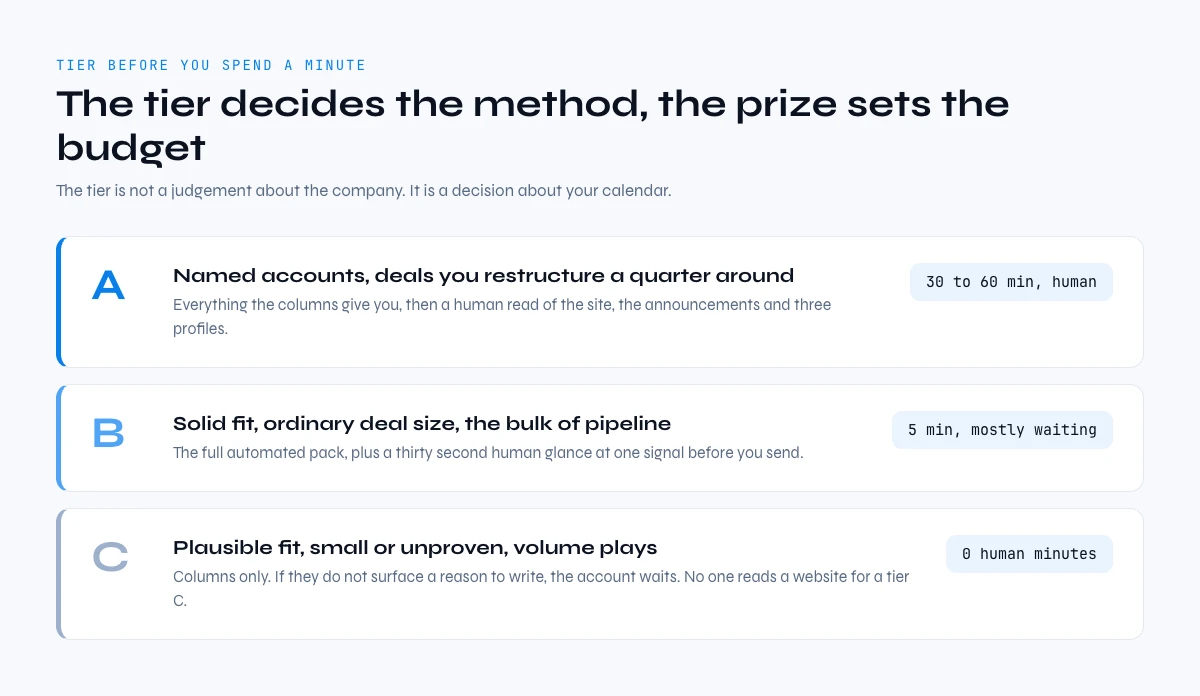
Tier the account before you spend a minute on it
The single most expensive mistake in account research is giving every account the same treatment. Forty minutes of manual reading on an account worth 400 euros a year is a loss you take on purpose. Two automated columns on an account worth 60,000 euros a year is negligence.
Set the budget first, from the size of the prize, then let the tier decide the method.
| Tier | Typical account | Research budget | Method |
|---|---|---|---|
| A | Named accounts, the deals you would restructure a quarter around | 30 to 60 minutes, by a human, per account | Everything the columns give you, then a manual read of their site, their recent announcements and three profiles. This is where a human earns the salary |
| B | Solid fit, ordinary deal size, the bulk of the pipeline | 5 minutes, per account, mostly waiting for a column to fill | The full automated pack, plus a thirty second human glance at one signal before you send |
| C | Plausible fit, small or unproven, volume plays | Zero human minutes | Columns only. If the columns do not surface a reason to write, the account waits. No one reads a website for a tier C |
The tier is not a judgement about the company, it is a decision about your calendar. An account can move up a tier the day a signal fires, and that is the point of running the cheap columns even on tier C: they are what promote an account to a tier where a human shows up.
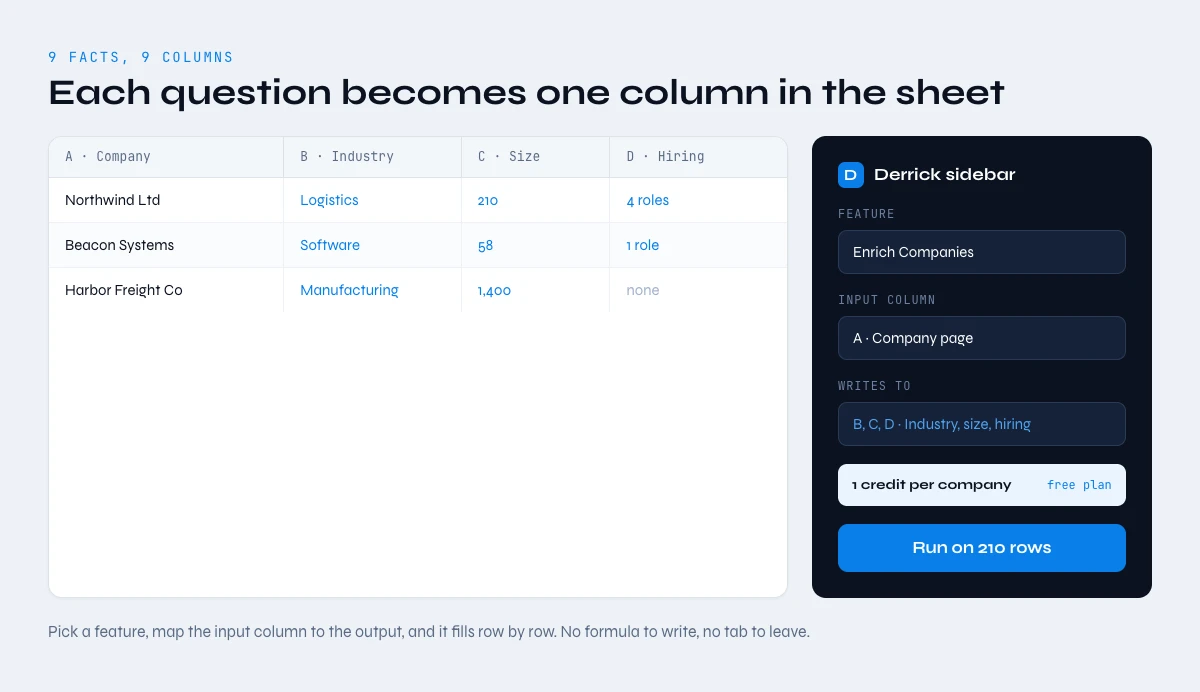
The nine facts a column can answer for you
This is the part almost no research guide commits to, because committing means putting numbers on the page. Nine of the twelve questions resolve to a column in a spreadsheet. Each one has a cost, and the cost has a billing mode that matters more than the price: some features bill for every row you submit, others bill only when they actually find something.
| Question | Input you need | Feature | Cost |
|---|---|---|---|
| What do they do, how big, where | LinkedIn company page | Enrich Companies | 1 credit per company, billed per row submitted. Available on the free plan |
| I only have a company name | Company name | Search Companies | 1 credit per company, billed per row submitted. Available on the free plan |
| Are they hiring, and for what | Company page | Company Hiring Signal | 1 credit per company, billed per row submitted. Available on the free plan |
| What happened to them recently | Company name | Google News Scraper | 1 credit per news item, billed per row submitted |
| What is running on their site | Domain | Website Technologies | 2 credits per website, billed per row submitted |
| What does their own site claim | Domain | Website Crawler | 2 credits per line, billed per row submitted |
| Who works there, in which function | Company page | Find a company's people | 1 credit per person, billed per row submitted |
| Who is this person exactly | Profile URL | Enrich Leads | 1 credit per profile, billed per row submitted. Available on the free plan |
| How do I reach them | Name plus domain | Email Finder, then Email Verification | 5 credits per email and 1 credit per verification, both billed only when a result comes back |
Two consequences follow from that last column, and they are the whole reason the order of operations matters. Anything billed per row submitted has to run after your fit gate, never before, because you pay for the rows you should have dropped. Anything billed only on a result can be run generously, because a miss costs nothing.
Revenue deserves its own note. It is the one firmographic that resists automation almost everywhere, because most private companies never publish it. If you need it, treat it as an estimate with a stated method rather than a fact, and read how to find a company's revenue before you put a number in a column that someone will later quote in a forecast.
In the web app or Google Sheets
The nine columns, filled before the call
Account research is twelve questions asked one tab at a time. Derrick crawls the company website from your list and returns its content in a column, which is what the positioning, offer and customer questions in this article are answered from.
- Feature
- Website Crawler
- Credit cost
- 2 credits per call
The first button opens the web app (nothing to install): 2 credits per call, available from the STANDARD plan. The second details the feature and its cost per plan.
The three facts no column will ever answer
Three of the twelve questions stay human, and pretending otherwise is how research becomes theatre.
What their model really is. A company can describe itself as a platform and run entirely on services delivered by twelve people. The tells are in how they price, whether they publish a pricing page at all, whether their job openings are engineering or delivery, and what their case studies actually describe. A column can hand you those inputs. Reading them is judgement.
Who owns the problem you solve. Job titles map to the org chart, not to responsibility. The person who owns data quality might carry the title of head of sales operations, or of revenue operations, or nothing that says data at all. Our guide on finding a company's leadership is useful for the top of the chart, but the owner of a specific problem is usually two levels below the name you would recognise.
Whether the moment is real. A hiring signal for three sales roles means something different at a company of 40 than at a company of 4,000. Automation can tell you the event happened. Only a human can decide whether the event is a reason to write today.
The practical rule: the columns produce evidence, the human produces the interpretation, and the interpretation is the only part that belongs in the first line of the message.
The app works through your list row by row: 2 credits per call.
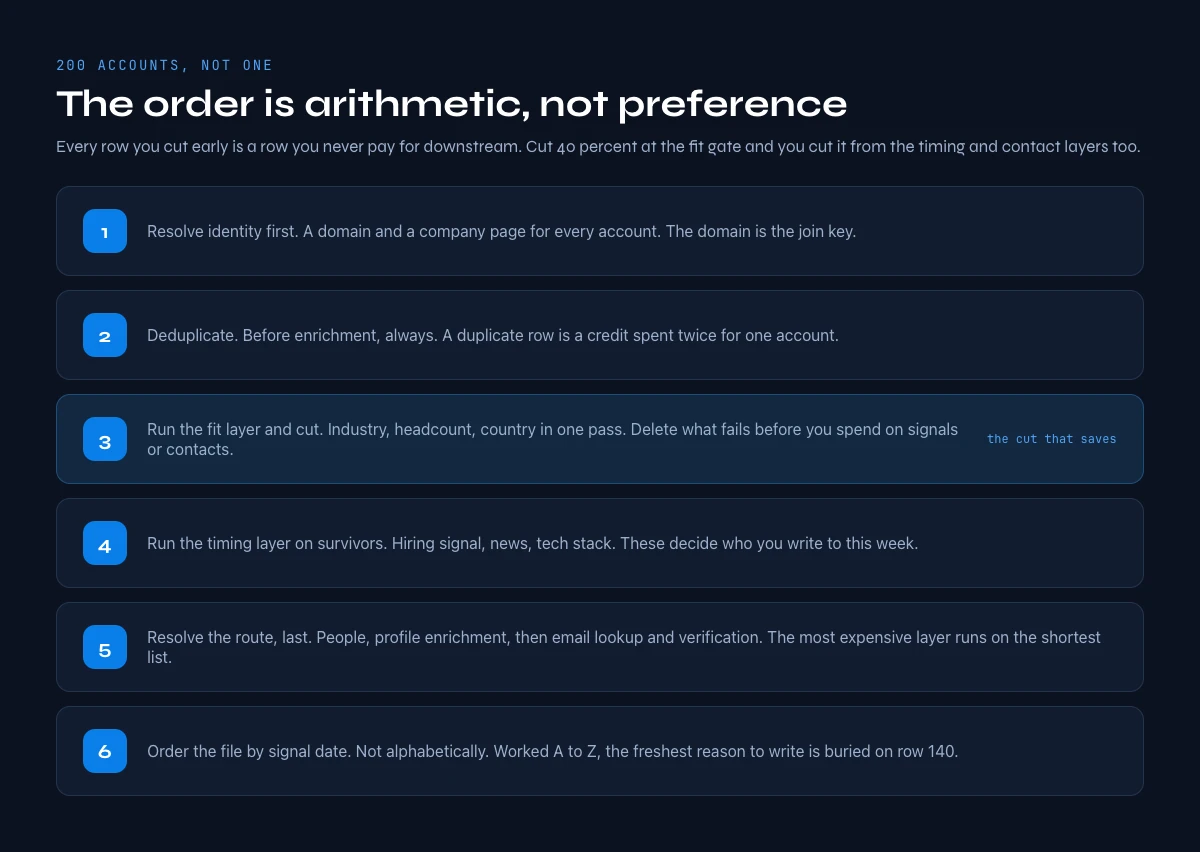
How to research a company for sales across 200 accounts, not one
Everything above is per account. At 200 accounts, the method has to change shape, because the bottleneck stops being knowledge and becomes sequencing. Six steps, in this order, and the reason each one sits where it does.
One, resolve identity first. Every account needs a domain and a company page before anything else runs. The domain is the join key: company names collide, get rewritten and get abbreviated, domains rarely do. If you started from names, resolve them first and read how to go from a domain to a company name for the reverse direction.
Two, deduplicate. Deduplication before enrichment, always. Every duplicate row you enrich is a credit spent twice for one account, and worse, it is two half-researched records that will disagree with each other in your CRM next month.
Three, run the fit layer and cut. Enrich Companies gives you industry, headcount and country in one pass. Apply the fit gate on those columns and delete what fails, before you spend anything on signals or contacts. This is the step that separates a 5 credit account from a 14 credit account.
Four, run the timing layer on the survivors. Hiring signal, news, tech stack. These are the columns that decide who you write to this week, and they are the ones that make a tier C account interesting enough to promote.
Five, resolve the route, last. People, profile enrichment, then email lookup and verification. This is the most expensive layer per account, which is exactly why it runs on the shortest list you will have.
Six, order the file. Sort by signal date, not alphabetically. A list worked in alphabetical order is a list where the freshest reason to write is buried on row 140.
The reason this order is not negotiable is arithmetic. Steps three, four and five are billed per row you submit. Every row you remove in step two or three is a row you never pay for downstream, and the removals compound: cutting 40 percent at the fit gate removes 40 percent of the timing layer and 40 percent of the contact layer with it.
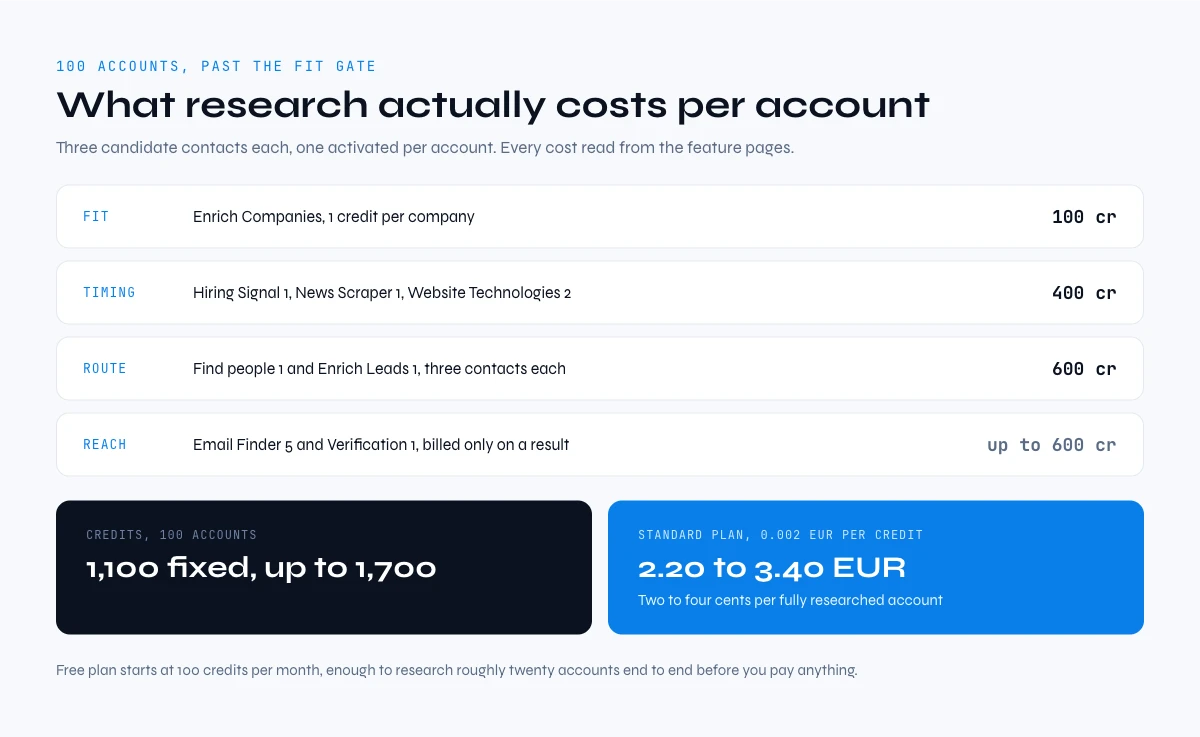
What research actually costs per account
Worked example, all costs read from the feature pages, all plan prices from the public pricing table. Say 100 accounts that already passed the fit gate, three candidate contacts each, one contact activated per account.
| Layer | What runs | Credits for 100 accounts |
|---|---|---|
| Fit | Enrich Companies, 1 credit per company | 100 |
| Timing | Company Hiring Signal at 1 credit, Google News Scraper at 1 credit, Website Technologies at 2 credits | 400 |
| Route | Find a company's people at 1 credit per person for 3 people, Enrich Leads at 1 credit per profile for 3 profiles | 600 |
| Reach | Email Finder at 5 credits and Email Verification at 1 credit, billed only on a result, on the 100 activated contacts | 6 per email actually returned, so up to 600 |
| Total | 1,100 fixed, up to 1,700 with a full reach layer | |
At the Standard plan rate of 0.002 euro per credit, that is 2.20 to 3.40 euros for 100 fully researched accounts, so between two and four cents per account. Note what is deliberately absent from that table: a hit rate. The reach layer costs 6 credits for every email that comes back and nothing for the ones that do not, so the honest number is a formula, not a percentage someone invented.
Compare that to the alternative most teams actually run, which is a rep spending five minutes per account reading websites. On 100 accounts that is more than eight hours. The columns are not cheaper than a human because they are better. They are cheaper because they never get bored on row 60.
Plans start at 100 credits per month on the free tier, which is enough to research roughly twenty accounts end to end and decide whether the method holds for your market before you pay anything.
How to research a company for sales when there is almost nothing public
Some companies have a one page site, no news coverage, a company page with 40 followers and no job openings. This is the normal state of most small and mid-sized businesses, and it is where generic advice quietly stops working.
Three moves survive the drought.
Go sideways. If the account itself is opaque, the shape of the market around it is not. Pulling a set of comparable companies gives you the vocabulary, the typical stack and the typical structure of that segment. You are researching the category and applying it to the account, which is weaker than direct evidence but far better than a blank first line.
Read what the site does, not what it says. A three page website still runs analytics, a form handler, a booking tool, a payment processor. The stack is a statement about how the company operates, and it does not require anyone to have written a blog post. This is often the only fresh evidence available on a small account.
Read the people instead of the company. When a company publishes nothing, its employees usually still have profiles: previous employers, tenure, how the team is structured, who joined in the last six months. A team of four with three recent joiners tells you more about the moment than any press release would.
And the discipline that goes with it: if none of the three produces a specific fact, do not manufacture one. A message built on a fabricated observation reads worse than a short honest one, because the reader knows their own company and will spot the invention immediately.
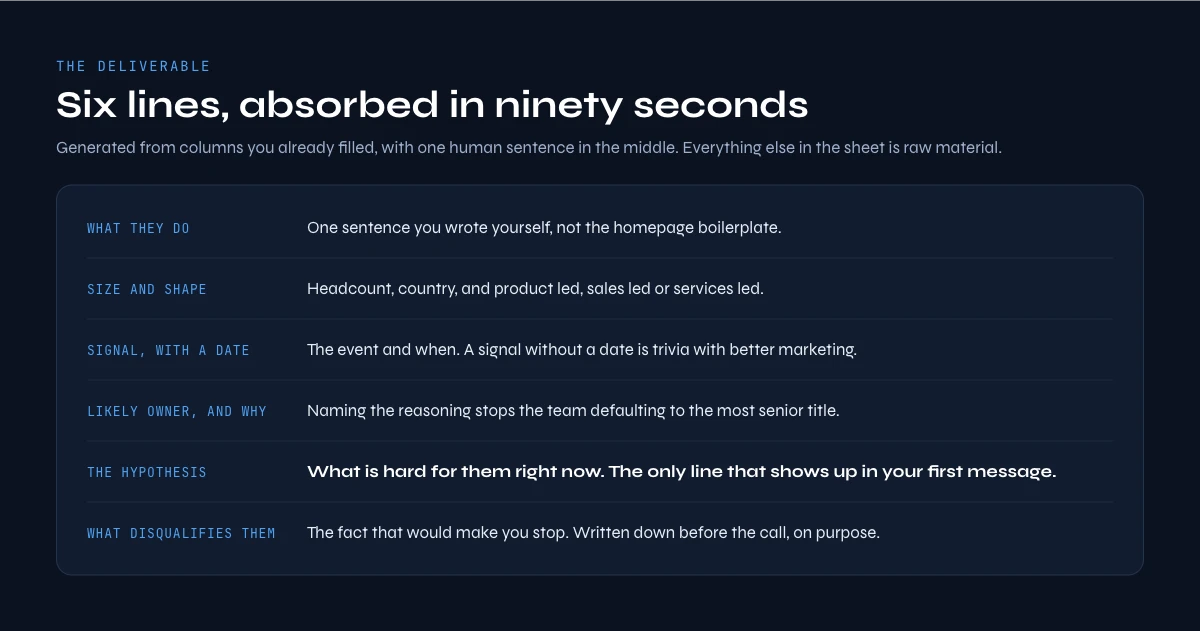
Turn the research into a brief that fits on one screen
Research that stays in a spreadsheet does not survive contact with a call. It has to compress into something a person can absorb in ninety seconds, and the compression is where most of the value gets created or lost.
A workable brief holds six lines and nothing else.
What they do, in one sentence you wrote yourself. Not the boilerplate from their homepage. If you cannot write it, you have not done the research.
Their size and shape. Headcount, country, and whether they are product-led, sales-led or services-led. Three facts that set the entire register of the conversation.
The signal, with a date. The event and when it happened. A signal without a date is not a signal, it is trivia with better marketing. Anything older than a quarter should be treated as background, not as a reason to write.
The likely owner, and why you think it is them. Naming your reasoning here is what stops the whole team from defaulting to whoever has the most senior title.
The hypothesis. One sentence: what you believe is hard for them right now, based on the evidence above. This is the only line that will actually show up in your first message.
What would disqualify them. The fact that, if you learned it on the call, would make you stop. Writing it down before the call is what keeps a bad fit from becoming a three month opportunity that closes lost.
Six lines, generated from columns you already filled, with one human sentence in the middle. That is the deliverable. Everything else in the sheet is the raw material it was compressed from.
How to research a company for sales without redoing it every quarter
The research you did in January is mostly wrong by June, and not evenly. Some fields age slowly, others rot fast, and treating them the same is why teams rebuild their account files from scratch every year.
| Field | How it ages | What to do |
|---|---|---|
| Industry, country, what the company does | Stable for years | Enrich once. Re-run only when something big happens |
| Headcount, tech stack | Drifts continuously | Refresh on the accounts you are actively working, not on the whole file |
| The contact and their title | Breaks the day they change jobs | This is the field that silently invalidates everything else. Re-verify before any send |
| Signals: news, hiring, leadership moves | Expire in weeks | Re-run on a schedule, or subscribe to the change instead of re-reading the file |
Two columns do most of the work of keeping a file alive: the date each row was enriched, and the source it came from. They cost nothing to fill and they let you refresh only what actually aged, instead of re-running the entire pack on 200 accounts because you no longer trust any of it.
The step beyond that is to stop pulling entirely on the timing layer. Tracking accounts for job changes, funding, hiring bursts and stack moves turns research from something you redo into something that arrives, which is the difference between a file you maintain and a file that maintains itself.
Start with the ten accounts you care about most. Run the fit and timing columns, write the six line brief by hand, and see whether the brief changes what you would have said. If it does not, your questions are wrong, not your tooling. If it does, you now know exactly which columns earned their credits, and that is the pack you scale to the next two hundred.
Frequently asked questions
How long should you spend researching a company before reaching out?
What should you look for when researching a company for sales?
Can company research be automated?
What does it cost to research 100 companies?
How do you research a company that has almost no online presence?
Should you research before or after building your prospect list?
How often should account research be refreshed?
Keep reading
Continue exploring this cluster


The State of B2B Company Data 2026: Firmographic Decay & What Stale Records Cost
Read →

How to Find a Company's Founding Year (5 Methods, 2026)
Read →

How to Find Company Headquarters Country: Complete Guide
Read →

Company Industry Lookup: How to Find Any Business Industry Instantly
Read →