
SIRET Number: How to Read, Validate and Use It as a Data Key
Understand the SIRET number: 14-digit format, validation with the Luhn check, SIREN vs SIRET for targeting, and why it goes stale in a database.


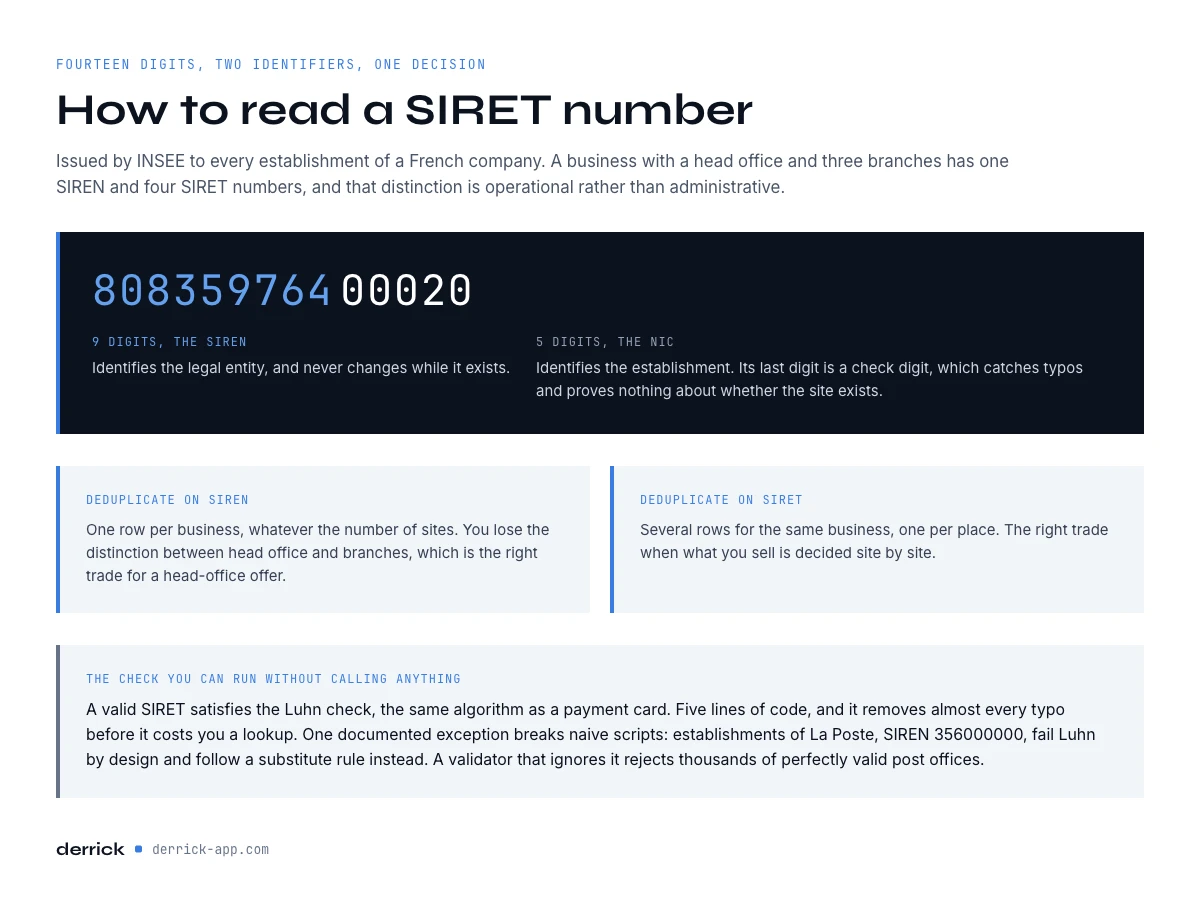
A SIRET number is a 14-digit identifier issued by INSEE to every establishment of a French company. It is made of the company's 9-digit SIREN followed by the establishment's 5-digit NIC. A business with a head office and three branches therefore has one SIREN and four SIRET numbers.
That distinction is operational, not administrative. It decides what you target, what breaks in your database when a company moves, and how you deduplicate a file. This guide treats the SIRET number as a data key rather than as paperwork.
How to read a SIRET number
Take 80835976400020. The first 9 digits, 808359764, are the SIREN: they identify the legal entity and never change while it exists. The next 5, 00020, are the NIC, the establishment's internal classification number. Its last digit is a check digit.
The direct consequence for a database: SIREN is the stable identifier of a company, SIRET the identifier of a place. Deduplicate on SIRET and you keep several rows for the same business. Deduplicate on SIREN and you lose the distinction between head office and branches. The right choice depends on what you sell: a head-office offer deduplicates on SIREN, a per-location offer on SIRET.
SIRET or SIREN: which one to target on
Use SIREN when your contact decides for the whole company: general management, IT, group procurement. You want one row per business, whatever the number of sites.
Use SIRET when the decision happens locally: shops, restaurants, practices, branches, franchises. A 60-store chain is one SIREN but 60 contacts, and a file built on SIREN makes you miss 59 of them.
The classic trap is the mixed file: SIREN rows and SIRET rows in the same column, distinguishable only by length. A 9-character column and a 14-character one do not join, and a naive match returns zero results without ever raising an error.
Validating a SIRET number without calling an API
A valid SIRET satisfies the Luhn check, the same algorithm used for payment card numbers. Double every second digit from the right, subtract 9 from any result above 9, sum everything: the total must be divisible by 10. It takes five lines of code and it removes almost every typo before it costs you a lookup.
There is an exception, and it breaks scripts. Establishments of La Poste, SIREN 356000000, do not satisfy the Luhn check. Verified on six of their real SIRET numbers: all fail Luhn, and all have a digit sum divisible by 5. That is the official substitute rule for this company. A validator that ignores it will reject thousands of perfectly valid post offices.
Keep the general principle in mind: a check digit catches typing errors, it does not prove an establishment exists. A number can be formally correct and point at a site closed years ago. Only the SIRENE register settles that.
In the web app or Google Sheets
Validate the identifier against the registry
A SIRET stored as text breaks silently: leading zeros disappear, establishments get confused with companies. Derrick enriches the row from the registry and returns the legal identifiers and company data, which is how you tell a typo from a real establishment.
- Feature
- SIRET/SIREN enrichment (France)
- Credit cost
- 1 credit per company enriched
The first button opens the web app (nothing to install): 1 credit per company enriched, 100 free credits every month. The second details the feature and its cost per plan.
Where to find a company's SIRET number
- The INSEE SIRENE register, the official source, freely searchable and available as an API for volume use.
- The Kbis extract, which carries both the SIREN and the head office SIRET.
- Commercial documents: invoices, quotes, terms, the legal notice of a website. Displaying the SIRET there is a legal obligation, which makes it a reliable and often the fastest source.
- Legal directories, convenient one at a time, quickly limiting as soon as a list is involved.
One practical note on the register itself. SIRENE is free and complete, but it answers one establishment at a time and it is not built for bulk lookups from a spreadsheet. Teams usually discover this after writing a script that works beautifully on ten rows and gets rate-limited on a thousand. Decide early whether your volume belongs in a manual lookup, in an API integration you maintain, or in a tool that already handles the batching for you.
A second note on freshness. The register reflects declarations, and declarations lag reality: a company that moved in March may only appear at its new address weeks later. That delay is normally harmless, but it matters if you are checking an address before sending something physical, or before a rep drives across a region.
Two of those sources are worth ranking. The website legal notice is the fastest when you have one company and a browser: it is a legal obligation in France, so it is almost always there, and it is maintained by the company itself. The SIRENE register is the only one worth trusting when you have a list, because it is the source every other source copies from, and because it carries the administrative state that tells you whether the establishment is still open.
What breaks a database built on these identifiers
The SIRET is not stable, and that is the most common cause of decay in a file of French companies.
Moving changes the SIRET. When an establishment changes address, INSEE closes the old number and issues a new one. The SIREN does not move. Your database keeps a SIRET that matches nothing, while the company is still there, active, a few streets away. Read from a spreadsheet, that row looks like a company that disappeared.
A closed establishment keeps its number. SIRET numbers are not recycled, they simply move to the administrative state "closed". A match that reads only the number, without checking that state, treats establishments that no longer exist as valid.
The head office moves. A company can transfer its head office from one establishment to another: both SIRET numbers already existed, it is the "head office" attribute that changed rows. If you captured it only once, your file points at the former head office.
The practical consequence fits in one sentence: store the SIREN next to the SIRET. The SIREN lets you find the company again when its SIRET goes stale, and turns a dead row into a row to refresh.
How many establishments does a company have
As many as it has establishments, and the count often surprises. A single-site SME has one. A business with a head office and a warehouse has two. A retail network has one per outlet, plus one for the head office, plus sometimes one per site or temporary office.
That count is commercial information in itself. A company opening three establishments in a year is expanding, and expansion is a buying moment: it hires, it equips, it changes suppliers. Conversely, a company whose establishments close one by one is an account to deprioritise, however fresh its contact details are.
Few teams use that signal because it is invisible on a single row: you have to count establishments per SIREN and look at their dates. It is exactly the kind of calculation that fits in one spreadsheet column, once the legal data is in.
The four mistakes that damage an identifier column
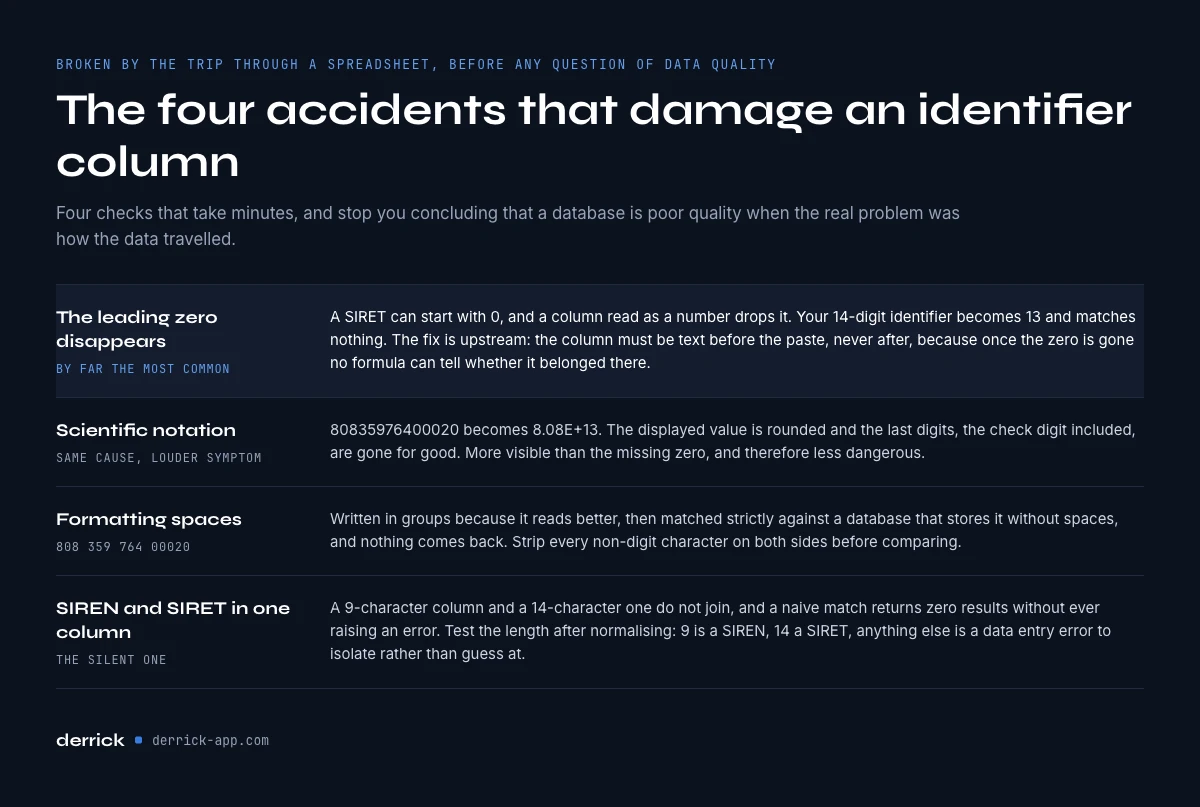
Before any discussion of data quality, most SIRET files are already broken by their trip through a spreadsheet. Four accidents come up every time.
The leading zero disappears. By far the most common. A SIRET number can start with 0, and a spreadsheet reading the column as a number drops it: your 14-digit identifier becomes 13 and matches nothing. The fix is upstream, the column must be text before the paste, never after. Once the zero is gone, no formula can tell whether it belonged there.
Scientific notation. Same cause, different symptom: a spreadsheet turns 80835976400020 into 8.08E+13. The displayed value is rounded and the last digits, including the check digit, are permanently lost. This one is more visible than the previous case, so less dangerous.
Formatting spaces. SIRET numbers are often written in groups, "808 359 764 00020", because it reads better. A strict match against a database that stores them without spaces returns nothing. Normalise by stripping every non-digit character, on both sides, before comparing.
Mixing SIREN and SIRET. A column holding both joins to nothing reliably. Test the length after normalising: 9 characters is a SIREN, 14 a SIRET. Anything else is a data entry error to isolate rather than guess at.
These four checks take minutes and stop you concluding that a database is poor quality when the problem was how the data travelled.
The equivalent in other countries
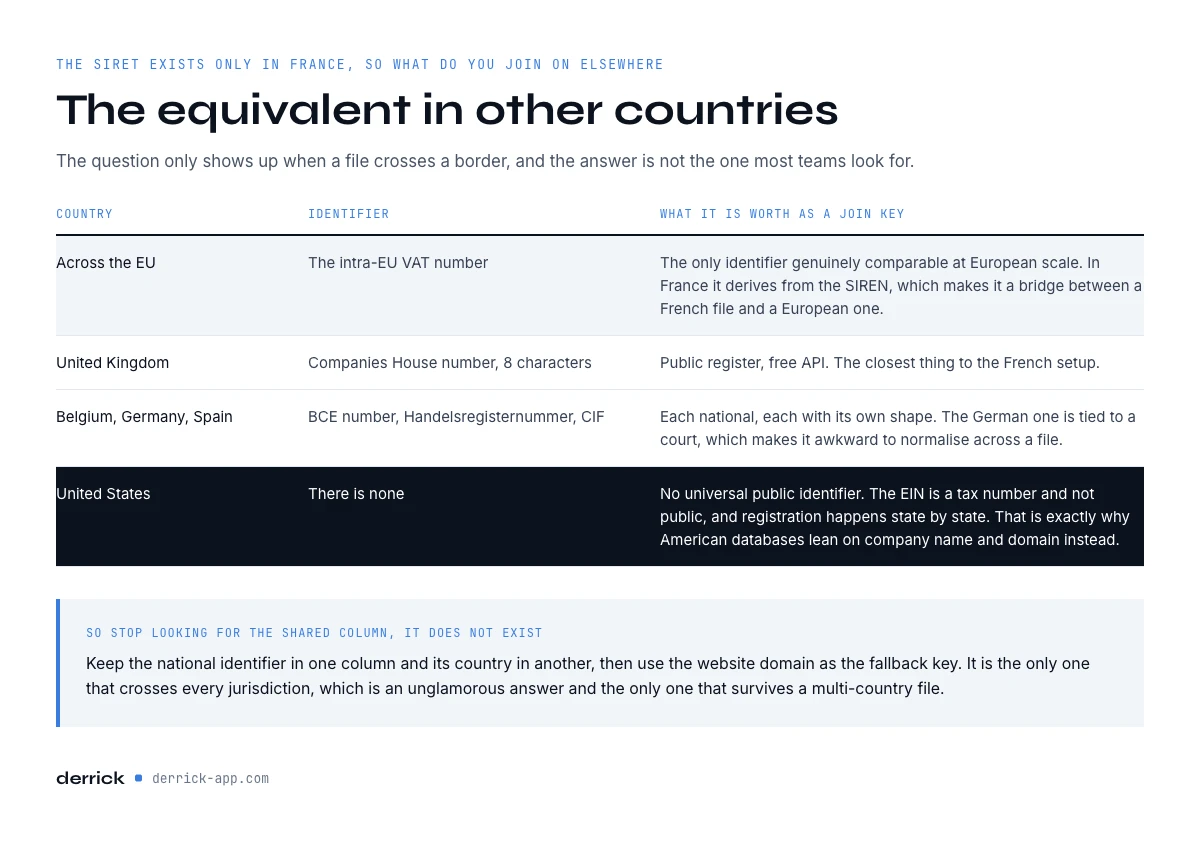
If you prospect beyond France the question becomes: what do you join foreign companies on, since the SIRET exists only here.
- The intra-EU VAT number is the only identifier genuinely comparable at European scale. In France it derives from the SIREN, which makes it a convenient bridge between a French file and a European one.
- The United Kingdom uses the Companies House company number, 8 characters, with a public register and a free API.
- Belgium has the BCE enterprise number, Germany the Handelsregisternummer tied to a court, Spain the CIF.
- In the United States there is no universal public identifier: the EIN is a tax number and not public, and registration happens state by state. That is why American databases lean on company name and domain rather than a number.
The consequence for a multi-country file: do not look for one shared identifier column, it does not exist. Keep the national identifier in one column, its country in another, and use the website domain as the fallback key. It is the only one that crosses every jurisdiction.
From a SIRET number to a full company record
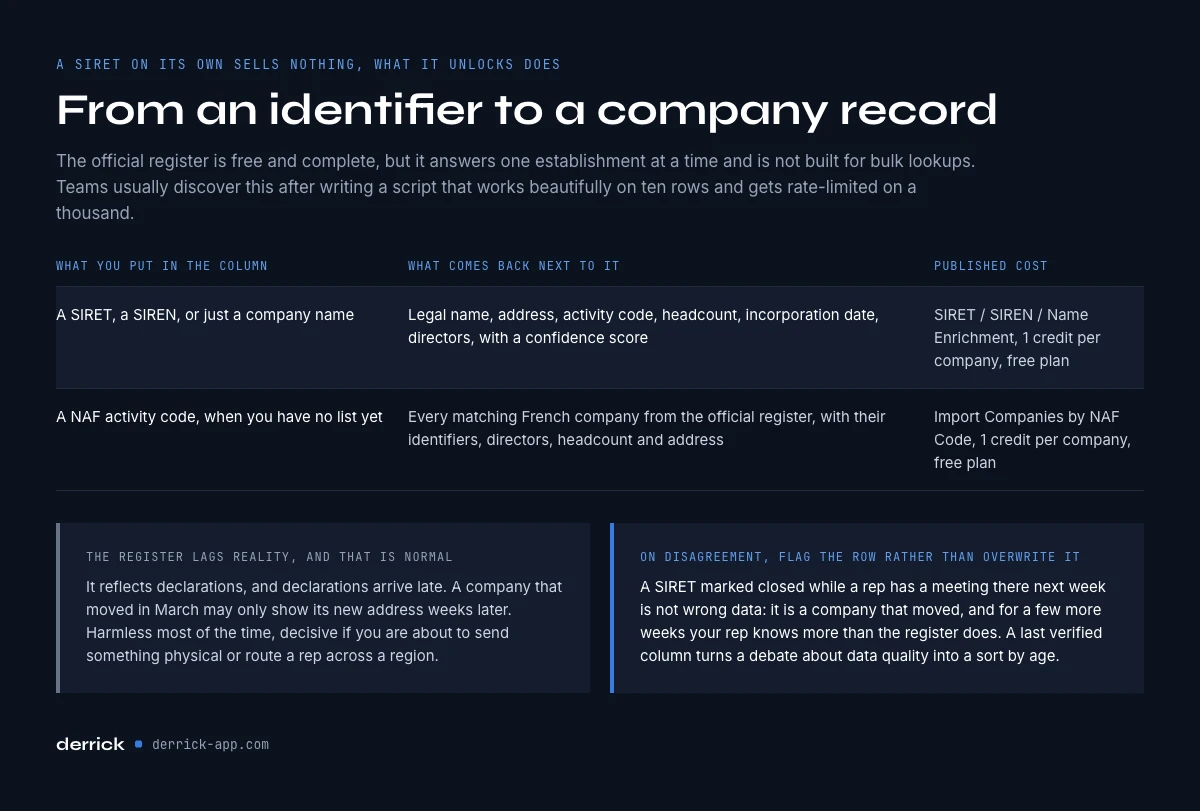
A SIRET on its own sells nothing. What has value is what it unlocks: legal name, address, activity code, headcount, incorporation date, executives.
Derrick's SIRET / SIREN / Name enrichment does exactly that trip, in the web app or inside Google Sheets: you drop in a column of SIRET numbers, SIREN numbers or even company names, and the official legal data comes back next to it, at 1 credit per company. The free plan includes 100 credits per month at no cost, enough to check a hundred rows before committing.
The reverse works too: start from a NAF activity code with Import Companies by NAF Code and you get the companies in a sector with their identifiers, rather than starting from a list of SIRET numbers you do not have. Start free and run your file through before buying anything.
Keeping it right in a CRM: who updates what
Getting the SIRET is easy. Keeping it right is a process problem, not a data one.
The first question is ownership. In most teams nobody is responsible for the freshness of legal identifiers: marketing imports them once, sales fix them case by case in individual records, and nothing reconciles the two. Six months later the database holds three versions of the truth and none of them is dated.
The second is cadence. A full refresh every quarter is enough for most uses, because moves and closures do not happen weekly. Continuous refresh is only justified if you bill on that data or feed a scoring engine with it.
The third is what to do on disagreement. When an official source contradicts your record, the right reaction is to flag the row, not to overwrite it. A SIRET marked closed in the register while a rep has a meeting there next week is not wrong data: it is a company that moved, and for a few more weeks your rep knows more than the register does.
A "last verified" column next to the SIRET settles most of these three questions. It turns a debate about data quality into a sort by age.
What a SIRET number will never tell you
The SIRET gives an identity and an address, nothing more. It does not say whether the company is solvent, whether it trades, whether its declared headcount matches the reality of the site, or who decides what there.
It does not say what the company actually does either. The attached activity code is declared and not audited: a business that changed trade can keep a code describing nothing for years. Our guide on the NAF code of a company covers that limit and how to work around it.
So use the SIRET for what it is: a reliable join key between your data and the official registers. Everything else is built on top, and verified elsewhere. Our guides on finding a company headquarters and finding a company CEO cover the two needs that come right after.
Frequently asked questions
What is the difference between a SIRET number and a SIREN?
Can a SIRET number change?
How do I check that a SIRET number is valid?
Does a valid SIRET number mean the company exists?
Where can I find a company's SIRET number?
How do I enrich a list of SIRET numbers?
Keep reading
Continue exploring this cluster


NAF code: find and use French activity codes
Read →

NAF Code List: All 88 Divisions and 732 Sub-Classes (2026)
Read →

How to Find Company Headquarters Country: Complete Guide
Read →

How to Find a Company's CEO from Its Name or Domain
Read →