
Third Party Intent Data Sources: Where the Signal Really Comes From
The six third party intent data sources, how each collects its signal, and why they point at companies not people. Build the layer you can verify, free.


Someone offers you a list of accounts that are "in market" right now. Before you spend anything on it, one question is worth asking and almost nobody asks it: which machine saw what, and how did it decide this account was interested? Third party intent data sources are not interchangeable, and the answer changes what the list is worth.
This guide takes the six families apart one mechanism at a time: publisher co-operatives, review and comparison sites, content syndication, bidstream, reverse IP, and public observable signals. For each one, where the signal comes from, what it resolves to, how old it is on arrival, and whether you can check it yourself.
The short version: nearly every third party intent data source resolves to a company, not to a person, and it lands days after the behaviour happened. That makes it very good at deciding which accounts to work this week, and useless for writing a sentence to a named individual. The only signals you can audit yourself, line by line, are the public observable ones: hiring, tech stack, funding and job moves.
What third party intent data sources actually are
A third party intent data source is any dataset collected by an organisation that has no relationship with you and no relationship with the account, then packaged and resold as evidence of buying interest. The distance is the whole point: the seller sees behaviour you could never see, across properties you do not own.
Every one of them, whatever the marketing says, has three parts. A collection point, where a behaviour is recorded. A resolution step, which turns that behaviour into an identity. A delivery cadence, which is how often the result reaches you. Most buyers evaluate the first and ignore the other two, which is where the disappointment comes from.
The resolution step creates the value and loses most of it at the same time, and it is the step nobody puts on a slide. Our State of B2B Intent Data 2026 report found that 91% of B2B teams buy intent data while only 24% report a return on it, and that gap is not caused by bad signal. It is caused by teams treating an account-level, multi-day-old score as if it were a person-level, real-time one.
First-party, second-party and third-party intent in one pass
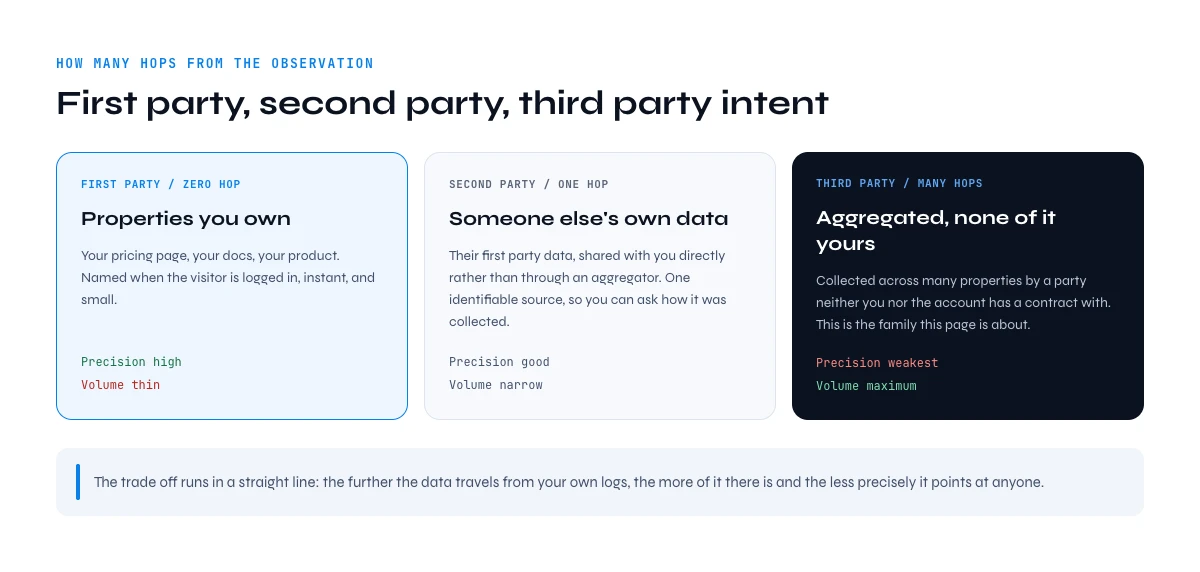
The labels describe how many hops separate you from the observation.
First-party intent is what happens on properties you own: your pricing page, your docs, your product. Named when the visitor is logged in, instant, and small. Nothing beats it for precision and nothing is thinner in volume.
Second-party intent is somebody else's first-party data, shared with you directly rather than through an aggregator. A review site selling access to its own visitors' behaviour is the textbook case. One hop, one identifiable source, and you can ask how it was collected.
Third-party intent is aggregated across many properties, none of which is yours, by a party neither you nor the account has a contract with. Maximum volume, maximum coverage, weakest resolution.
The trade-off runs in a straight line: the further the data travels from your own logs, the more of it there is and the less precisely it points at anyone. Wider context in our B2B intent data hub.
The six third party intent data sources, side by side
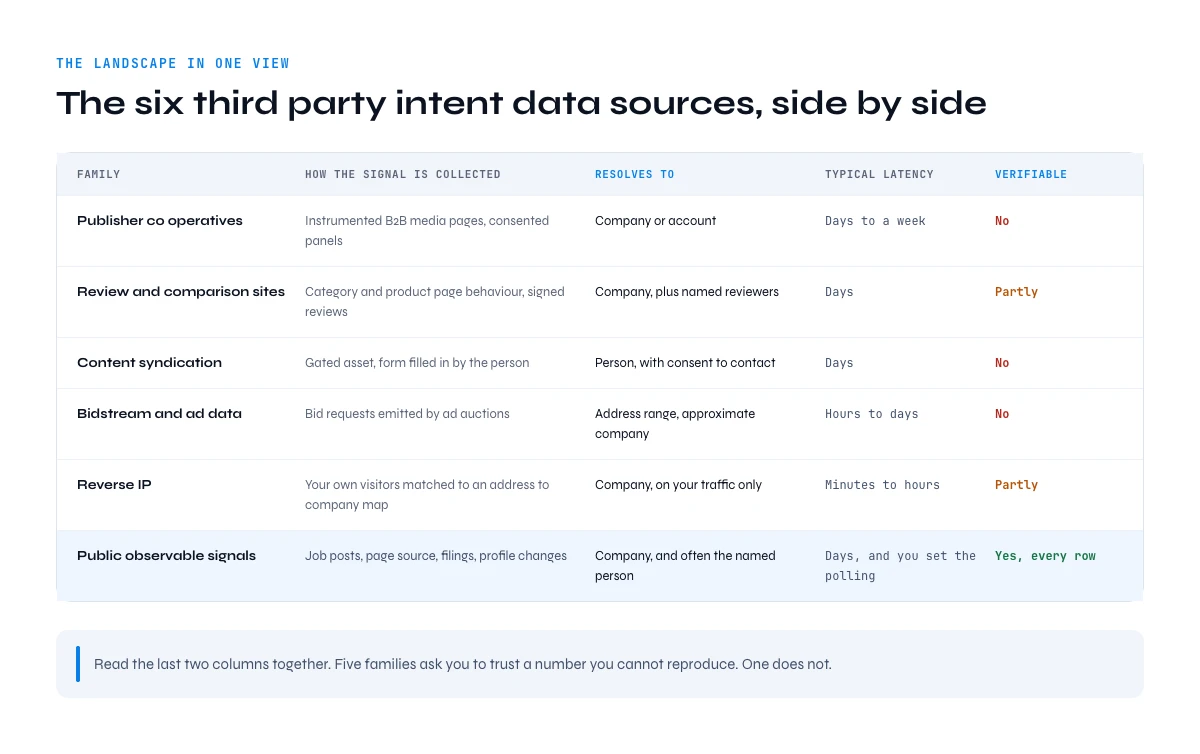
The landscape in one view. "Resolves to" is the unit the source can honestly identify. "Verifiable" means you can confirm a row without the seller's word for it.
| Family | How the signal is collected | Resolves to | Typical latency | Verifiable by you |
|---|---|---|---|---|
| Publisher co-operatives | Instrumented B2B media pages, consented panels | Company or account | Days to a week | No |
| Review and comparison sites | Category and product page behaviour, signed reviews | Company, plus named reviewers | Days | Partly, the reviews are public |
| Content syndication | Gated asset, form filled in by the person | Person, with consent to contact | Days | No |
| Bidstream and ad data | Bid requests emitted by ad auctions | Address range, approximate company | Hours to days | No |
| Reverse IP | Your own visitors matched to an address-to-company map | Company, on your traffic only | Minutes to hours | Partly, you own the logs |
| Public observable signals | Job posts, page source, filings, profile changes | Company, and often the named person | Days, and you set the polling | Yes, every row |
Read the last two columns together. Five families ask you to trust a number you cannot reproduce. One does not.
Publisher co-operatives: the backbone of topic intent
This is what most people mean by "intent data". A network of B2B media properties instruments its pages. A reader opens four articles about data warehousing in a fortnight. The co-operative resolves that reader's network address to a company, increments a topic score, and when the score crosses a threshold the account is reported as surging.
Two properties of this mechanism deserve more attention than they get. First, the aggregation to company level is deliberate, not a technical limitation. The co-operative sells access to a pool of publishers who contribute audience behaviour on the condition that individual readers are never resold. Asking for the person is not a feature request, it is asking the vendor to break the arrangement that makes the pool exist at all.
Second, the score is almost always relative to the account's own baseline. It introduces a structural bias: a 30,000-person company generates enough background reading to look noisy on every topic, while a 25-person company can have its entire buying committee read your category for a month and never cross a threshold. If your ideal customer profile is small, relative baselines will systematically under-report your best accounts.
In the web app or Google Sheets
The public family, collected per account
Of the six families compared here, public news is the one you can source yourself and cite in an email. Derrick returns recent company news in a column of your list, so the trigger is visible next to the account it belongs to.
- Feature
- Google News Scraper
- Credit cost
- 1 credit per news found
The first button opens the web app (nothing to install): 1 credit per news found, 100 free credits every month. The second details the feature and its cost per plan.
Review and comparison sites: declared, named, slower than you think
When someone opens a category page and compares two products side by side, the intent is unambiguous in a way that reading an article never is. Nobody browses a pricing comparison by accident, which is why this family has the best signal-to-noise ratio of the six and is priced accordingly.
It also has a property no other third-party family has: part of the evidence is public. The reviews are signed, dated and readable. You can see what a named person wrote about the tool their team pays for, which is the difference between a score and a quote. Our guides on scoring and segmenting with review-site insights and on mining product reviews for prospecting intent cover that workflow in full, so this page will not repeat it.
The limit is coverage. Review sites see the categories they cover, when a buyer chooses to visit them, which is a fraction of the whole evaluation. An account can run six months of private demos and never show up once. Ratings are also a stack signal in their own right, covered in our guide to reading product ratings as a tech stack indicator.
Content syndication: the only source that hands you a person
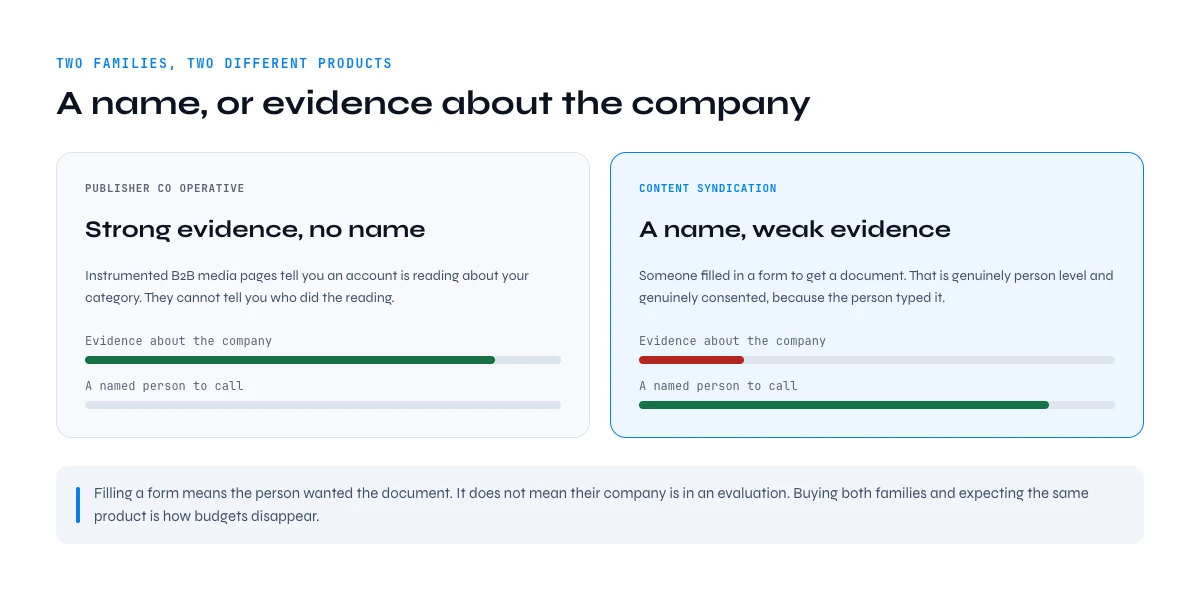
A vendor pays a media network to distribute a whitepaper behind a form. Someone fills it in. The lead arrives with a name, a job title, an email address and an explicit agreement to be contacted about the topic. That is genuinely person-level and genuinely consented, because the person typed it.
The catch is what the behaviour proves. Filling a form means the person wanted the document. It does not mean their company is in an evaluation, that a budget exists, or that they will remember downloading anything when you call three weeks later. And syndication is sold per lead against a delivery target, which is an incentive to loosen the filter as the deadline approaches.
Put the two families side by side and the trade is clear. A co-operative gives strong evidence about a company and no name. Syndication gives a name and weak evidence about the company. Buying both and expecting the same product is how budgets disappear.
Bidstream and advertising data: cheap, broad, the weakest link
Every time an ad slot is auctioned, the bid request sent to buyers describes the context: page address, approximate location, device type, network address. Billions happen daily, and some of that exhaust is captured, aggregated and resold as topic intent.
It is the cheapest signal to produce and it has by far the widest reach, which is exactly why it deserves care. An ad request is not a reading. It records that a page was loaded in a browser that received an ad slot, not that a human read the article, and certainly not that they cared. Attention was never measured.
The risk is not that somebody sells you pure bidstream and says so. It is that bidstream gets blended quietly into products presented as consented panel data, because it fills coverage gaps cheaply. So the question is not "do you use bidstream", it is "what share of my delivered signal comes from bid requests". A vague answer is itself an answer.
Reverse IP: your own traffic, partially de-anonymised
Reverse IP matches a visitor's network address against a map of address ranges to organisations. Strictly speaking the visit is your first-party data and only the mapping is bought in, which makes this the odd one out. It is also the most precise about behaviour: you know which page was read, for how long and in what order, because it happened on your own site.
What breaks is the match, in ways that correlate with your best prospects. Remote workers on consumer connections resolve to an internet provider, not an employer. Corporate VPNs collapse a whole company into one exit point abroad. Mobile traffic behind carrier-grade address translation resolves to nothing. Smaller companies rarely own address ranges at all.
So the number that matters is the match rate on your traffic, not the vendor's average, and it is always lower than the demo suggests. Measure it on the traffic segments you care about rather than on the total: a healthy overall figure can hide a near-total blind spot on exactly the segment you sell to.
Public observable signals: hiring, stack, funding and job moves
The last family is different in kind. Hiring activity, technologies detected on a website, funding announcements, leadership changes and news are not intent in the vendor sense. They are facts with an implication, and the implication is often stronger than a topic score.
A company posting six sales roles in a quarter is going to buy sales tooling, and you needed no panel to work that out. A company that just added a marketing automation tag is mid-migration and mid-budget. A newly arrived VP will push to reinstall the stack they already know, which is why job moves predict purchases better than almost anything else here.
The decisive property is that every one of these is checkable. The job posting has a public address. The technology is in the page source. The funding round was announced. The role change sits on the person's own profile. You are not told an account is interested, you look at the evidence and conclude. Our guide to plugging intent signals into an existing playbook covers how to sequence them once you hold them.
Granularity: why third party intent data sources point at accounts, not people
This is the constraint that decides what the whole category is good for, and the one the market talks about least.
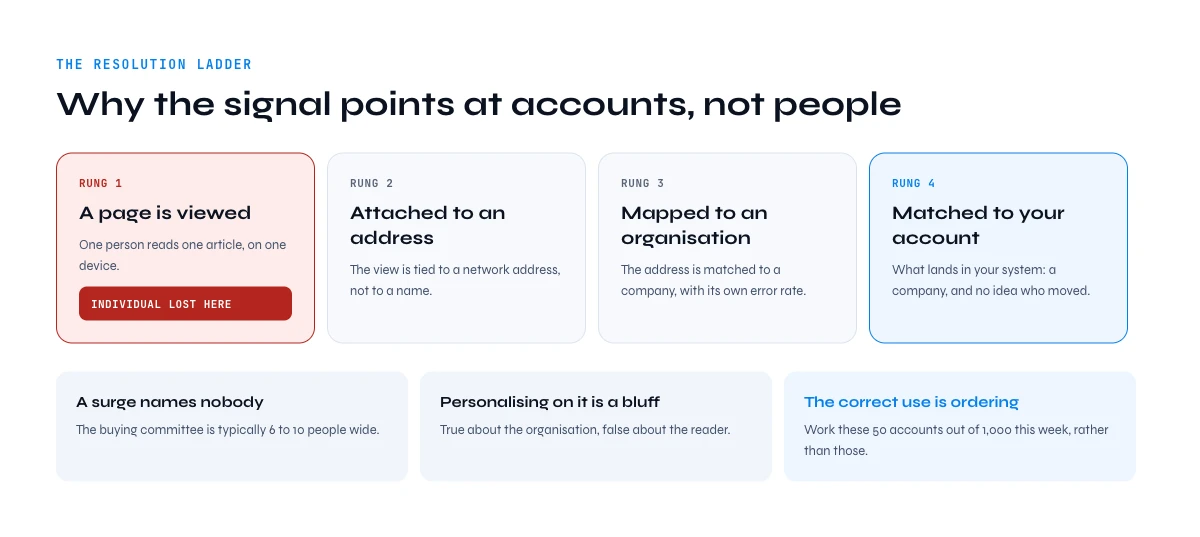
Follow the resolution ladder. A page is viewed. The view is attached to a network address. The address is mapped to an organisation. The organisation is matched to an account in your system. Four rungs, and the individual is lost on the first one, before any of the interesting work happens. Everything downstream is reasoning about a company. Three consequences follow, and they are practical rather than philosophical.
- A surging account tells you nothing about who moved. In a 4,000-person company, the reading behind the surge could have come from a procurement analyst, an intern or the person who signs. The signal holds no opinion, and the buying committee is typically 6 to 10 people wide.
- Personalising an opening line on a topic surge is a bluff. "I saw you were looking into data quality" is, at best, true about the organisation and false about the reader. Senders think it lands as relevance. It reads as surveillance to someone who knows they read nothing.
- The correct use is ordering, not messaging. The signal is an instruction about sequence: work these 50 accounts out of 1,000 this week rather than those. That is a large amount of value, and it is not what the pitch promises.
Which points at the actual gap. Intent tells you the account. It is contact data that tells you the people inside it, and no amount of topic score substitutes for a verified name, title and email address. That handover is precisely where the 91% who buy and the 24% who see a return part company.
Latency: how stale third party intent data sources are on arrival
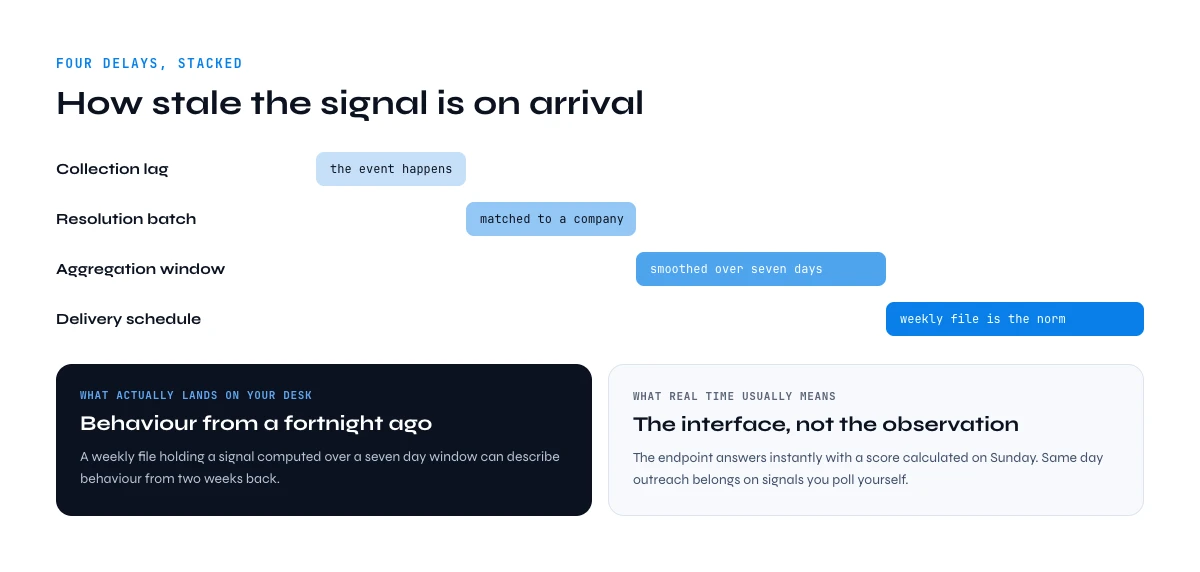
Every source in the table carries four delays stacked on each other: the collection lag, the resolution batch, the aggregation window used to smooth out noise, and the delivery schedule. They compound. A weekly file holding a signal computed over a seven-day window can describe behaviour from a fortnight ago.
Weekly delivery is the norm, daily costs more, and "real time" usually describes the interface rather than the observation: the endpoint answers instantly with a score calculated on Sunday.
The rule that falls out of this is simple. Any play that depends on reacting within the hour cannot be built on third-party intent, and belongs instead on your own site traffic or on signals you poll yourself. Third-party sources are for choosing the week's target list, not for triggering same-day outreach.
How to evaluate third party intent data sources before you buy
Six questions, in this order, will tell you more than any demo.
- Which mechanisms are in the blend, and in what proportion? Almost every commercial feed mixes several of the six families. The mix is the product.
- What is the resolution unit? Account, domain, address range or person. Ask in writing, because "account-level" and "domain-level" stop meaning the same thing the moment a group runs twelve subsidiaries on one domain.
- What is the match rate against my own list? Hand over 500 accounts you already know and count how many come back. Vendor averages describe the vendor's universe, not yours.
- How old is the freshest signal, measured from the event? Not from delivery. The two answers can be a week apart.
- Is the threshold relative or absolute? Relative baselines under-report small companies, which alone can decide the evaluation.
- What can I verify without you? If the honest answer is nothing, you are buying a belief, and you should price it like one.
Then run the overlap test. Give the vendor 200 accounts you closed and 200 you lost in the same period, and see whether the score separates them. A source that scores both groups alike is decoration.
The intent signals you can verify yourself, line by line
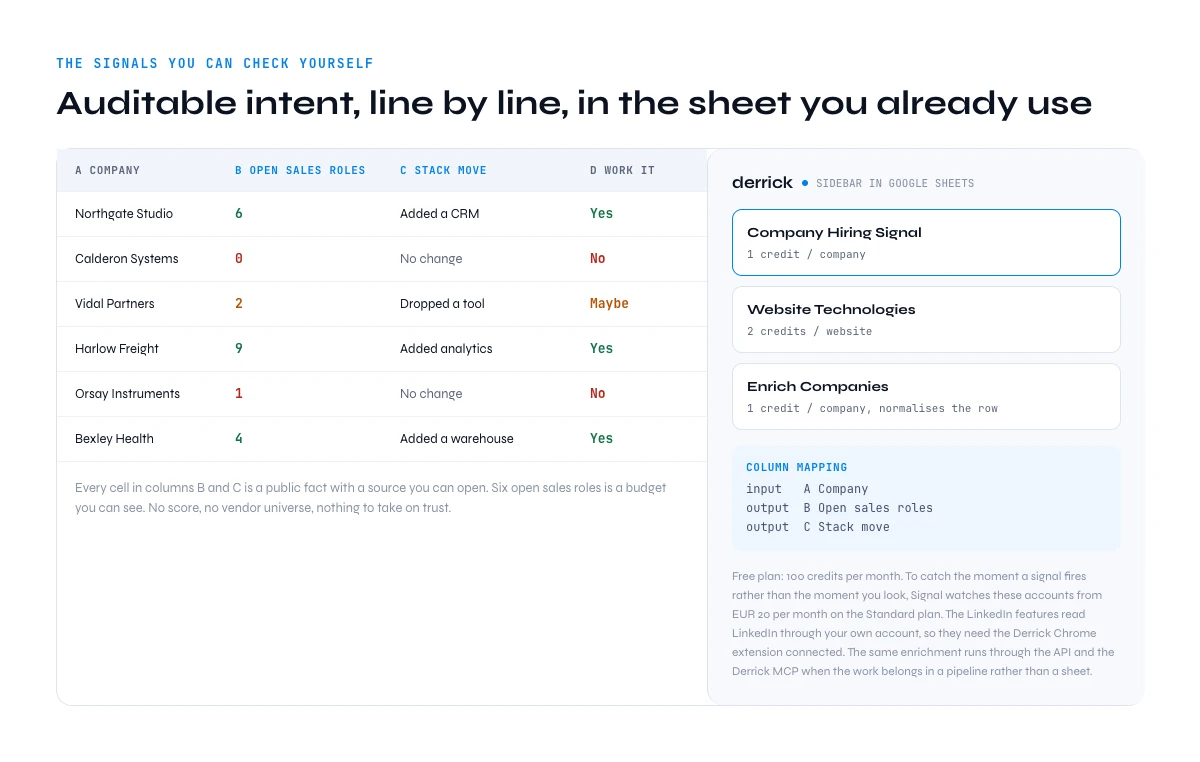
The auditable families are the ones you can build on your own account list, on your own schedule, without a contract. Derrick runs in its web app, and also as a sidebar inside Google Sheets, so this happens on the rows you already have rather than in another tool with another export.
Company Hiring Signal returns which companies are hiring on LinkedIn and for which roles, at 1 credit per company on the free plan. Six open sales roles is a budget you can see. Website Technologies identifies the technologies running on any website at 2 credits per website: the stack signal and the migration signal in one column. Both are checkable in thirty seconds.
Around those two, Enrich Companies fills in headcount, industry and location at 1 credit per company on the free plan, which is what lets you normalise a signal instead of comparing a 30-person company with a 30,000-person one.
To catch the moment a signal fires rather than the moment you happen to look, Signal tracks leads and accounts for job changes, funding rounds, hiring sprees and tech-stack moves, from €20 per month on the Standard plan, at 1 credit per triggered signal. To turn those columns into a written reason a rep can read, Ask Claude does it at 2 credits per line. If the work belongs in a pipeline rather than a sheet, the same enrichment runs through the API and the Derrick MCP from any compatible AI assistant, both from the Plus plan.
To be honest about scope: this is not a replacement for a topic-intent subscription, and it does not pretend to see the anonymous reading a co-operative sees. It is the layer underneath, where every row has a source you can open. It costs nothing to test on the free plan and its 100 credits per month.
Where this leaves you
Third-party intent is worth buying when you know what you bought: a company-level, days-old ranking instruction assembled from mechanisms of very different quality. Used to order a list, it earns its price. Used to write a first line to a named person, it invents a fact. Build the base from what you can verify, add a bought feed on top, and keep the two labelled separately so you never lose track of which column is evidence and which is inference.
Frequently asked questions
What are the main third party intent data sources?
Where does third-party intent data actually come from?
What is the difference between first-party, second-party and third-party intent data?
Can third-party intent data identify the person who showed interest?
How fresh is third-party intent data when you receive it?
Which intent data sources can you verify yourself?
Is bidstream data reliable for B2B intent?
How should you use third-party intent data without wasting it?
Keep reading
Continue exploring this cluster


The B2B Buying Committee Report 2026: How Many People Really Sign Off
Read →

The State of B2B Intent Data 2026: The Signal-to-Pipeline Gap
Read →

Intent Marketing: How to Harness Data Intelligently?
Read →

Product Rating Checker: How to Identify Your Prospects' Tech Stack via Reviews
Read →