
The B2B Buying Committee in 2026: How Many People Really Sign Off
B2B buying committee report 2026: 6-10 stakeholders per decision, why one contact per account is never enough, and how many verified contacts you need.


Last updated: 2026-06-18
The single biggest reason good prospecting underperforms is also the most ignored: B2B decisions are made by groups, not individuals, and most outreach reaches one person per account. This report quantifies the modern buying committee, how many people sign off, across how many functions, and how that has changed, and shows why reaching one well-chosen contact and stopping there means working a fraction of the people who actually decide.
The thesis is that account selection is half the job and account coverage is the other half. Finding the right company is solved; reaching enough of the right people inside it, with verified contact data, is where deals are won or quietly lost. A signal or a shortlist points at an organization; pipeline requires a mapped group of reachable humans.
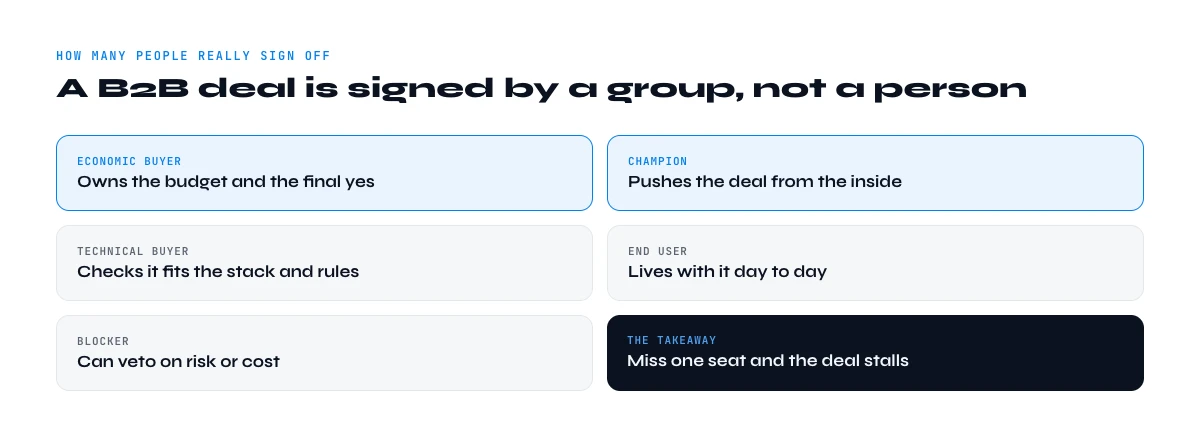
How many people really sign off
The committee is large and getting larger. Gartner's research describes a typical B2B buying group of roughly six to ten stakeholders, and across more complex purchases the range runs wider, on the order of five to eleven people spanning five distinct business functions. Forrester's work on business buying puts the number higher still for many deals, with a dozen or more individuals involved across the lifecycle. However you count it, the lone decision-maker is a myth.
This matters because outreach economics are usually built for one contact per account. A list with one name per company quietly assumes a single buyer, when the real structure is a cross-functional group, each member with their own questions, their own veto, and their own moment of involvement. Reaching one of eight is not 12 percent of the work, it can be zero percent if the one you reached is not the one who carries the deal.
So the first reframe is to think in accounts and groups, not individuals and lists. When a company looks promising, the job is to map the committee, the economic buyer, the technical evaluator, the champion, the user, the blocker, not to fire a single touch at whoever surfaced first. The intent-to-pipeline mechanics behind this are in the B2B intent data report.
The committee has grown for structural reasons, not fashion. Purchases are more cross-functional than they used to be: a tool that touches data, security, finance, and the end user pulls each of those functions into the decision, and each adds a representative with a veto. The larger and more strategic the purchase, the larger the group, which is why enterprise deals routinely involve more stakeholders than mid-market ones and why the trend line on committee size keeps rising.
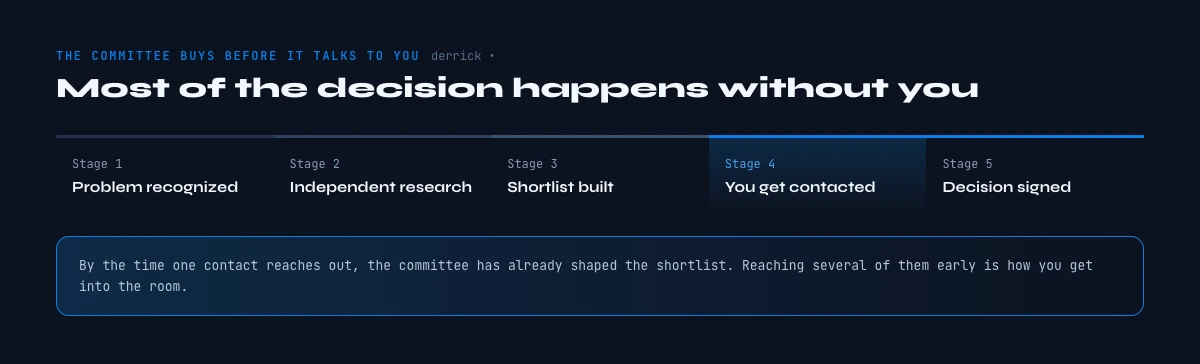
The committee buys before it talks to you
The committee also does most of its work without you. Independent research finds that around 83 percent of buyers have largely defined their requirements before they ever speak to a vendor, and Gartner reports that buyers spend only about 17 percent of their total buying time meeting with potential suppliers, split across every vendor they consider. A growing majority, by Gartner's 2026 reading two-thirds, actively prefer a rep-free buying experience for parts of the journey.
The implication for coverage is sharp. If the group forms its view largely in private and gives you a thin slice of its time, you cannot afford to spend that slice on the wrong member. Reaching several of the right people raises the odds that your message lands with someone whose view still matters at the moment they are deciding, rather than the one stakeholder who has already made up their mind or moved on.
This is why broad, shallow outreach and narrow, single-threaded outreach both fail: the first wastes the limited attention, the second bets everything on one relationship in a group decision. The winning pattern is multi-threaded coverage of a mapped committee, which only works if you can actually reach those several people. The signal-scoring side of this is covered in the guide to scoring with review insights.
There is a measurement trap hiding in this. Win-rate and conversion analyses usually attribute outcomes to the contact in the CRM, the one person you happened to engage, which hides the role of everyone you did not reach. A deal recorded as won through a champion may really have turned on a finance stakeholder you never logged, and a loss blamed on price may have been a security veto you never saw. Thinking in committees is also the only way to read your own funnel honestly.
Function matters as much as headcount. A committee is not six interchangeable contacts, it is a set of distinct roles, economic, technical, user, and often a procurement or security gate, each evaluating you on different criteria. Covering three contacts who all sit in the same function is not real coverage; covering one each across the economic, technical, and champion roles is. The target is breadth across functions, not just a count of names.
In the web app or Google Sheets
Map the committee on your own accounts
The report counts the people who sign off; your deals have their own count. From your list of target companies, Derrick imports the people matching the roles you name, one row each, so the committee is a list rather than an assumption.
- Feature
- Import Leads from Target Companies
- Credit cost
- 1 credit per lead imported
The first button opens the web app (nothing to install): 1 credit per lead imported, 100 free credits every month. The second details the feature and its cost per plan.
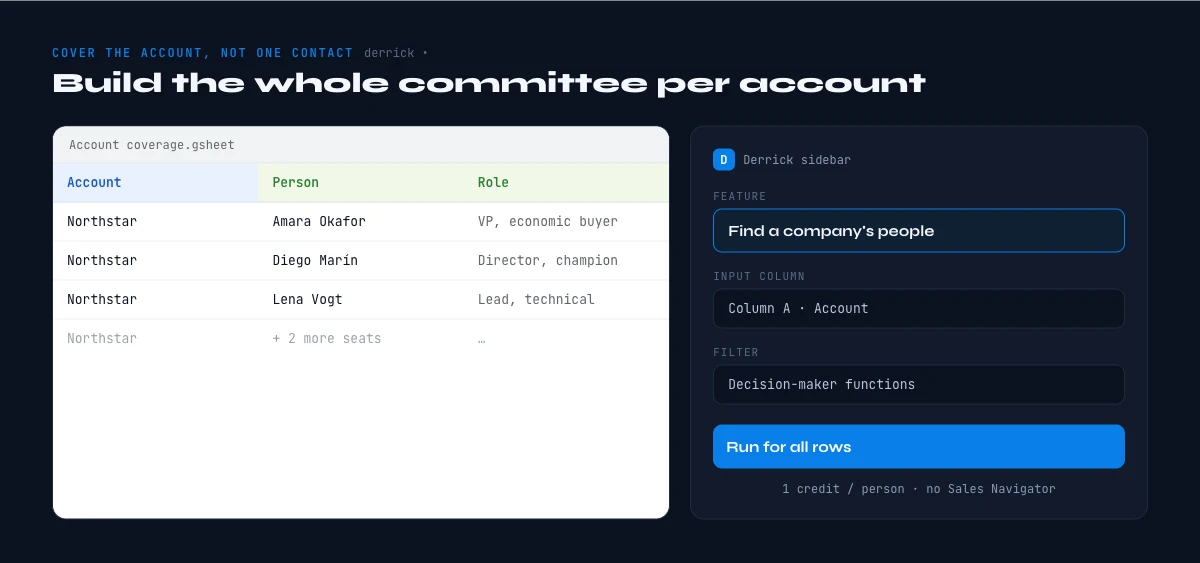
How many contacts you actually need per account
Translate the committee size into a coverage target. If the group is six to ten people across several functions, single-threading one contact covers a tenth of the decision surface; reaching three to five of the right roles covers enough of it to influence the outcome. The goal is not to contact everyone, it is to reach a multi-functional subset, typically the economic buyer, the likely champion, and the technical evaluator, so your story is represented where the decision is actually argued.
The practical bottleneck is that this multiplies the contact-data problem. Covering one account well now means finding and verifying contact details for several people, at the moment of outreach, which is exactly the repetitive, high-volume work that breaks down when done by hand. A coverage strategy that looks great on a slide collapses if a recruiter or rep cannot actually obtain a current email and phone for each mapped stakeholder.
This is the layer Derrick is built for. Starting from a target account, Derrick finds the relevant people inside it and verifies their emails and phone numbers and enriches their profiles, in the Derrick web app or directly inside Google Sheets, so mapping a committee turns into a column of reachable, current contacts rather than a manual research project. The targeting upstream of this is in the intent marketing strategy guide.
This also explains why timing is unforgiving. Different members enter the decision at different stages: the user and champion early, finance and procurement late. If your contact data lets you reach only some of them, you are not just under-covered, you are under-covered at specific stages, blind to the deal exactly when the late-stage gatekeepers are forming their view. Coverage has to span both functions and the timeline.
One last reframe for forecasting. A deal with one engaged contact and a deal with four engaged stakeholders across functions are not the same opportunity, even at the same stage, yet most pipelines weight them identically. Coverage is a leading indicator: the share of the committee you have actually reached predicts whether a deal will survive the late-stage gates better than almost any activity metric, and it is one you can act on directly by reaching more of the right people.
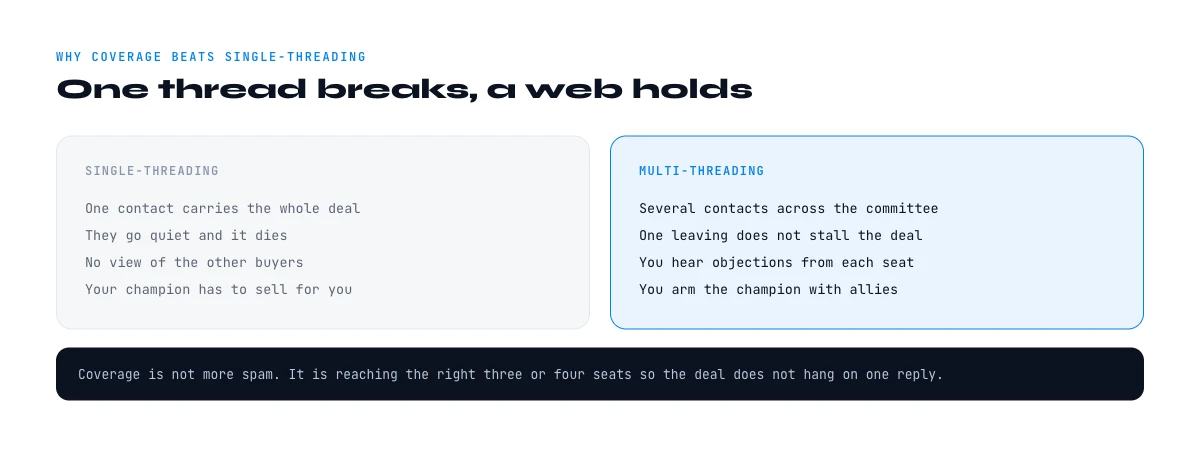
Why coverage beats single-threading
Single-threading is fragile in a group decision for reasons beyond reach. Your one contact may champion you and then change jobs; may like you but lack the budget authority; may simply go quiet, leaving you blind to a decision forming around people you never engaged. Multi-threaded coverage is resilient: if one contact goes cold or leaves, the deal does not vanish, because the story is already represented with others in the group.
Coverage also changes what a single bad data point costs. Reach one contact and a wrong email means the account goes silent with no explanation. Map six to ten and verify them, and stale data on a few still leaves you connected to the rest, the very stakeholders most likely to advance or block the deal. Real coverage is only real if the data on each member is current, which is why verification at the moment of outreach is the hinge.
The combined point is that Sales Navigator, intent platforms, and lists are strong at finding the account and naming people; the win is turning that into a mapped, verified, multi-threaded group you can actually reach. The companion review-mining guide shows one way to surface the individual stakeholders worth mapping.
It is worth being concrete about the failure mode. A rep single-threads a friendly user-level contact who loves the product, forecasts the deal, and then watches it stall in procurement or die on a security review, never having spoken to either gate. The CRM shows an engaged contact and a lost deal, and the lesson, that the committee was never covered, is invisible unless you were tracking the group from the start.
The good news is that coverage is a solvable, mechanical problem once the data layer is in place. Mapping a committee is judgment work a rep should do; finding and verifying the contact details for the mapped roles is repetitive work that should be automated. Separating the two, human judgment on who to reach, automation on how to reach them, is what makes multi-threading practical at the volume real pipelines require rather than a best-practice nobody has time for.
Quantifying the coverage gap on your own pipeline is straightforward and usually sobering. Take a sample of recent closed deals, won and lost, and count how many distinct stakeholders you actually engaged per account versus the committee size for that purchase. The ratio is your coverage rate, and for most teams it sits far below where it should, which means a large part of every group decision was happening with no representation from your side at all.
None of this argues for spray-and-pray across the whole org. The aim is precise breadth: the smallest set of contacts that represents the decision, reached on data fresh enough to land. More names is not the goal; the right roles, reachable, is. That precision is what separates disciplined multi-threading from the volume outreach that trains buyers to ignore you.
A coverage checklist, methodology and sources
Use this checklist per target account. Do you know the likely committee size and functions for this type of purchase? Have you mapped at least the economic buyer, the champion, and the technical evaluator? Do you have a verified email and phone for each, confirmed at the moment of outreach, not from an old list? Are you multi-threaded enough that one contact going cold does not end the deal? And do you measure your contactable coverage, the share of the mapped committee you can actually reach, per account? Most teams map well and reach poorly, and the gap is contact data.
Map and reach the whole buying committee with Derrick, free for 100 credits per month, in the web app or in Google Sheets. Find the right people in a target account, verify their contact data, and multi-thread on a group you can actually reach. This report draws on non-vendor, primary sources: Gartner on buying-group size, time spent with suppliers, and rep-free preference; Forrester on the number of stakeholders in business buying; and independent buyer research on requirements being defined before vendor contact. Where a statistic could only be traced to a data or outreach vendor's marketing, we did not cite it.
A closing thought. The market spends enormously on finding the right accounts and far less on reaching enough of the right people inside them, yet the second is where group decisions are won. Map the committee, reach a multi-functional subset on verified data, and stay multi-threaded, and the deals that used to stall on a single cold contact start moving, because your story is finally present everywhere the decision is being made, not just wherever a single contact happened to answer first. In a group decision, presence across the group is the whole game.
Frequently asked questions
How many people are in a B2B buying committee?
Why isn't one contact per account enough?
How many contacts should I reach per account?
Why does multi-threaded coverage beat single-threading?
How does Derrick help cover the buying committee?
Keep reading
Continue exploring this cluster


The State of B2B Intent Data 2026: The Signal-to-Pipeline Gap
Read →

Intent Marketing: How to Harness Data Intelligently?
Read →

How to Score, Segment, and Personalize Your Outreach Using G2 Insights
Read →

Product Review Finder: How to Mine Reviews for B2B Prospecting Intent
Read →