How to sell to decision makers when five people share the decision
Discover the five seats on a B2B buying committee, what each one buys on, the order to reach them, and the coverage number that proves it works.


Every seller has run the deal that died of politeness. One contact, warm and responsive, says all the right things for six weeks, then goes quiet. The deal was never theirs to sign. It was being decided in a room you were never in, by people who had never heard your name.
That is the whole problem in one sentence. To sell to decision makers in 2026 is not to find the one person with authority. It is to work a group of five to ten people who each hold a different question, a different fear and a different veto, and to give each one the specific proof they need before the group meets without you. This guide covers who sits in that room, what each seat buys on, the order to approach them, the message that moves each one, and the number that tells you whether your coverage is real or imagined.
Why you cannot sell to decision makers one at a time anymore
The lone buyer is a myth that survives because it is convenient. Our 2026 report on the B2B buying committee puts a typical decision at six to ten stakeholders across roughly five business functions, with complex purchases running to a dozen or more. Selling Power reports that more than 85 percent of opportunities now involve multiple decision makers. The number varies by source. The direction never does.
Two consequences follow, and both are uncomfortable. The first is arithmetic: reaching one person out of eight is not one eighth of the work done, because the seven you did not reach are the ones who will raise objections you never get to answer. The second is timing. The same report finds that roughly 83 percent of committees define their requirements before they contact a supplier, and that suppliers get about 17 percent of the total buying time. By the time your champion replies, the criteria are largely written.
What that changes in practice: you stop treating the extra contacts as a nice-to-have you add if the deal progresses, and start treating account coverage as an entry condition. A deal with one named contact is not an early-stage deal. It is an uncovered deal, and it will stall in month three for reasons nobody logs in the CRM.
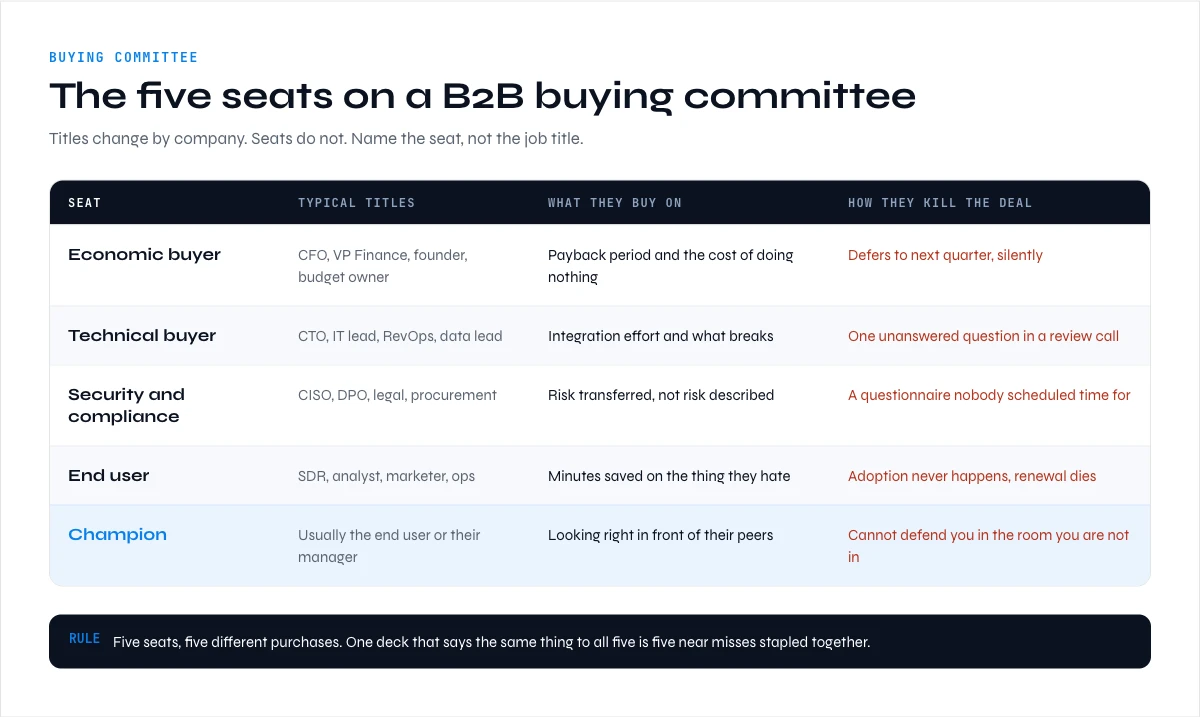
The five seats on a B2B buying committee, and what each one buys on
Titles change by company. Seats do not. Almost every B2B purchase, from a 400 euro tool to a six-figure platform, allocates the same five jobs across whoever happens to be available. Name the seat, not the job title, and your playbook stops breaking every time you move up-market.
| Seat | Typical titles | What they actually buy on | How they kill a deal |
|---|---|---|---|
| Economic buyer | CFO, VP Finance, founder, budget owner | Payback period and the cost of doing nothing | Defers to next quarter, silently |
| Technical buyer | CTO, IT lead, RevOps, data lead | Integration effort and what breaks | One unanswered question in a review call |
| Security and compliance | CISO, DPO, legal, procurement | Risk transferred, not risk described | A questionnaire nobody scheduled time for |
| End user | SDR, analyst, marketer, ops | Minutes saved on the thing they hate | Adoption never happens, renewal dies |
| Champion | Any seat, usually the end user or their manager | Looking right in front of their peers | Cannot defend you in the room you are not in |
Read that table twice, because it contains the entire argument. Five seats, five different purchases. A single deck that says the same thing to all five is not efficient. It is five near-misses stapled together.
The economic buyer: sell to decision makers who sign the invoice
The economic buyer is the seat most sellers get wrong in the same way: they send the feature list to the person who cares least about features. This seat is not evaluating your product. It is comparing your line item against every other line item competing for the same budget, and against the option of spending nothing.
Three things move this seat, in this order. Payback period, expressed in weeks or months, not percentages. The cost of the current situation, quantified with their own numbers, not your benchmarks. The risk of the decision itself, which is why a small, reversible first step beats an annual commitment every time.
Practical version: if a team of four SDRs each spends five hours a week researching accounts by hand, that is 80 hours a month. You do not need a slide to make that number frightening. You need the number, sourced from a discovery call with the end user, repeated back to the economic buyer in their own words. The wider set of B2B sales challenges almost always resolves to one of these arithmetic conversations that nobody had.
The technical and security seats: the two quiet vetoes
Nobody in these seats will tell you they killed your deal. They will ask a question in a meeting, receive a vague answer, and the group will move on to the safer option. The veto is exercised through doubt, not through refusal, which is why it is so hard to see coming.
The technical seat wants to know what it costs them, in their time, to make this work: where the data lands, what has to be maintained, and what happens when it breaks at 2am. The security and compliance seat wants risk transferred rather than described. Anything you can put in writing beforehand, you should: data handling, retention, sub-processors, where records sit.
The move that works: reach both seats before the formal review, with a short written answer to the three questions they always ask. Not a deck. A page. You are not trying to win them. You are trying to make sure that when your champion presents, neither seat has an open question to raise. Silence from these seats at the decision meeting is a win, and it is the only win they will ever give you.
In the web app or Google Sheets
Get the whole committee, not just your champion
The article's point is that one contact per account is not enough. From your list of target companies, Derrick imports the people matching the roles you name, one row each, so the committee is visible in your list before the deal stalls on someone you never met.
- Feature
- Import Leads from Target Companies
- Credit cost
- 1 credit per lead imported
The first button opens the web app (nothing to install): 1 credit per lead imported, 100 free credits every month. The second details the feature and its cost per plan.
The end user and the champion: your inside track
The end user is the only seat that experiences your product rather than evaluating it. They are also the cheapest seat to win, because their criterion is narrow and honest: does this remove the part of my week I dread. Win the end user and you get something no research can buy, which is the actual language the company uses to describe its own problem.
The champion is not a separate person so much as a role someone takes on. A champion is whoever is willing to spend internal credibility on you. That is a real cost to them, which means your job is to lower it. Give them the one-page business case they can forward without editing. Give them the answer to the objection you know finance will raise. Give them the number, not the adjective.
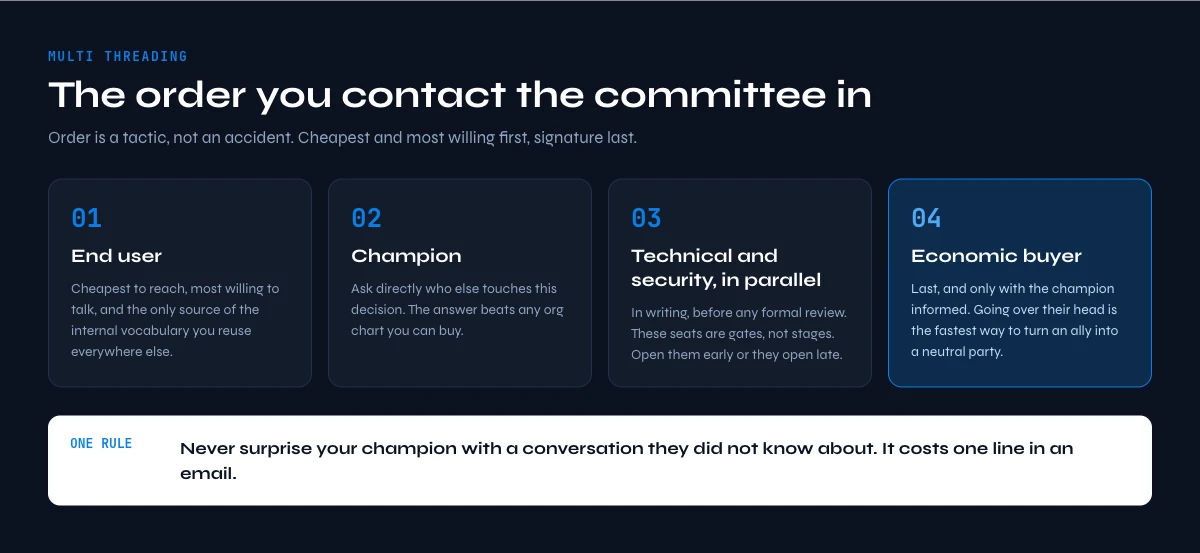
The order matters: a sequence to sell to decision makers without burning your champion
Most multi-threading advice stops at "talk to more people", which is how sellers end up emailing a CFO and a champion the same week with the same message, and losing both. Order is a tactic, not an accident.
A sequence that survives contact with a real organisation:
- End user first. Cheapest to reach, most willing to talk, and the only source of the internal vocabulary you will reuse everywhere else.
- Champion second, usually the same person or their manager. Ask directly who else touches this decision. The answer is more accurate than any org chart you can buy.
- Technical and security in parallel, in writing, before any formal review. These seats are gates, not stages. Open them early or they open late.
- Economic buyer last, and only with the champion informed. Going over a champion's head without warning is the single fastest way to convert an ally into a neutral party.
One rule holds the whole sequence together: never surprise your champion with a conversation they did not know about. Tell them who you are contacting and why, every time. It costs one line in an email and it is the difference between multi-threading and going behind someone's back. The same discipline shows up in any well-run outbound sales process, where sequence design is what separates coverage from noise.
The app works through your list row by row: 1 credit per lead imported.
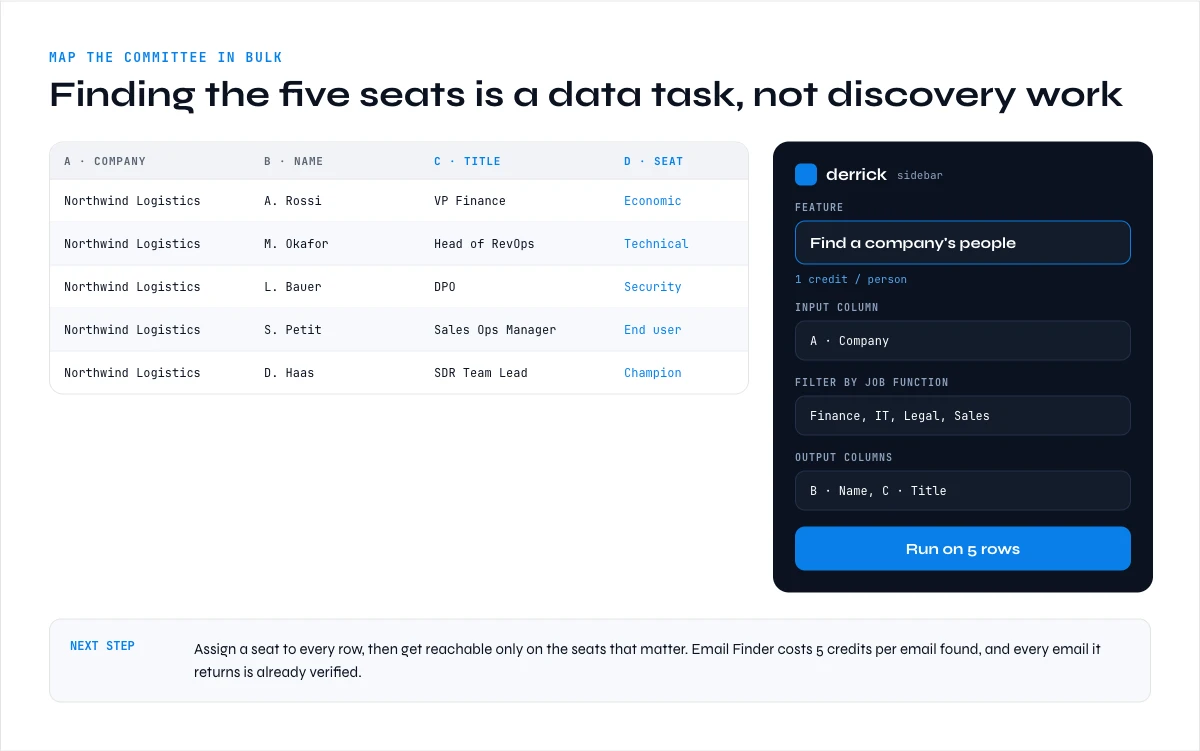
Map the committee before you write a single message
Everything above assumes you know who the five seats are. Almost nobody does. The standard CRM holds one or two contacts per account, and "find the rest" gets treated as discovery work that a rep does in the gaps between calls. That is why it never happens at scale.
It is a data task, and it should be done in bulk before the first email goes out. A published leadership page is often the fastest way to see the shape of a committee before you spend a credit on it: compare the decision-makers listed for Microsoft with Amazon's C-suite and the difference in how the two companies distribute authority is visible in one screen. The practical shape of it, in a spreadsheet:
- List the people at each account. Find a company's people returns current and former staff for any company, optionally filtered by job function, at 1 credit per person, without needing Sales Navigator. Filtering by function is what turns a headcount dump into a committee shortlist.
- Or cross your account list with your own criteria. Import Leads from Target Companies takes a list of target accounts plus your Sales Navigator criteria and returns the matching people, at 1 credit per lead, available on free and paid plans. It was built for exactly this ABM shape.
- Enrich what you pulled so you can assign seats rather than guess them. Enrich Leads fills in the profile detail at 1 credit per profile, on free and paid plans.
- Get reachable on the seats that matter. Email Finder costs 5 credits per email found, and every email it returns is already verified, so there is no separate verification pass to run. Phone Finder costs 200 credits per phone found, which is why you reserve it for the seats where a call genuinely changes the outcome rather than spraying it across the list.
Both finders bill per result found, so an account where nothing is found costs you nothing on that step. That distinction matters more than it sounds when you are running this across hundreds of accounts.
Derrick runs this in its web app or as a Google Sheets sidebar: you pick a feature, map the input columns, and it fills output columns row by row. If your motion is programmatic rather than manual, the same enrichment is available through the REST API from the Plus plan at 47.50 euros per month, through Zapier, Make and N8N, and through the Derrick MCP server, which lets you ask for the data from Claude, ChatGPT or any MCP-compatible assistant and get it back in the conversation. The same committee mapping works on 20 accounts or 20,000.
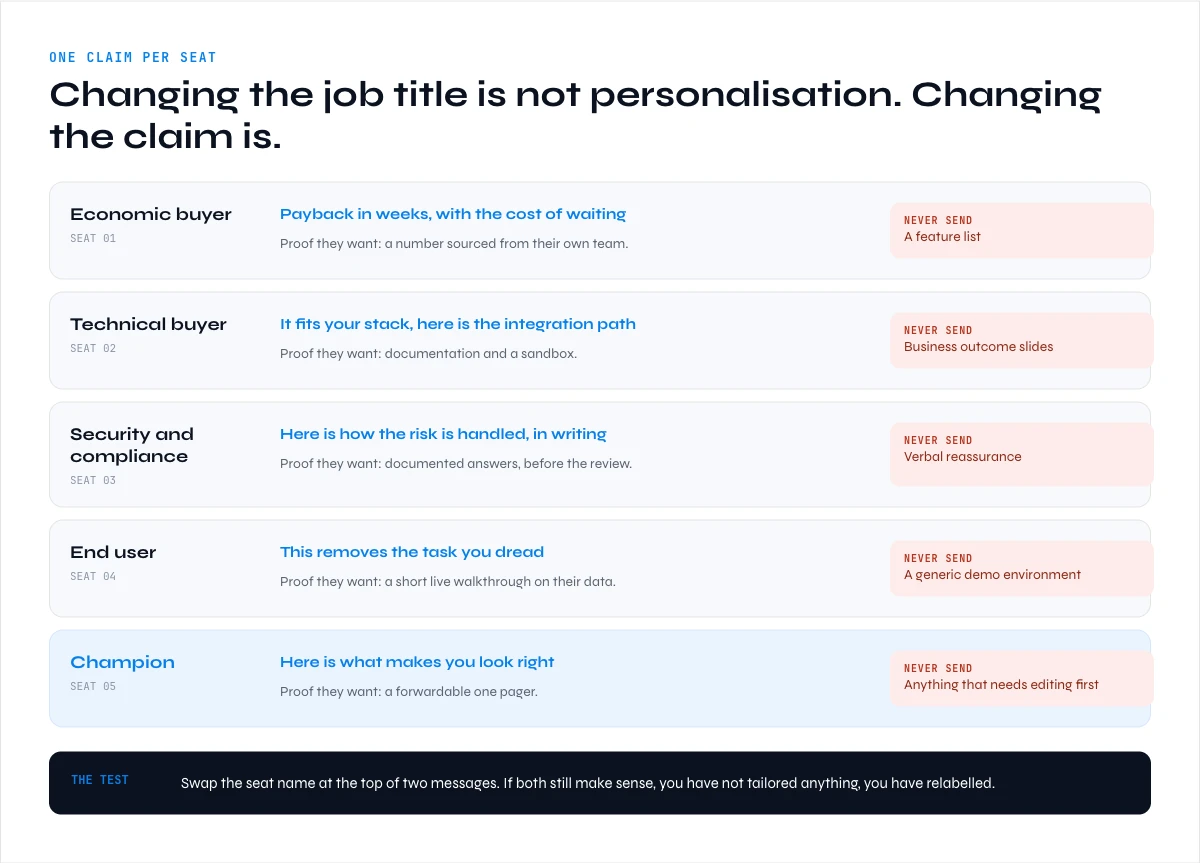
The message per seat, and the proof each one asks for
Tailoring is where most teams stop at the word and skip the work. Changing the job title in the first line is not personalisation. Changing the claim is.
| Seat | The claim that lands | The proof they want | What to never send them |
|---|---|---|---|
| Economic buyer | Payback in weeks, with the cost of waiting | A number sourced from their own team | A feature list |
| Technical buyer | It fits your stack, here is the integration path | Documentation and a sandbox | Business outcome slides |
| Security and compliance | Here is how the risk is handled, in writing | Documented answers, before the review | Verbal reassurance |
| End user | This removes the task you dread | A short live walkthrough on their data | A generic demo environment |
| Champion | Here is what makes you look right | A forwardable one-pager | Anything that needs editing first |
The test is simple. If you could swap the seat name at the top of two messages and both still make sense, you have not tailored anything, you have relabelled. Teams running structured account-based marketing programmes formalise exactly this, one content angle per seat rather than one campaign per account.
How to sell to decision makers when a gatekeeper blocks the path
The gatekeeper problem is usually misdiagnosed. An executive assistant filtering inbound is not an obstacle to route around, they are the best-informed person about that executive's actual priorities, and they will tell you if you ask them a real question instead of trying to slip past.
Three approaches that work, in decreasing order of reliability:
- Ask the assistant for routing, not for access. "Who owns the decision on X, and what is the right way to reach them" is a question a professional will answer. "Can you put me through" is a question they are paid to decline.
- Enter through the end user. An internal forward outperforms a cold approach to the executive by a wide margin. This is the strongest argument for the sequence in part 06.
- Change the channel, not the volume. If email is not landing at the executive seat, that is a channel problem. A verified direct number is the answer, which is what makes the 200 credits per phone found defensible on exactly those seats and indefensible across a whole list.
What does not work, and is worth naming: pretending you have already spoken to the executive, marking cold emails as urgent, or using a personal mobile number obtained in a way you would not want to explain in the first call. All three buy one conversation and cost the account.
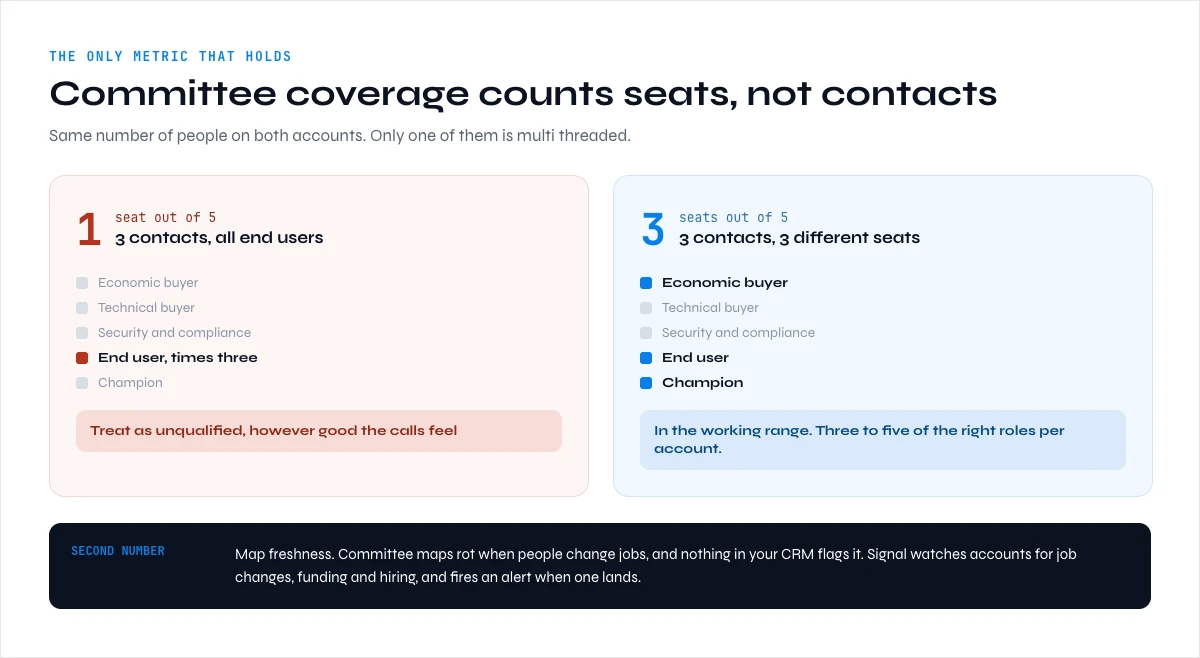
Committee coverage: the number that tells you it is working
Multi-threading collapses without a metric, because everyone believes they already do it. Track one number per open opportunity: named and contacted seats out of five. Not contacts, seats. Three contacts who are all end users is a coverage of one, not three.
Our buying committee report sets the working target at three to five of the right roles per account, and notes that single-threading a lone contact covers roughly a tenth of the decision surface. Below three seats, treat the opportunity as unqualified regardless of how good the calls feel.
Second number, and the one teams forget: map freshness. Committee maps rot. Contact data decays at roughly 2.1 percent per month, driven mostly by job changes, which compounds to somewhere between 22 and 30 percent a year. On a committee of five, that means a seat changing hands most years, and nothing in your CRM will flag it. This is what Signal is for: it tracks accounts and leads for job changes, funding rounds and hiring sprees, and fires the alert when one lands. It is available from the Standard plan at 20 euros per month, billed 1 credit per signal that actually fires.
What it costs to map and reach 100 committees
Sellers avoid this arithmetic, which is why coverage stays theoretical. Take 100 target accounts and five seats each, so 500 people.
| Step | Feature | Rate | Credits for 500 people |
|---|---|---|---|
| List the people at each account | Find a company's people | 1 credit per person | 500 |
| Enrich to assign seats | Enrich Leads | 1 credit per profile | 500 |
| Verified email, roughly 8 in 10 found | Email Finder | 5 credits per email found | about 2,000 |
| Total to map and reach 100 committees | about 3,000 |
Three thousand credits sits inside the Standard plan at 20 euros per month, which carries 10,000 credits and rolls unused credits over. The free plan carries 100 credits per month and no card, which is enough to map roughly twenty seats and see whether the workflow fits before you spend anything.
Direct dials are the expensive exception and should be budgeted deliberately: 200 credits per phone found means 100 numbers costs 20,000 credits, which is a Plus plan question at 47.50 euros per month rather than something you slip into the same run. Pick the seats worth calling. That is a strategy decision, not a budget accident. The same cost-per-row thinking applies when you build a prospect list from scratch.
Start with the free plan and run one account end to end before you scale the motion.
Five mistakes that quietly kill multi-threaded deals
- Going over the champion's head unannounced. Contacting the economic buyer without telling your champion converts your best asset into a neutral observer, permanently.
- Sending the same message to every seat. Five people compare notes. Five identical emails signal a campaign, not a conversation.
- Counting contacts instead of seats. Four names in one department is single-threading with extra steps.
- Mapping once and never again. A map built in January describes a committee that no longer exists by autumn.
- Waiting for the deal to progress before covering it. Coverage is what makes the deal progress. Reversing the order is how you end up with a pipeline of polite conversations.
None of these are selling failures. They are process failures, and every one of them is cheaper to fix than the deals it is costing. If the underlying issue is that your database cannot support this motion at all, that is a B2B database marketing problem before it is a sales one.
We publish one email every 2 weeks with playbooks like this one and the data behind them. The capture form below this article is where it goes out.
Frequently asked questions
How many decision makers are involved in a typical B2B deal?
Who are the five seats you need to sell to?
In what order should you contact a buying committee?
How do you get past a gatekeeper to reach a decision maker?
What does committee coverage mean and what is a good number?
How do you keep a buying committee map up to date?
What does it cost to map the buying committee across 100 accounts?
Can you map buying committees without Sales Navigator?
Keep reading
Continue exploring this cluster


The State of B2B Marketing Performance 2026: Benchmarks Report
Read →

Account-Based Marketing (ABM): Definition, Techniques, Examples
Read →

Inbound vs Outbound Marketing: Differences, When to Pick Each
Read →

B2B Lead Generation: Strategies, Tools, Tips in 2026
Read →