The 7 sales process steps, and the data each step runs on
The 7 sales process steps in order, the exact data each one depends on, the symptom that shows when it is missing, and a free diagnostic to find your leak.


A sales process is the repeatable sequence of stages a B2B team uses to turn a target account into a customer: who to contact, what to prepare, how to open, how to present, how to handle doubt, how to close and how to follow up. Written down, it lets you see where deals drop, coach one stage at a time, and forecast from progression rather than hope.
Every guide to the sales process steps gives you the same seven boxes: prospecting, preparation, approach, presentation, handling objections, closing, follow-up. The model is a century old, it is genuinely useful, and it is where almost every article stops. What none of them tell you is that four of those seven steps are not skill problems at all. They are data problems, and a rep with a perfect script will still stall on them if the row in front of them is wrong.
This guide walks the seven stages in order, and for each one names the specific thing that has to be true about your data for that stage to work. That is the part that decides whether the process runs or quietly leaks.
Why a defined sales process matters
A sales process that lives only in the heads of your best reps cannot be measured, and what cannot be measured gets fixed in the wrong place. Take an illustrative outbound month: 400 target accounts in, 300 with a reachable decision maker, 30 conversations, 10 qualified meetings, 3 deals. Without defined stages, all you see is 3 deals out of 400 and a vague feeling that closing is weak.
With the stages written down, the same month reads differently. A quarter of the list never had a reachable contact, which is a stage 1 data leak. Only one conversation in ten turned into a meeting, which is an approach problem. Closing converted 3 meetings out of 10, which is healthy. The team that had decided to buy closing training now knows it needs a better list and a sharper opener. That is the whole value of a defined process: it moves the fix to the stage that is actually broken.
It also makes the process teachable. A new rep can be coached on one stage at a time, and a manager can compare conversion between stages across reps instead of comparing total revenue, which mostly measures territory.
The sales process steps, in one table
The classic model is linear on paper and circular in practice. Here is the whole thing before we take it apart, with the failure that is most common at each stage.
| # | Step | What it actually decides | Most common failure |
|---|---|---|---|
| 1 | Prospecting | Who enters the pipeline at all | A list built from whoever was easy to find |
| 2 | Preparation | What you know before the first word | Research done by the rep, one tab at a time |
| 3 | Approach | Whether you get a conversation | An opener that could have been sent to anyone |
| 4 | Presentation | Whether the value lands on their problem | A demo of your roadmap instead of their workflow |
| 5 | Handling objections | Whether doubt gets surfaced or buried | Treating an objection as a signal to push harder |
| 6 | Closing | Whether the decision gets made | Asking the wrong person to sign |
| 7 | Follow-up | Whether the account grows or churns | Nothing scheduled after the contract |
Read the failure column again. Steps 1, 2 and 6 fail because of something you knew or did not know about the account. That is the thread this guide pulls.
Two neighbouring ideas are worth keeping apart. The stages as they appear in your CRM are covered in the guide to sales pipeline stages, and the time a deal takes from first contact to signature is the sales cycle. This guide is about the work done at each stage.
Sales process step 1: prospecting is a data problem
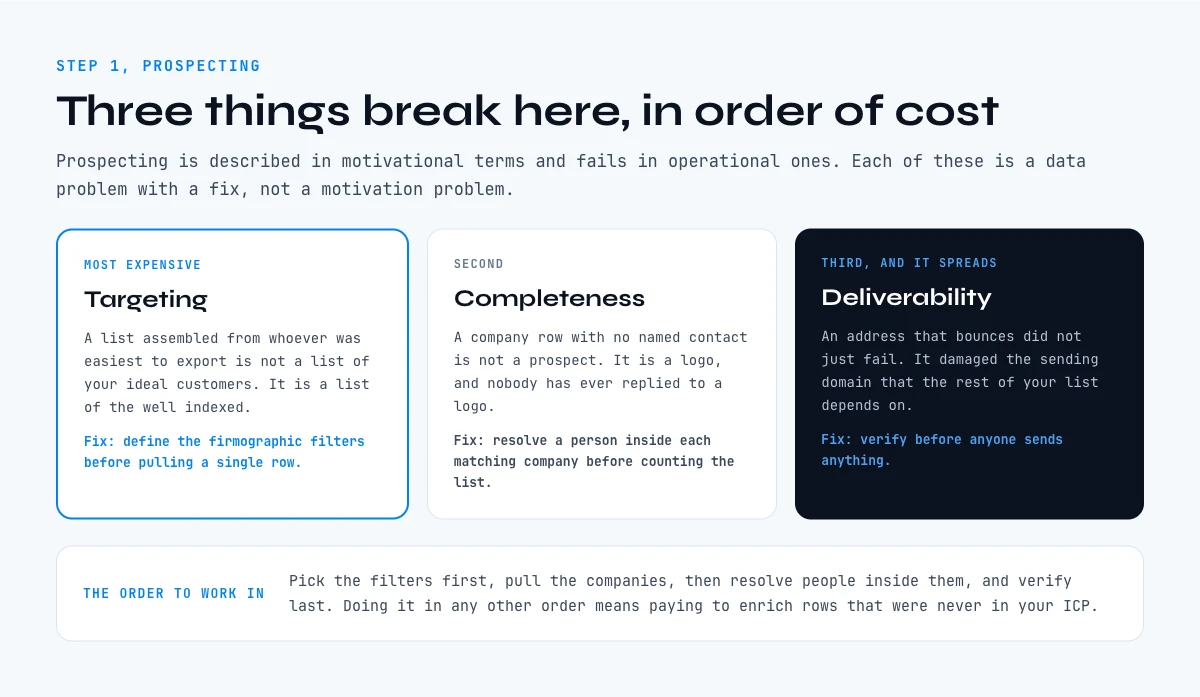
Prospecting is where the process is won or lost, and it is the step most often described in motivational terms rather than operational ones. "Build a list of ideal customers" is not an instruction. The instruction is: define the firmographic filters that describe an account worth your time, pull every company that matches, find the person in the relevant function, and get a contact point that resolves.
Three things break here, in order of how expensive they are. The first is targeting: a list assembled from whoever was easiest to export is not a list of your ideal customers, it is a list of the well indexed. The second is completeness: a company row with no named contact is not a prospect, it is a logo. The third is deliverability: an email address that bounces did not just fail, it damaged the sending domain that the rest of your list depends on.
The mechanics of getting this right are a subject of their own, and the step-by-step version with the real cost per thousand rows lives in the guide on how to build a prospect list. The short version: pick the filters first, pull the companies, then resolve people inside them, and verify before anyone sends anything.
This is also the step where tooling changes the shape of the work rather than just the speed. Pulling a few hundred matching companies and finding the right person inside each one is a batch operation, not a browsing session. Derrick runs it wherever your list already lives: the web app or the Google Sheets sidebar for a column of rows, the MCP server when you are asking a question inside an AI client like Claude, and the REST API when it is a step in an automated workflow. Enrich Companies costs 1 credit per company and works on the free plan, which is 100 credits a month at no cost. It reads LinkedIn company pages, so connect your LinkedIn account through the Derrick Chrome extension first.
Step 2: preparation, and the hours it quietly costs
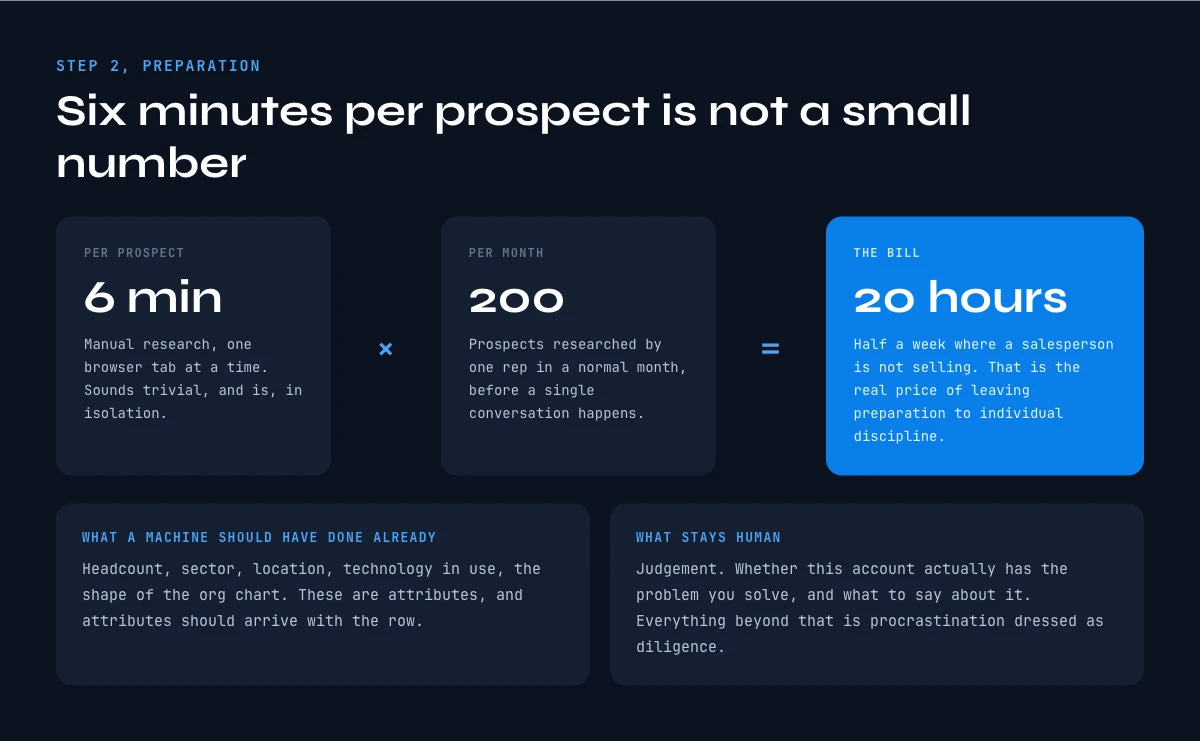
Preparation is the step that looks free and is not. The classic advice is to research the account before you reach out, which is correct and completely unactionable at volume. Six minutes of manual research per prospect sounds trivial. Across two hundred prospects in a month it is twenty hours, which is a salesperson not selling for half a week.
What the rep actually needs before the first contact is short and specific: what the company does in plain language, roughly how big it is, whether it matches the profile of accounts that already buy, who else sits on the buying committee, and one recent fact that proves you looked. Everything beyond that list is procrastination dressed as diligence.
The distinction that matters is between research a human must do and research a machine should have already done. Headcount, sector, location, technology in use and the shape of the org chart are all attributes, and attributes should arrive with the row rather than being fetched one browser tab at a time. What stays human is judgement: whether this account has the problem you solve, and what to say about it.
Steps 3 and 4: approach and presentation
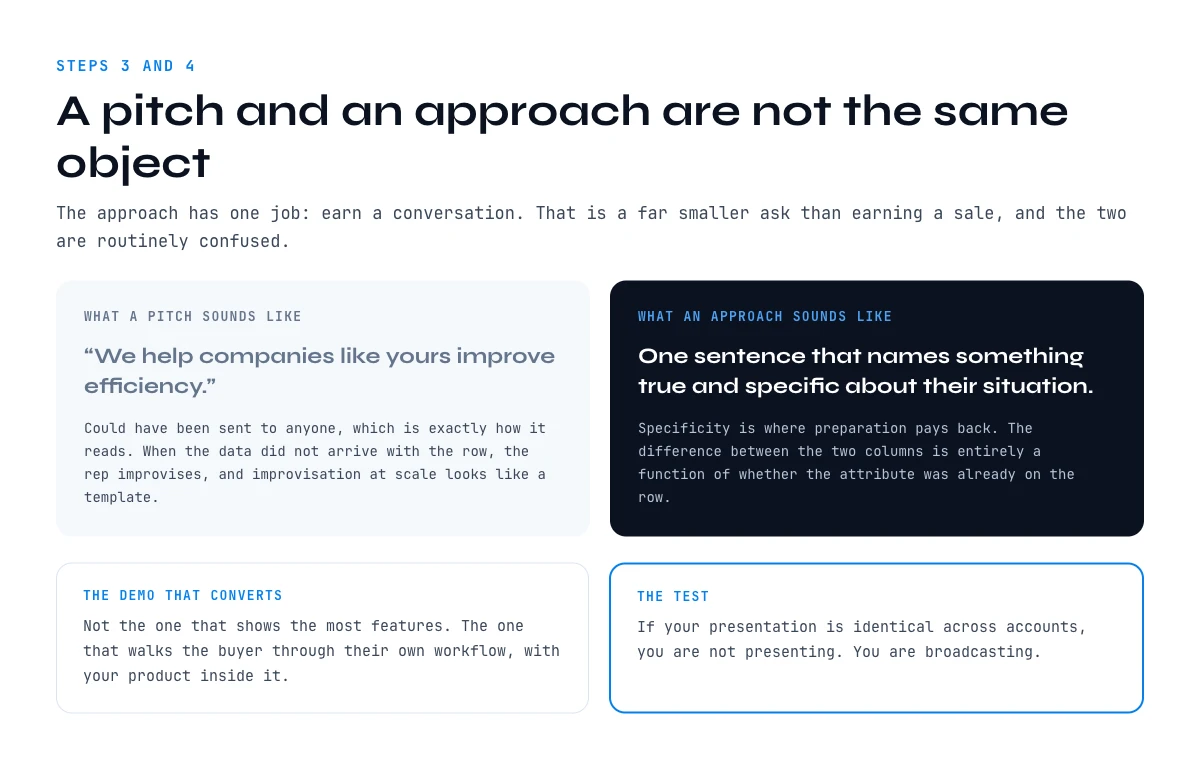
The approach is the first real contact, by phone, email or a LinkedIn message. Its only job is to earn a conversation, which is a much smaller ask than earning a sale and is routinely confused with it. An opener that describes your product is a pitch. An opener that names something true and specific about their situation is an approach.
Specificity is where preparation pays back. The difference between "we help companies like yours improve efficiency" and a sentence that references what their team actually does is entirely a function of whether the data arrived with the row. If it did not, the rep improvises, and improvisation at scale reads as a template.
Presentation is the step where most teams over-index on their own product. The demo that converts is not the one that shows the most features, it is the one that walks the buyer through their own workflow with your product inside it. That requires knowing the workflow, which loops back to step 2 again. If your presentation is identical across accounts, you are not presenting, you are broadcasting.
Channel choice belongs here too. A phone conversation and a written approach fail for different reasons and are worth reading about separately, which is what the guide on outbound sales covers in detail.
Steps 5 and 6: objections and closing
Handling objections is the most misunderstood of the seven stages, because the word "handling" suggests something to be overcome. An objection is information. It tells you either that the value has not landed, that the timing is wrong, or that you are talking to someone who cannot say yes. Only the first is a selling problem.
The third is a data problem wearing a selling costume. "I need to check with the team" is very often not a stall, it is an accurate description of a buying committee you did not map. In B2B the person who takes the first meeting is frequently not the person who signs, and the number of people involved has grown steadily. Mapping that committee before the close rather than discovering it during is covered in the guide on how to sell to decision makers.
Closing, when the previous five steps have been done, is usually undramatic. The theatrical close belongs to a world where the seller controlled the information. Today the buyer has read your pricing page, your documentation and two alternatives before the first call. A close in that world is an agreement on next steps, not a performance.
Step 7: follow-up, where the revenue actually is
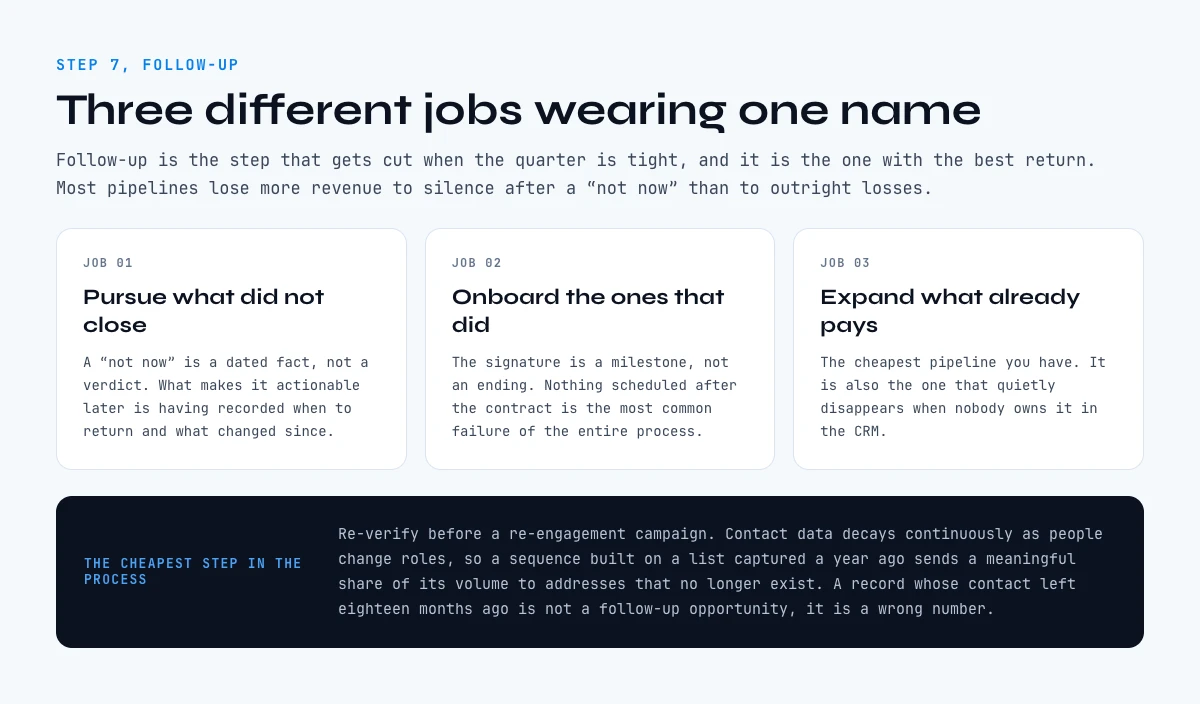
The seventh step is the one that gets cut when the quarter is tight, and it is the one with the best return. Follow-up covers three distinct jobs that get lumped together: pursuing deals that did not close, onboarding the ones that did, and expanding accounts that are already paying.
Most pipelines lose more revenue to silence after a "not now" than to outright losses. A "not now" is a dated fact, not a verdict, and the thing that makes it actionable later is having recorded when to return and what changed since. That is a CRM hygiene question, and CRM hygiene is a data question: a record whose contact left the company eighteen months ago is not a follow-up opportunity, it is a wrong number.
Contact data decays continuously as people change roles. A follow-up sequence built on a list captured a year ago will quietly send a meaningful share of its volume to addresses that no longer exist, which is both a wasted touch and a deliverability cost. Re-verifying before a re-engagement campaign is the cheapest step in the entire process.
The data layer under the sales process steps
Here is the same seven steps, mapped to the specific attribute that has to be present for the step to work. This is the table the other guides do not print.
| Step | Data it depends on | Symptom when it is missing |
|---|---|---|
| 1. Prospecting | Firmographics matching a defined ICP | High volume, low reply rate |
| 2. Preparation | Company context and org structure | Reps spend hours in browser tabs |
| 3. Approach | A verified, current contact point | Bounces and unanswered numbers |
| 4. Presentation | The buyer's actual workflow and stack | Generic demos, long sales cycles |
| 5. Objections | Knowing who is in the room | "I'll check internally" with no follow-through |
| 6. Closing | The decision maker identified early | Deals stall at the final step |
| 7. Follow-up | Contact records that are still accurate | Re-engagement lands nowhere |
Notice that steps 3 and 7 depend on the same thing: a contact point that resolves today. Finding one is a discrete job with a price. Email Finder costs 5 credits per email and only charges when a result is found. Phone Finder costs 200 credits per phone number on the same find-only basis. Both are on the paid plans.
Where is your sales process leaking?
Pick the step where deals most often stall. The output names the data dependency behind that step and what to check first.
Pick the step where your deals most often stall.
A diagnostic, not a verdict. If two steps feel equally bad, start with the earlier one: a leak at step 1 shows up as a symptom at every step after it.
Sales process vs sales methodology
The two words get used interchangeably and they should not be. The sales process is the what and the when: the stages a deal moves through and the exit criteria for each one. A sales methodology is the how: the framework a rep uses inside a stage to qualify, question or frame value. SPIN Selling is a questioning method for discovery and presentation. MEDDIC is a qualification checklist that mostly lives in stages 1, 5 and 6. Challenger is a way of teaching the buyer something during the approach and the presentation. You can swap methodologies without touching the process, and you should keep the process stable while you test them, otherwise you cannot tell which change did the work.
How to build your sales process in 5 steps
- Map what actually happens today. Pull the last twenty closed deals, won and lost, and list the real sequence of touches. The process on the slide and the process in the CRM rarely match.
- Define the stages and their exit criteria. A stage ends when something verifiable is true (a meeting is booked, a budget owner is named), not when a rep feels good about it.
- Define the data each stage needs. For every stage, write the attributes that must be on the record before the rep starts it: firmographics for stage 1, company context for stage 2, a verified contact for stage 3, the buying committee for stage 6. This is the step most teams skip.
- Assign owners. Decide who runs each stage and where the handoffs sit, so no account falls between two people.
- Measure conversion between stages. Track the drop-off and the time spent at each stage from the first week, so the next change is driven by a number.
SDR, BDR, AE: who owns which step
SDR vs BDR is mostly a question of where the lead comes from. An SDR (sales development rep) works inbound leads and qualifies them; a BDR (business development rep) creates pipeline from cold outbound. Both hand over to the AE (account executive), who runs the deal to signature. In smaller teams the three roles collapse into one person; the stages stay the same.
| Stage | SDR (inbound) | BDR (outbound) | AE |
|---|---|---|---|
| 1. Prospecting | Triages inbound leads | Builds and works the target list | Names strategic accounts |
| 2-3. Preparation and approach | Qualifies the request | Researches and opens the account | Reviews the handover |
| 4-6. Presentation to closing | Hands over | Hands over | Owns the deal |
| 7. Follow-up | Re-engages lost leads | Re-engages "not now" accounts | Onboarding and expansion |
The BDR vs SDR split matters for the data layer: a BDR needs a complete list before stage 1 even starts, while an SDR needs fast enrichment of whoever just filled in a form.
B2B vs B2C sales process
The stages are the same; the weight is not. A B2C purchase is usually one person deciding in minutes or days, so approach and closing collapse into a checkout. A B2B purchase involves several people, a budget cycle and often procurement, so preparation, objection handling and closing stretch over weeks. This guide is written for the B2B case, where the data behind each stage matters most.
When to update your sales process
Revisit it when the conversion between two stages moves by more than a few points for two months in a row, when you launch into a new segment or price point, or when the average deal size changes enough that the old stage count costs more than the deal returns. Otherwise leave it alone: a process that changes every month cannot be measured.
The seven-step model is a scaffold, not a script. A self-serve product with a fourteen day trial and an enterprise deal with a procurement review share the same skeleton and almost nothing else. Three adjustments cover most cases.
- Collapse steps when the deal is small. Below a certain contract value, approach and presentation are the same message. Running six formal stages on a deal worth a few hundred euros a year costs more than the deal returns.
- Split step 6 when a committee is involved. Enterprise closing is rarely one event. Legal, security and procurement each behave like their own mini-cycle with their own objections.
- Move step 2 upstream when volume is high. At scale, preparation stops being something a rep does per account and becomes something the list arrives with. This is the single highest-leverage change most teams can make.
The one thing not to adjust is the order. Every attempt to skip prospecting rigour and make it up later with better closing produces the same result: a full pipeline of accounts that were never going to buy, and a team that concludes it has a closing problem.
Whether your motion is inbound or outbound changes which steps carry the weight, and the comparison is worked through in inbound vs outbound marketing. If most of your pipeline raises its hand first, the guide on inbound sales is the closer fit.
Sales process optimization: where the process leaks
Sales process optimization starts with three numbers per stage, not with a new tool. The first is the drop-off: the share of accounts that enter a stage and never leave it forward. The second is the duration: how many days an account spends in the stage, which tells you where deals stall rather than where they die. The third is the cost in hours: rep time spent per account at that stage, which is where the invisible leaks sit.
Put the three side by side and the priority is usually obvious. A stage with a high drop-off and a short duration is a qualification problem upstream. A stage with a normal drop-off and a long duration is a handoff or a committee problem. A stage with a normal drop-off, a normal duration and a high cost in hours is an automation candidate.
That last category is almost always stages 1, 2 and 7: building the list, preparing the account, and keeping contact records accurate. They are supply work rather than selling work, and they are where automation pays first. Enriching a list of companies with Enrich Companies costs 1 credit per company and runs on the free plan (with your LinkedIn account connected through the Chrome extension); finding and checking the contact point (Email Finder at 5 credits per email found, then Email Verification at 1 credit per email) opens from the Standard plan at 20 euros a month. Run it in the Derrick web app for a list, in the Google Sheets sidebar if the list already lives there, or through the API from the Plus plan when it has to run inside your CRM without anyone clicking.
What not to automate is judgement: whether an account has the problem you solve, and what to say about it. Stages 3 to 6 improve with coaching and better inputs, not with more volume.
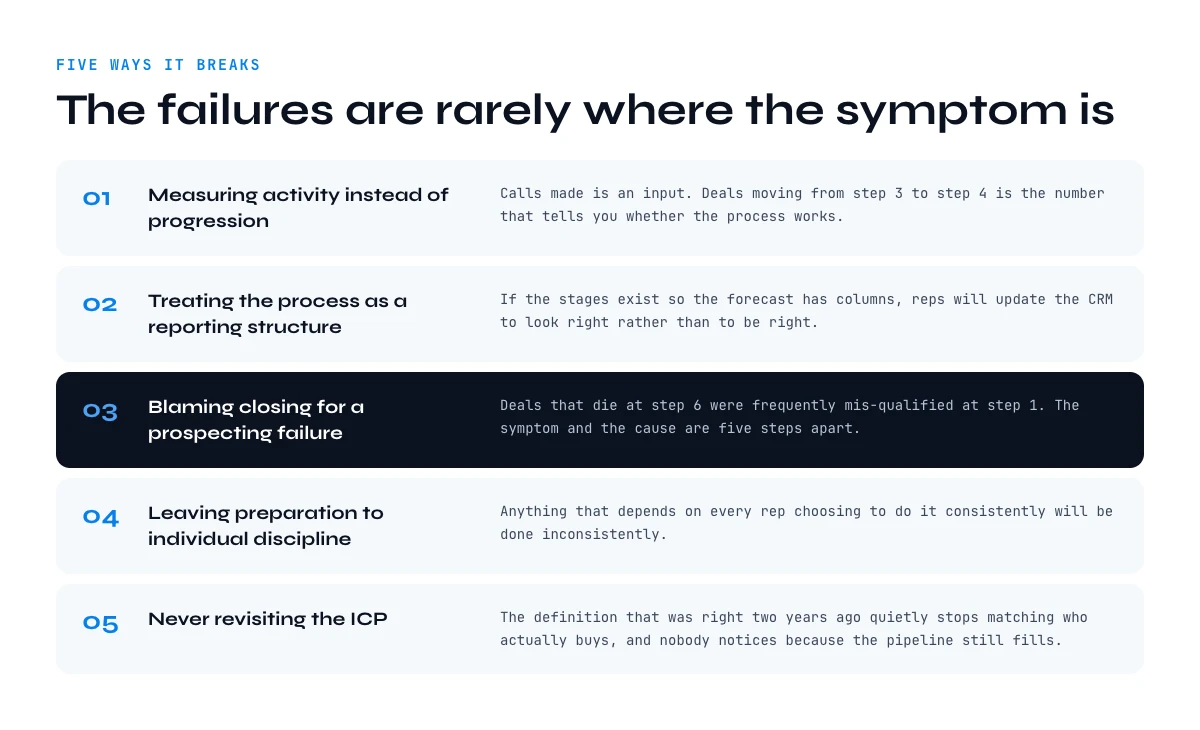
Five ways the sales process steps break
- Measuring activity instead of progression. Calls made is an input. Deals moving from step 3 to step 4 is the number that tells you whether the process works.
- Treating the process as a reporting structure. If the stages exist so the forecast has columns, reps will update the CRM to look right rather than to be right.
- Blaming closing for a prospecting failure. Deals that die at step 6 were frequently mis-qualified at step 1. The symptom and the cause are five steps apart.
- Leaving preparation to individual discipline. Anything that depends on every rep choosing to do it consistently will be done inconsistently.
- Never revisiting the ICP. The definition that was right two years ago quietly stops matching who actually buys, and nobody notices because the pipeline still fills.
Where to start
Pick the earliest step that is leaking and fix that one. Teams tend to work on the last step that hurt, which is usually closing, and closing is usually a symptom. If your reply rates are low and your bounce rate is not, the leak is targeting. If your bounce rate is high, the leak is the contact data. If demos feel generic, the leak is preparation.
Two of the seven steps can be improved this week without changing anything organisational, because they are supply problems rather than behaviour problems: the completeness of the list, and the accuracy of the contact point. Start on the free plan in the web app with 100 credits a month and run one week of prospecting through an enriched list before you change a single script. The full catalogue of what can be resolved per row is on the features page.
We publish one email every 2 weeks with playbooks like this one and the data behind them. The capture form below this article is where it goes out.
Frequently asked questions
What are the 7 steps of the sales process?
Which step of the sales process matters most?
How long should the sales process take?
Why do deals stall at the closing step?
What data does each stage of the sales process need?
How do I know which stage of my sales process is failing?
What is the difference between a sales process and a sales methodology?
What is the first step of the sales process?
Keep reading
Continue exploring this cluster


How to Build a Prospect List: 6 Steps and the Real Cost per 1,000 Rows
Read →

Outbound sales
Read →

What Is Inbound Sales? Process, Qualification and Metrics
Read →

How to Sell to Decision Makers: The Buying Committee Playbook
Read →