
LinkedIn Account Based Marketing: The List Problem Nobody Mentions
LinkedIn account based marketing fails on execution, not strategy. Fix the match rate, the committee coverage and the contact layer before the tactics.


Most guides on this subject open with the definition and close with ad formats. The part in between, the part that decides whether the programme works, gets three sentences: how you actually assemble the list of accounts and the people inside them.
LinkedIn account based marketing is the practice of picking a finite set of companies you intend to win, then coordinating advertising, outreach and content against that specific set on LinkedIn rather than against a broad audience. It is the same discipline as ABM anywhere else, with one platform-specific complication that almost nobody warns you about: LinkedIn has to recognise your companies before it can target them, and it will not recognise all of them.
The short version: the tiering frameworks are fine and freely available. The list is the hard part, the match rate is the silent failure, and the buying committee inside each account is what turns a targeted impression into a conversation. Build those three properly and the tactics take care of themselves.
What LinkedIn account based marketing actually requires
Strip away the vocabulary and the programme has four inputs. A list of companies you have decided to win. A recognised identity for each of those companies on the platform. A named set of humans inside each one. And a reason to contact each of them that is specific enough to survive being read by a busy person.
Everything else, tiering models, orchestration diagrams, attribution dashboards, sits on top of those four. If the list is vague, the tiering is theatre. If the companies are not matched, the ads do not run. If the committee is a single contact, the deal stalls at the first internal handover.
The reason this matters on LinkedIn specifically is that the platform is unusually good at the last mile and unusually unhelpful at the first. It will let you reach a named seniority inside a named company with great precision, and it will give you very little help assembling that list of companies in the first place. Our general treatment of what account-based marketing is and how it works covers the strategy layer; this page is about the plumbing. The wider B2B marketing hub sets both in context, and the outbound sales guide covers the motion once the list exists.
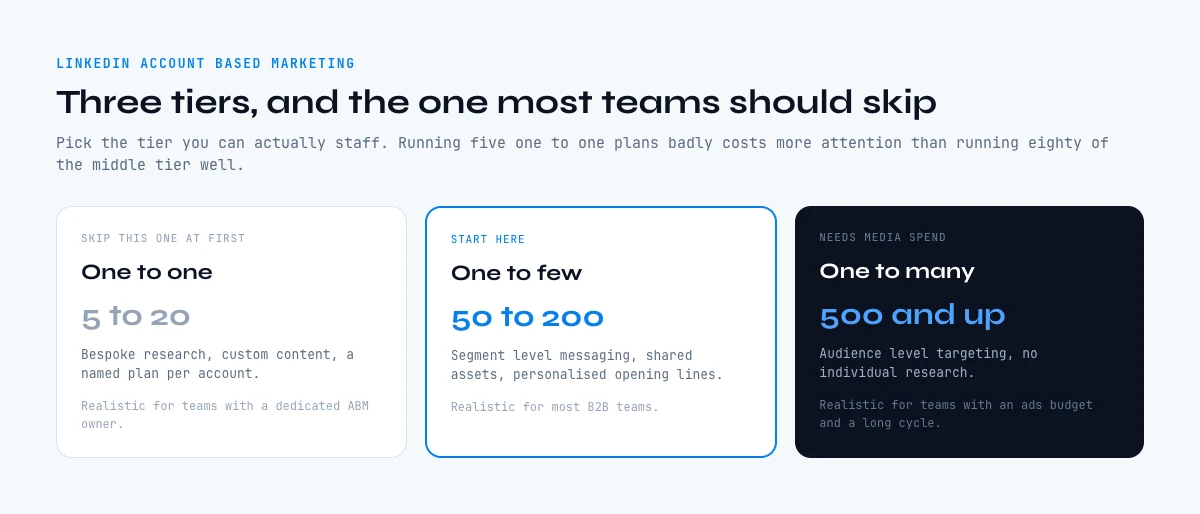
The three tiers, and the one most teams should skip
The standard model splits accounts three ways, and it is genuinely useful as long as you are honest about which tier you can actually staff.
| Tier | Accounts | What it means in practice | Realistic for |
|---|---|---|---|
| One to one | 5 to 20 | Bespoke research, custom content, named plan per account | Teams with a dedicated ABM owner |
| One to few | 50 to 200 | Segment level messaging, shared assets, personalised opening lines | Most B2B teams |
| One to many | 500 to several thousand | Audience level targeting, no individual research | Teams with an ads budget and a long cycle |
The tier most teams should skip is the first, at least initially. One to one ABM is really an account plan wearing a marketing label, and running five of them badly costs more attention than running eighty of the middle tier well. Start in the middle, where the personalisation is real but the research is bounded, and graduate the accounts that earn it.
The tier most teams overrate is the third. One to many on LinkedIn is essentially paid audience targeting with an account filter, which is a fine thing to buy and a poor thing to confuse with ABM. It produces impressions against companies. It does not produce a named person you can call.
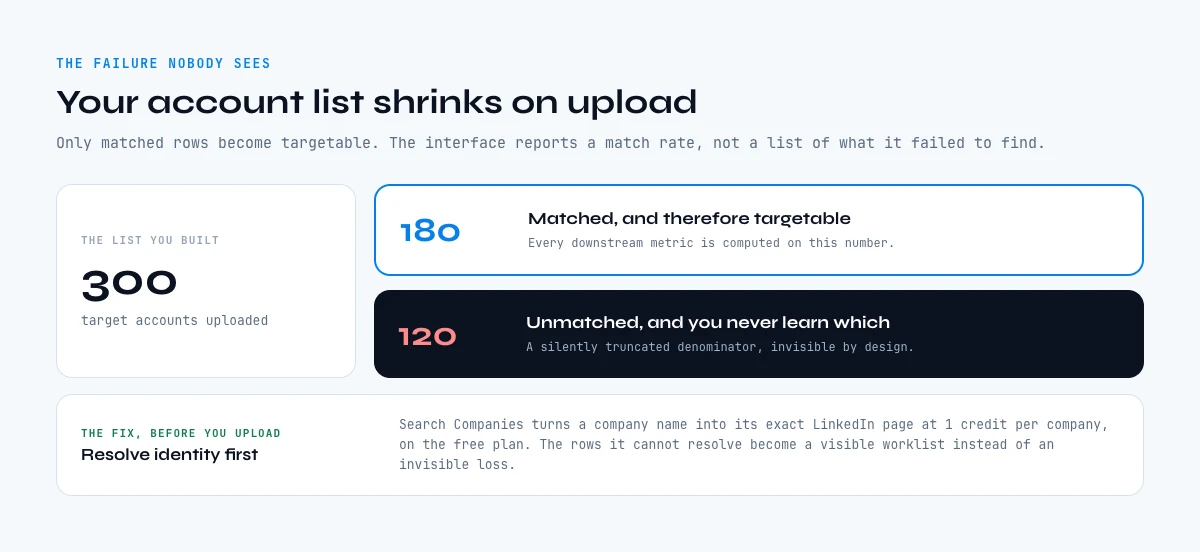
The hidden failure: your account list shrinks on upload
Here is the mechanic that quietly halves a lot of programmes. The feature is called Matched Audiences: you upload a list of company names or website domains, and LinkedIn matches them against its own company pages. Only the matched rows become targetable. The unmatched rows disappear, and the interface, as it works today, reports a match rate rather than a list of what it failed to find.
Names are the problem. A company files as "Acme Group Holdings SAS", trades as "Acme", and runs a LinkedIn page called "Acme | Industrial Automation". Your CRM has one of those three, your list has another, and the matcher has to guess. Subsidiaries, rebrands, accented characters and country suffixes all make it worse.
The consequence is worth stating plainly: you can build a perfect list of 300 target accounts, upload it, target 180 of them, and never learn which 120 fell out. Every downstream metric is then computed on a silently truncated denominator.
There is a second constraint stacked on top. LinkedIn documents a minimum of 300 member accounts before an ad set can run, so a fifty account list that matches at 60% may simply be too small to serve, and you find that out after building the campaign rather than before. The fix for both problems is the same: resolve the identity before you upload rather than after. Search Companies takes a company name and returns its LinkedIn URL at 1 credit per company, on the free plan. Running your list through it first turns a fuzzy name match into an exact page reference, and the rows it cannot resolve become a visible worklist instead of an invisible loss.
Building the account list that LinkedIn account based marketing runs on
A target account list is something you decide, and an export is something you receive. The useful ones are short, defensible line by line, and built from something other than a filter panel.
Three starting points work well, and they combine. The first is your own best customers: take the five accounts you would happily clone and find their neighbours. Find Similar Companies turns one LinkedIn company page into an ICP matched list with industry, country and a score, at 1 credit per matched company on the free plan.
The second is a written description of who you want. If your ICP is a sentence rather than a set of checkboxes, Import Companies from a Prompt takes that sentence and returns matching companies with name, industry, country, website and LinkedIn URL, at 1 credit per company.
The third is qualification on top. Whichever way the list arrives, enrich it before you commit budget to it: Enrich Companies fills in the full company detail at 1 credit per company. Our guide to building a prospect list and its real cost per thousand rows works through the arithmetic, and the data-first playbook for database marketing covers keeping it current.
One discipline to impose early: cap the list at what your team can genuinely cover in a quarter. Above a couple of hundred accounts you have stopped doing ABM and started maintaining a mailing list with better vocabulary.
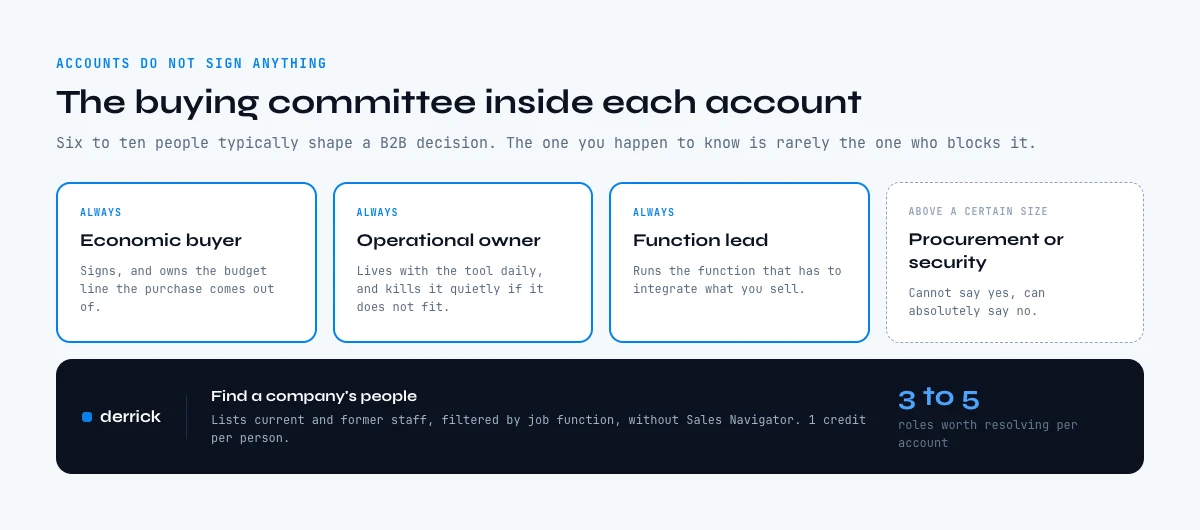
Resolving the buying committee inside each account
Account level targeting reaches a company. Companies do not sign anything. Between six and ten people typically shape a B2B decision, and the one you happen to know is rarely the one who blocks it.
So the second list matters as much as the first: for each account, the three to five roles that matter in your deal. Usually that is the economic buyer, the operational owner who will live with the tool, and whoever runs the function that has to integrate it. Sometimes procurement or security, depending on the size.
Import Leads from Target Companies is built for exactly this: it crosses your list of target accounts with your Sales Navigator criteria and imports the matching people, at 1 credit per lead. If you do not have Sales Navigator, Find a company's people lists current and former staff filtered by job function at 1 credit per person, with no Sales Navigator needed. That one is a paid feature, unlike the list building steps above, so it is the point where an ABM programme starts costing money per account rather than per company.
Then decide, per role, what a first touch looks like. The mistake is treating the committee as one audience and sending everyone the same asset. The operational owner cares about the workflow, the economic buyer cares about the number, and sending each the other's message is how a well targeted campaign produces polite silence. Our page on selling to decision makers and the buying committee goes into the sequencing.
Running LinkedIn account based marketing without an ads budget
Paid amplification makes ABM faster. It is not what makes it work, and treating the ad account as the programme is the most expensive way to learn that.
The organic version has four moving parts and no media spend. Your team follows and engages with the target accounts, so the brand appears in the feed of the people you care about before you ever write to them. Your executives publish against the specific problem those accounts have, which is worth more than a sponsored post because it comes from a person. Your reps work the committee individually, with an opening line drawn from something real. And the whole thing is coordinated on one shared list, so marketing and sales are demonstrably working the same accounts.
That last point is the one that actually separates ABM from ordinary outbound, and it costs nothing but agreement. Our guide to LinkedIn prospecting on a free account covers the ceilings you will hit on the organic route, which are real and worth planning around.
Where paid earns its place is coverage. Advertising reaches the six people in the committee you never identified, and it keeps reaching them between touches. That is a genuine benefit, and it works on top of a resolved list rather than in place of one.
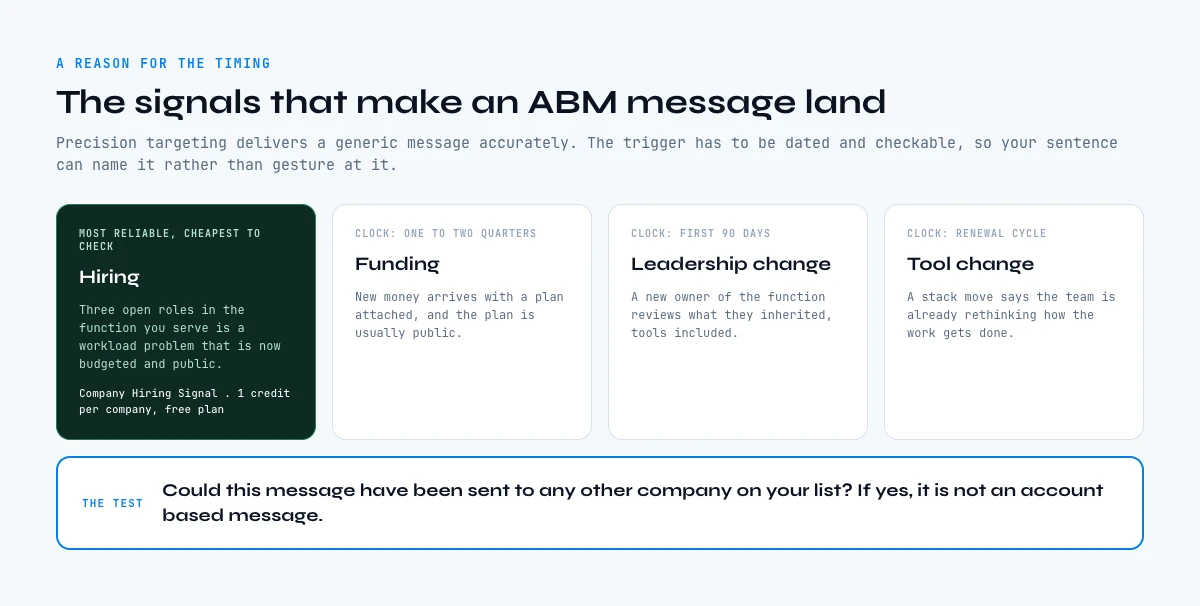
The signals that make an ABM message land
Precision targeting delivers a generic message accurately, which is a different thing from making it relevant. What makes an account based message land is a reason for the timing, and the reason has to come from outside your own funnel.
Hiring is the most reliable one and the cheapest to check. A company opening three roles in the function you serve has a workload problem that is now budgeted and public. Company Hiring Signal returns which companies on your list are hiring and for which roles, at 1 credit per company, on the free plan.
Funding, leadership changes and tool changes work the same way with different clocks. What matters is that the trigger is dated and checkable, so the sentence you write can name it rather than gesture at it.
The practical test for any ABM message is whether it could have been sent to a different company without editing. If it could, the targeting did not reach the copy, and no amount of account matching will fix that.
Coverage maths: how many contacts your list really needs
Before committing to a tier, price the contact layer it implies. The calculator below turns an account count and a tier into the number of humans you will have to resolve, which is the number that actually determines whether the programme is staffable.
ABM coverage: how many contacts your account list implies
Pick your tier and how many accounts you intend to work. The output is the committee coverage that tier demands, and what it means for a quarter.
Pick a tier and an account count to see the contact layer it implies.
Committee sizes follow the usual 6 to 10 stakeholders per B2B decision, of which you realistically work a subset. Adjust down for transactional deals and up for enterprise.
Measuring LinkedIn account based marketing honestly
Lead counts are the wrong instrument here. A programme aimed at 150 companies will always look bad next to one aimed at everybody, and reporting it on volume guarantees it gets cancelled.
| Measure | What it counts | Read it when |
|---|---|---|
| Coverage | Share of target accounts with at least three resolved, contactable people | Weekly. It is the only one you control directly |
| Penetration | Distinct people per account who have engaged at all | Monthly. It tells you if you are reaching the committee or one person |
| Progression | Accounts that moved from unaware to engaged to in conversation | Quarterly, or one sales cycle, whichever is longer |
| Concentration | Share of total engagement coming from accounts on the list | Quarterly. It tells you whether the list is the programme or a decoration |
Coverage is the one to instrument first, because it is the only one you control directly and it predicts the rest. An account with one contact is an account that stalls the moment that person goes quiet.
Set the measurement window to your sales cycle rather than to the reporting calendar. Judging a nine month cycle on a quarterly lead number is how good programmes get killed at month four.
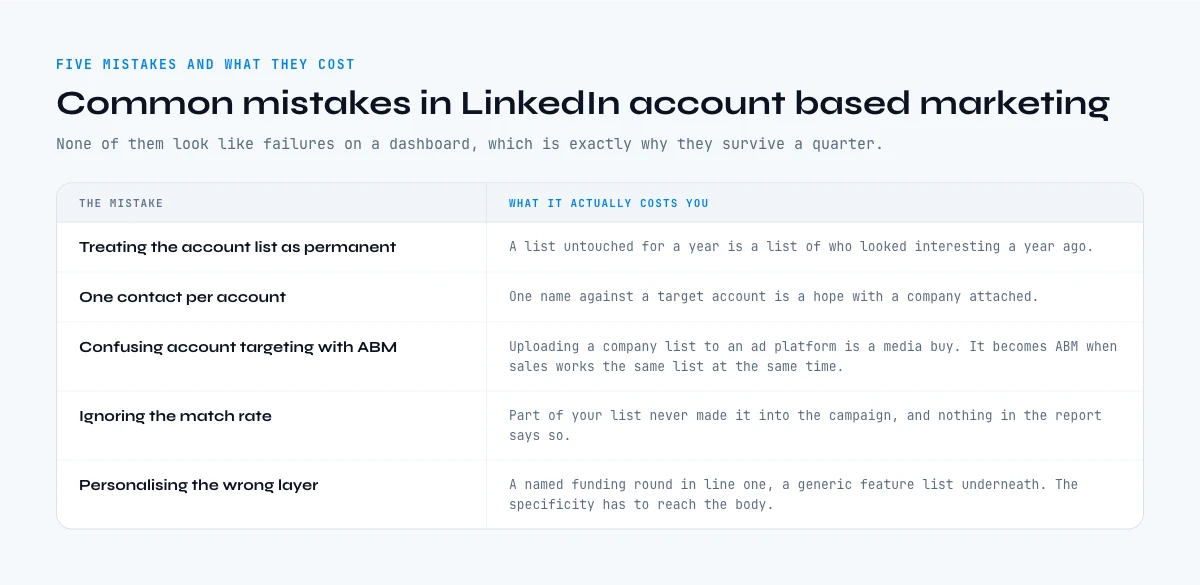
Common mistakes in LinkedIn account based marketing
- Treating the account list as permanent. Companies change and so does fit. A list that has not been revised in a year is a list of who looked interesting a year ago.
- One contact per account. The single most common failure, and the easiest to fix. If your CRM holds one name for a target account, what you have is a hope with a company attached.
- Confusing account targeting with ABM. Uploading a company list to an ad platform is a media buy. It becomes ABM when sales works the same list with the same message at the same time.
- Ignoring the match rate. Covered above, and worth repeating because it is invisible by design.
- Personalising the wrong layer. Mentioning a company's recent funding in the first line of a message whose body is a generic feature list fools nobody. The specificity has to reach the offer as well as the greeting.
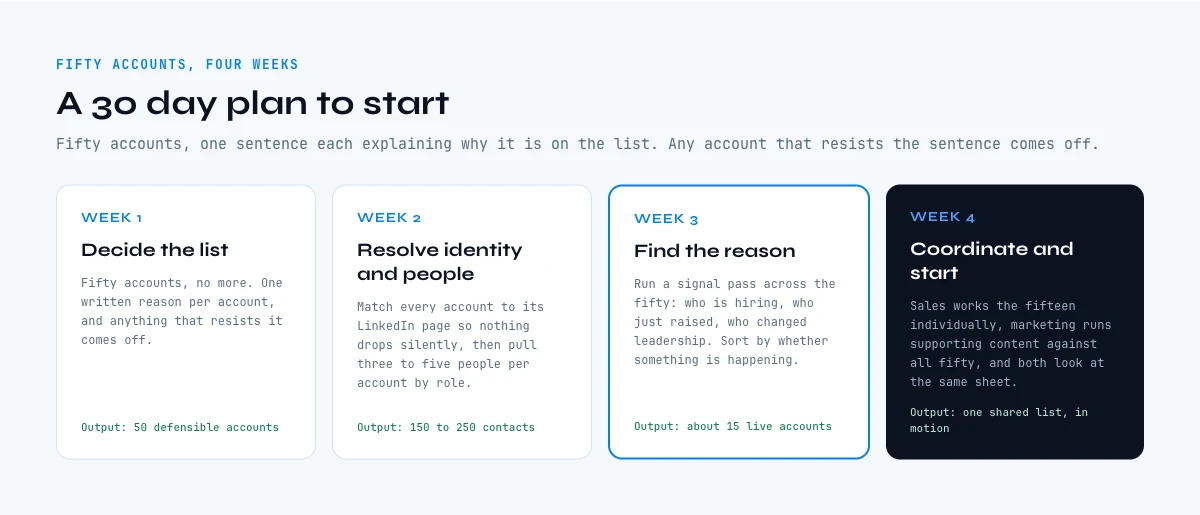
A 30 day plan to start
- Week one, decide the list. Fifty accounts, no more. Write one sentence per account explaining why it is on there. Any account that resists the sentence comes off.
- Week two, resolve identity and people. Match every account to its LinkedIn page so nothing silently drops later, then pull three to five people per account by role. That is 150 to 250 contacts, which is a day of work rather than a project.
- Week three, find the reason. Run a signal pass across the fifty: who is hiring, who just raised, who changed leadership. Sort the list by whether something is happening, and accept that maybe fifteen accounts have a live reason this month. Those fifteen are the campaign.
- Week four, coordinate and start. Sales works the fifteen individually, marketing runs supporting content against all fifty, and both look at the same sheet. If you intend to add paid coverage, check first that the Matched Audience clears the 300 member account minimum, which a fifty account list frequently will not; otherwise keep week four organic and save the budget for the tier above. Then measure coverage and penetration, not leads.
If this workflow belongs in a pipeline rather than a spreadsheet, the same lookups run through the REST API and the Derrick MCP from any compatible AI assistant, both on a paid plan.
Where this leaves you
The strategy layer of ABM is well documented and mostly free. The execution layer is where programmes fail, and it fails in three specific places: a list built from a filter rather than a decision, companies that never matched, and accounts represented by a single contact.
Fix those three and the tactics become interchangeable. Ads, InMail, executive posts, events: all of them work reasonably well against a list of the right fifty companies with the right four people identified inside each. None of them work against a list of two thousand names nobody chose.
Start with fifty accounts and the people inside them. The free plan includes 100 credits per month, and resolving an account to its LinkedIn page costs 1 credit, so it covers an identity pass on 100 accounts and tells you straight away how many of yours would not have matched. Add the committee layer at 1 credit per person and the same allowance covers closer to twenty accounts end to end, which is why the first pass is worth running on its own.
Frequently asked questions
What is LinkedIn account based marketing?
Why do accounts disappear when you upload a list to LinkedIn?
How many accounts should be on an ABM target list?
How many contacts do you need per target account?
Can you do ABM on LinkedIn without an ads budget?
How do you measure LinkedIn account based marketing?
What makes an ABM message actually land?
What is the difference between account targeting and ABM?
Keep reading
Continue exploring this cluster


The State of B2B Marketing Performance 2026: Benchmarks Report
Read →

Account-Based Marketing (ABM): Definition, Techniques, Examples
Read →

Inbound vs Outbound Marketing: Differences, When to Pick Each
Read →

B2B Lead Generation: Strategies, Tools, Tips in 2026
Read →