
How to prospect effectively: six sales prospecting decisions and the rate behind each
Learn how to prospect effectively: six sales prospecting decisions, the rate that judges each, scripts for six channels, a weekly plan and six templates.


What sales prospecting is, and how to prospect effectively
Sales prospecting is the work of finding potential buyers who do not know you yet and starting a conversation with them, before anything reaches the pipeline. The short definition lives in our glossary entry on sales prospecting. This guide takes the next question: how to prospect effectively, week after week, with numbers that tell you whether it works.
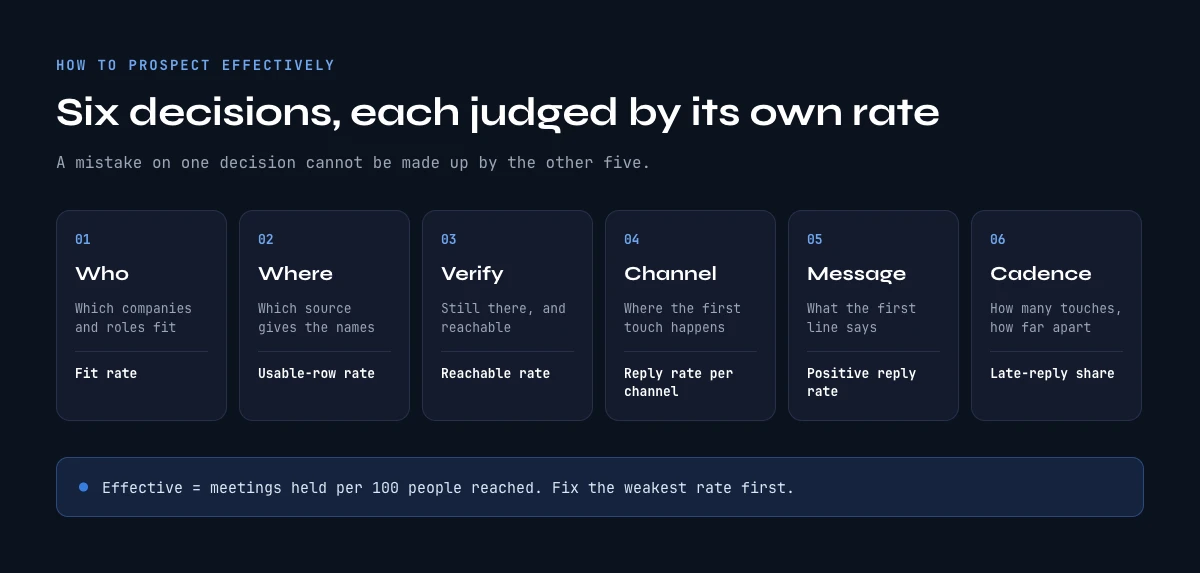
Most prospecting tips and prospecting strategies you will find are lists of advice. The advice is often sound, and it skips the part that decides the result. Prospecting in sales is a chain of six decisions, and each one can be right or wrong on its own:
- Who you go after.
- Where the names come from.
- What you check before you write.
- Which channel opens the conversation.
- What the first message says.
- How many times you come back.
A mistake on one of them cannot be made up by the other five. That is why this page treats the sales prospecting process as a set of decisions rather than a set of steps.
Here, "effectively" has one precise meaning: meetings held per 100 people reached. Emails sent and cost per lead are other questions, covered by other guides in this series. Every decision below comes with the rate that tells you whether that decision was good, and all six rates roll up into meetings held per 100 people reached.
Prospect, lead, and how prospecting differs from lead generation
The two terms are often confused, which skews reporting. In short: a lead is someone who has shown some interest, through a form, a download or a reply. A prospect is someone who fits your target and has not raised a hand yet. B2B prospecting turns prospects into conversations. Lead generation is the wider system, inbound included, that produces leads from any source, and our B2B lead generation guide covers it. This page stays on the outbound side: people you chose, reached on your initiative.
The key points to remember
- Sales prospecting is six decisions in a row: who, where, what to verify, which channel, what to say, how often. Each has its own rate.
- The effectiveness rate is meetings held per 100 people reached. A campaign that sends less and holds more meetings is the better campaign.
- The channel follows the prospect: role, company size, signal and reachability decide it.
- A signal before the message (hiring, funding, a new role, engagement on a post) lifts the reply rate more than any rewrite of the copy.
- Discipline carries the week: fixed blocks, fixed volumes, one change at a time.
Why today's buyers make prospecting harder, in numbers
Buyers now decide as a group of six to ten people, arrive with their requirements mostly set, and give vendors a thin slice of their time, so prospecting has to reach several people with a relevant reason, fast. A single buyer waiting to be informed by a sales rep was the assumption of prospecting ten years ago. The figures below come from our own research reports, each one tied to the section where you can read the detail and the original source.
- Six to ten people sign off. Gartner describes a typical B2B buying group of roughly six to ten stakeholders, and wider for complex purchases. We lay out the sources in the B2B buying committee report, section "How many people really sign off". One contact per account covers a fraction of the decision.
- Around 83% of buyers have largely defined their requirements before they talk to a vendor, according to independent research cited in the same report, section "The committee buys before it talks to you".
- About 17% of total buying time goes to meeting potential suppliers, split across every vendor under consideration, per Gartner in that same section. Your slice of attention is thin before you even start.
- Two thirds of buyers prefer a rep-free experience for parts of the journey, by Gartner's 2026 reading, also in that section. The conversation has to be earned.
- Reps spend only around 28% of their time actually selling, per Salesforce's State of Sales research, as summarized in our Sales Navigator prospecting report, section "How reps actually spend their time". The rest goes to administration, data entry and research.
- Automating the non-relational parts of selling can free roughly 20% of sales capacity, a McKinsey estimate reported in our B2B data enrichment ROI report, section "The selling-time tax".
- B2B contact data decays at roughly 2.1% per month, which compounds to about 22.5 to 30% per year; Gartner places broader business-data decay near 3% per month. Same report, section "The cost of inaction: decay". A list built last year is about a quarter wrong today.
- A buying signal loses value within about 48 hours. Teams that act on a fresh signal inside that window convert at several times the rate of teams that let it sit, as our B2B intent data report explains in "The 48-hour activation window".
Put together, these numbers say three things about how to prospect effectively in 2026. First, reach several people per account, because the decision is collective; the committee report puts the useful coverage at three to five of the right roles, in "How many contacts you actually need per account". Second, reach them with something that relates to what they are already researching, because they arrive half decided. Third, protect the hours: a large share of the prospecting week goes to rebuilding data that should have been right, a point our manual prospecting report develops in "Where the week actually goes" and "The context-switching tax". Every tab you open to find an email is time taken from the conversation.
Cold outreach still works in this context. What it punishes is carelessness, and the rest of the guide removes the carelessness one decision at a time.
The sales prospecting process: six decisions and the rate that judges each
Here is the whole method on one table. Read it as a checklist you can run before any campaign, and as a diagnostic after it: when the final number disappoints, the rate that fell tells you which decision to revisit.
| Decision | The question | The rate that judges it | A bad rate usually means |
|---|---|---|---|
| Who | Which companies and roles fit? | Share of contacted accounts that turn out to be a fit | The profile is too wide or written from intuition |
| Where | Which source gives you the names? | Share of sourced rows usable as they are | Stale source, wrong filters, duplicates |
| What to verify | Is the person still there, and reachable? | Share of the list you can actually reach | Unverified addresses, people who left |
| Channel | Where does the first touch happen? | Reply rate per channel | Channel chosen by habit |
| Message | What does the first line say? | Positive reply rate | Generic opener, no reason to answer now |
| Cadence | How many touches, how far apart? | Share of replies that arrive after touch one | Stopping after one attempt, or pushing too hard |
You make the six decisions again for every segment, and you revisit one of them each time its rate drifts. Below, one section per decision, each with what to decide, how to decide it, and the rate to watch.
How to prospect effectively, decision 1: who to go after and the fit rate
Every sales prospecting problem that looks like a copy problem should first be checked here. When the people you contact could never buy, the reply rate quietly blames the writing, and the campaign cannot recover through the message.
Deciding who means two layers. The account layer: industry, headcount, country, the tools a company uses, whether it is growing. The person layer: the roles that feel the problem you solve and the roles that sign. Write both down, with criteria you can check on a record. "Fast-growing SaaS companies" is an adjective. "Software companies with 50 to 500 employees, based in the US or UK, with at least two open sales roles" is a filter.
The method for deriving that profile from your won deals, rather than from a workshop, is in our ICP in sales guide. What matters for this decision is the rate that checks it: the fit rate, the share of contacted accounts that, once you talk to them, match the profile you wrote. You measure it from replies and meetings. If fewer than two out of three conversations confirm the fit, tighten the criteria before you touch anything else.
How many people per account
The "who" decision is also a number. Because six to ten people take part in a B2B purchase, one contact per account is a bet on a single person. For accounts that matter, pick two or three roles: the person who feels the problem every day, the person who owns the budget, and, when the product touches their systems, the technical evaluator. Contact them a few days apart, with a message adapted to each role. For a volume segment of small companies, one person, usually the founder or the head of the function, is enough.
One practical rule: keep a separate profile per segment. A single profile that blends two markets produces an average fit rate that hides a good segment and a bad one. Split them, and each rate becomes readable.
Where the names come from: the usable-row rate
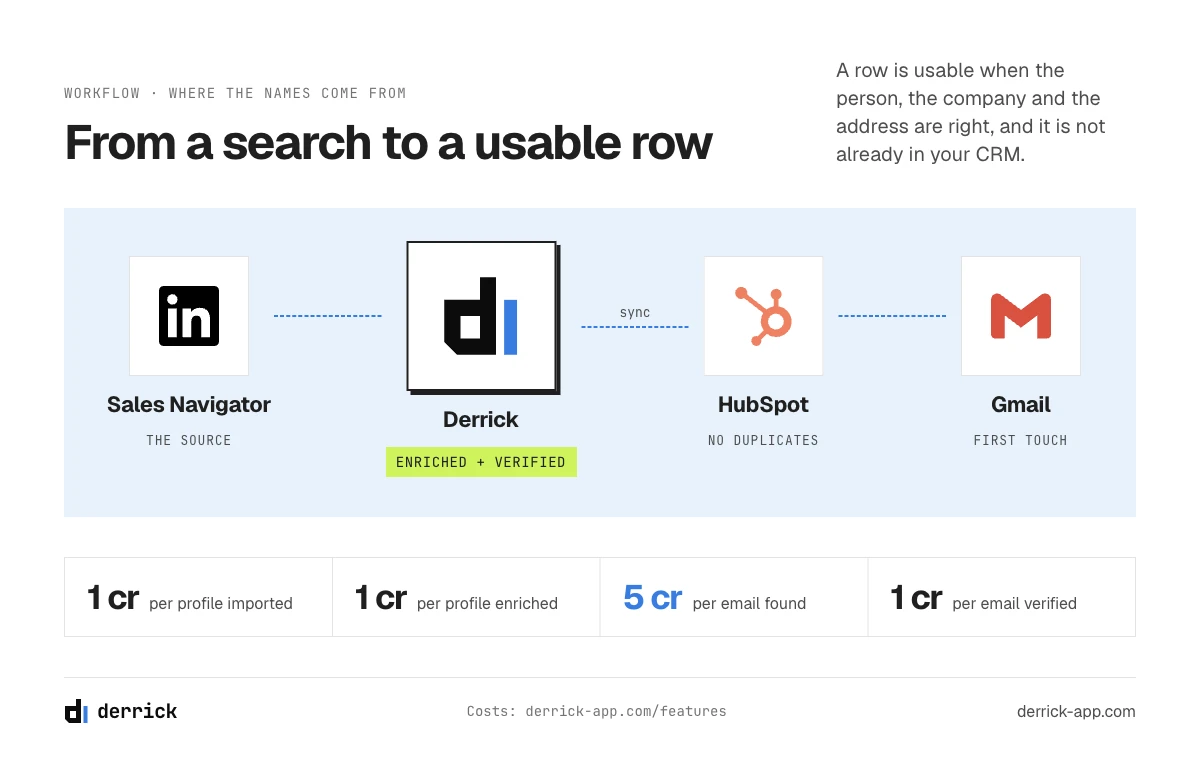
Once the profile is written, you need names. Sources vary: a search on LinkedIn or Sales Navigator, a list of target accounts crossed with roles, a public registry, people who engaged with a post, event attendee lists, your own CRM. Each source has its own blind spots, and the choice depends on the profile you just wrote. A narrow list of named accounts calls for an account-first approach; a broad segment of small companies calls for a registry or a search.
What this decision needs is a way to compare sources, and the rate for that is the usable-row rate: out of 100 rows a source gives you, how many can be used as they are, with the right person, the right company and no duplicate?
Two sources can look identical in volume and differ by half in usable rows. Track the rate per source for a month and the choice becomes obvious. A source that delivers 60 usable rows out of 100 costs more time than one that delivers 90, because each bad row is discovered by hand, later, by someone whose job is to sell.
What to verify before you write: the reachable rate
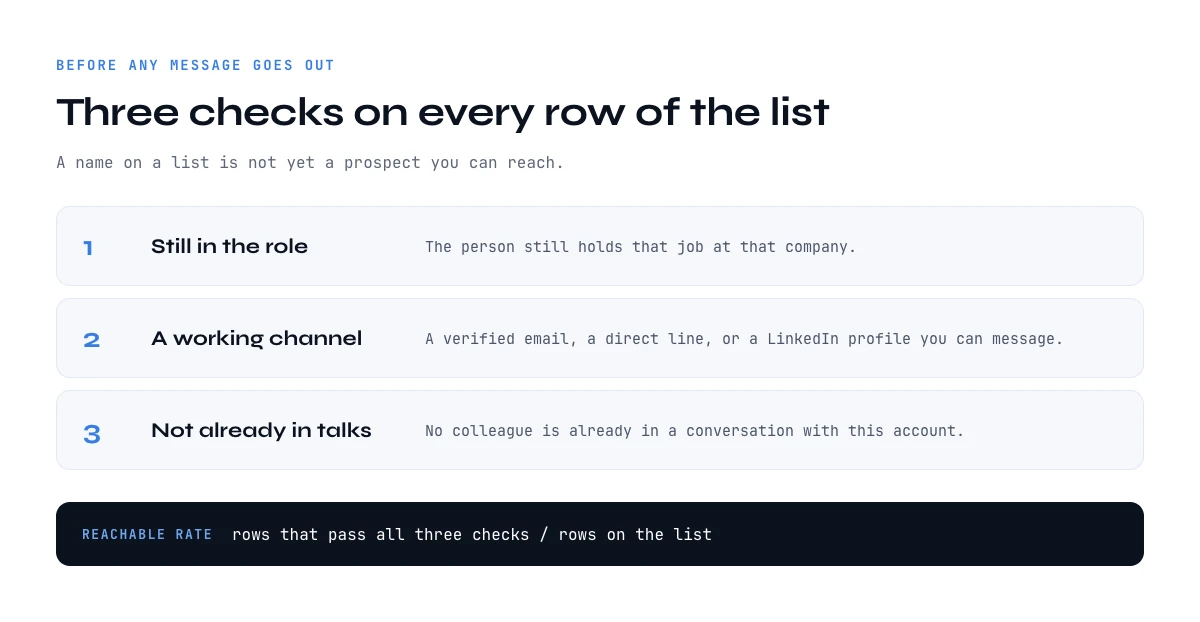
This decision sits between the list and the message, and most teams skip it. A name on a list is not yet a prospect you can reach. The person may have left the company six months ago. The email may bounce. The phone number may be a switchboard. Contact data decays by roughly 2% a month, so a list that was clean in January has lost part of its value by summer.
Before any message goes out, check three things on each row: the person still holds the role at that company, you have a working channel to reach them (a verified email, a direct line, or a LinkedIn profile you can message), and the account is not already in conversation with a colleague. The rate that judges this decision is the reachable rate: the share of your list you can actually reach once the checks are done. Everything below that rate is outreach that cannot land.
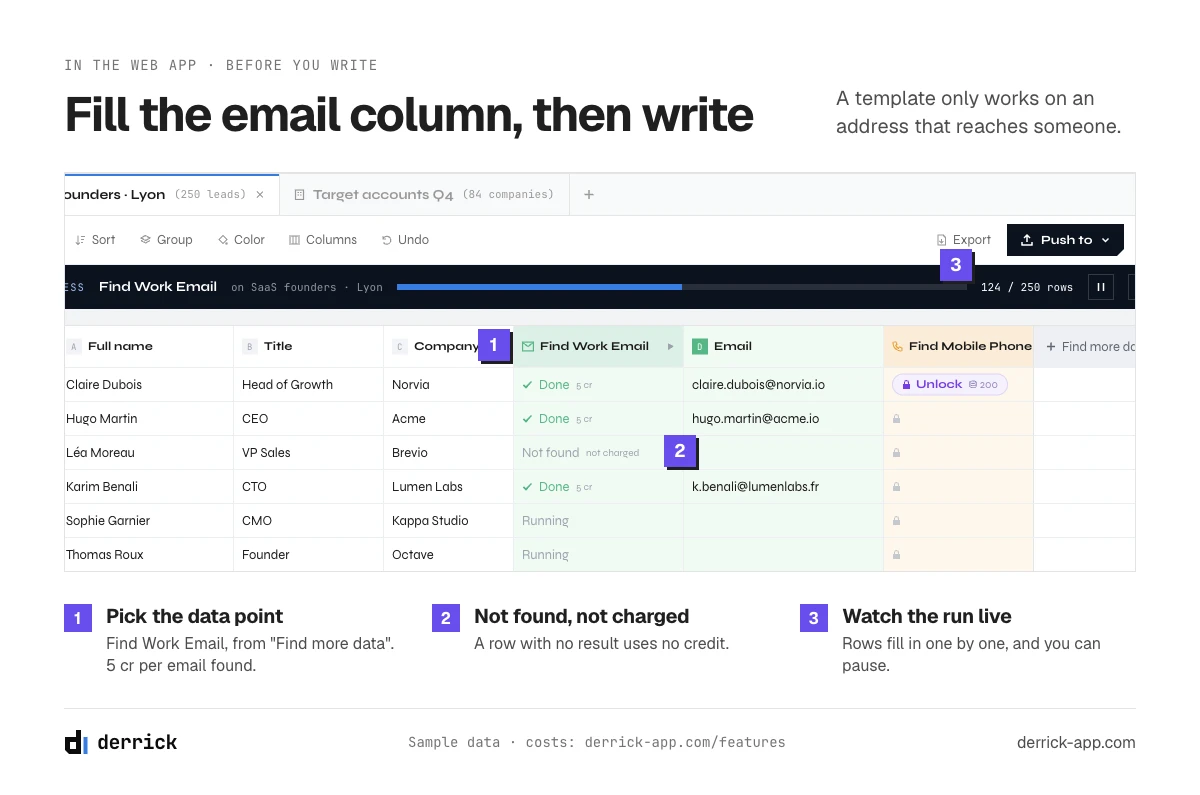
This is where Derrick fits in a sales prospecting workflow. Email Finder starts from the LinkedIn profile URLs in your list and returns professional emails that are already verified, at 5 credits per email found and nothing when no email is found; it is part of the paid plans, from Standard at 20 euros a month. For addresses that come from elsewhere, an old CRM or an imported file, Email Verification checks each one before it enters a sequence, at 1 credit per email, also on the paid plans. Both run from the Derrick web app (or its Google Sheets sidebar). The MCP server, for Claude, ChatGPT or any MCP client, and the REST API are available from the Plus plan, at 47.50 euros a month; the web app needs nothing to install.
Qualification, deciding whether a reachable person is worth a sales conversation, is a separate question. The check here is narrower and comes first: can this person be reached today?
Picking the channel for the first touch: reply rate per channel
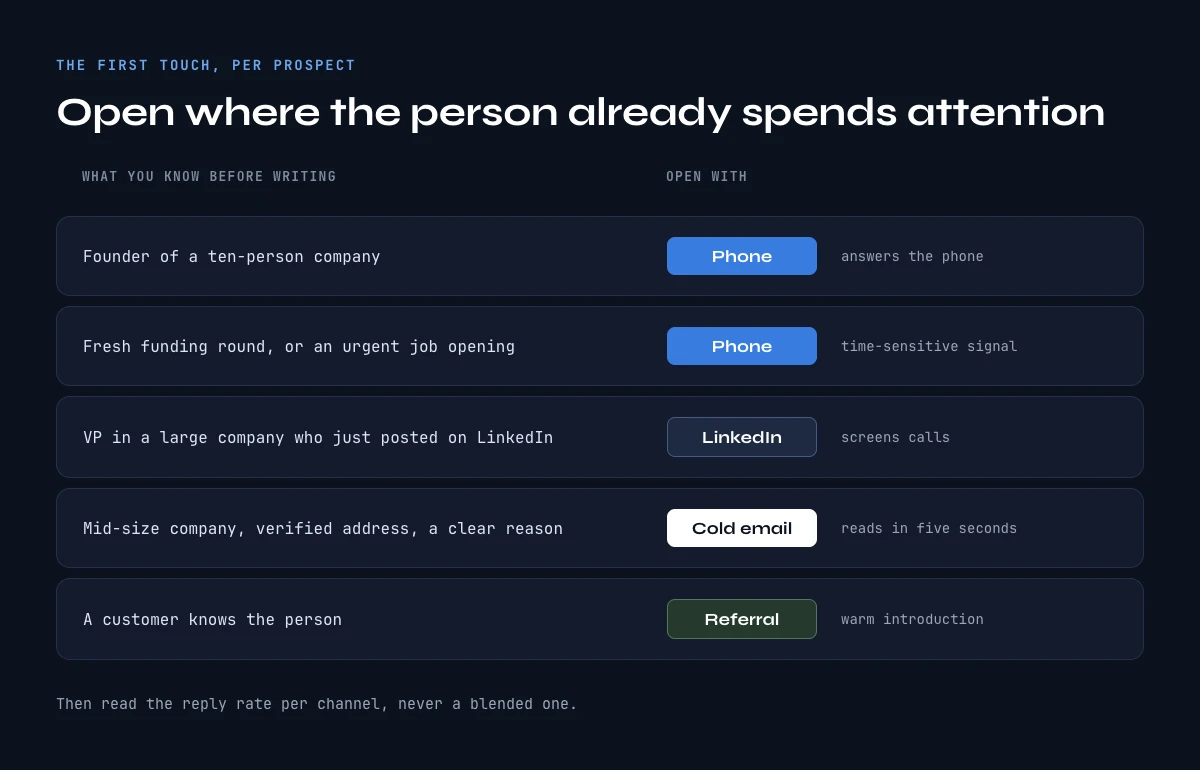
Pick the opening channel per prospect, from four facts you can check before writing: company size, role, the signal you have, and how reachable the person is on each channel. Teams tend to pick a channel once and apply it to everyone: an email team emails, a phone team calls. The rate that judges this decision is the reply rate, measured separately for each channel. A blended reply rate across email, phone and LinkedIn leaves you with no basis to choose next month's channel.
Two principles frame the choice. The first touch should happen where the person already spends attention: a founder of a ten-person company answers the phone, a VP in a large company screens calls and reads LinkedIn in the evening. And the channel should match the reason you have to write: a signal seen on LinkedIn (a post, a new role) calls for LinkedIn first, a signal that is time-sensitive (a fresh funding round, an urgent job opening) calls for the phone. How channels chain together over a full sequence is covered in our outbound sales guide; this decision is about the opener, because the first channel sets the tone of everything that follows.
The channel rule, in one table
| Channel | Open with it when | Weak when | What you learn first | Usual delay to a first answer |
|---|---|---|---|---|
| Cold email | You have a verified address and a reason the person can read in five seconds; mid and large companies | The address is unverified, or the role lives in the field and rarely reads email | Open and reply signals within days | Hours to a few days |
| Phone | Small companies, owner-led businesses, time-sensitive signals, roles that sit at a desk | Large companies with switchboards and assistants, no direct line | Yes, no or later, in one minute | Immediate |
| The person is active on LinkedIn, the signal came from LinkedIn, senior roles that screen calls | Dormant profiles, roles with no LinkedIn habit | Acceptance, then reply | One to several days | |
| Referral | A customer, partner or former colleague knows the person | No shared contact, or the shared contact is weak | Whether the introduction happens at all | Days |
| Events | Your targets attend the same event, in person or online | No overlap between the event audience and your profile | A face and a context for later messages | Same day for the conversation, weeks for the meeting |
| Video message | High-value accounts where ten minutes of preparation is justified | Volume segments, or no specific observation to show | Whether the video was watched, then reply | Days |
The table carries no reply rates per channel. Published figures vary widely by market, offer and list quality, so the useful reference is your own: measure the reply rate per channel for four to six weeks, then use it as the baseline for the next quarter.
Reading the table as a rule: start from reachability (which channels you actually have for this person), then use the signal to pick among them, then use company size and role to break ties. A founder of a 15-person agency with a direct mobile number and a job posting from yesterday gets a phone call. A VP of sales at a 2,000-person company who commented on an industry post last week gets a LinkedIn message referring to it, followed by an email two days later.
A third case: an operations manager at a 300-person logistics company, no visible LinkedIn activity, no signal, a verified email and a switchboard number. Email opens, because it is the only channel that reaches the person directly, and the phone comes second, through the switchboard, once the email has given the call a context. When none of the four facts points anywhere, email is the default choice.
Deciding what to say: the positive reply rate
With the right person, reached on the right channel, the message decides whether they answer. The rate here is the positive reply rate: replies that open a next step, divided by people reached. Count all replies too, since a flood of "not interested" means the message is read, and steer on the positive share.
Four things move that rate more than style does. A reason to write now, ideally a signal about their company or their role. One problem, named in their words. A small ask: a question, a short call, permission to send something; a 45-minute demo waits for later. And length: a first email that fits on a phone screen without scrolling, a LinkedIn message of two or three sentences.
Personalization that holds at volume
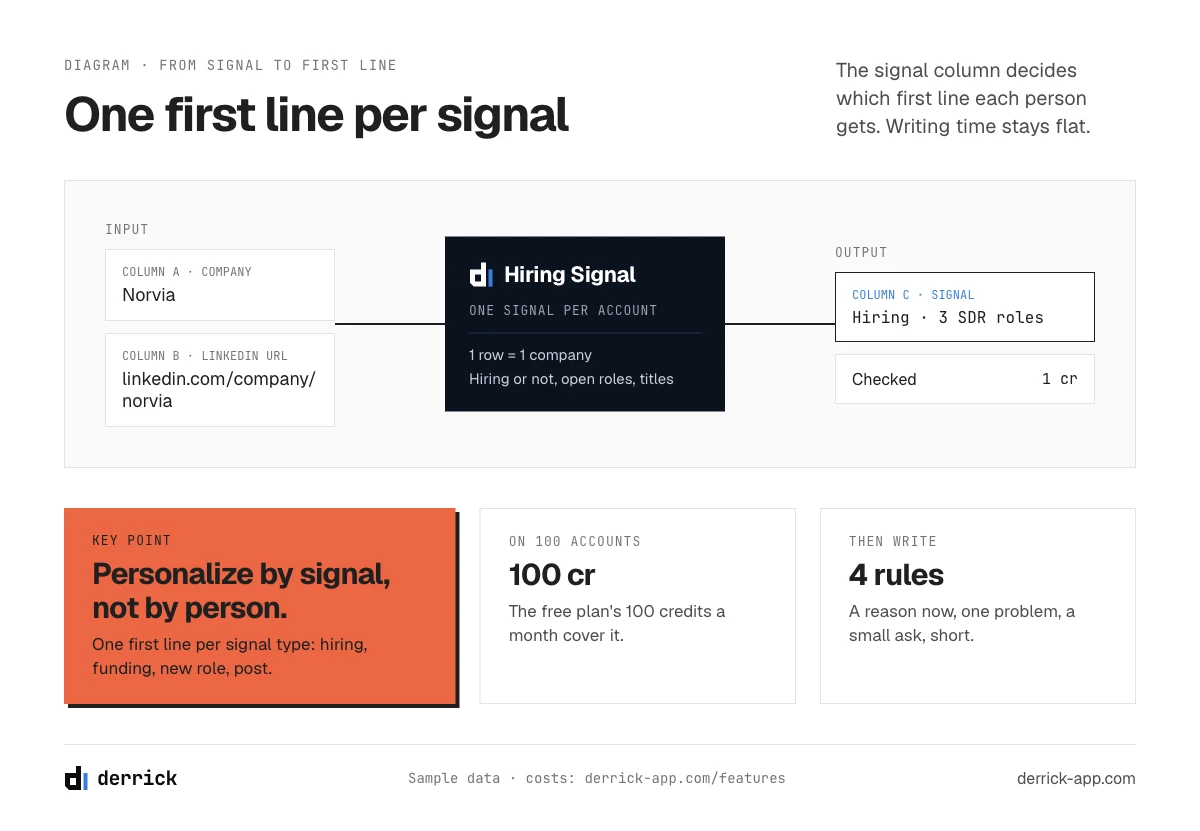
Personalizing every message by hand stops working past a few dozen people a week. The way out is to personalize by segment and by signal rather than by person. Write one first line per signal type (hiring, funding, new role, post engagement), one problem sentence per segment, and let the signal column of your list decide which line each person gets. A hundred messages then carry a real reason each, and the writing time stays flat. Keep the fully hand-written message for the priority accounts, where a video or a referral would also make sense.
Clever subject lines, compliments on a post the person knows you did not read, and long feature lists rarely move the rate. The templates later in this guide follow the four rules above, and each one shows where the personalization goes. Treat them as structures to fill with your own signal.
How many times to come back: the late-reply share
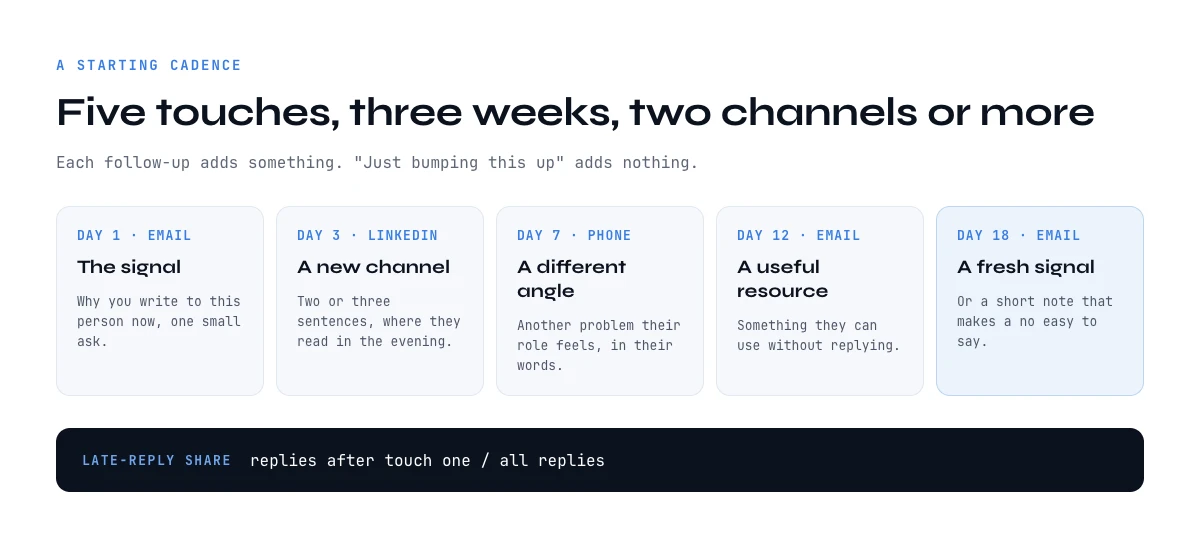
The last decision is persistence. A single attempt leaves most of the possible replies on the table, because people answer when the timing suits them. Too many attempts turn a no-reply into an unsubscribe or a complaint. The rate that settles the question is the late-reply share: the percentage of all replies that arrived after the first touch.
If most of your replies come after touch two or three, your cadence is doing its job and cutting it would cost meetings. If almost nothing arrives after touch three, the later touches are noise, and the fix is either a better reason to follow up or fewer follow-ups. Each follow-up should add something: a different angle, a useful resource, a new signal, a switch of channel. "Just bumping this up" teaches the reader to skip your name.
As a working frame, four to six touches over two to three weeks, across at least two channels, is a common starting point. Our lead generation guide lays out a full outbound cadence with its plays. Start there, then let your late-reply share tell you whether to add or remove a touch for your segment.
Six prospecting channels: how to prospect effectively on each, with a script
The channel rule tells you where to open. This section gives each channel its working structure and a script. Acme stands for your company in every example and template on this page.
Cold email: the default channel, used with a reason
Email is the backbone of most B2B prospecting because it scales and leaves a written trace. It works when three conditions hold: the address is verified, the reason to write is visible in the first line, and the ask is small. When one of the three is missing, the email fails quietly, and all you get back is a number.
The structure that works in a first email has four parts. A first line that shows why you are writing to this person now. One sentence on the problem, in their terms. One sentence of proof, a result or a concrete observation. A question that is easy to answer. Keep it under 100 words. Send from a real person, with a plain signature, no images, one link at most. Three full email templates sit further down. Before sending at volume, the deliverability basics matter as much as the words: a warmed-up domain, authentication in place, and a list with a low bounce rate, which is why the verification decision comes first.
Phone: the fastest answer, for the right prospects
A call gets you a yes, a no or a "call me in March" in under a minute, which no other channel does. It is the best opener for small companies, owner-led businesses and any time-sensitive signal, and the weakest for large companies where the switchboard stands between you and the person, unless you have a direct line.
A call that works follows a short arc. Permission: "Hi Sarah, it's Tom from Acme, I know I'm calling out of the blue, do you have 30 seconds?" Reason: "I saw you're hiring three account executives this quarter." Problem: "Teams that scale that fast usually find their reps spend the first weeks building lists instead of calling." Question: "How are your new reps getting their first list today?" Then listen. The goal of the call is the next step, a meeting or a follow-up email. Have the signal, the company size and the person's role in front of you before you dial, and log the outcome in one word right after hanging up.
LinkedIn: context first, message second
On LinkedIn the conversion step is the connection. People accept requests from people who seem relevant, and they read messages from connections they recognize. So the opener on LinkedIn is often a comment on something the person posted, or a connection request with one line of context, and the actual message comes after acceptance.
A connection note that works fits in one sentence: "Saw your post on onboarding new SDRs, we work on the list side of that problem, happy to connect." No pitch, no link. Once accepted, wait a day, then send two or three sentences that continue the reason you gave and end with a question. The full LinkedIn workflow, including what a free account can and cannot do, lives in our LinkedIn prospecting guide. LinkedIn opens best with senior roles who screen calls, with people who are visibly active on the platform, and with any signal you found there in the first place.
Referrals: the warmest channel almost nobody schedules
A warm introduction from someone the prospect trusts beats every cold channel on reply rate, and almost every team treats it as luck. Referrals can be scheduled like any other channel. Once a month, list the ten accounts you most want to reach, look for shared connections (customers, partners, investors, former colleagues), and ask for a small number of introductions from the people most likely to say yes.
Make the ask easy to forward by writing the introduction for them, so they only have to send it. A request that works:
"Hi Maria, you mentioned you know David Chen at Northwind. We help sales teams like theirs get verified contact data without the manual research. Would you be open to introducing us? Here is a two-line note you could forward as is: 'David, meet Tom from Acme. They helped us cut the time our reps spend building lists. Worth 20 minutes if that's on your radar.' No pressure either way, and thanks for thinking of it."
Track referrals like any other channel: asks made, introductions sent, meetings held. The volumes are small, and the meetings held per introduction are usually the highest of any channel, which earns ten asks a month a fixed slot in the week.
Events: before, during and after
An event, a trade show, a meetup or a webinar puts your targets and you in the same place at the same time. Its value for prospecting sits mostly before and after it. Before: get the list of attendees or speakers if it is public, check which ones match your profile, and send a short message a week ahead proposing to meet. During: have real conversations and write down one specific detail about each person. After: follow up within 48 hours with that detail.
A pre-event message that works: "Hi James, I see we're both at the RevOps Summit next Thursday. I'd like to hear how your team handles list building at your size. Coffee near the main stage at 10:30?" And the follow-up after: "James, good to meet you at the summit. You mentioned your SDRs spend Monday mornings cleaning the CRM. Here is the short note I promised on how other teams handle it. Worth 20 minutes next week to compare with your setup?" Online events work the same way with smaller stakes: the people who asked a question in a webinar chat have told you what they care about, and the follow-up can pick up that exact question.
Video messages for the accounts that deserve ten minutes
A short personalized video, one to two minutes, recorded with the prospect's website or LinkedIn page on screen, is the most time-consuming opener in this list and the most memorable. Reserve it for accounts where one meeting would justify ten minutes of preparation, and for follow-ups after a first touch went unanswered. Volume segments are better served by the other channels.
A video script that works has four beats, in about 90 seconds. Name and reason: "Hi Laura, I'm Tom from Acme, I'm recording this because I saw your team posted four sales openings this month." Observation: show something specific on screen, such as the job posts or a page of their site, and say what you notice. Problem and proof: one sentence each. Ask: "If it's useful, reply to this email and I'll send the two-page version." Then send the video inside a short email with a thumbnail and a plain-text summary, since many people read before they watch. Measure it like the rest: videos sent, videos watched, replies, meetings held. A video that gets watched and gets no reply usually had an observation too vague, or an ask too big.
Prospecting techniques that start from a signal
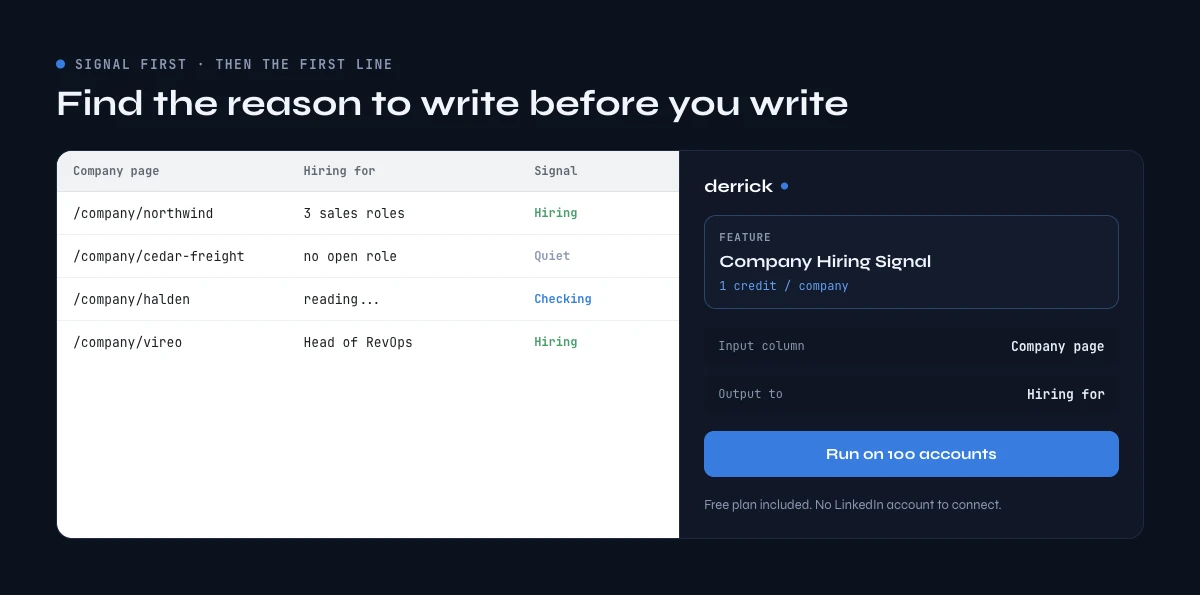
Of all prospecting techniques, the one that moves results most is also the simplest to describe: find a reason to write before you write. A buying signal is an observable change that makes your offer more relevant now than last month. Hiring for the team you sell to. A funding round. A new person in a decision role. An expansion to a new country. A comment or a like on a post about the problem you solve. Negative reviews of a tool you replace.
The technique has three moves. Detect the signal on a list of accounts that already fit your profile, since a signal on a company outside your profile is only noise. Act inside the window, ideally within 48 hours, since the intent report quoted earlier shows how fast a signal loses value. And write the first line from the signal, then connect it to one problem. "I saw you opened three SDR roles" leads naturally to "teams hiring that fast usually hit the list-building wall in the first month".
Other prospecting techniques build on the same logic: multi-threading an account, warm versus cold sequencing, reactivating closed-lost deals. For the hiring signal specifically, Derrick's Company Hiring Signal reads a column of LinkedIn company URLs and returns whether each company is hiring on LinkedIn, how many roles are open and their titles, at 1 credit per company. It is available on the free plan and does not need a LinkedIn account connected, so the 100 free credits a month cover a hiring check on 100 accounts.
Reactivation deserves its own line. Deals you lost six or twelve months ago, and prospects who said "not now", are accounts where the fit is already proven. A new signal on one of them (a new head of sales, a new funding round) is the best reason there is to write again.
Warm and cold sales prospecting: when each one pays
Cold sales prospecting reaches people who have never heard of you. Warm sales prospecting reaches people who have already had some contact with you or your company: they engaged with a post, attended a webinar, visited the pricing page, were introduced by a customer, or talked to you a year ago. Both belong in a healthy week, and they call for different expectations.
Warm prospects answer more often and faster, but there are few of them, and their number depends on work done elsewhere: content, events, customer relationships. Cold prospects are unlimited in number and answer less, and a signal or a sharp profile is what lifts their rate. A useful split for a team starting out is to work every warm prospect first, week after week, then fill the remaining volume with cold accounts chosen by signal. When the warm pool grows, the cold volume can shrink, and meetings held per 100 people reached rise without sending more.
Keep the two pools apart in reporting. Mixed together, a strong warm pool hides a weak cold motion, and the team only finds out the day the warm pool dries up.
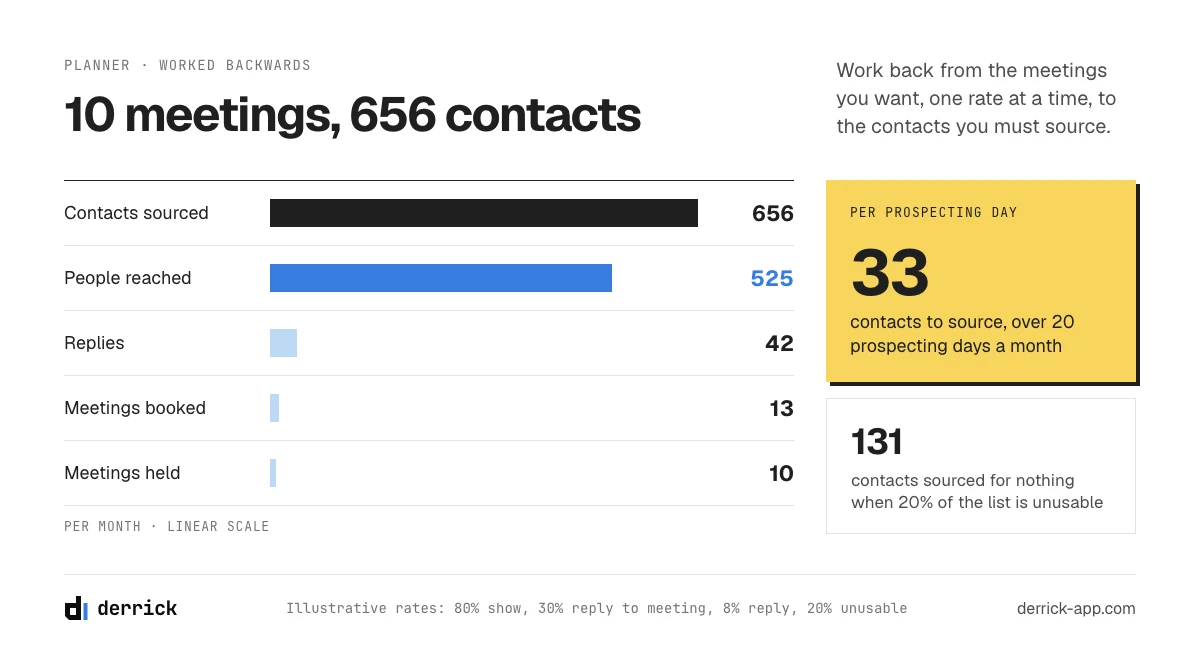
How to prospect effectively at the right daily volume per channel: a planner from meetings to touches
Enter the number of meetings you want to hold each month and your current rates. The planner works backwards to the replies you need, the people you must reach, the raw contacts to source once the unusable part of the list is removed, and the daily volume per channel. Everything runs in your browser, and the default values are working assumptions to replace with your own.
From meetings held to contacts per day
The results update as you type.
Fill in the fields to see your volumes.
Take the reply and show rates from your last campaign report rather than from memory. The unusable share is the one teams underestimate most: count hard bounces, people who replied that they have left, and wrong roles.
Run it twice. Once with last quarter's real rates, once with the unusable share set to 2%. The difference in daily volume is what list quality is worth to your team, counted in hours rather than in budget. If the daily number looks impossible for the people you have, the honest options are to narrow the profile so the reply rate goes up, or to lower the meeting target.
A prospecting week that holds up
Sales prospecting is a skill, and like any skill it degrades without routine. The teams that prospect effectively block time, fix volumes, and protect those blocks from meetings. The week below is a starting structure for one person whose job is mostly prospecting; halve the volumes if prospecting is a part-time duty.
| Day | Morning block (90 min) | Afternoon block (60 min) | Rough volume |
|---|---|---|---|
| Monday | Review last week's five rates, pick one change, check new signals on target accounts | Build and verify this week's list | List of the week ready |
| Tuesday | First touches: calls to the phone segment, then emails | Replies and follow-ups due | Daily volume from the planner |
| Wednesday | First touches: LinkedIn comments and connection requests, emails | Replies, follow-ups, one referral ask | Daily volume from the planner |
| Thursday | First touches and second touches, calls to people who opened without replying | Videos for two or three priority accounts | Daily volume from the planner |
| Friday | Follow-ups due, last calls of the week | Update the CRM, log outcomes, prepare Monday's review | Lighter day, cleaning and logging |
Three habits make the structure work. First, prospect in the morning, before the day fills up with meetings; a block that moves to "later" rarely happens. Second, batch similar tasks: a run of calls, then a run of emails, rather than switching channel at every row, which is exactly the context-switching tax our manual prospecting report measures. Third, change one thing per week. If you change the list and the message in the same week, you will never know which one moved the rate.
The structure changes with the size of the team. A founder doing sales prospecting alone keeps the two blocks but halves the volumes, and uses the Friday block to decide whether a segment deserves another week. A team with several SDRs splits the work differently: one person builds and verifies the lists for everyone on Monday, the others spend their blocks on touches and replies. The rates stay per person and per segment, so a weak week can be traced to a decision rather than to a name.
Discipline also means knowing when to stop. If a segment has produced no meeting after four full weeks at the planned volume, with a healthy reachable rate, the segment is the problem. Park it, write down why, and move the volume to a segment that responds.
Six prospecting templates you can adapt
These sales prospecting templates follow the rules of the message decision: a reason first, one problem, one proof, one small ask. Replace every bracket with a real observation about the person. If you cannot fill the first bracket with something specific, that prospect is not ready for this message yet. As in the rest of the page, Acme and [Your company] stand for your own company.
Email 1: the signal opener
Subject: [Their company]'s new sales hires
Hi [First name], I saw [Their company] opened [three account executive roles] this month. When teams grow that fast, new reps often spend their first weeks building lists instead of selling. At [Your company], we help sales teams get verified contact data for their target accounts in minutes, in the tools they already use. How are your new reps getting their first list today? [Your name]
Email 2: the problem-first opener, no signal
Subject: Bounces on [Their company]'s outbound
Hi [First name], most [RevOps leads] we talk to at [companies of 200 to 500 people] tell us the same thing: a good part of their outbound list has changed jobs since it was built, and nobody knows which part until the bounces come back. At [Your company], we fix that upstream, before the sequence starts. Is list decay something your team measures, or is it more of a guess today? [Your name]
Email 3: the follow-up that adds something
Subject: Re: [previous subject]
Hi [First name], one more thought, then I'll leave you alone. [A head of sales at a similar company] told us their SDRs got back [half a day a week] once list building stopped being manual. If that's a problem on your side too, I can send the two-page version of how they set it up. Worth sending? [Your name]
Call script: the 30-second opener
"Hi [First name], it's [Your name] from [Your company]. I'm calling out of the blue, do you have 30 seconds to tell me if this is relevant? ... Thanks. I saw [signal]. Teams in that situation usually tell us [problem in one sentence]. Is that something you're dealing with right now?" If yes: ask one open question, listen, propose a 20-minute call with a date. If no: "Fair enough. Is it someone else's topic on your team, or not a topic at all?" If later: "When should I call back, and what should I bring?"
LinkedIn 1: the connection note
"Hi [First name], your post on [topic] matched what we hear from other [role] teams. I work on the [list-building] side of that problem. Happy to connect."
LinkedIn 2: the first message after acceptance
"Thanks for connecting, [First name]. In your post you said [specific point]. Out of curiosity, how does your team handle [related problem] today? We see two very different setups at companies your size, happy to share what we see if useful."
Use each template on a small batch first, 30 to 50 people in one segment, and compare its positive reply rate to your baseline before rolling it out. Each template is a hypothesis about a segment, and the rate tests it.
How to prospect effectively, measured: five rates to steer by
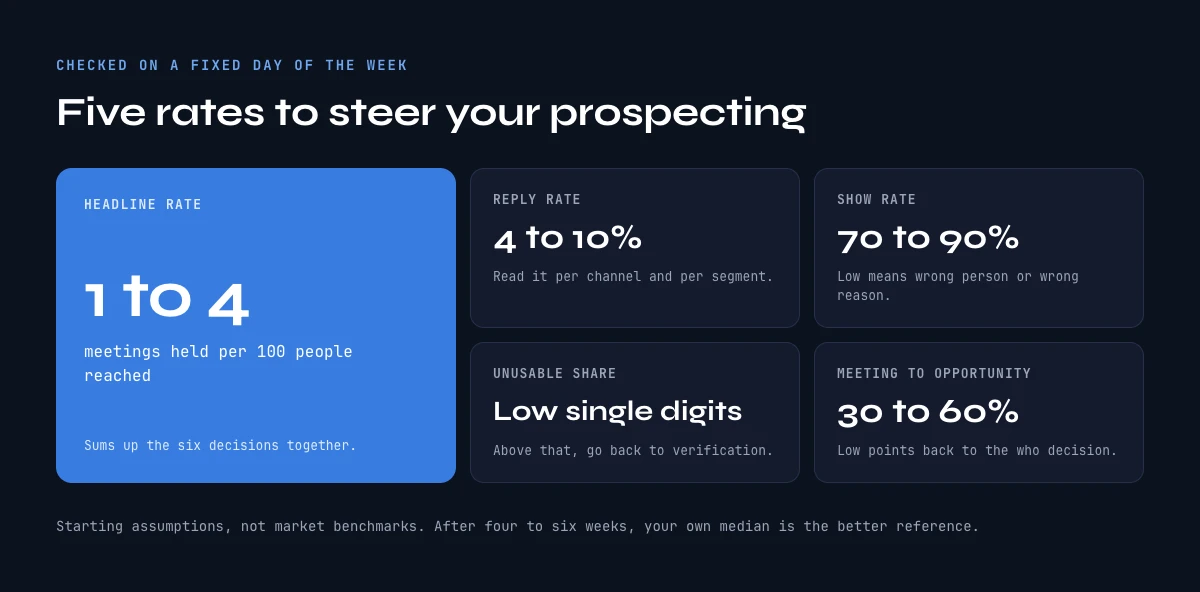
Knowing how to prospect effectively takes numbers you check on a fixed day of the week. Five rates are enough to steer; with more, nobody reads them. Each range below is a starting assumption, and your own median after four to six weeks is the better reference.
- Meetings held per 100 people reached, the headline rate that summarizes the six decisions together. Starting assumption, not a market benchmark: 1 to 4.
- Reply rate, all replies divided by people reached. Starting assumption, not a market benchmark: 4 to 10%. Read it per channel and per segment.
- Show rate, meetings held divided by meetings booked. Starting assumption, not a market benchmark: 70 to 90%. A low show rate often means the meeting was booked with the wrong person or for the wrong reason.
- Unusable share of the list, rows that could not be used (bounced, left the company, wrong role) divided by rows sourced. Starting assumption, not a market benchmark: a low single-digit share; above that, go back to the verification decision.
- Meeting to opportunity rate, held meetings that become a qualified opportunity. Starting assumption, not a market benchmark: 30 to 60%. A low rate points back to the "who" decision.
Why starting assumptions rather than market figures? Because B2B prospecting benchmarks mix markets, offers and list qualities that have little in common with yours. A 3% reply rate can be excellent for cold outreach to large-company executives and weak for warm outreach to founders. Your four-week median, per segment and per channel, is the only baseline that moves when your decisions move.
These five rates are the dashboard. For steering week to week, one rule is enough: when meetings held per 100 people reached drops, look first at the rate that moved the most, then at the decision behind it.
A Monday review in fifteen minutes
The review that keeps sales prospecting honest fits in a quarter of an hour on Monday morning. Write the five rates of last week next to the four-week median. Circle the one that moved most. Name the decision behind it. Decide one change for this week and write it down, with the date you will read the result. Six months later, that written line tells you which changes worked and which ones were noise.
Count time as well. Prospecting hours per week, and meetings held per prospecting hour, tell you whether the process is getting more efficient or just busier. Flat meetings per hour while volume rises means you are paying for activity.
A worked example: one month of B2B prospecting on 400 accounts
Here is how the six decisions and their rates read on a realistic month. The numbers are an illustration, built to show the method. A team sells to software companies of 50 to 500 people and targets heads of sales and RevOps leads.
| Decision | What the team did | Rate observed | Reading |
|---|---|---|---|
| Who | 400 accounts matching a written profile, two segments | Fit confirmed in 18 of 24 conversations (75%) | Profile holds |
| Where | People sourced from a LinkedIn search on each account | 560 usable rows out of 700 sourced (80%) | Acceptable, one filter too wide |
| What to verify | Role and email checked before sending | 448 people reachable out of 560 (80%) | Fine |
| Channel | Email for everyone, calls for the small-company segment | Reply rate 5% by email, 11% by phone | Phone underused |
| Message | Signal-based first line for half the list, generic for the other half | Positive replies 3.1% with a signal, 0.9% without | Signal wins clearly |
| Cadence | Four touches over 15 days | 55% of replies after touch one | Keep the follow-ups |
At the end of the month: 9 meetings booked, 7 held, out of 448 people reached, so about 1.6 meetings held per 100 people reached. The headline number looks modest, and the table says exactly why and what to change. The team keeps its list and its tools. It needs two things: call the small-company segment instead of emailing it, since the phone reply rate is twice the email rate there, and find a signal for the half of the list that got a generic opener. Each change touches one decision, so next month's rates will say which one worked.
The example reads the data before touching the message, and it fixes a conversion rate with a better decision rather than with more volume. That is what prospecting effectively means in practice.
How to prospect effectively from next week: start with one decision
Most failed sales prospecting campaigns share a handful of causes, and a bad subject line is rarely one of them:
- An unverified list. A share of the people have left, a share of the addresses bounce, and the text gets blamed for the reply rate.
- A generic message. It could have gone to anyone in the segment, and the reader recognizes that in the first line.
- A single touch. The replies that would have come on the second or third attempt, often the larger share, never arrive.
- No measurement. Each campaign ends on an impression shaped by the last reply received, good or bad.
- Aged data. A list built for last quarter is reused as is, while roughly 2% of it decays every month.
- Everything changed at once. A new segment, message and channel in the same week, so a good result cannot be repeated and a bad one cannot be fixed.
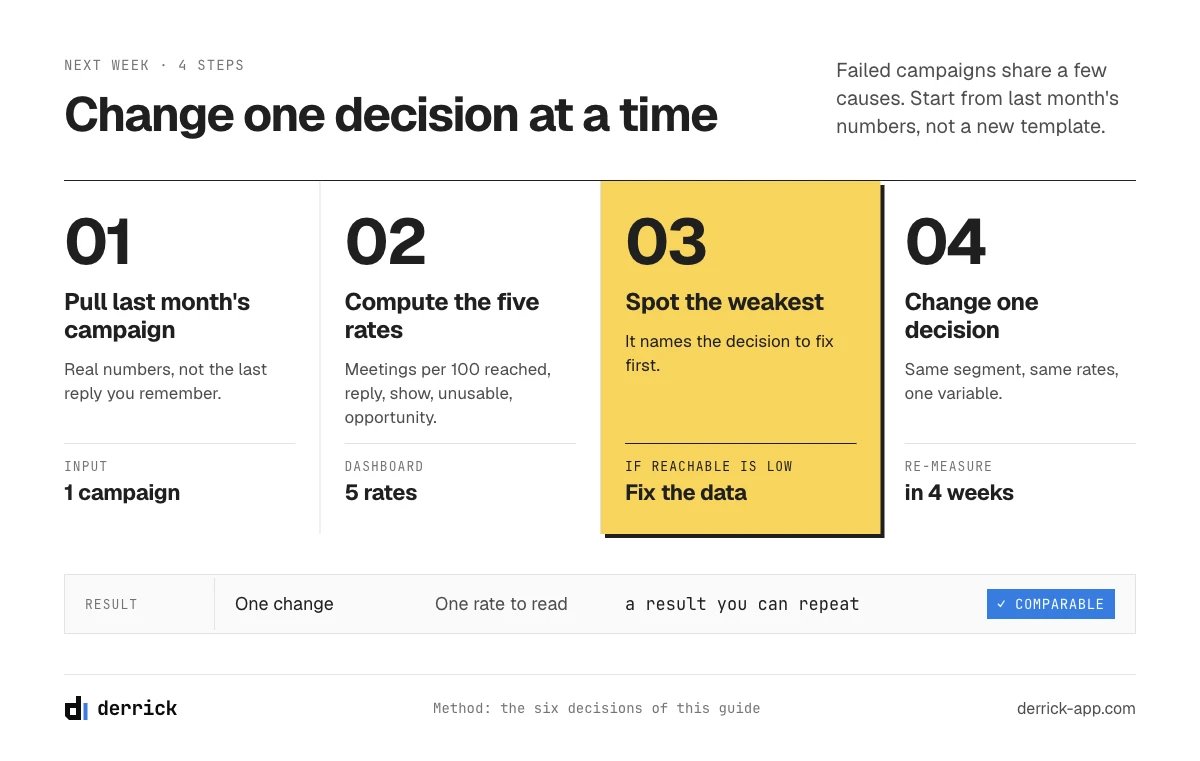
They share one remedy: make the six decisions explicit, give each one its rate, and change one decision at a time. Take last month's campaign, compute the five rates, and find the decision behind the weakest one. If it is the reachable rate, fix the data before you touch the message. If it is the positive reply rate, find a signal for each account and rewrite only the first line. If it is the late-reply share, add one follow-up that brings something new. Run the planner above with your real numbers, and measure again in four weeks.
What the other B2B marketing guides cover
This page is the sales prospecting method: the six decisions, the channel rule, the scripts, the week and the measurement. Several topics it touches have a dedicated guide in the same series. The outbound plays and the full two-week cadence are in the B2B lead generation guide. Building the list itself, from the fit gate to the ordered file, is in the guide to building a prospect list. The limits of a free LinkedIn account are in the LinkedIn prospecting guide, and the multichannel sequence with its roles and metrics in the outbound sales guide. Tools by task, what one lead costs, and what the 100 free credits a month can buy when you start from zero are in our lead generation tools guide, linked below.
When the weak point is the data, Derrick handles it at any volume, from a list of 50 accounts to one of 50,000. The web app and the Google Sheets sidebar cover every plan, and the MCP server and the API are available from the Plus plan at 47.50 euros a month. The free plan comes with 100 credits a month and no card, which covers Company Hiring Signal on 100 accounts; Email Finder and Email Verification come with the paid plans, from 20 euros a month. Start with the free plan, or browse the other B2B marketing guides first.
Frequently asked questions
What is the most effective way to prospect?
How do you measure prospecting effectiveness?
How many prospects should you contact per day?
Which prospecting channel works best for B2B?
What is the difference between prospecting and lead generation?
How many follow-ups should a prospecting sequence have?
What are the best sales prospecting techniques?
How much time should you spend prospecting each week?
Keep reading
Continue exploring this cluster


The State of B2B Marketing Performance 2026: Benchmarks Report
Read →

Account-Based Marketing (ABM): Definition, Techniques, Examples
Read →

Inbound vs Outbound Marketing: Differences, When to Pick Each
Read →

B2B Lead Generation: Strategies, Tools, Tips in 2026
Read →