
B2B lead generation in 2026: process, lead types, strategies and tools
Discover how B2B lead generation works: the types of leads, a 5-step process, the strategies that fill a pipeline and how to source the list behind them.


B2B lead generation is the work of finding businesses that could buy from you and turning them into contacts your sales team can actually talk to. It covers four jobs: defining the target, building the list, reaching or attracting the right people, and qualifying them before they go to sales.
What is B2B lead generation?
B2B lead generation is a marketing strategy to attract prospects who are interested in your products or services. This technique allows you to transform these visitors into leads thanks to the implementation of several marketing processes (inbound marketing, outreach,…).
With the implementation of these various strategies, the future customer will be subjected to various contents and offers that meet his needs. They will gradually be attracted to your brand until they show a real interest and will certainly end up making a purchase decision.
What is a lead?
A lead is a person who is interested in your products or services. This person has chosen (or not) to get in touch with the company by any means: newsletter registration, social networks, satisfaction surveys, cold email..
Why B2B lead generation matters. A B2B purchase is rarely one person's call. Several people weigh in, the cycle runs for weeks or months, and the amount is high enough that nobody buys on impulse. So your pipeline can't depend only on the prospects who happen to find you. B2B lead generation is how a team decides who it wants as a customer, then does the work to get in front of them instead of waiting.
Types of B2B leads: MQL, SQL, inbound, outbound, warm and cold
Not all B2B leads deserve the same treatment. Teams sort them along three lines (how qualified, where they came from, how well they know you), and that sorting decides who follows up and how fast.
| Type of lead | What it means | What you do with it |
|---|---|---|
| Marketing qualified lead (MQL) | Engaged with marketing (a download, a webinar, repeat visits to pricing) and fits the target profile, but hasn't asked to talk. | Nurture it, score it, and watch for the moment intent shows up. |
| Sales qualified lead (SQL) | Sales has checked fit and need, and there's a real reason to talk now. | Book the meeting. This is the lead that enters the pipeline. |
| Inbound lead | Came to you: a form, a demo request, a reply to a piece of content. | Answer fast. The intent is real, but it fades within days. |
| Outbound lead | You picked the account first and reached out. | Earn the reply with one specific fact about the account. |
| Warm lead | Already knows you: a past conversation, an event, a referral, an interaction with your posts. | Use the shared context in the first line. |
| Cold lead | Matches your profile but has never heard of you. | Open with relevance, not with the product. |
The line between MQL and SQL is where most of the friction between marketing and sales lives, because each team draws it in a different place. Our guide on how to qualify sales leads goes through the criteria (budget, authority, need, timing) and the questions that separate a curious contact from a buyer.
The B2B lead generation process, step by step
Every strategy further down this page is a variation on the same five steps of B2B lead generation. Teams that skip one usually find out at step five, when sales sends half the B2B leads back.
- Define who you want. Write the ideal customer profile (industry, headcount band, country, the role that owns the problem) and list the people inside one account who weigh in on the purchase. If you can't use the profile to say no to a company in ten seconds, it's still too wide.
- Source the list. Turn that definition into real companies and real people: a LinkedIn or Sales Navigator search, companies pulled by activity code, a map search for local businesses, or lookalikes of your best customers. Then enrich each row with what you need to reach and qualify it.
- Reach or attract them. Outbound goes to the list directly, by email, LinkedIn or phone. Content, SEO, ads and events bring people to you. Most B2B teams run both, with outbound first because it produces answers from week one.
- Qualify. Score each lead on fit (does the company match the profile?) and on intent (is there a reason to buy now?). Fit without intent goes back to nurturing. Intent without fit gets a polite no.
- Hand off to sales. Pass the qualified lead with its context: where it came from, the signal, the conversation so far. Then check what sales did with it, so step one gets sharper next quarter.
When should a lead go to sales?
When it fits your target profile and shows a reason to talk now. Fit alone isn't enough, and neither is one content download.
The reason can be a demo request, a reply asking for details, a pricing page visit from someone at a target account, or a strong buying signal such as a hiring push in the function you serve. This hand-off is where most B2B lead generation programs leak, so write the rule down and get both teams to agree on it. A short service level agreement does the job: what counts as sales-ready, how fast sales follows up (an inbound lead cools within hours, not weeks), and what happens to a lead sales turns down. Our guide to inbound lead management covers routing, response times and follow-up rules in detail.
B2B lead generation strategies: outreach and content marketing
The B2B lead generation strategies that still work in 2026 fall into two families. Outreach goes to the buyer: you pick the account and start the conversation. Content marketing brings the buyer to you, slowly at first, then it compounds. Paid channels, covered after, sit in between. Below is how each family of B2B lead generation turns into B2B leads. Further down come the outbound plays and the sourcing step they all rely on.
Outreach: from a sourced list to a first conversation
The shape of that outreach changes a lot with who runs it. If you are a solo operator rather than a team, the playbook for solo consultants and freelancers covers the version of this that one person can actually sustain.
Outreach is a marketing technique that consists in getting in touch with prospects (leads). It is a way to create links with Internet users likely to be interested in your brand by offering them a product or service that they might like.
The principle of outreach is to gradually capture prospects who will interact with your brand, talk about it, consume the content, or follow it on social networks. By creating privileged links, outreach allows you to reinforce your brand's image.
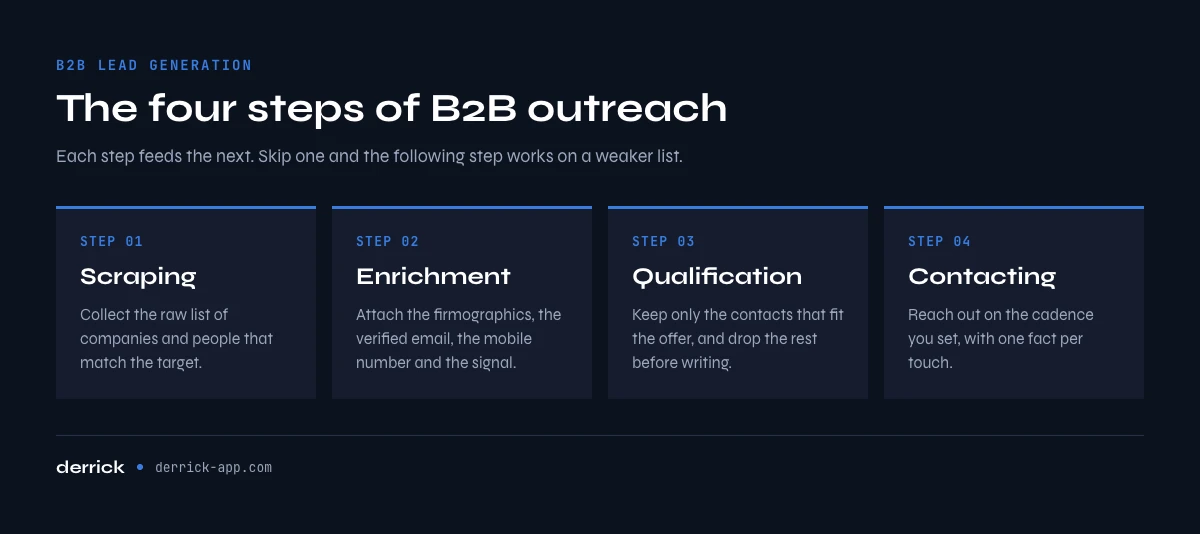
To perfect this method, find leads and turn them into customers, you will go through several steps:
- Scraping: This is a method that allows you to collect customer data: email, phone number by sucking the data present on a site.
- Enrichment: Collect a maximum of information on your prospect to enrich your database in order to improve prospect knowledge.
- Qualification: Choose the most relevant contacts for your prospecting process.
- Contacting: Once all the steps have been completed, you can contact your prospect in a personalized manner.
What is scraping and how can this technique help you in your prospecting?
B2B lead generation & outreach: scraping leads on LinkedIn
Scraping is a method to retrieve valuable data from the web. It is an excellent way to build a prospecting file. LinkedIn is a small gold mine with more than 500 million members.
Derrick allows you to find the linkedin account of any person, only with the first and last name or to scrape information on the profiles:
- The lead search feature on Derrick:
All you need is a list, in the Derrick web app or in a Google Sheet, with at least the first and last name of the contact you are looking for. The more information you include, the more precise the search will be.
- The lead import feature on Derrick :
It allows you to retrieve leads & companies from a list on LinkedIn Sales Navigator and import them into the web app or a Google Sheet document in 1 click.
B2B lead generation & outreach: Enrich your data
Your lead import is complete, but you are missing more precise information to understand and precisely target your scrapped contacts?
Enrich your document with reliable and up-to-date data. This allows you to know exactly who you're talking to when making contact by email (or other contact channels). By writing a personalized email, your lead will be more likely to answer you.
Derrick allows you to retrieve numerous data such as
- the job
- the position in the company
- the profile description
- the city
- the email,..
B2B lead generation & outreach: account based marketing
Account based marketing or "strategic account marketing" is a form of B2B marketing strategy. It allows you to set up highly personalized digital campaigns on a number of high value-added prospects. These prospects are part of the companies you want to turn into customers. To do this, you need to build a persona or target that includes the position held, the company, its list of needs, its objections, its typical day..
Do you want to build a database centered on companies corresponding to your sector of activity? With Derrick, it's entirely possible to import company names from LinkedIn Sales Navigator directly into the web app or your Google Sheet document. Check out our tutorial below:
Once your company list is complete, you can import it into your LinkedIn Sales Navigator (Professional and Team subscriptions). This import will allow you to view and find the people working in these companies.
To import your company list:
- Go to your LinkedIn Sales Navigator profile;
- Click on "account list", create an account list, download the account list in .csv.;
- Import your list with a simple drag & drop;
- Match the columns of your file with the fields imposed by Linkedin ;
To identify the prospects :
- Click on your file;
- In the top right corner, click on "Actions", "Search for leads";
- A list of all the leads of the companies you are targeting is displayed;
- Use the filter function to further refine your search.
Identify the prospects that correspond precisely to your persona and send them hyper-personalized messages to obtain concrete results.
B2B lead generation & outreach: lead qualification
Derrick offers many features that allow you to adapt your strategy to each prospect based on the data you have collected.
Whether you work in the Derrick web app or in the Google Sheets extension, Derrick makes the cleanup easier when you have hundreds of rows to process:
- Deleting data you're not interested in;
- Possibility to find the gender of a person (male or female);
- Possibility to find the first and last name in a complete name;
- remove emojis or other characters that are not a first or last name.
- etc.
You can then use this data in variables forsending automatic messages. This allows you to create messages specifically for each prospect while saving time. Personalizing your messages offers the possibility to stand out from other senders, generates more interesting open rates and gives your prospects the impression that you are addressing them directly.
For example:
- Hello {{gender}}, being {{jobtitle}} {{prefix}} {{companyname}}
- Hello Mrs, being a Founder at deux.io
- Hello Sir, being an editor at Maison du monde.
These automatic messages serve as a first approach to your cold lead. They may know you, so this is the time to introduce you and your company but especially to talk about their problem, to show empathy. The goal is to create a good relationship while showing that you are a good listener, trustworthy and that you are an expert in your field.
Present them with useful content based on their interests that will reinforce your position as an expert. You can then implement your activation strategy towards "hot" prospects.
B2B lead generation & outreach: making contact
Prospecting is a very long process that can waste a lot of time. It prevents you from focusing on high value-added tasks.
How can you organize yourself to be more efficient?
Simply by using automated prospecting tools or CRM.
Thanks to your database built on Derrick, you can now connect it to an automation tool like Lagrowthmachine and Zapier or to a CRM like hubspot or pipedrive.
Lagrowthmachine is a tool to create multi-channel prospecting campaigns via LinkedIn, Twitter and email. Its use is very simple. It comes in the form of an application that launches campaigns composed of sequences. By combining it with the Zapier tool, you can automate actions via connections between the different applications. For example, you can create one of the following actions by linking Derrick, Lagrowthmachine and Zapier:
- A new lead arrives in Derrick
- Derrick sends the lead to Lagrowthmachine
Here zapier makes the link between the 2 applications! You can then start your contact directly in Lagrowthmachine.
Thanks to the different variables of your document, as seen before, you will be able to edit your personalized messages and gain efficiency when contacting your prospects. Let's now see how to attract your prospects and maximize your prospecting with content marketing.
Content marketing: let the right buyers find you
Content marketing consists of producing content and distributing it on different media. These contents allow you to obtain visibility and notoriety. Content marketing is completed by various marketing strategies that we will see below.
Inbound marketing
Inbound marketing is a technique that consists in attracting new customers by creating useful, engaging and entertaining content for a specific target. The principle is to make the customer come to you! This allows you to create engagement and to give confidence to the Internet users.
There are 4 steps to maximize your inbound marketing strategy:
- Step 1: Attract the visitor to your site. For this you need to know your target well, create your content strategy with high added value.
- Step 2: Convert the visitor into a lead. This is the principle of engagement. Encourage your visitors to perform actions through CTAs (Call-To-Action): download an ebook, sign up for a webinar, take a survey…to collect information like an email. These emails will allow you to use marketing automation by sending automatic emails. These emails are part of your strategy and will serve to "feed" your prospect.
- Step 3: Engage the prospect in the buying process. Identify your prospect's specific needs and offer them the most perfect solution to their problem.
- Step 4 : Retain the customer. You've made the sale? Now it's time to build loyalty. Stay in touch with your customer, send him personalized emails, a satisfaction questionnaire. Show your customers that you care about them.
SEO copywriting
SEO copywriting is part of web writing that respects the rules of natural referencing. The objective of SEO copywriting is to rank the content in the first positions of the SERP (Search Engine Result Page) in search engines and especially Google. The writing of an SEO content must take into consideration many elements:
- Readable and easy-to-read content;
- Knowledge of the target audience to propose relevant content corresponding to the search intent;
- The work of specific keywords and semantic field;
- Propose new and unique content, update old articles;
- Work on internal linking and backlinks;
- Become an expert in your field.
The netlinking
Netlinking is an SEO technique that consists in obtaining numerous URL links, called "backlinks" pointing to your website. It aims toimprove your visibility. The link received by the page of a site gives it value and aims to improve your popularity. It is therefore in your interest to integrate netlinking into your strategy to climb in the SERPs of various search engines such as Google, Yahoo, Bing.
Netlinking can be done in different ways:
- Create quality content and wait for sites to link naturally;
- Guest posting: propose guest articles to sites dealing with a theme close to yours;
- Ask non-competing sites to add links to your site;
- Buying sponsored links: you pay a site to publish an article;
- Automated prospecting: this technique allows you to obtain links to sites close to your theme. You just have to scrape the founders of these sites on LinkedIn with Derrick for example. You enrich your database in the Derrick web app or on Google Sheet to get information on them and their company. All you have to do is contact them via Lagrowthmachine for example.
In the web app or Google Sheets
The sourcing step of every strategy listed here
Whichever strategy you pick, it ends on the same task: getting named people into a list. Derrick imports leads into the web app or Google Sheets from a plain-language description of the target, then fills their profile fields in the same sheet.
- Feature
- Import Leads from a Prompt
- Credit cost
- 1 credit per lead imported
The first button opens the web app (nothing to install): 1 credit per lead imported, 100 free credits every month. The second details the feature and its cost per plan.
B2B lead generation: Intent market vs. community market with LinkedIn Ads and Google Ads
You can use advertising in your business development. It can be part of your long-term strategy because it serves as a transitional or complementary lever to inbound prospecting. Well-targeted advertisements allow you to make your site, your services and products known to leads who are certainly interested!
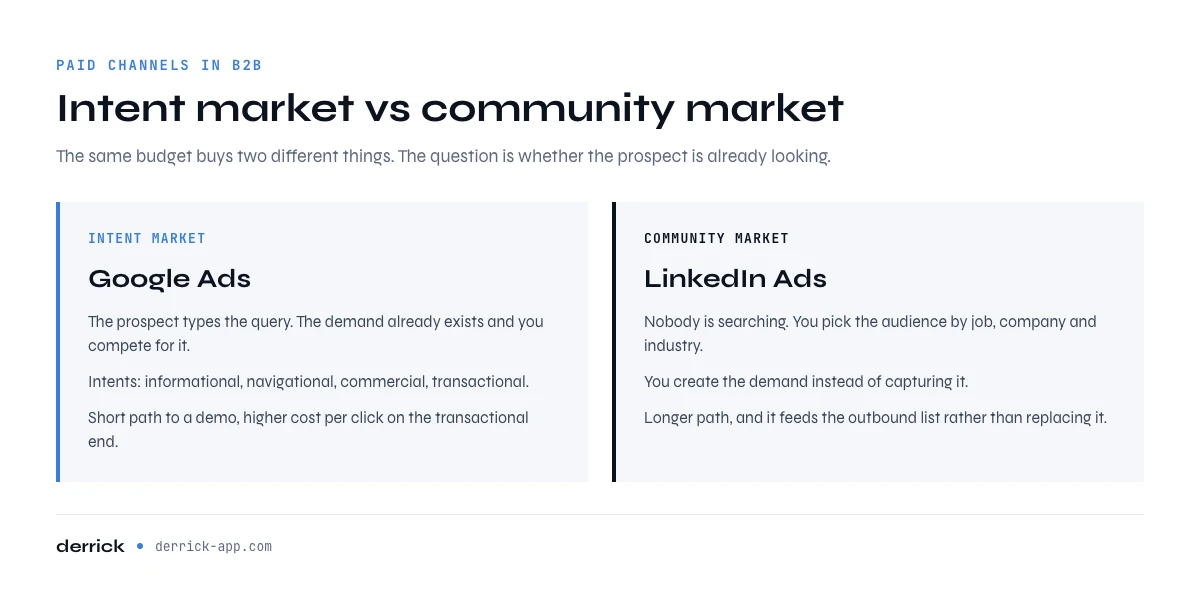
Web advertising is also present on search engines like Google but also on social networks. In a B2B inbound marketing strategy, it is important to understand the notions of search intent and community market. Indeed, both allow you to use advertising channels in different ways. Your message will be more impactful and logical for your prospect.
Search Intent
The search intent or expression is a group of keywords that the Internet user will type on the search engine. It allows the user to findanswers to a question, find a brand site or learn about a specific product or service.
Google's algorithm is currently powerful enough to understand the search intent behind an expression. There are several search intents: informational, navigational, commercial and transactional.
Google Ads
Google Ads is the advertising network of the Google search engine. It allows you to carry out advertising campaigns via ads and to display them in the search results. The Internet user can see the ads according to his search intention via keywords.
Best practices google ads
To succeed in your Google Ads campaign, it is essential to follow good practices to have optimal results:
- As a new advertiser, do not start with an automatic bidding system. This technique does not allow you to have total control over your campaign and your budget can quickly be exhausted;
- Choose only one search network (Search Network or Display). The ads on the search network are only textual and on the Display, visual;
- Configure the geographical area of your target;
- Set a budget from the start;
- Set a bidding strategy that matches your objective: generate clicks, maximize conversions..
Known strategies
During your Google Ads campaigns, you can use the retargeting and lookalike strategies:
- Retargeting: Google Ads offers you to make remarketing campaigns to display ads to customers who have visited your website. Setting up this kind of campaign is interesting if you want to use the Display network. It's a perfect tool to go up your conversion tunnel and lead your prospect to the transaction.
- Lookalike: Determine which users are most similar to your existing audience using Google's learning algorithm. Once common characteristics are identified, Google Ads takes care of delivering ads to these potential customers.
To optimize your Google Ads campaigns on search intent, you can look directly at Google results and observe the top search results. There are also SEO tools to find the search intent. We can mention Answer the Public which allows you to understand the needs of Internet users.
The community market
The community market or community marketing is a strategy to acquire customers. These Internet users have a similar lifestyle and behavior to other users. To engage these prospects, you can align your brand promise with what they value in their daily lives. This method engages and can trigger word-of-mouth marketing via referrals.
LinkedIn ads
As with most social networks, web advertising is also present on LinkedIn. This feature is accessible through the Campaign Manager interface to create your own ads. There are several ad formats to showcase your brand. The objective of LinkedIn advertising is to generate leads.
Best practices LinkedIn Ads
To put all the chances on your side and create an optimized and profitable ad campaign, here are some best practices to follow:
- Find the right targeting criteria: target users according to their position, company, sector and interests. You have to find the right balance between a large and a small audience;
- Prioritize decision-makers based on job title or seniority;
- Tailor the content to your audience to have more chances to be clicked;
- Test and optimize your ads to improve your visibility.
Known strategies
There are various strategies on LinkedIn to increase your conversion rates:
- Retargeting: this technique consists of targeting visitors to your site who have not converted. It is therefore necessary to be present on the platforms where they are used to visit. For B2B, this is usually LinkedIn. You can retarget based on 5 criteria: location, company, position, status, subscriptions.
- Lookalike: This feature gives you the ability to create audiences similar to your existing audience based on people or company names. Using similar audiences can be useful to expand your targets to a new country, find new customers to increase your revenue, generate more quality traffic having a point with your prospects.
The app works through your list row by row: 1 credit per lead imported.
Building the B2B lead generation list: who to reach and where the names come from
Read any list of B2B lead generation strategies and you'll find the same gap. They tell you to run outbound, ABM, retargeting or webinars, and none of them say where the names come from. Yet each of those strategies starts with a list: accounts to target, people to email, companies to load into a matched audience. If the list is wrong, the best copy and the best ads end up talking to the wrong people, and the B2B lead generation numbers look like a channel problem when they are a data problem.
Who to reach inside one account: the buying committee
Sourcing B2B leads isn't sourcing one name per company. A purchase goes through several people, and each needs a different message. Map these roles before you pull contacts:
- The economic buyer, who signs and owns the budget. Often a VP or a C-level for the function.
- The champion, who lives with the problem day to day and will push for a fix internally. Usually a manager or a team lead.
- The users, who will live with what you sell. They rarely decide. They can still kill a deal.
- The technical evaluator (IT, security or ops), who checks integration and risk.
- Procurement or legal, who shows up late and controls the contract.
In practice, source two or three of these roles per account rather than one. When your only contact changes job, the account doesn't go cold with them. Treating the account, not the lead, as the unit you work is the whole idea behind an account-based approach to B2B marketing.
Building the list in Derrick, step by step
This is the part of B2B lead generation that Derrick is built for. In the Derrick web app, with nothing to install:
- Import the accounts. Describe the companies you want in plain language, for example "SaaS companies in Germany with 50 to 200 employees", and Import Companies from a Prompt brings back the matches with name, industry, country, website and LinkedIn URL. It costs 1 credit per company with your LinkedIn account connected through the Derrick Chrome extension, 10 without.
- Enrich the companies. Enrich Companies adds what the LinkedIn company page holds (industry, headcount, location, website) at 1 credit per company, on the free plan too. This is where the accounts that don't fit drop out.
- Find the buying committee. Find a company's people lists the people of each account, filtered by job function, at 1 credit per person. It's on the paid plans, from STANDARD at €20 a month.
- Get the contact data. Then find each contact's professional email at 5 credits per address, billed only when one is found (paid plans too).
- Send the list where the outreach runs. Push it to La Growth Machine straight from the app, or export it.
The same steps run on the other surfaces, and the use case picks the one. If the list already lives in a spreadsheet, the Google Sheets extension fills the columns in place. If you're exploring an account from Claude or ChatGPT, the MCP server answers inside the chat. If the list has to refresh itself each Monday and land in your CRM, the REST API runs the same calls with nobody clicking (MCP and API from the PLUS plan). Starting from people rather than companies? Import Leads from a Prompt turns a plain-language description into matching Sales Navigator profiles, at 1 credit per lead with LinkedIn connected and 10 without.
Buy a list of B2B leads, or build it?
Buying looks faster. In practice a bought file was built for everyone who paid for it, so the same names get the same pitch from several senders, the data starts ageing the day it's exported, and you rarely know how it was collected. Building the list from a live source costs more effort per row, and every row matches your own profile and gets checked before you send. If you're weighing the two, our guide on whether to buy an email list lists what to check first.
Try the sourcing steps in the app on the free plan: 100 credits a month, no card needed.
Outbound lead generation: seven plays that fill a B2B pipeline
Outbound lead generation is the half of the discipline where you choose the account first, and the account never asked to hear from you. Everything above waits for a hand to go up: content waits for a search, ads wait for a click. Outbound goes and finds the hand. The seven plays below are the ones that still survive contact with a 2026 inbox, ordered from the one that decides everything to the one that only starts to matter once the rest works.
- Write an ICP narrow enough to disqualify. An ideal customer profile that excludes nobody is a description of your market, not a target. A usable one names a sub-industry, a headcount band, a country, a role that owns the problem and at least one thing that must be true about the company right now. The test is simple: if you cannot look at a company and say no in ten seconds, the profile is still too wide.
- Build the list from a source, not from a saved search. A list that came from one export ages the day it was made. Pick a source that can be re-run: a LinkedIn or Sales Navigator search, an activity code for a French market, a map query for businesses with a physical presence, or a seed company you want more of. Our guide on how to build a prospect list covers the sourcing side in detail.
- Verify before you send, not after you bounce. A bounce is not a neutral event: it is a permanent mark on the domain that sent it. Deliverability teams generally hold the bounce rate under 3% and treat anything above that as a reason to stop the campaign, not to push harder. Verification costs 1 credit per address with Email Verification, billed only when a verdict comes back, which is always cheaper than the reputation it protects.
- Reach the whole buying committee, not one name. B2B decisions rarely have a single owner. When only one person on the account knows your name, the deal dies the moment that person changes job or gets busy. Pull the people around the role you first identified, then decide who gets the first message and who gets the second.
- Sequence across channels, in one thread of thought. A LinkedIn message that repeats the email word for word reads as automation. A LinkedIn message that continues the email reads as a person. The cadence in the next section is one workable shape for that.
- Trigger on a signal instead of a calendar. The single highest-leverage change in outbound is to stop reaching out when it suits your quarter and start reaching out when something moved on the account. That is the section after next.
- Protect the sending infrastructure. Separate the sending domain from the corporate one, warm it for several weeks before volume, and hold each inbox to a few dozen sends a day rather than a few hundred. The deliverability checklist is the operational version of this play.
Notice what is not on the list: a bigger list. Volume is the lever teams reach for first and the one that moves the number least, because a wider list dilutes relevance on every channel at once. Start on the free plan with 100 credits a month and build one narrow list properly before you build a wide one badly.
The 14-day outbound cadence, channel by channel
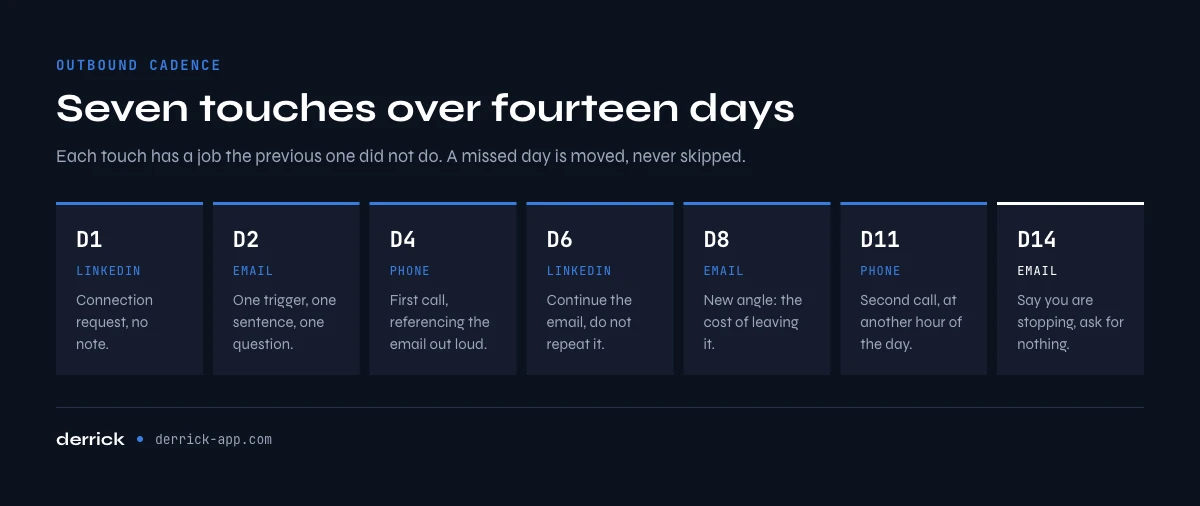
Most first replies do not arrive on the first touch, and most teams stop before the touch that would have worked. A cadence solves that by deciding in advance what happens on which day, so the decision to continue is not re-litigated every morning. The shape below runs seven touches over fourteen days across three channels, and each touch has a job that the previous one did not do.
| Day | Channel | What it does |
|---|---|---|
| 1 | Connection request, no note. You are buying recognition for the message that comes later, nothing else. | |
| 2 | First email. One trigger, one sentence about them, one question. No attachment, no calendar link. | |
| 4 | Phone | First call. Reference the email out loud. A voicemail that names the email is a second impression, not a first one. |
| 6 | Message on the accepted connection, continuing the email rather than repeating it. | |
| 8 | Second email, new angle. If the first was about the problem, this one is about the cost of leaving it. | |
| 11 | Phone | Second call, at a different hour of the day than the first. |
| 14 | Closing message. Say you are stopping, and leave the door open. This one gets replies precisely because it asks for nothing. |
Two rules make the table work. The first is that every touch needs a fact about the account that the previous touch did not use, which is why the enrichment step matters more than the copy. The second is that a missed day is not skipped, it is moved: a cadence with holes in it teaches the prospect that you are not really there.
Buying signals: reach the account at the moment it moves
A cold message sent on a random Tuesday competes with everything else in the inbox. The same message sent three days after the company opened a role for the function you serve competes with almost nothing, because the reason to read it is already on the reader's desk. Signal-based prospecting is the practice of letting the account choose the timing.
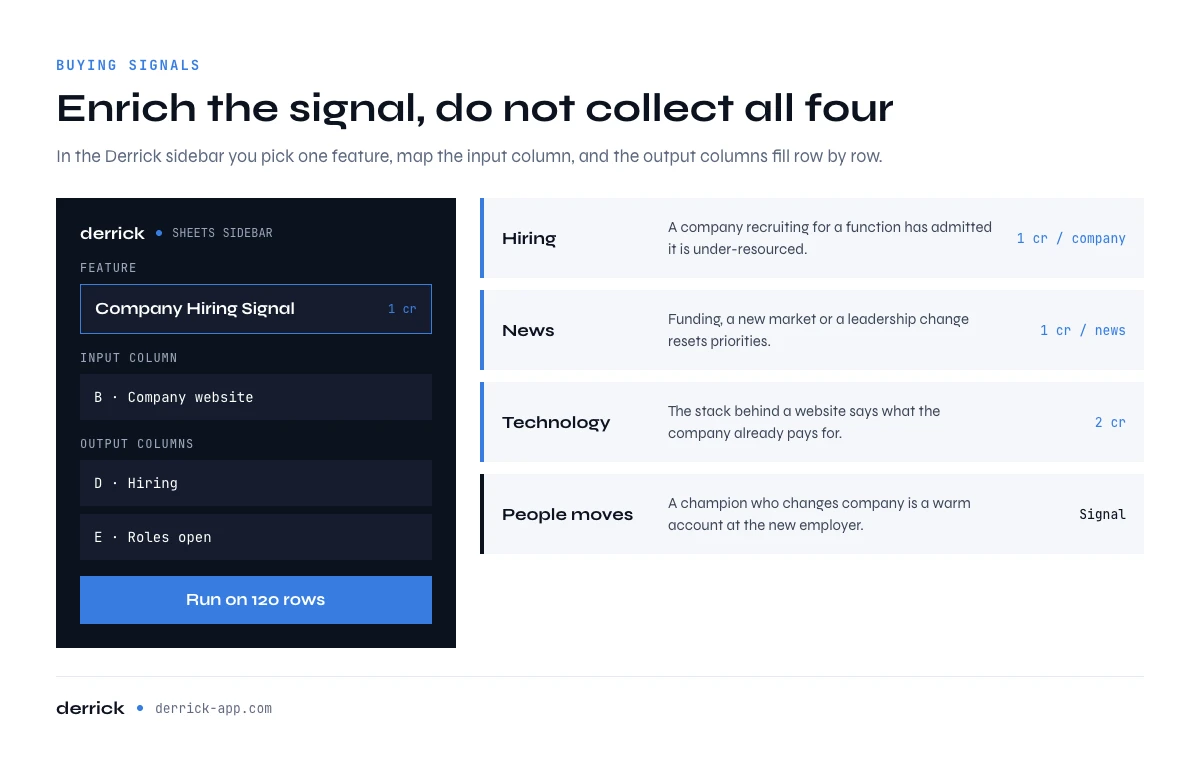
Four signals carry most of the value in B2B, and each one is observable from outside the company:
- Hiring. A company recruiting for a function is a company that has admitted the function is under-resourced. Company Hiring Signal returns which companies are hiring on LinkedIn and for which roles, at 1 credit per company, and it sits on the free plan.
- News. Funding, a new market, a leadership change or an acquisition all reset priorities. Google News Scraper pulls the most relevant recent article for each company on the list, with publisher and date, at 1 credit per news item.
- Technology. What a company runs tells you what it has already decided to spend on and what it is missing. Website Technologies identifies the stack behind any website at 2 credits.
- Movement of people. A champion who changes company is a warm account at their new employer and a cold one at the old. Signal watches leads and accounts for job changes, funding, hiring sprees and stack moves and fires the alert when one lands, from 20 EUR a month.
The discipline here is to enrich the signal, not to collect all four. A list where every row carries one specific, recent, checkable fact beats a list where every row carries four generic ones, because the message can only use one of them anyway.
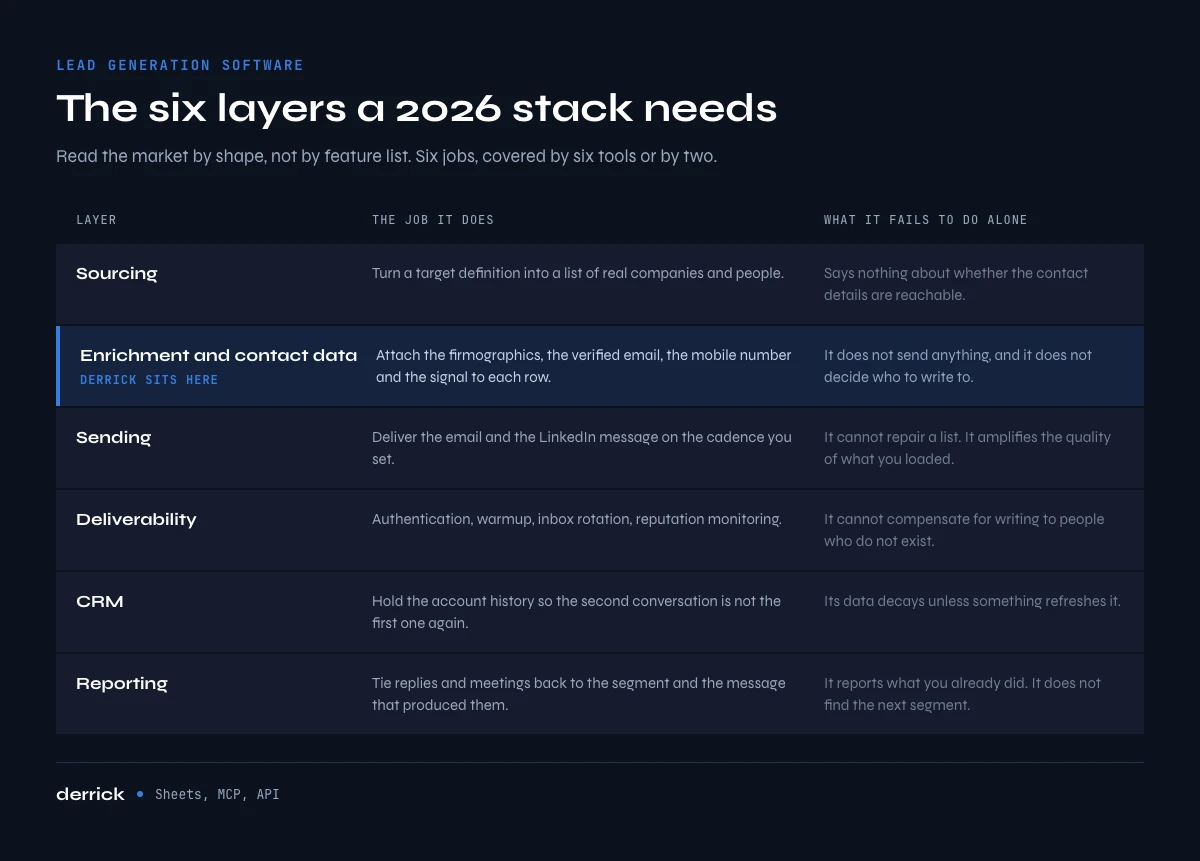
Lead generation software: the six layers a 2026 stack needs
Comparing lead generation software by feature list is how teams end up paying twice for the same layer and nothing for the one that was actually missing. The market is easier to read by shape. Every working stack covers these six jobs, whether with six tools or with two.
The tools that sit in each of those layers, with what one qualified lead costs step by step, are compared in our guide to lead generation tools, layer by layer and with prices.
| Layer | The job it does | What it fails to do alone |
|---|---|---|
| Sourcing | Turn a definition of the target into a list of real companies and people. | Nothing about whether the contact details are reachable. |
| Enrichment and contact data (Derrick) | Attach the firmographics, the verified email, the mobile number and the signal to each row. | It does not send anything, and it does not decide who to write to. |
| Sending | Deliver the email and the LinkedIn message on the cadence you set. | It cannot repair a list. A sending tool amplifies the quality of what you loaded. |
| Deliverability | Authentication, warmup, inbox rotation, reputation monitoring. | It cannot compensate for writing to people who do not exist. |
| CRM | Hold the account history so the second conversation is not the first one again. | Its data decays unless something refreshes it. |
| Reporting | Tie replies and meetings back to the segment and the message that produced them. | It reports what you already did; it does not find the next segment. |
Derrick sits deliberately in one of those rows. It is the data layer, and it is built to be consumed from wherever the work already happens, which is the second thing to check when you evaluate software in this category. There are four ways in:
- The web app, for a list to enrich with nothing to install.
- The Google Sheets extension, when the work is a list you already have in a spreadsheet and you want a column filled.
- The MCP server, when the question is asked inside an AI assistant such as Claude or ChatGPT and you want the answer enriched without leaving the conversation.
- The REST API, when the enrichment belongs inside a workflow, a CRM sync or a product, with no human in the loop.
The right entry point is decided by the use case, not by preference: a list to enrich goes to the web app, or to Sheets if it already lives in a spreadsheet, a question asked in a chat goes to MCP, an automated pipeline goes to the API. Email Finder returns a verified address at 5 credits, billed only when an address comes back, and the same call is available on all of them.
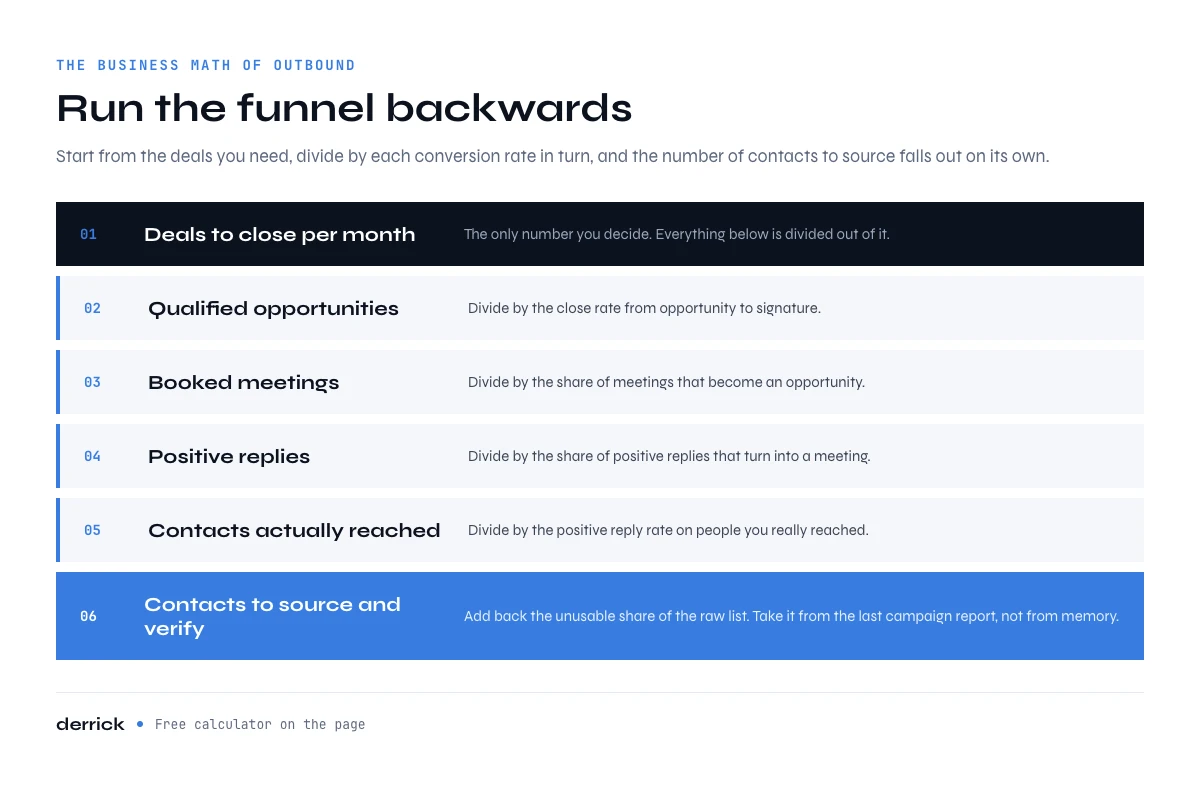
The business math of outbound: how many contacts one deal really costs
Outbound stops being a matter of opinion the moment you run the funnel backwards. Start from the deals you need, divide by each conversion rate in turn, and the number of contacts you have to source and verify falls out on its own. Teams are usually surprised by how large it is, and that surprise is exactly why campaigns get abandoned two weeks in: the volume was never going to be enough.
Outbound pipeline math
Work back from the deals you need to the contacts you have to source. Nothing leaves your browser.
Fill the six fields and press Calculate.
The unusable share is the input teams guess and get wrong. Take it from the last campaign report rather than from memory: hard bounces, role addresses, and everyone who replied that they have left the company. The credit line below prices the email lookup only, at 5 credits per address found; sourcing and verification are separate calls with their own cost.
The same backwards logic answers the cost question. Price each step of the funnel (data, tools, the hours spent) and divide by the qualified B2B leads it produced, and you have the real cost per lead of that B2B lead generation channel. Our guide to calculating cost per lead breaks the formula down by channel. Run the calculator once with last quarter's real rates, then again with the unusable share at 2%. The gap between the two raw-contact figures is what data quality is worth to you every month, expressed in the only unit that survives a budget conversation. If the number of contacts to source looks impossible for the team you have, the honest conclusions are to narrow the ICP so the reply rate rises, or to accept fewer deals, not to send the same message to more people.
Where outbound stops and inbound takes over
The two halves of this article are not competing strategies, they are answers to different questions. Outbound answers "who should know about us that does not yet", and it works from the first day because you control the volume. Content and ads answer "who is already looking", and they compound but only after months of publishing. The usual sequence for a young B2B company is outbound first to learn what the market answers to, then content built on what outbound taught you, which is a very different brief from writing content in the dark. We compare the two in detail in inbound vs outbound, and the account-level version of the same motion is covered in account based marketing. If you would rather not run any of it yourself, the criteria for picking a partner are in our guide to choosing a lead generation company.
We publish one email every 2 weeks with what we measure on prospecting data and outbound, including the numbers behind pages like this one. Subscribe from the homepage.
Frequently asked questions
What is B2B lead generation?
What are the steps of a B2B outreach strategy, and where does scraping fit?
How do content marketing and paid ads generate B2B leads?
What is outbound lead generation?
How many contacts do you need to source to close one B2B deal?
What software do you need for B2B lead generation?
What is the average cost per lead in B2B?
Is buying B2B leads worth it?
Keep reading
Continue exploring this cluster


Account-Based Marketing (ABM): Definition, Techniques, Examples
Read →

Inbound vs Outbound Marketing: Differences, When to Pick Each
Read →

Go-to-Market Strategy: B2B Framework & 7 Steps (2026)
Read →

Lead generation company
Read →