
Go-to-market strategy: the B2B framework and 7 steps
A go-to-market strategy maps how you reach B2B buyers and win revenue. Learn the 7-step GTM framework, a plan template, motions and metrics.


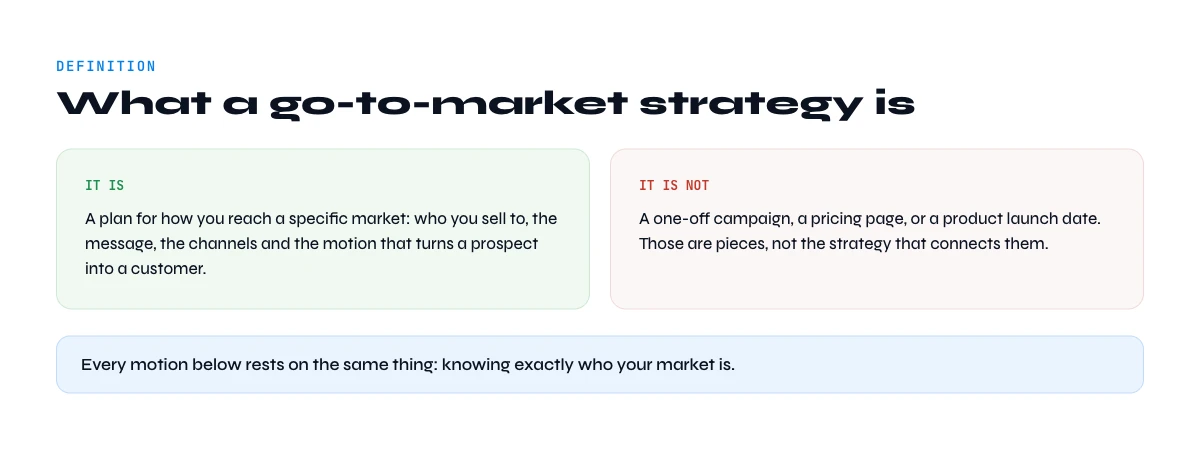
What is a go-to-market strategy?
A go-to-market strategy (GTM strategy) is the plan that defines how a company brings a product to a specific market: who you sell to, what problem you solve for them, how you reach them, and how you turn that reach into revenue. It connects four moving parts that usually live in separate teams: the target market, the offer and its positioning, the sales and marketing motion, and the metrics that tell you whether any of it is working.
People often confuse a GTM strategy with a marketing strategy or a business plan. They are not the same thing. A business plan answers "should we build this and can we fund it". A marketing strategy answers "how do we generate awareness and demand over time". A go-to-market strategy is narrower and sharper: it answers "how do we land this specific offer with this specific buyer, starting now". It has a beginning and an end, and it is built around a launch or an expansion, not around a calendar year.
Most GTM strategies fail for the same boring reason: the team picks a motion and a channel before it has defined the buyer with enough precision to act on. The steps below put that in the right order.
Go-to-market strategy vs marketing strategy
The two plans overlap, which is why teams mix them up. The simplest way to tell them apart: a go-to-market strategy decides where and how you enter, a marketing strategy decides how you keep demand flowing once you are there.
| Dimension | Go-to-market strategy | Marketing strategy |
|---|---|---|
| Question it answers | How do we land this offer with this buyer? | How do we build awareness and demand over time? |
| Scope | One product, one market or segment | The whole brand and portfolio |
| Time frame | A launch or an expansion, with a start and an end | Ongoing, usually planned by year |
| Who is involved | Product, marketing, sales and customer success together | Mostly marketing |
| Main output | Target, motion, pricing, channels, target account list | Brand, content, campaigns, media plan |
| Judged on | Pipeline and revenue from the new market | Reach, engagement and demand over time |
In practice the GTM strategy comes first and sets the frame. Once you know the buyer, the motion and the channels, the marketing strategy runs the engine inside that frame.
GTM strategy vs GTM tactics
The GTM strategy is the set of choices: which segment, which problem, which motion, which price, which channels. Tactics are the actions that carry those choices out: a cold email sequence, a webinar, a LinkedIn campaign, a partner program. A quick test: would the item still make sense if you changed segment tomorrow? If yes, it's probably a tactic. Teams that start with tactics ("let's run ads") end up with plenty of activity and no go-to-market strategy behind it.
When do you need a go-to-market strategy?
You build a fresh go-to-market strategy whenever the buyer, the offer, or the route to market changes. Three situations call for it:
Launching a new product
A new product means a new value proposition and, often, a new buyer. The GTM strategy is what stops a launch from becoming a press release with no pipeline behind it.
Entering a new market or segment
Selling the same product to a new country, a new industry, or a new company size is a new go-to-market problem. The pain is framed differently, the buying committee looks different, and the channels that worked before may be dead in the new segment.
Repositioning an existing offer
When growth stalls, the cause is frequently a GTM mismatch rather than a product gap: you are reaching the wrong people, or reaching the right people with the wrong message. A GTM refresh fixes the targeting and the narrative before you spend more on ads.
Benefits of a go-to-market strategy
- A shared target. Product, marketing and sales chase the same buyer instead of three versions of it.
- Faster launches. Price, channel and message are decided once, up front, instead of being reopened every week.
- Less wasted spend. Budget goes to the channels where the buyer actually is, not to every channel at once.
- A clear read on what works. Metrics are set before launch, so after 90 days you know which step leaks.
- Lower risk on a new market. You test a segment with a short sprint before you hire for it.
Who owns the go-to-market strategy?
In a startup, the founder usually owns the GTM strategy until the first sales or marketing leader arrives. In larger companies it typically sits with product marketing, the CMO or a dedicated GTM or revenue operations lead. It is never a one-team job, though. Product brings the offer, marketing brings positioning and demand, sales brings the motion and what buyers say on calls, customer success brings retention. Name one owner who arbitrates, and make the other teams co-authors.
In the web app or Google Sheets
Turn the segment you defined into an account list
A go-to-market slide names a segment; execution needs the accounts. Describe the segment in a sentence and Derrick imports the companies into the web app or Google Sheets with domain, LinkedIn page and firmographics, ready to be prioritised.
- Feature
- Import Companies from a Prompt
- Credit cost
- 1 credit per company imported
The first button opens the web app (nothing to install): 1 credit per company imported, 100 free credits every month. The second details the feature and its cost per plan.
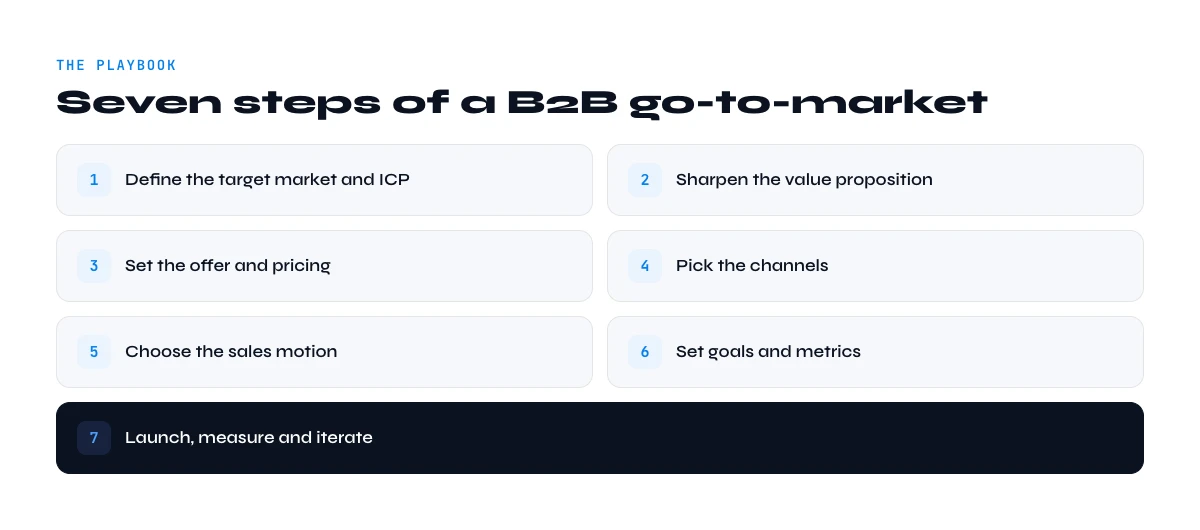
The 7 steps of a B2B go-to-market strategy
This is the sequence that works in 2026. Each step feeds the next, so resist the urge to jump ahead to channels and tactics.
1. Define the problem and the market opportunity
Start with the incident that forces a buyer to act: board pressure, a missed pipeline number, a competitor launch, a new regulation. Write down which metric failed for them and why that failure hurts. A GTM strategy built on a real trigger sells; one built on a vague "they could be more efficient" does not. Pair the trigger with a sober view of the opportunity size so you know whether the market is worth the motion you are about to build.
Deliverable: a one-page problem statement with the trigger, the failing metric and a rough market size.
2. Pin down your ICP and the buying committee
Your ideal customer profile (ICP) is not a persona sketch. It is the set of company-level traits where your pain hits a quantifiable threshold: industry, headcount, tech stack, growth stage, geography. Inside each account, map the buying committee, because B2B purchases are rarely made by one person. You typically have a champion who feels the pain, a budget owner who signs, a technical evaluator who vets risk, and a finance lead who calculates ROI. Each of them needs a different argument.
If you want the mechanics of building and prioritising a named account list, our account-based marketing playbook goes deeper on tiering and account selection.
Deliverable: a written ICP with firmographic thresholds, and a map of the buying committee roles.
3. Choose your GTM motion
Three motions dominate B2B, and your product shape decides which one fits. Product-led growth (PLG) works when the product is simple enough for an individual to adopt without talking to sales. Sales-led works when the deal needs integration, security review, or multi-stakeholder buy-in. ABM (or ABX) fits when you are selling high-value contracts into a small, named set of large accounts. Many companies run a hybrid, but pick a primary motion first; a strategy that tries to do all three at once usually does none well.
Deliverable: one primary motion, written down with the reason it fits the product.
4. Build positioning and messaging by persona
Your positioning is the one-sentence claim about why your offer is the obvious choice for this buyer. From there, build messaging segment by segment and persona by persona. The CFO cares about ROI and total cost of ownership. The VP of Marketing cares about time-to-value and how much it complicates the stack. The end user cares about whether it makes their day easier. Same product, three narratives, one consistent through-line.
Deliverable: a positioning statement and one message per persona.
5. Build the target account and contact list
This is the step most GTM decks skip, and it is the one that decides whether the plan ever touches a real buyer. A motion is only as good as the list it runs on. You need accounts that match the ICP from step 2, and inside them, the named people from the buying committee, with clean contact data. The deeper section below on the data layer covers exactly how to build that list without burning a week in spreadsheets.
Deliverable: a tiered list of target accounts with the named contacts inside each one.
6. Sequence your channels
Channel sequencing matters more than channel count. Start with the high-intent channels where buyers are already looking for a solution (outbound to the named list, retargeting, partner referrals), then layer demand-creation channels (content, paid social, events) to widen the top of the funnel. The split between inbound and outbound depends on your motion and your sales cycle; our breakdown of inbound vs outbound marketing lays out the trade-offs and a decision framework.
Deliverable: a channel plan in launch order, with a budget per channel.
7. Set metrics and run a 90-day sprint
Define the KPIs for each stage before launch: cost per lead, MQL-to-SQL conversion, pipeline created, speed-to-lead, win rate. Then run the strategy as a 90-day sprint rather than a 6-month plan. A tight sprint forces you to ship, measure, and adjust while the assumptions are still fresh, which beats a long planning cycle every time for early and growth-stage teams.
Deliverable: a KPI sheet with a target per stage and a weekly review slot.
Go-to-market plan template
Turn the seven steps into a one-page GTM plan. Copy the table below into a doc or a spreadsheet, fill one row per step and review it every week of the sprint. Each row points back to the step above, so the go-to-market strategy template stays short.
| Step | Deliverable | Typical owner | Metric to watch |
|---|---|---|---|
| 1. Problem and opportunity | Problem statement, failing metric, market size | Founder or product marketing | Size of the addressable segment |
| 2. ICP and buying committee | Written ICP, committee roles | Product marketing with sales | Share of pipeline that matches the ICP |
| 3. GTM motion | Primary motion and why | GTM owner | Sales cycle length |
| 4. Positioning and messaging | Positioning statement, message per persona | Product marketing | Reply rate, demo-to-opportunity rate |
| 5. Target account and contact list | Tiered account list with named contacts | Sales or revenue operations | Accounts covered, contacts reachable |
| 6. Channel sequence | Channel plan in launch order, budget per channel | Marketing and sales | Cost per lead by channel |
| 7. Metrics and 90-day sprint | KPI sheet, weekly review | GTM owner | Pipeline created, win rate |
The owners are typical, not fixed. In a five-person startup one person may hold every row. What matters is that each row has a name next to it.
The app works through your list row by row: 1 credit per company imported.
GTM motions compared
A quick side-by-side to sanity-check the motion you picked in step 3.
| Motion | Best fit | Primary channel | Sales cycle |
|---|---|---|---|
| Product-led (PLG) | Simple, self-serve product; individual adopter | In-product, organic, content | Days to weeks |
| Sales-led | Mid-market deal; multi-stakeholder buy-in | Outbound, inbound demos | Weeks to months |
| Account-based (ABM) | High-value contracts; named enterprise accounts | Targeted outbound, 1:1 campaigns | Months to quarters |
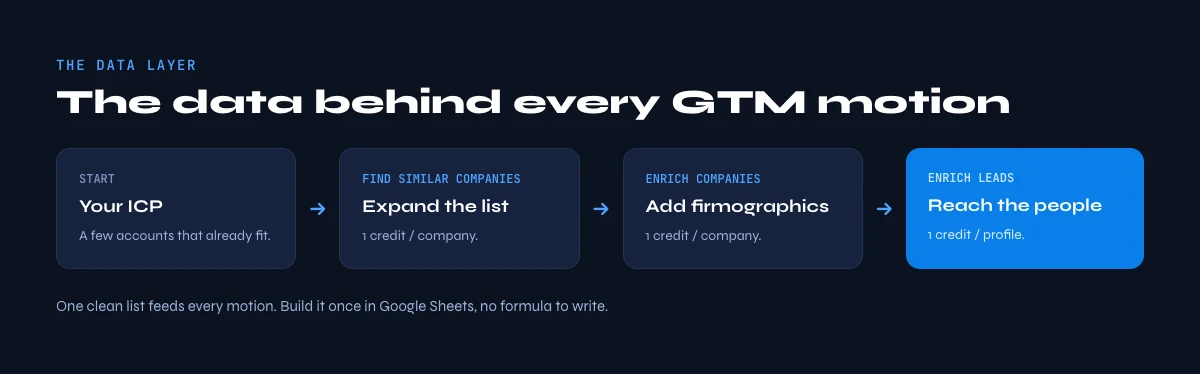
The data layer behind every GTM motion
Whichever motion you chose, it runs on a list: the right accounts and the right people inside them. This is where most go-to-market plans quietly stall, because building that list by hand means hours of copy-pasting LinkedIn pages, guessing company fit, and chasing missing emails.
Derrick is a data-enrichment tool that runs in its web app and in a Google Sheets sidebar, so the list stays where your team already works, no formulas to maintain. Three jobs map directly onto the steps above:
- Turn your ICP into a list. Paste one company that fits your profile and Find Similar Companies returns a set of look-alike accounts with industry, country, and a match score, for 1 credit per company. That is step 2 and step 5 in one move.
- Enrich the accounts. Enrich Companies pulls firmographic detail from each company's LinkedIn page (1 credit per company) so you can tier the list against your ICP threshold. Enrich Companies and Enrich Leads read LinkedIn, so they need your LinkedIn account connected through the Derrick Chrome extension.
- Add the buying committee. Enrich Leads completes the named contacts (1 credit per profile) so your channel sequencing in step 6 reaches real people, not "info@".
Derrick scales the same way whether your sprint targets 50 accounts or 5,000, so the same workflow that validates a niche also powers a full expansion. The free plan includes 100 credits per month, which is enough to build and enrich a first target list end to end before you commit to anything.
A go-to-market strategy example
To make the seven steps concrete, here is a compressed example for a fictional B2B SaaS that automates expense reports.
Step 1, trigger. Finance teams at 50 to 200-person companies are closing the books late because expenses arrive as a mess of spreadsheets. The metric that fails is days-to-close, and it hurts because it delays board reporting.
Step 2, ICP. Companies with 50 to 200 employees, a dedicated finance hire, and a modern accounting stack, in markets where the team already has language coverage. The buying committee: the finance manager (champion), the CFO (budget), an IT lead (security review).
Step 3, motion. The product needs a short onboarding and touches accounting data, so a sales-led motion with a guided trial beats pure self-serve.
Step 4, messaging. To the finance manager: "close two days faster." To the CFO: "cut the cost of late reporting and audit risk." To IT: "SOC 2, SSO, no data leaves your tenant."
Step 5, list. Take one happy customer that fits perfectly, generate look-alike accounts, enrich them, and pull the named finance leads. You now have a ranked list to run, not a guess.
Step 6, channels. Outbound to the named finance managers first, retarget visitors second, then publish a "days-to-close benchmark" piece to create demand.
Step 7, sprint. Ninety days, with a target of 30 qualified demos and a 20 percent demo-to-opportunity rate, reviewed weekly.
The example is deliberately small, but the shape holds at any size: a clear trigger, a precise ICP, one motion, persona-specific messaging, a real list, sequenced channels, and a short measurable sprint.
Example 2: a product-led launch
A fictional note-taking app for sales teams wants individual reps to adopt it before their managers hear about it. Trigger: reps lose call details between the meeting and the CRM update. ICP: account executives at software companies with 20 to 500 employees. Motion: product-led, with a free plan and a paid team plan. Messaging: to the rep, "never retype call notes"; to the manager, "read every deal note without asking". List: no outbound at first, but the team watches which companies have three or more active free users and hands those accounts to sales. Channels: in-product invitations, a template library, short videos on social. Sprint metric: the share of free workspaces that reach three active users within 30 days.
Example 3: a sales-led expansion into a new country
A fictional logistics software company that sells well in France opens Germany. Same product, new go-to-market strategy. The pain is framed in the local market's terms, the buying committee is mapped again from scratch, and the old channel mix built on trade shows gives way to outbound to a named list of 300 mid-sized carriers, generated from one existing customer used as the look-alike seed. Sprint goal: 20 qualified meetings in 90 days, with one local seller and translated case studies.
How to measure go-to-market success
A GTM strategy without instrumentation is a hope, not a plan. Track a small set of metrics across the funnel so you can see where the motion leaks:
- Cost per lead (CPL). What you pay to generate one qualified lead, broken down by channel so you can cut the losers fast.
- MQL-to-SQL conversion. The share of marketing-qualified leads that sales accepts. A low rate usually means the ICP or the messaging is off, not that sales is lazy.
- Speed-to-lead. How fast you follow up after a buyer raises a hand. In B2B this single number often moves win rate more than any creative change.
- Pipeline created and win rate. The end-of-funnel proof that the strategy turns reach into revenue, not just activity.
Read these weekly during the 90-day sprint, not quarterly. The point of a short sprint is that you can react to a leaking step while it still matters. Benchmarks for each of these live in our 2026 B2B marketing performance report, so you are comparing your numbers to the market rather than to last year's gut feel.
One nuance worth flagging: do not optimise a single metric in isolation. A team that chases CPL alone often buys cheap, low-fit leads that crater MQL-to-SQL conversion two steps later. The metrics form a chain, and the right move is to find the weakest link and fix that one, then re-read the whole funnel. When the chain holds for a full sprint, the strategy is ready to scale, and that is the moment to widen the target list and add channels rather than before.
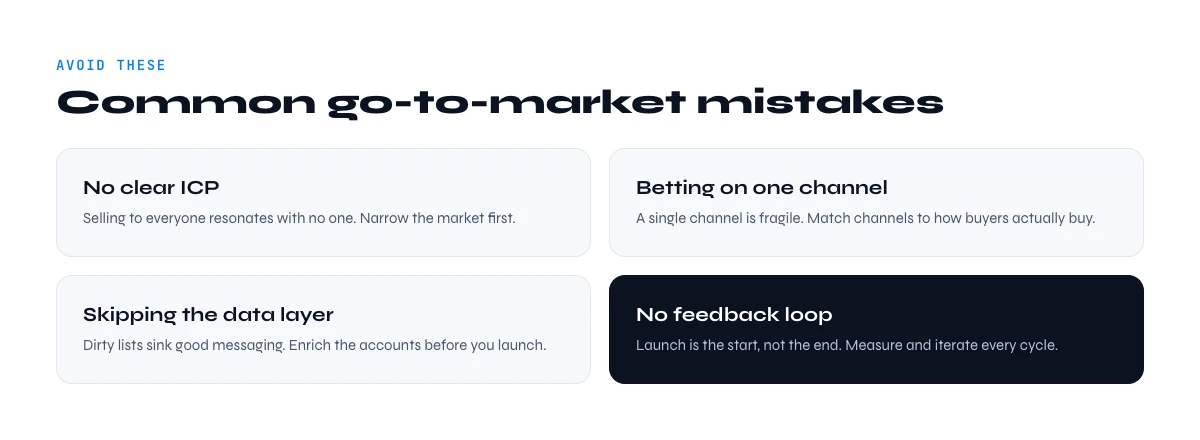
Common go-to-market mistakes
Picking the channel before the buyer
Deciding "we'll do LinkedIn ads" before you have defined the ICP is the most common GTM error. The channel should fall out of the buyer and the motion, not the other way around.
Running on a stale or guessed list
A brilliant message sent to the wrong accounts, or to inboxes that bounce, looks exactly like a failing strategy. Treat list quality as a first-class part of the plan, not an afterthought.
Planning for six months
The market moves faster than your annual plan. Ship a 90-day version, read the metrics, and recut. For the numbers to benchmark against, see our 2026 B2B marketing performance report.
Frequently asked questions
What is a go-to-market strategy?
What is go to market?
What are the steps of a B2B go-to-market strategy?
Which go-to-market motion should I choose?
How do I build the target account list for a GTM strategy?
What are the five pillars of a go-to-market strategy?
What is GTM vs RTM?
Keep reading
Continue exploring this cluster


The State of B2B Marketing Performance 2026: Benchmarks Report
Read →

Account-Based Marketing (ABM): Definition, Techniques, Examples
Read →

Inbound vs Outbound Marketing: Differences, When to Pick Each
Read →

B2B Lead Generation: Strategies, Tools, Tips in 2026
Read →