The 8 B2B Sales Challenges, and How to Tell Which One Is Actually Yours
The 8 B2B sales challenges that matter, each with the metric that confirms it is yours and the lever that fixes it. Plus a 30-day diagnostic you can run.


Ask ten B2B sales leaders what their biggest challenge is and you will get ten versions of the same three answers: the cycle is too long, the right people will not respond, and the forecast keeps slipping. Ask them to prove which one is actually costing the most, and the room goes quiet.
That is the real problem with most lists of B2B sales challenges. They describe symptoms everyone recognizes and then recommend advice nobody can measure. This guide does it differently: eight challenges, each with the number that tells you whether it is really yours, and the specific lever that moves it. Several of them are not sales problems at all. They are data problems wearing a sales costume.
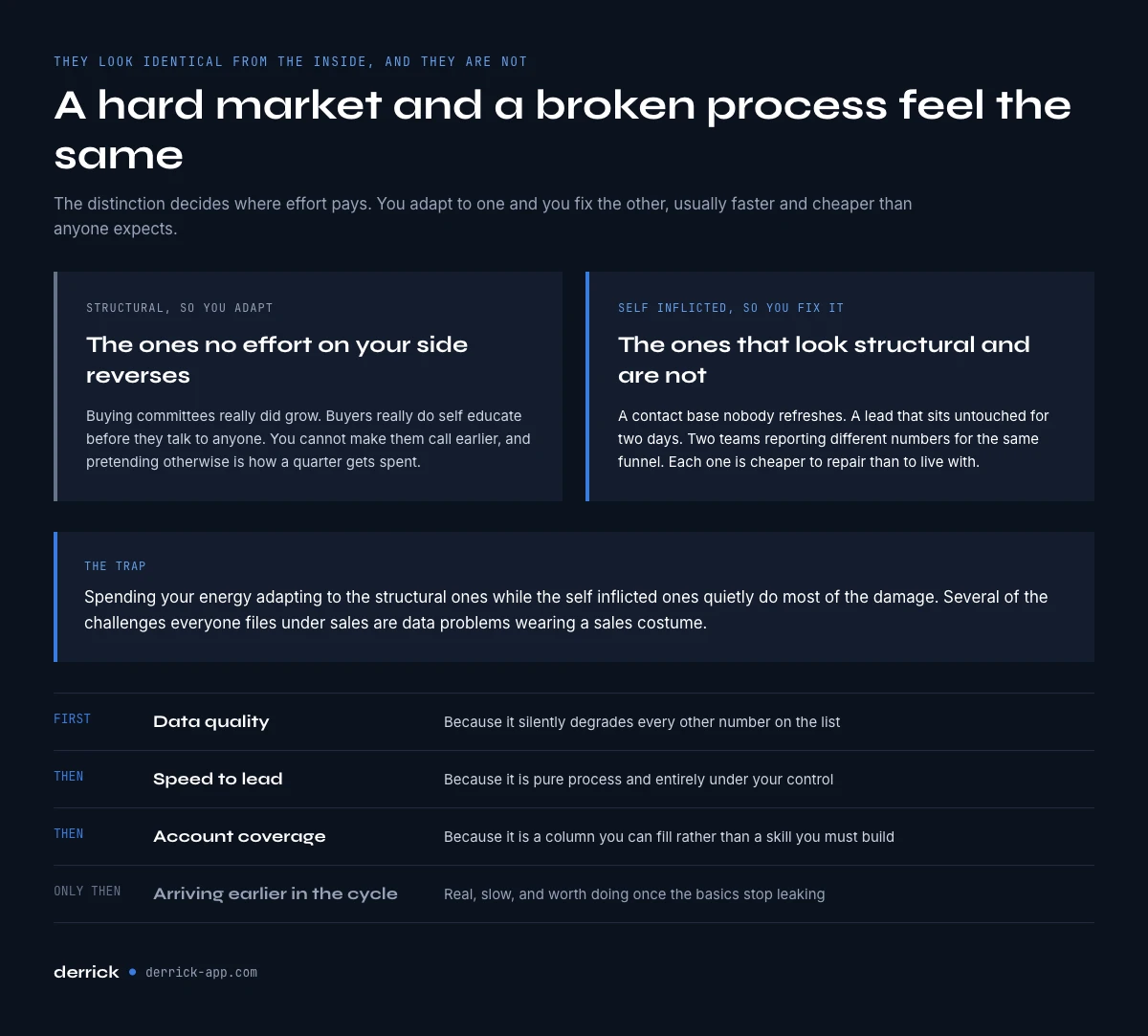
The two kinds of B2B sales challenges: hard market versus broken process
Some B2B sales challenges are structural. Buying committees really did grow, buyers really do self-educate before they talk to anyone, and no amount of effort on your side reverses that. Other challenges look identical from the inside but are entirely self-inflicted: a contact base nobody refreshes, a lead that sits untouched for two days, two teams reporting different numbers for the same funnel.
The distinction matters because it decides where effort pays. You adapt to structural challenges. You fix the self-inflicted ones, usually faster and cheaper than anyone expects. The trap is spending your energy adapting to the structural ones while the self-inflicted ones quietly do most of the damage.
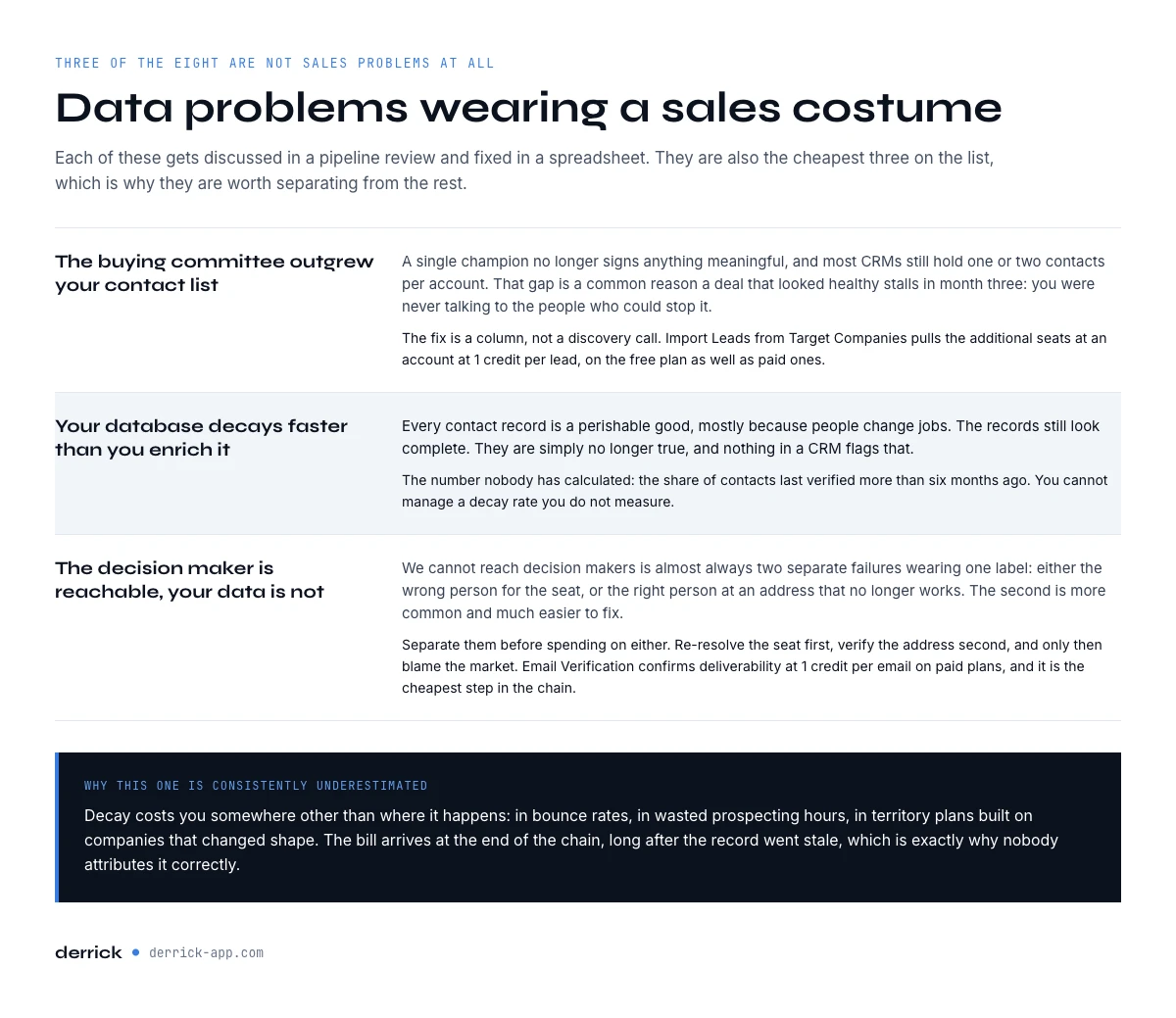
Challenge 1: the buying committee outgrew your contact list
A single champion no longer signs anything meaningful. Our 2026 report on the B2B buying committee puts a typical decision at six to ten stakeholders, spanning the end user, the economic buyer, and the data, security and finance functions, each evaluating you on different criteria.
Most CRMs still hold one or two contacts per account. That gap is a common reason a deal that looked healthy stalls in month three: you were never talking to the people who could stop it, so you never saw them coming.
The number that tells you: your average contacts per open opportunity. The same report sets the coverage target at three to five of the right roles, and notes that single-threading one contact covers about a tenth of the decision surface. Below three, the committee is deciding without you in the room.
The fix: treat account coverage as a data task rather than a discovery task. Import Leads from Target Companies pulls the additional seats at an account for 1 credit per lead, on free and paid plans alike, which turns "who else is involved" from a research project into a column.
Challenge 2: your database decays faster than you enrich it
Every contact record is a perishable good. Our B2B data decay benchmark puts the canonical rate at roughly 2.1 percent per month, driven mostly by job changes. Compounded, that works out to about 22 to 30 percent per year, so a quarter to nearly a third of a database left untouched is wrong within twelve months, and nothing in your CRM flags it. The records still look complete. They are simply no longer true.
This is the challenge teams most consistently underestimate, because its cost shows up somewhere else: in bounce rates, in wasted SDR hours, in territory plans built on companies that changed shape. The cost surfaces at the end of the chain, in pipeline velocity, long after the record went stale.
The number that tells you: the share of your CRM contacts last verified more than six months ago. Most teams have never calculated it, which is the point: you cannot manage a decay rate you do not measure.
The fix: a refresh cadence, not a one-off cleanup. Re-verify before a campaign rather than after it fails.
In the web app or Google Sheets
Separate a targeting problem from a message problem
Most of the eight challenges look alike until the list is qualified. Enrich your current pipeline with job title, seniority and company, then count how many contacts actually match the profile you sell to. The answer tells you which challenge is yours.
- Feature
- LinkedIn Leads Profile Enrichment
- Credit cost
- 1 credit per lead enriched
The first button opens the web app (nothing to install): 1 credit per lead enriched, 100 free credits every month. The second details the feature and its cost per plan.
Challenge 3: the decision maker is reachable, your data is not
"We cannot reach decision makers" is almost always two separate failures wearing one label. Either you have the wrong person for the seat, or you have the right person at an address or number that no longer works.
The second failure is more common and much easier to fix. Provider quality varies far more than the marketing suggests: our 2026 benchmark of B2B data providers collects the independent tests, which land phone-data accuracy roughly between 63 and 91 percent depending on the provider, lower and wider than the 85 to 95 percent vendors advertise. A team working the low end of both ranges is not facing a hard market, it is facing a bad file.
The channel has shifted too. The desk phone has largely stopped connecting, so a dial list built on switchboard numbers underperforms for reasons that have nothing to do with the script.
The number that tells you: connect rate by channel and hard bounce rate on the first send. Our cold email benchmarks put a well maintained list at roughly 1.2 percent overall bounce, with hard bounces under 0.5 percent, against a B2B average of 2.33 percent. Cross those lines and you have a data verdict, not a copy verdict.
The fix: separate the two failures before spending on either. Re-resolve the seat first, then verify the address, and only then blame the market. Email Verification confirms deliverability at 1 credit per email on the paid plans, and it is the cheapest step in the chain.
Challenge 4: speed to lead decides the deal before the pitch does
When an inbound lead arrives, the clock starts. Response time is one of the few variables that consistently correlates with conversion, and it is almost entirely under your control. Our 2026 B2B marketing performance benchmarks cover the speed-to-lead numbers alongside CPL and MQL-to-SQL conversion.
The bottleneck is rarely willingness. It is that the lead arrives as an email address and nothing else, so the rep has to research before they can act. Every minute of that research is a minute a faster competitor is using to reply. The five-stage inbound lead management playbook covers how to close that gap structurally.
The number that tells you: median minutes from form submission to first human contact, measured over a full week rather than on your best day.
The fix: enrich on arrival so the rep opens a complete record instead of a blank one. Routing cannot be fast if qualification is manual.
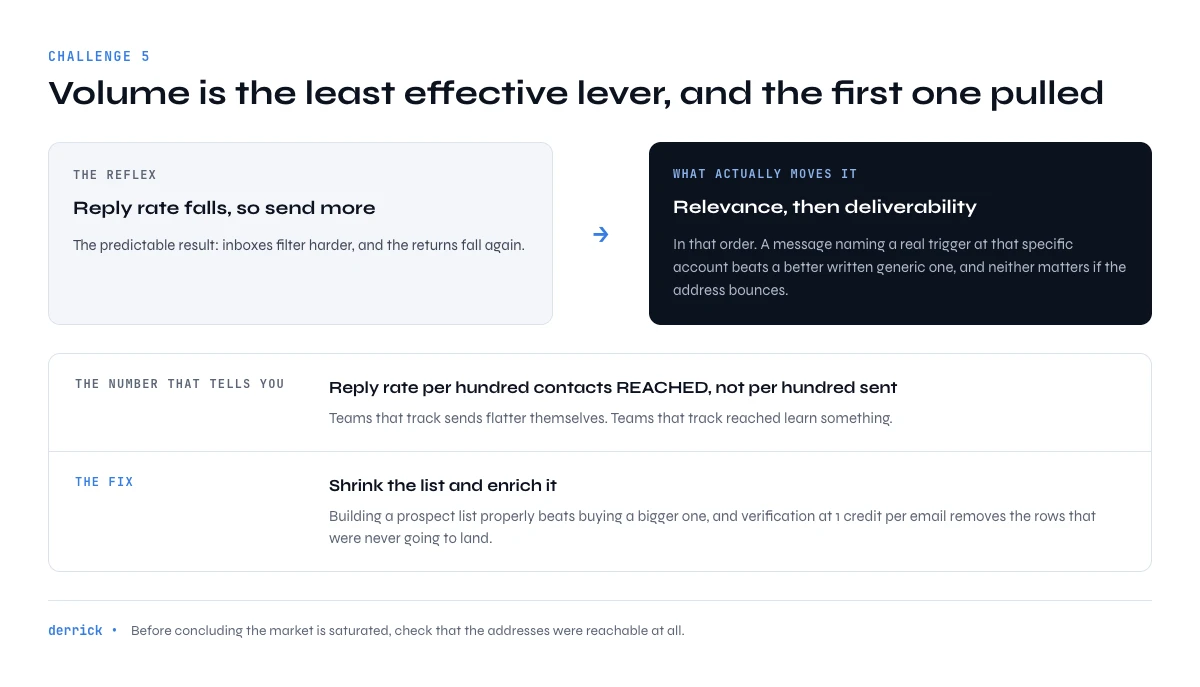
Challenge 5: outbound volume is up and reply rate is down
The reflex response to falling reply rates is to send more. The predictable result is that inboxes filter harder, and the returns fall again. Volume is now the least effective lever available, and it is the one most teams pull first.
What still moves the number is relevance and deliverability, in that order. A message that names a real trigger at that specific account outperforms a better-written generic one, and neither matters if the address bounces. Our 2026 cold email benchmarks give the reply, open and bounce bands to hold yourself to before you conclude the market is saturated.
The number that tells you: reply rate per hundred contacts reached, not per hundred sent. Teams that track sends flatter themselves; teams that track reached learn something.
The fix: shrink the list and enrich it. Building a prospect list properly beats buying a bigger one, and Email Verification at 1 credit per email removes the rows that were never going to land.
Challenge 6: sales and marketing are measuring different things
The classic symptom is two dashboards that disagree about the same month. Marketing reports lead volume up; sales reports pipeline flat. Both are telling the truth about different definitions.
This is not a relationship problem and it does not respond to another alignment meeting. It responds to one shared definition of a qualified lead, written down, with the data fields that prove it. Our comparison of demand generation and lead generation is a useful place to start, because most of these disputes are really an argument about which stage of the funnel each team owns.
The number that tells you: MQL-to-SQL acceptance rate. As a working rule of thumb, sustained acceptance below half means the two teams do not share a definition, whatever the meeting notes say.
The fix: write the definition as required fields rather than as adjectives. "Enterprise-ready" is an opinion; "headcount above 200, in one of these four industries, with a named contact holding one of these five titles" is a filter both teams can apply to the same spreadsheet and get the same answer. Once the definition is a set of columns, the argument stops being about judgment and starts being about whether the columns are filled.
Challenge 7: the buyer arrives already decided
By the time a buyer talks to a rep, they have read the comparison pages, asked their network, and formed a shortlist. This one is genuinely structural. You cannot make buyers call earlier.
What you can do is show up before the shortlist forms, which is what account-based motions and intent signals are for. Our guide to account-based marketing covers the plays that work when the buyer controls the timeline, and outbound sales remains the only channel where you choose the moment rather than wait for it.
The number that tells you: share of won deals where you were the first vendor contacted. If it is low and your win rate is fine, you are winning bake-offs. If both are low, you are arriving too late.
The fix: stop competing on the shortlist and start building the account list before the trigger. That means watching for the events that precede a purchase, a funding round, a new hire in the function you sell to, a technology change, and reaching out on the strength of that event rather than on a calendar cadence. It is slower to set up than a sequence and it is the only version of this problem that has a real answer.
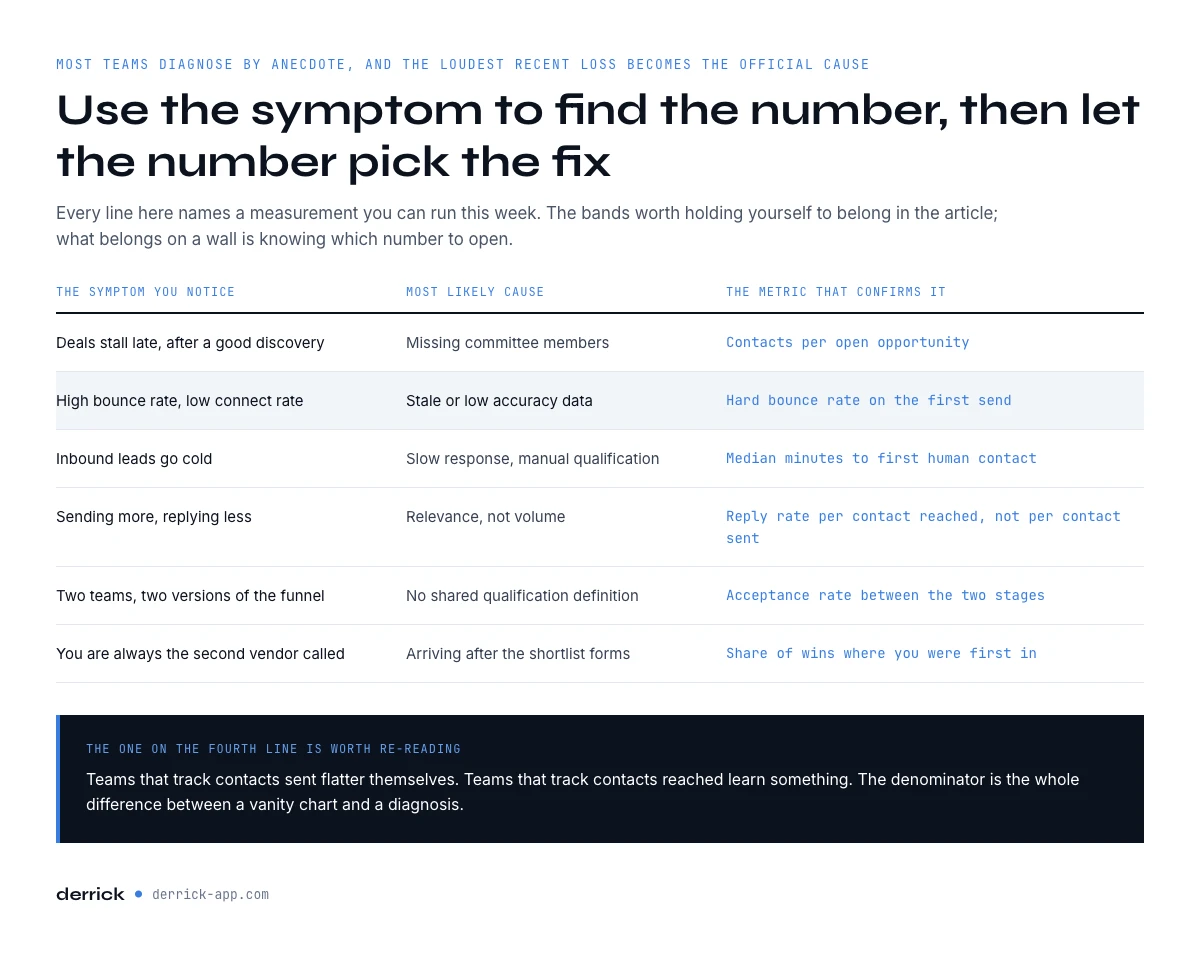
Challenge 8: nobody can name which B2B sales challenges are actually yours
This is the challenge underneath the other seven. Most teams diagnose by anecdote: the loudest recent loss becomes the official cause, and the next quarter's plan is built on it.
Use the symptom to find the number, then let the number pick the fix.
| Symptom you notice | Most likely cause | The metric that confirms it |
|---|---|---|
| Deals stall late after a good discovery | Missing committee members | Contacts per open opportunity under 3 |
| High bounce rate, low connect rate | Stale or low-accuracy data | Hard bounce above 0.5 percent on first send |
| Inbound leads go cold | Slow response, manual qualification | Median minutes to first contact |
| Sending more, replying less | Relevance, not volume | Reply rate per contact reached |
| Two teams, two versions of the funnel | No shared qualification definition | MQL-to-SQL acceptance rate |
| You are always the second vendor called | Arriving after the shortlist | Share of wins where you were first in |
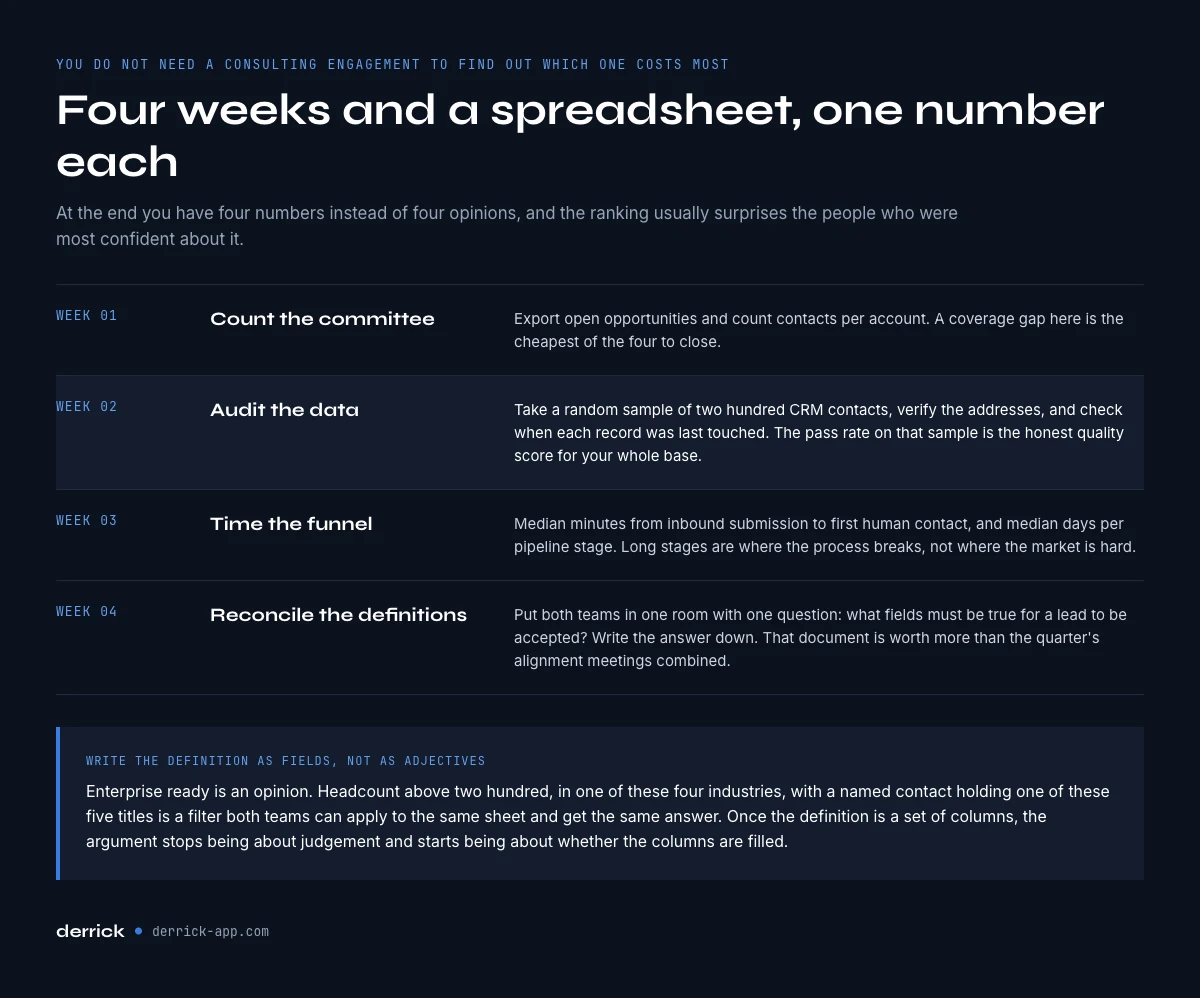
A 30-day diagnostic that ranks your B2B sales challenges
You do not need a consulting engagement to find out which challenge is costing you most. You need four weeks and a spreadsheet.
- Week 1, count the committee. Export open opportunities and count contacts per account. Anything under four is a coverage gap, and it is the cheapest one to close.
- Week 2, audit the data. Take a random sample of 200 CRM contacts, verify the addresses, and check when each record was last touched. The pass rate on that sample is the honest quality score for your whole base.
- Week 3, time the funnel. Measure median minutes from inbound submission to first human contact, and median days per pipeline stage. Long stages are where the process breaks, not where the market is hard.
- Week 4, reconcile the definitions. Put sales and marketing in one room with one question: what fields must be true for a lead to be accepted? Write the answer down. That document is worth more than the quarter's alignment meetings combined.
At the end, you will have four numbers instead of four opinions, and the ranking will usually surprise you.
Which B2B sales challenges to fix first
Fix the self-inflicted challenges before adapting to the structural ones, because they are cheaper and the results arrive within a quarter. In practice that ordering is almost always: data quality first, because it silently degrades every other metric on this page. Then speed to lead, because it is pure process. Then account coverage, because it is a column you can fill. Only then the structural work of arriving earlier in the buying cycle, which is real, slow, and worth doing once the basics stop leaking.
None of this requires a stack rebuild. It requires knowing which number is actually broken. Derrick handles the data layer in its web app or as a Google Sheets sidebar, at any scale, from a founder working forty accounts to a team refreshing forty thousand rows, with Import Leads from a Prompt at 1 credit per lead on free and paid plans. The diagnostic above costs nothing but four weeks of attention.
Frequently asked questions
What are the biggest challenges in B2B sales in 2026?
Why are B2B sales cycles getting longer?
How do I know if my sales problem is data quality or my sales process?
How fast does B2B contact data go stale?
Should I send more outbound emails to fix a low reply rate?
How many contacts should I have per target account?
Keep reading
Continue exploring this cluster


The State of B2B Marketing Performance 2026: Benchmarks Report
Read →

Account-Based Marketing (ABM): Definition, Techniques, Examples
Read →

Inbound vs Outbound Marketing: Differences, When to Pick Each
Read →

B2B Lead Generation: Strategies, Tools, Tips in 2026
Read →