Sales proposal template: the eight sections, and the data each one needs
A sales proposal template is 80 percent boilerplate. See the eight sections, which five depend on buyer data, and where each fact actually comes from.


What a sales proposal template is, and the part that decides the deal
A sales proposal template is a reusable document structure for the offer you send once a deal is qualified: executive summary, proposed solution, scope, pricing, terms, next steps. In practice about four fifths of the document is boilerplate you write once, and the proportion is an observation from the structure itself rather than a measured figure: five of its eight sections are reusable prose, three are not. The remaining twenty percent is variables, and that twenty percent is the entire difference between a proposal that gets forwarded internally and one that gets skimmed.
Every guide on this topic covers the eighty percent. They will tell you to keep it short, add a video, design it well, enable e-signature. All true, and all about the container. Almost none of them says where the contents of the variables come from, which is the actual bottleneck: you cannot write "your 340 person support team across four sites" unless you know the headcount and the sites. This page covers the structure quickly, then spends its time on the variables and where each fact is sourced. It sits in our B2B marketing cluster.
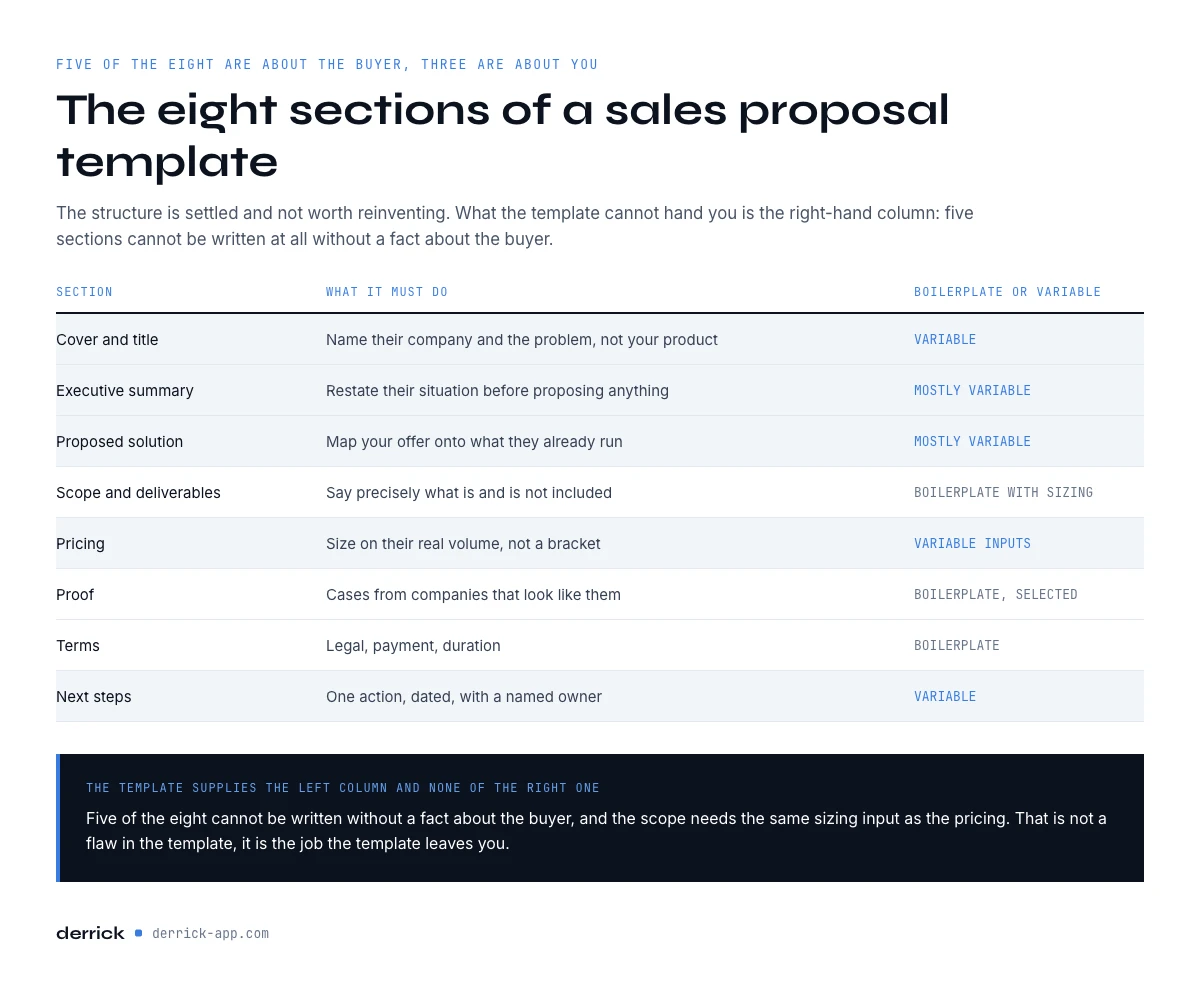
The eight sections of a sales proposal template
Five of these eight sections are about the buyer and three are about you, and that ratio is what separates a template that converts from one that does not. The structure itself is settled and not worth reinventing.
| Section | What it must do | Boilerplate or variable |
|---|---|---|
| Cover and title | Name their company and the problem, not your product | Variable |
| Executive summary | Restate their situation before proposing anything | Mostly variable |
| Proposed solution | Map your offer onto what they already run | Mostly variable |
| Scope and deliverables | Say precisely what is and is not included | Boilerplate with sizing |
| Pricing | Size on their real volume, not a bracket | Variable inputs |
| Proof | Cases from companies that look like them | Boilerplate, selected |
| Terms | Legal, payment, duration | Boilerplate |
| Next steps | One action, dated, with a named owner | Variable |
Count the rows: five of the eight cannot be written at all without a fact about the buyer, and a sixth, the scope, needs the same sizing input as the pricing. A template supplies none of them. That is not a flaw in the template, it is the job the template leaves you.
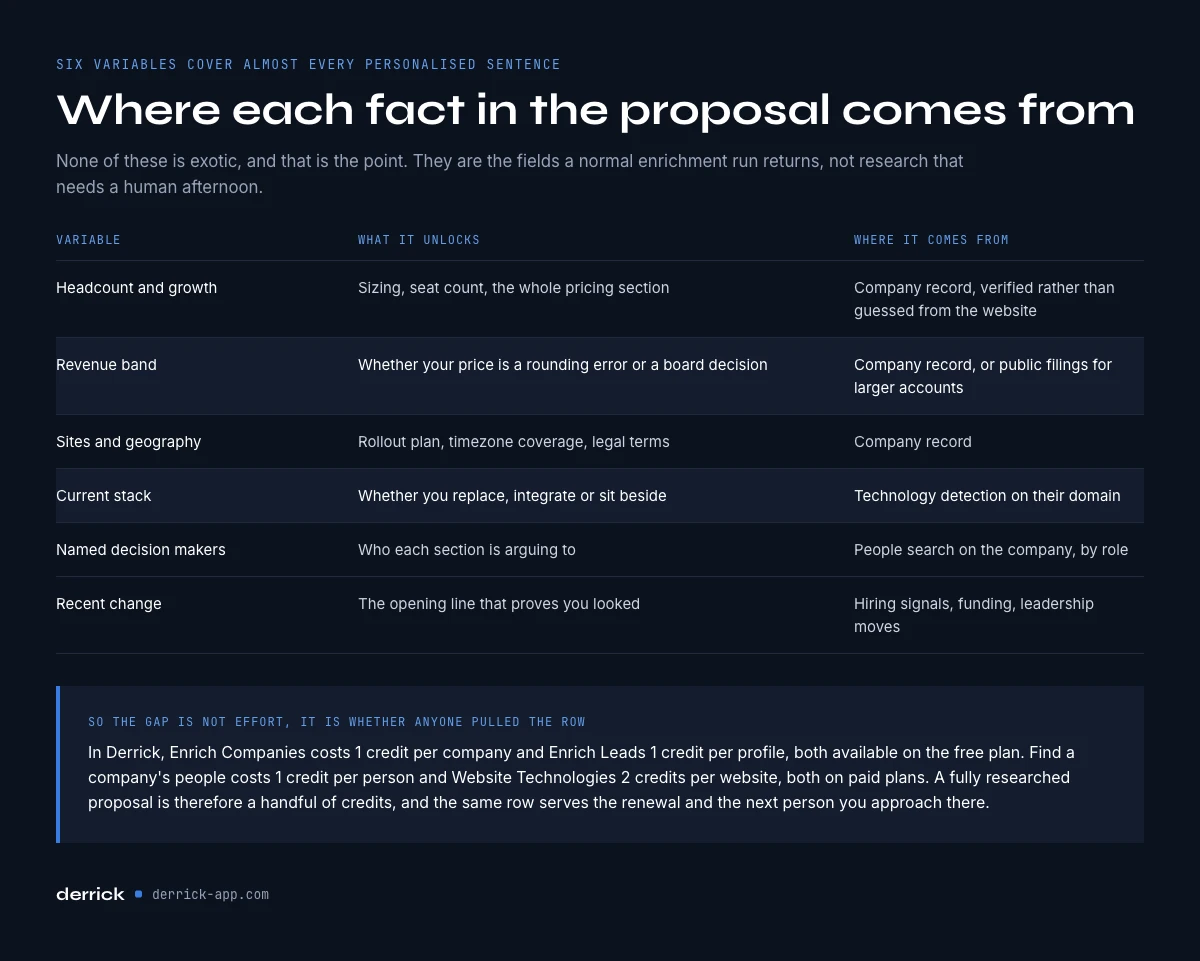
The sales proposal template variables, and where each fact comes from
Six variables cover almost every personalised sentence a proposal contains, and each one has a known source that costs a credit or two. This is the part the proposal guides skip: they describe the container and stop at the moment the container has to be filled.
| Variable | What it unlocks | Where it comes from |
|---|---|---|
| Headcount and growth | Sizing, seat count, the whole pricing section | Company record, verified rather than guessed from the website |
| Revenue band | Whether your price is a rounding error or a board decision | Company record, or public filings for larger accounts |
| Sites and geography | Rollout plan, timezone coverage, legal terms | Company record |
| Current stack | Whether you replace, integrate or sit beside | Technology detection on their domain |
| Named decision makers | Who each section is arguing to | People search on the company, by role |
| Recent change | The opening line that proves you looked | Hiring signals, funding, leadership moves |
The ordering also mirrors the one in our sales process guide, where each stage has its own data requirement. None of these is exotic, and that is the point: they are the fields a normal enrichment run returns, not research that needs a human afternoon. The gap between a generic proposal and a specific one is therefore not effort, it is whether anyone pulled the row before opening the document. Two things follow. The first is that these are cheap: a company record and a profile are a credit each, so a fully researched proposal costs a handful of credits rather than an afternoon. The second is that they are the same variables our cold email formats need at the top of the funnel, so a team that already enriches for outreach is not paying for them twice: the research done at the top of the funnel is still valid at proposal time.
Test what your proposal can actually say
Answer three questions about the account in front of you. The checker maps your answers onto the four sections that carry the document.
Proposal readiness checker
Three questions on what you actually hold about this account, and what your proposal can say because of it.
Answer the three questions to see what your proposal can say.
This scores what you HOLD, not how good your offer is. A proposal can be excellent and still read as generic, and that is usually a data problem rather than a writing one.
The pattern to watch for is a high score on size and a zero on people. It is the most common shape, and it produces a well-sized proposal that nobody in the room feels addressed by.
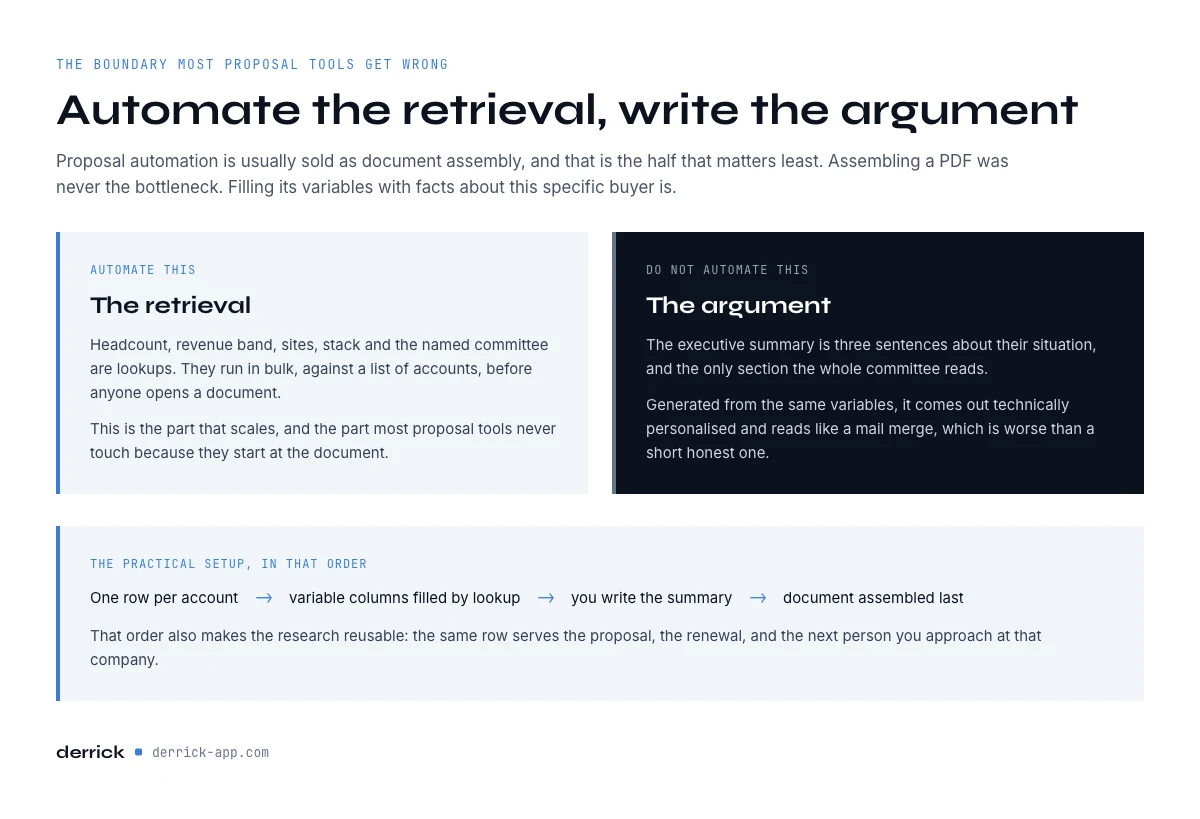
Proposal automation: what can be automated, and what cannot
Proposal automation is usually sold as document assembly, and that is the half that matters least. Assembling a PDF from a template was never the bottleneck; filling its variables with facts about this specific buyer is. Split the work in two and the boundary becomes obvious.
Automate the retrieval. Headcount, revenue band, sites, stack and the named committee are lookups. They run in bulk, against a list of accounts, before anyone opens a document. This is the part that scales, and it is the part most proposal tools do not touch because they start at the document.
Do not automate the argument. The executive summary is three sentences about their situation, and it is the only section the whole committee reads. Generating it from the same variables produces a paragraph that is technically personalised and reads like a mail merge, which is worse than a short honest one. Automate what feeds the sentence, write the sentence.
The practical setup is a spreadsheet where each row is an account, the variable columns are filled by lookup, and the document is assembled last. That order also means the research is reusable: the same row serves the proposal, the renewal, and the next person you approach at that company. Our guide on building a prospect list covers the same workflow one stage earlier.
Why the buying committee is the hardest variable to fill
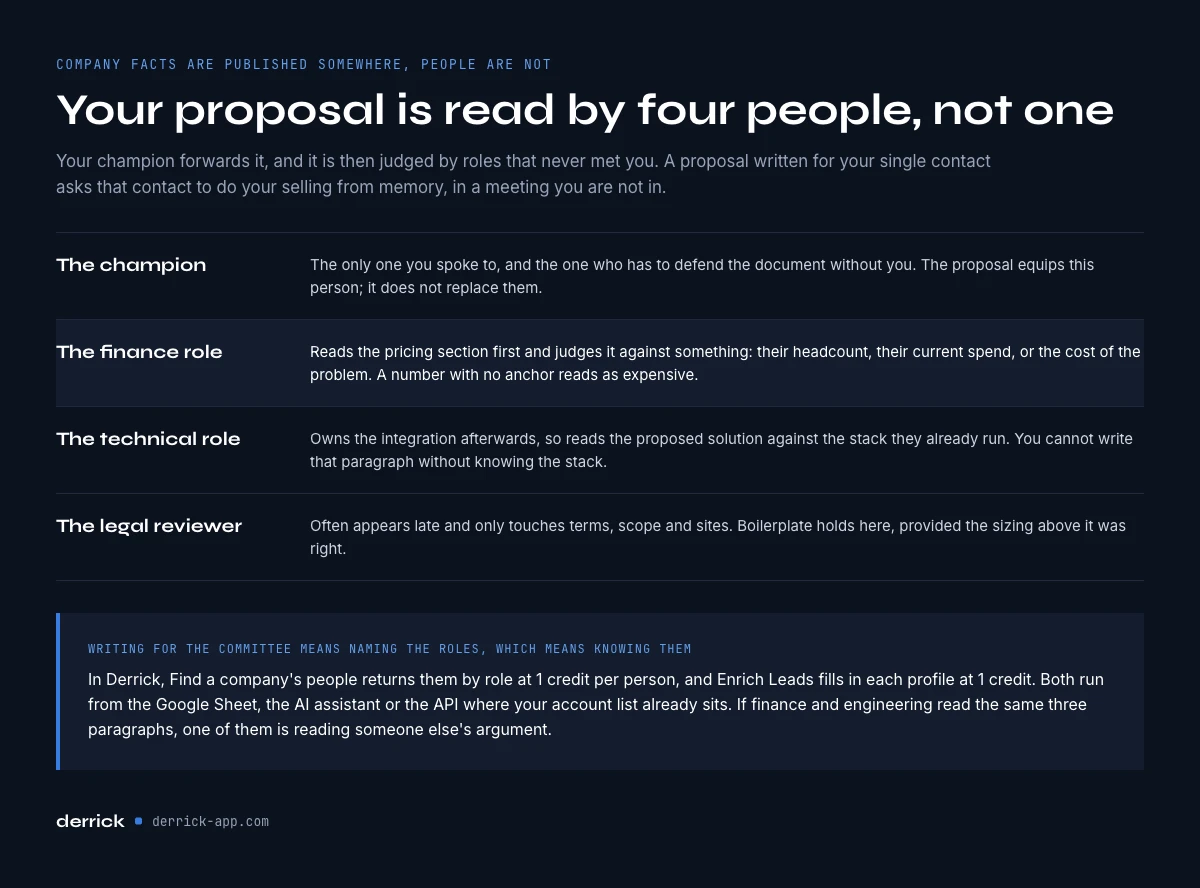
Company facts are published somewhere. People are not, and a B2B proposal is almost never read by one person. Your champion forwards it, and it is then judged by a finance role that never met you, a technical role that will own the integration, and often a legal reviewer.
The practical consequence is that a proposal written for your single contact asks that contact to do your selling for you, from memory, in a meeting you are not in. Writing for the committee means naming the roles and answering each one in its own paragraph, which requires knowing who they are. In Derrick, Find a company's people returns them by role at 1 credit per person, and Enrich Leads fills in each profile at 1 credit. Our playbook on selling to decision makers covers what each seat buys on.
Writing the executive summary from facts you hold
The executive summary is the only section most of the committee will read in full, and it is where the difference between the two kinds of proposal is visible in the first sentence.
The weak version opens on you: what your company does, how long you have existed, which awards you hold. The strong version opens on them, and it can only do that if you hold three things: their situation, its cost, and the change that made it urgent. Three sentences, in that order, and only then your offer. If you cannot write those three sentences without a placeholder, the summary is not ready and no amount of design will save it.
What a sales proposal template cannot fix
A deal that was never qualified. A proposal is a closing document, not a discovery one. If you are still learning what they need while writing it, the problem is upstream in your sales process.
A price the buyer has no frame for. Pricing lands relative to something: their headcount, their current spend, or the cost of the problem. Without one of those anchors your number is judged against nothing, and a number judged against nothing is read as expensive.
A missing champion. No document sells itself through an organisation. The proposal equips a person; it does not replace one, and identifying who that person is comes back to the committee mapping.
Sales proposal template mistakes that cost deals
- Leaving a placeholder in. A stray bracket or a previous client's name is the fastest way to prove the document is a form letter.
- Opening on your company. The first paragraph is the most expensive real estate in the document and it is usually spent on the seller.
- Pricing without sizing. A number with no stated basis invites a negotiation about the basis rather than the value.
- One document for the whole committee. If finance and engineering read the same three paragraphs, one of them is reading someone else's argument.
- No dated next step. A proposal that ends on "let us know" ends.
What a researched proposal costs to produce
A researched proposal costs a few credits and about ten minutes per account, and the research survives the deal. The objection to any of this is time, so it is worth pricing honestly. The variables above come to roughly a company record, a technology lookup and three to five profiles per account. At Derrick's rates that is a few credits per proposal, and the research is reusable for the renewal and for anyone else you approach at the same company.
The free plan gives you 100 credits per month, which covers Enrich Companies and Enrich Leads on a real set of accounts. Note that people search and technology detection sit on the paid plans, so the free tier is the way to test the workflow rather than to run it at volume.
Key takeaways
- A sales proposal template is eighty percent boilerplate; the twenty percent that converts is variables.
- Five of the eight standard sections depend on facts about the buyer, which the template does not supply.
- The variables are cheap and reusable: a company record, a stack lookup, and the named committee.
- The committee is the hardest one to fill and the one that most changes how the document reads.
- An executive summary that opens on the seller is the most common and most expensive mistake.
- A template cannot fix a deal that was never qualified, a price with no frame, or a missing champion.
Derrick does not write proposals and does not sell a template. What it does is fill the variables: the company record, the stack, the named committee, pulled from the Derrick web app, the Google Sheet, the AI assistant or the API where your account list already sits. Start with the free plan and its 100 credits per month, or read the rest of the B2B marketing cluster first.
We also publish one email every 2 weeks with what we are measuring on pipeline and data quality. Subscribe from the homepage.
Frequently asked questions
What is a sales proposal template?
What should a sales proposal include?
How long should a sales proposal be?
Why do sales proposals get ignored?
What data do you need to personalise a sales proposal?
Should a sales proposal be written for one contact or the whole committee?
Can sales proposals be automated?
How much does it cost to research a proposal properly?
Keep reading
Continue exploring this cluster


The State of B2B Marketing Performance 2026: Benchmarks Report
Read →

Account-Based Marketing (ABM): Definition, Techniques, Examples
Read →

Inbound vs Outbound Marketing: Differences, When to Pick Each
Read →

B2B Lead Generation: Strategies, Tools, Tips in 2026
Read →