Best cold email agencies in the United States, ranked and priced
Compare the 8 cold email agencies in the United States: ratings, pricing, deliverability setup, red flags, and work out your real cost per meeting held.


If you read just one thing: for B2B cold email in the US, Belkins is the safest pick (Clutch 4.9/5, 230+ reviews) and the most-reviewed agency in the category. If you want a smaller, more bespoke shop, Martal Group ranks consistently across independent listings. Tighter budget? Look for a US-based freelancer through Upwork or LinkedIn. Ranking based on 8 agencies in May 2026.
Before signing with an agency: build your list with Derrick
Before paying a US cold email agency $2,000-$10,000/month, make sure your list is clean. Derrick lets you enrich and verify 1,000 B2B emails in minutes, directly from Sales Navigator or any existing list export. You own the data, the agency just executes. That's what most senior cold email operators do to avoid getting locked into an external agency's data stack.
Create your free Derrick account - 100 free credits, no card required.
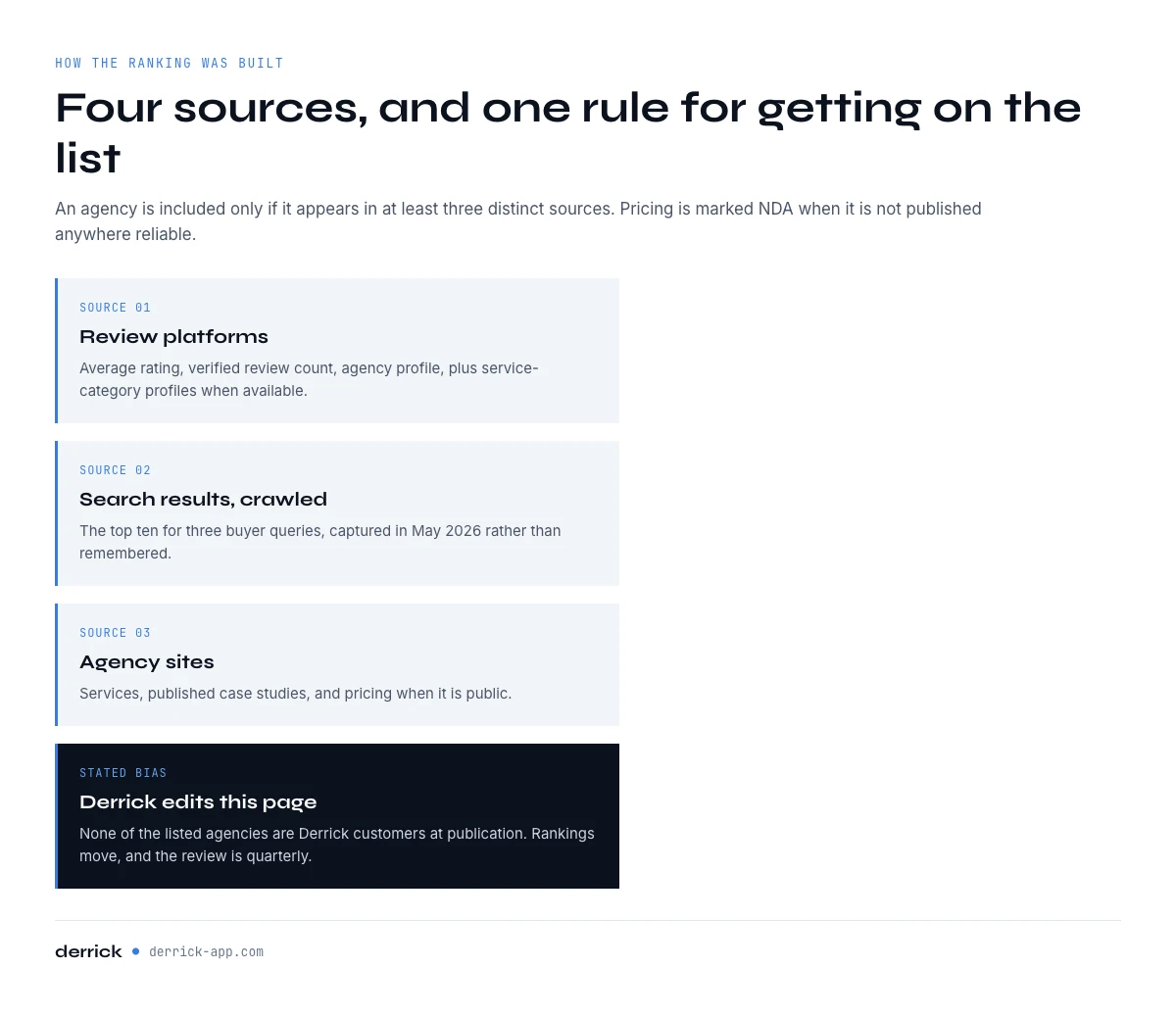
Updated May 5, 2026. Ranking based on 4 verified sources (Clutch, G2, Google SERP top 10 May 2026, agency direct sites).
How we ranked these cold email agencies in the United States
This ranking covers 8 cold email agencies headquartered in the United States or with a dominant US client base in May 2026. It relies on 4 distinct sources:
- Clutch - average rating, verified review count, agency profile
- G2 - service-category profiles when available
- Google SERP top 10 for queries "best cold email agency US", "best cold email agency", and "best B2B cold email agency 2026" (crawled May 2026)
- Direct agency sites to verify services, published case studies and pricing when public
Agencies are included only if they appear in at least 3 distinct sources (internal cross-check rule). Pricing is marked "NDA" when the agency does not publish it on their site and no external source converges on a reliable range.
Stated bias: Derrick edits this content. None of the listed agencies are Derrick customers as of publication, but some may become so. Rankings move - quarterly review planned.
Out of scope: this ranking does not cover non-US agencies (see our best cold email agencies in France article) or cold email SaaS tools (see our Lemlist alternatives).
The 8 agencies at a glance
| Agency | Source rating | Specialty | Pricing (est.) | Best for |
|---|---|---|---|---|
| Belkins | 4.9/5 Clutch (230+) | Cold email + SDR | $4-10K/mo | SaaS Series A-C |
| Martal Group | 4.9/5 Clutch (60+) | Email + phone + LinkedIn | $4.5-8K/mo | Tech B2B |
| CIENCE | 4.4/5 G2 (700+) | SDR + data + tech | $5-15K+/mo | Enterprise / complex sales |
| SalesRoads | 4.8/5 Clutch (50+) | Calling + email | $4-8K/mo | Services + mid-market |
| EBQ | 4.8/5 Clutch (40+) | Outsourced sales + ops | NDA | Bundled sales motion |
| Operatix | 4.6/5 G2 (40+) | SaaS sales dev | NDA | SaaS / cybersecurity |
| SalesNash | 4.8/5 Clutch (45+) | Outbound + appointment | $3-6K/mo | Mid-market |
| CloudTask | 4.6/5 G2 (30+) | SDR marketplace | $2.5K+/SDR/mo | Predictable per-seat |
Pricing estimates based on Clutch / G2 client testimonials and public agency mentions. Always confirm directly.
The 8 cold email agencies in the United States, reviewed one by one
1. Belkins
- Specialty: B2B cold email + appointment setting, outsourced SDR-as-a-service
- Pricing: NDA. Estimated $4,000-$10,000/month based on Clutch and G2 client testimonials.
- Target clients: B2B SaaS, professional services, Series A-C scale-ups
- Rating: 4.9/5 on Clutch (230+ reviews, May 2026), 4.8/5 on G2 (90+ reviews)
Belkins is the most-reviewed cold email agency on the market, period. Founded in 2017 with US headquarters, they operate as an SDR-as-a-service with a globally distributed team. Their public Clutch profile shows hundreds of detailed reviews with verified buyer information - an order of magnitude above most competitors.
Ideal use case: B2B SaaS or professional services that wants to industrialize outbound without hiring an internal SDR team, with a monthly budget of $5K+.
Pros:
- Most solid verified reviews on the market (gold standard)
- Mature outbound stack (warming, deliverability, tested sequences)
- Track record across multiple verticals (SaaS, fintech, services)
Cons:
- Pricing on the higher end of the market
- Structured process can feel heavy for an agile team
- Less flexible on bespoke or one-off projects
2. Martal Group
- Specialty: B2B sales-as-a-service (cold email + cold calling + LinkedIn)
- Pricing: NDA. Estimated $4,500-$8,000/month based on Clutch testimonials.
- Target clients: B2B tech, SaaS, IT services, mid-market
- Rating: 4.9/5 on Clutch (60+ reviews, May 2026)
Martal Group is a North-American sales-as-a-service shop active since 2009. They run multi-channel outbound (email + phone + LinkedIn) with a heavy emphasis on tech B2B verticals. Their team mixes US and Canadian SDRs, useful when the ICP spans both markets.
Ideal use case: B2B tech company that wants outbound and discovery calls handled together, by US SDRs with a vertical-specific playbook.
Pros:
- 15+ years of operational history (Clutch 2009 listing)
- Multi-channel (email + phone + LinkedIn) under one contract
- Vertical playbooks for tech, SaaS, IT services
Cons:
- Less specialized: cold email is one channel among others
- Smaller pure-cold-email team than Belkins
- Pricing requires a sales call
3. CIENCE Technologies
- Specialty: outbound SDR + data + tech, full-stack lead generation
- Pricing: NDA. Estimated $5,000-$15,000+/month based on G2 and Clutch testimonials.
- Target clients: enterprise, mid-market B2B, complex sales cycles
- Rating: 4.4/5 on G2 (700+ reviews, May 2026)
CIENCE is one of the largest pure-play outbound shops in the US, with a stack that combines SDR services, proprietary data and tech. They serve enterprise and complex mid-market deals where the cycle requires several touchpoints. Their G2 review volume (700+) is the highest in the category, with a more mixed signal than Belkins (4.4 vs 4.9).
Ideal use case: mid-market or enterprise B2B with complex sales motions and budget for a multi-month engagement.
Pros:
- Largest review sample on G2 in the category
- Combined SDR + proprietary data stack
- Track record on enterprise and complex sales
Cons:
- Mixed reviews, lower average than Belkins / Martal
- Heaviest engagement - not for short campaigns
- Higher minimums on commitment
4. SalesRoads
- Specialty: B2B appointment setting, outbound calling and email
- Pricing: NDA. Estimated $4,000-$8,000/month per Clutch testimonials.
- Target clients: B2B services, mid-market tech
- Rating: 4.8/5 on Clutch (50+ reviews, May 2026)
SalesRoads is a US-based outbound shop with a strong emphasis on appointment setting. They've been in the market since 2007 and combine cold calling with cold email in a single playbook. They market themselves around "guaranteed appointments", which is unusual but worth scrutinizing on case studies.
Ideal use case: B2B services or mid-market tech that wants real human SDRs picking up the phone in addition to email.
Pros:
- Combined email + calling under one team
- Long operating history (since 2007)
- Clear US English voice and phone presence
Cons:
- Less of a pure cold email specialist
- "Guaranteed appointment" claims need case-study verification
- Smaller scale than CIENCE / Belkins
5. EBQ
- Specialty: outsourced sales + marketing + Salesforce admin
- Pricing: NDA.
- Target clients: B2B mid-market, SaaS, tech services
- Rating: 4.8/5 on Clutch (40+ reviews, May 2026)
EBQ is a Texas-based outsourced sales and marketing shop. They handle appointment setting, lead nurturing and Salesforce admin in a single bundle, which makes them less of a pure cold email shop and more of a fractional sales department.
Ideal use case: B2B mid-market that wants a packaged outsourced sales motion (cold outreach + CRM ops + nurturing) rather than just cold email.
Pros:
- Bundled sales + marketing + CRM ops
- Salesforce-native team
- Texas-based, US-Central time zone
Cons:
- Not a pure cold email specialist
- Bundled offering may include services you don't need
- Less SERP visibility on cold-email-specific queries
6. Operatix
- Specialty: B2B SaaS sales development, US + EMEA
- Pricing: NDA.
- Target clients: B2B SaaS, cybersecurity, devtools
- Rating: 4.6/5 on G2 (40+ reviews, May 2026)
Operatix is a sales development agency with a strong focus on B2B SaaS, particularly cybersecurity and devtools. They run US and EMEA SDR teams, useful when targeting cross-Atlantic accounts. Their case studies skew enterprise SaaS rather than SMB.
Ideal use case: B2B SaaS in cybersecurity, devtools or similar technical verticals targeting US and EMEA.
Pros:
- Vertical specialization (SaaS, cybersecurity, devtools)
- US + EMEA coverage in one team
- Strong enterprise case studies
Cons:
- Less suited for SMB or consumer-adjacent verticals
- Higher minimum engagement commitment
- Pricing on the upper end
7. SalesNash
- Specialty: outbound prospecting + appointment setting, B2B mid-market
- Pricing: NDA. Public mentions cite roughly $3,000-$6,000/month.
- Target clients: B2B services, mid-market SaaS
- Rating: 4.8/5 on Clutch (45+ reviews, May 2026)
SalesNash is a Canadian-US outbound shop with a positioning between Belkins and Martal: medium-sized, focused on appointment setting, with a fair price point in the $3K-$6K/month range based on public testimonials. They emphasize industry-specific SDRs.
Ideal use case: B2B mid-market that wants a mid-priced, mid-sized agency with named industry SDRs.
Pros:
- Pricing in the more affordable mid-tier
- Industry-specific SDR pairing
- Strong Clutch profile for the size
Cons:
- Smaller team capacity than Belkins / CIENCE
- Less brand recognition than top 3
- Public pricing still requires a sales call
8. CloudTask
- Specialty: B2B SDR-as-a-service marketplace
- Pricing: starting around $2,500/month per SDR (public on site)
- Target clients: B2B SaaS, services, mid-market
- Rating: 4.6/5 on G2 (30+ reviews, May 2026)
CloudTask runs a marketplace model where buyers pick SDRs from a pool. It's closer to a hybrid between agency and freelance platform. The pricing per SDR is published, which is rare in this category and useful to budget exactly.
Ideal use case: B2B SaaS or services that wants SDR capacity with predictable per-seat pricing and quick ramp.
Pros:
- Public per-SDR pricing - rare transparency
- Marketplace model - faster sourcing
- Mix of email + LinkedIn + dialer
Cons:
- Less integrated playbook than Belkins / CIENCE
- Quality varies by SDR picked
- Less suited for highly technical verticals
What the engagement delivers, month by month
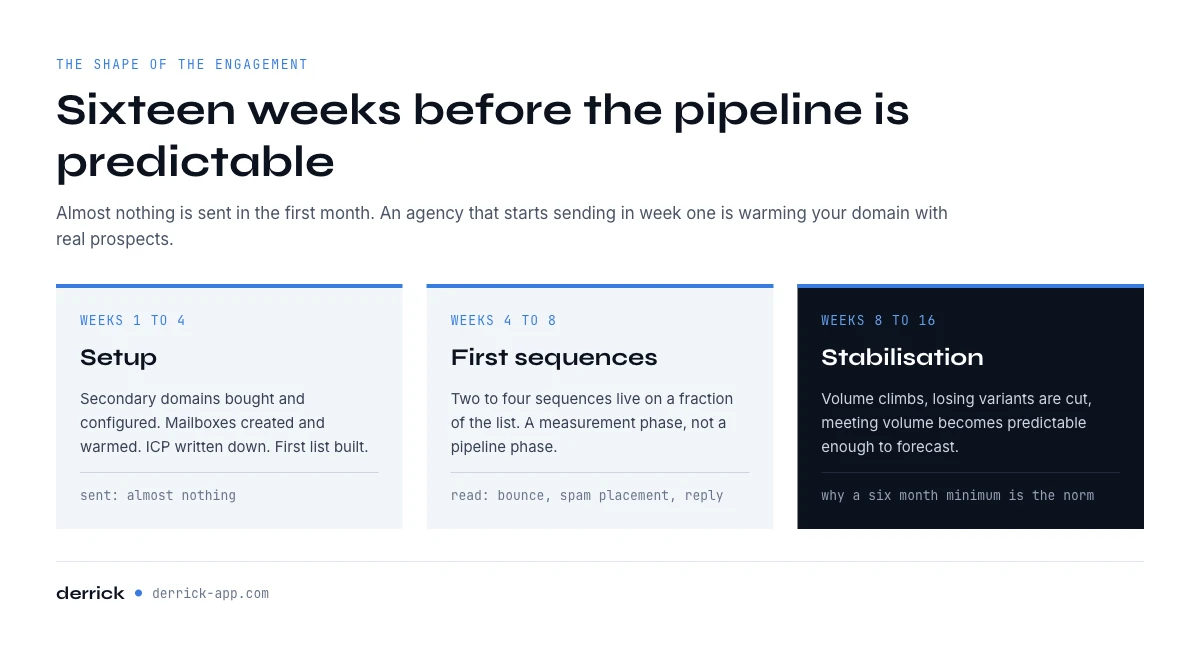
Every agency on this list sells the same headline outcome, which is meetings on your calendar. What separates them in practice is the month by month shape of the engagement, and that shape is remarkably consistent across the cold email agencies in the United States we reviewed.
Weeks 1 to 4, setup. Secondary sending domains are bought and configured, mailboxes are created and warmed, your ICP is written down, and the first list is built. Almost nothing is sent in this window. An agency that starts blasting in week one is warming your domain with real prospects, which is the single most expensive shortcut in the category.
Weeks 4 to 8, first sequences. Two to four sequences go live on a fraction of the list. This is a measurement phase, not a pipeline phase. You should be reading bounce rate, spam placement and reply rate, not counting meetings.
Weeks 8 to 16, stabilisation. Volume climbs, losing variants are cut, and meeting volume becomes predictable enough to forecast. Every agency we looked at describes a ramp in this range, which is why a six month minimum is the norm rather than a sales tactic.
Three things are frequently assumed to be included and frequently are not. Ask about each one explicitly before you sign.
- Reply handling. Some teams hand you a shared inbox and stop there. Others answer, qualify and book. The second costs more and is worth more, because a reply that sits unanswered for two days is a lost meeting.
- Appointment setting and no-show chasing. Booking a slot and making sure someone shows up are different jobs. SalesRoads, EBQ and SalesNash position around appointment setting specifically; a pure email shop may stop at the reply.
- The data. Who builds the list, who pays for the enrichment, and who keeps it at the end. This deserves its own section, below.
Deliverability: what a cold email agency in the United States sets up before it sends
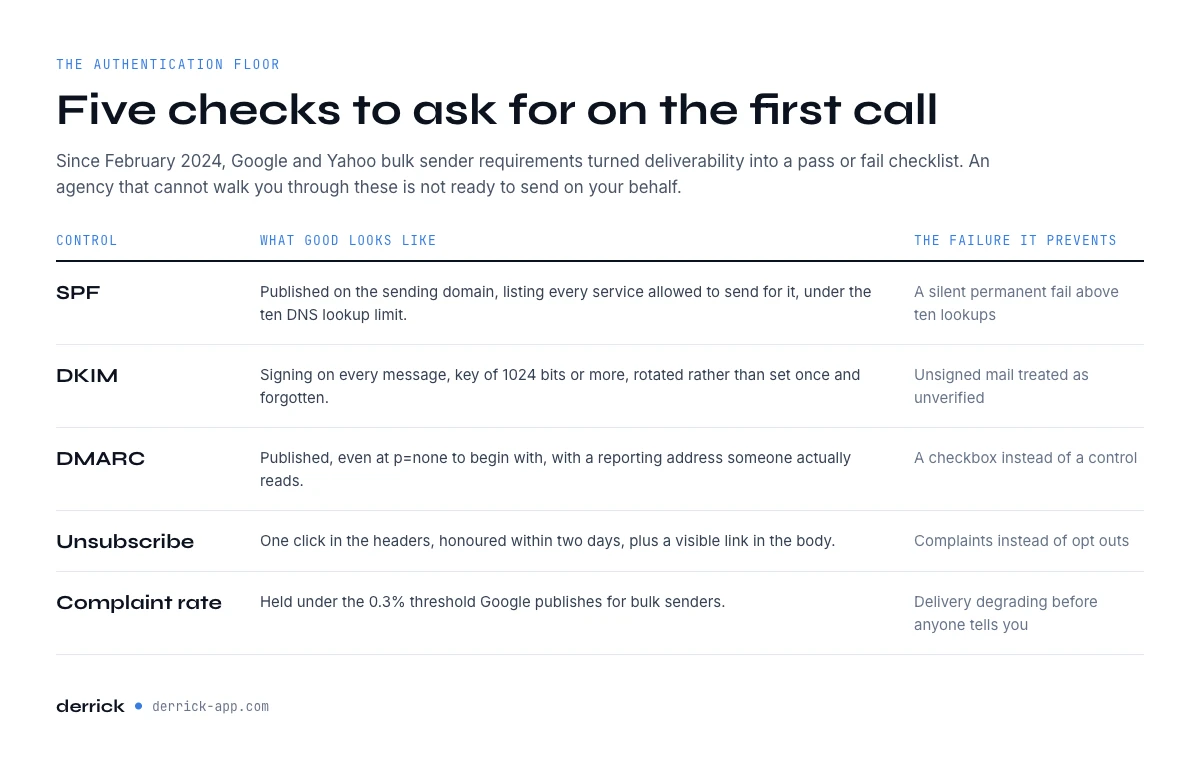
This is the part of the job a cold email agency in the United States gets paid for and the part buyers rarely audit. Since February 2024, Google and Yahoo enforce bulk sender requirements that turned deliverability from a craft into a pass or fail checklist. Any agency that cannot walk you through the following in a first call is not ready to send on your behalf.
The authentication floor
- SPF published on the sending domain, listing every service allowed to send for it, and staying under the ten DNS lookup limit. Our SPF record check counts those lookups on a record before you publish it.
- DKIM signing on every message, with a key of 1024 bits or more, rotated rather than set once and forgotten.
- DMARC published, even at
p=noneto begin with, with a reporting address someone actually reads. A DMARC record with no one monitoring the reports is a checkbox, not a control. - One click unsubscribe in the headers, honoured within two days, and a visible unsubscribe link in the body.
- Spam complaint rate held under 0.3%, which is the threshold Google publishes. Above it, delivery degrades before anyone tells you.
The domain architecture
No competent agency sends cold email from your primary domain. The standard pattern across the cold email agencies in the United States is a set of secondary domains, close variants of your brand, each carrying two or three mailboxes, each mailbox capped at twenty to fifty sends a day. Twenty mailboxes at thirty sends is six hundred emails a day without any single mailbox looking abnormal.
Warm up takes three to six weeks per mailbox and it is not optional. Ask how many mailboxes will be live at your target volume, what the per mailbox cap is, and what happens to the schedule if a domain starts landing in spam.
The input nobody audits
Authentication and warm up protect you from looking like a spammer. Neither protects you from a list that is thirty percent wrong. A hard bounce on an address that never existed is counted against your sending reputation regardless of how clean your DNS is, which is why list hygiene belongs in the deliverability conversation and not in a separate one. We come back to this below.
Who owns the sending domains and the data
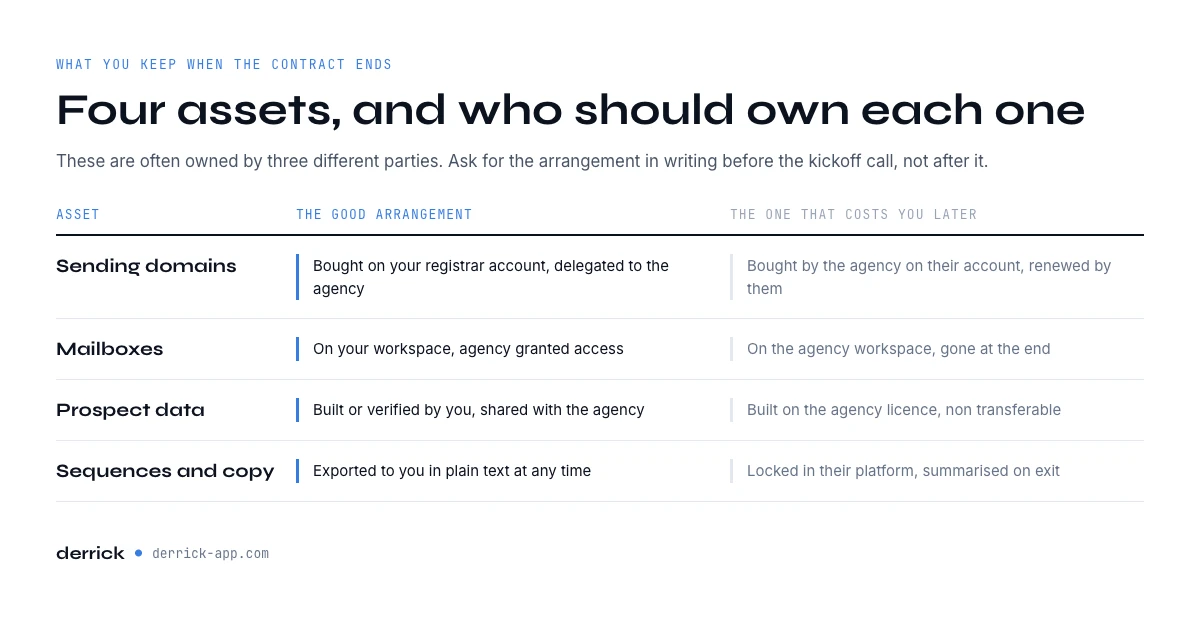
This is the question that decides what you are left with when the contract ends, and it is the one most likely to be skipped in a proposal. There are three separate assets and they are often owned by three different parties.
| Asset | The good arrangement | The one that costs you later |
|---|---|---|
| Sending domains | Bought on your registrar account, delegated to the agency | Bought by the agency on their account, renewed by them |
| Mailboxes | On your workspace, agency granted access | On the agency workspace, gone at the end |
| Prospect data | Built or verified by you, shared with the agency | Built on the agency licence, non transferable |
| Sequences and copy | Exported to you in plain text at any time | Locked in their platform, summarised on exit |
What happens when reputation is burned. If an agency sends carelessly on domains they own, they walk away and you never know. If they do it on domains you own, you inherit the problem, which sounds worse and is in fact better: you can see it, measure it, and put a remediation clause in the contract. Ask for the domain list in writing, and ask who pays to replace a domain that stops delivering.
The data question has the longest tail. An agency that builds your list on its own licence is, at the end of the contract, the only party that knows who you contacted and what they answered. The way out is simple and it is the reason this page exists: bring your own list, verified, and hand it over. That is covered in the last two sections.
Reply rate benchmarks, and the cost per meeting they imply
Numbers quoted in this category are wildly inconsistent, mostly because nobody states the denominator. Here is the frame that makes proposals comparable, with the ranges we see quoted across published agency material and buyer reports.
| Metric | Denominator that matters | Commonly cited range |
|---|---|---|
| Hard bounce rate | Emails attempted | Under 2% acceptable, under 0.5% on a verified list |
| Open rate | Emails delivered | Reported at 30 to 60%, and increasingly unreliable since image proxying |
| Reply rate | Emails delivered | 3 to 5% is a working campaign, 8% and above is strong |
| Positive reply rate | Replies received | 20 to 40% of replies, the rest are declines and opt outs |
| Meeting booked | Positive replies | 40 to 60% once reply handling is competent |
| Show rate | Meetings booked | 60 to 80%, lower without a confirmation sequence |
Two traps. First, open rate is the metric most likely to appear in a proposal and the least likely to mean anything, because privacy proxies fire the tracking pixel without a human reading anything. Second, a reply rate quoted on emails sent rather than delivered flatters a dirty list: the bounces are in the denominator, so bad data looks like a modest reply rate instead of a broken campaign.
The number that actually decides whether the engagement pays for itself is none of the above. It is the cost of one meeting that shows up. The calculator below works it out from the retainer and the funnel, in your browser.
Cost per meeting from an agency retainer
Enter the retainer and the funnel you were quoted. Nothing leaves your browser.
Fill the six fields and press Calculate.
The unusable share is the input buyers guess and get wrong. Take it from the agency first month report rather than from memory: hard bounces, role addresses, and everyone who replied that they left the company. The clean list line holds the retainer constant on purpose, so it shows a gross gain: verifying an address is itself a cost, 1 credit per verified email, billed only on a result, and you subtract it from that gain.
Run it once with the funnel the agency quoted you, then again with the unusable share set to 2%. The gap between the two numbers is what your data layer is worth per month, expressed in the only unit a finance team cares about. If that gap is larger than a month of retainer, the cheapest change available to you is not the agency: it is Email Verification at 1 credit per email, billed only when an address comes back with a verdict, run on the file you already hold. Check the list before you hand it over.
The app works through your list row by row. 100 free credits every month.
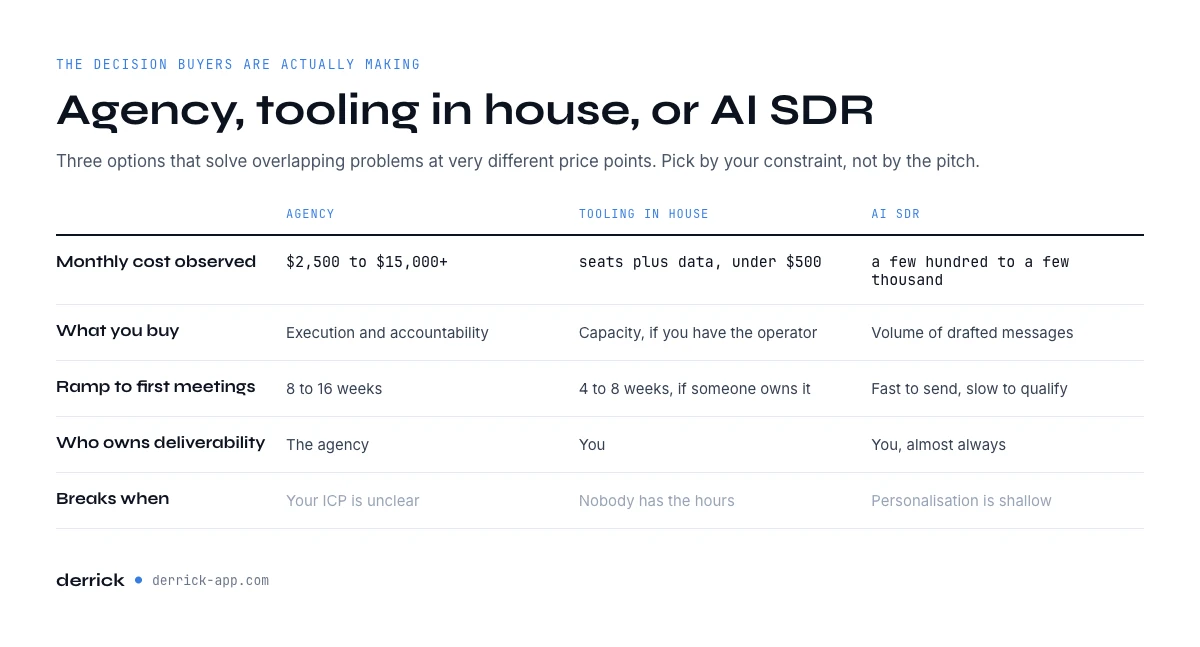
Agency, in house tooling, or AI SDR
This is the decision most buyers are actually making when they search for a cold email agency in the United States, and it is rarely framed properly. Three options solve overlapping problems at very different price points.
| Agency | Tooling in house | AI SDR | |
|---|---|---|---|
| Monthly cost observed | $2,500 to $15,000+ | Seats plus data, typically under $500 | A few hundred to a few thousand |
| What you buy | Execution and accountability | Capacity, if you have the operator | Volume of drafted messages |
| Ramp to first meetings | 8 to 16 weeks | 4 to 8 weeks, if someone owns it | Fast to send, slow to qualify |
| Who owns deliverability | The agency | You | You, almost always |
| Breaks when | Your ICP is unclear | Nobody has the hours | Personalisation is shallow |
Take the agency when the constraint is people and accountability. You have budget, you do not have an operator, and you want one throat to choke on meeting volume.
Keep it in house when the constraint is money and you already have someone who will own it week to week. The tooling cost of running outbound yourself is a rounding error next to a retainer; the hours are not.
Be careful with the AI SDR category when the promise is that personalisation is solved. Generated first lines are only as good as the facts they are generated from, and most of the disappointing results in this category trace back to a thin input, not a weak model. That is a data problem wearing a copy problem costume.
A common and sensible hybrid: keep list building and verification in house, hand a clean file to the agency, and pay them for sending, reply handling and booking. That is the arrangement this page was written for, and the rest of the site covers the other side of it, from LinkedIn outreach agencies in the US to full sales outsourcing.
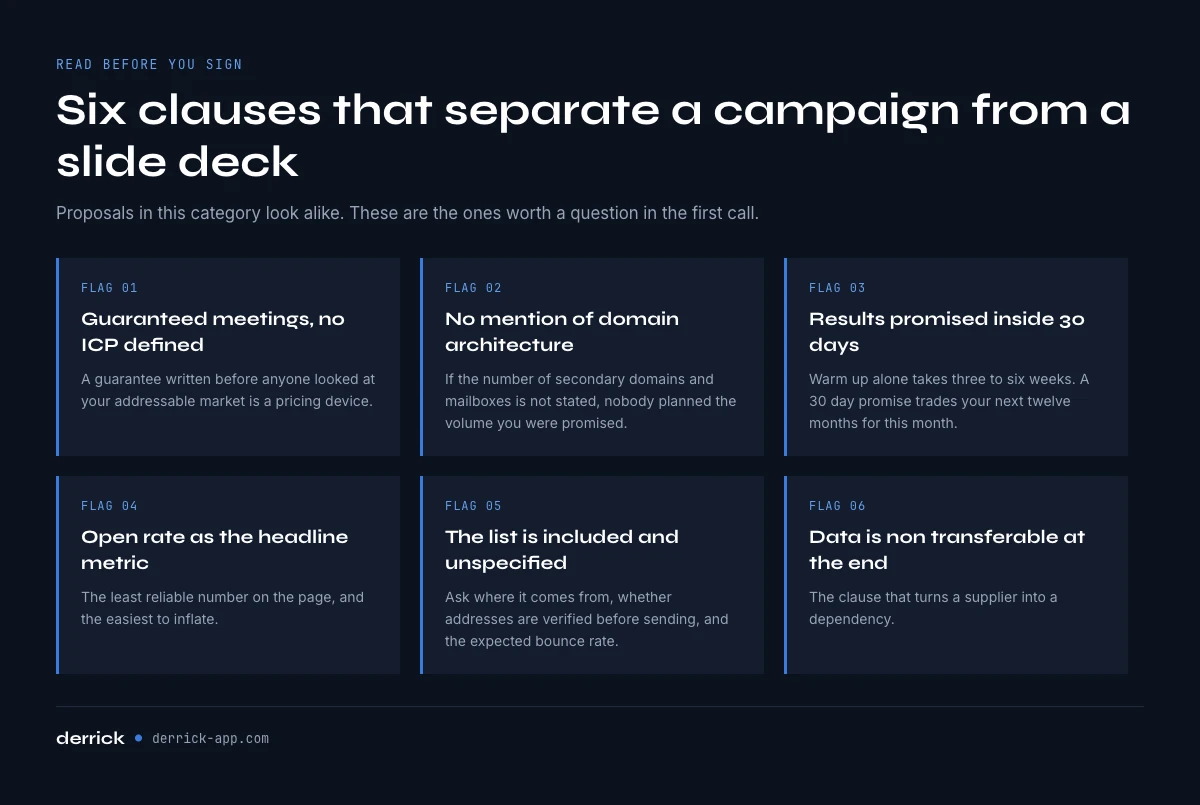
Red flags in a proposal
Proposals in this category look alike. These are the clauses and claims that separate a team that has run campaigns from one that has run a slide deck.
- A guaranteed number of meetings with no ICP defined. A guarantee written before anyone has looked at your addressable market is a pricing device, not a commitment. Ask what counts as a meeting and what happens to the ones that do not show.
- No mention of domain architecture. If the proposal does not say how many secondary domains and mailboxes will be live, nobody has planned the volume you were promised.
- Results promised inside 30 days. Warm up alone takes three to six weeks. A 30 day promise means sending on cold mailboxes, which trades your next twelve months for this month's number.
- Open rate as the headline metric. See the benchmarks section: it is the least reliable number on the page and the easiest to inflate.
- The list is included and unspecified. Ask where it comes from, whether addresses are verified before sending, and what the expected bounce rate is. "We handle the data" is not an answer.
- Data is non transferable at the end. Covered above. This is the clause that turns a supplier into a dependency.
- No named SDR and no named account manager. In a marketplace or pooled model that may be fine, but you should know which it is before you sign rather than after the kickoff call.
- Case studies with no verifiable contact. Every serious agency on this list has published reviews carrying reviewer identity. Ask for two references you can actually call.
One more, which is a positive signal rather than a red flag: an agency that tells you your market is too small for outbound, or that your ICP is not reachable by email, is doing you a favour. That is the subject of the next section.
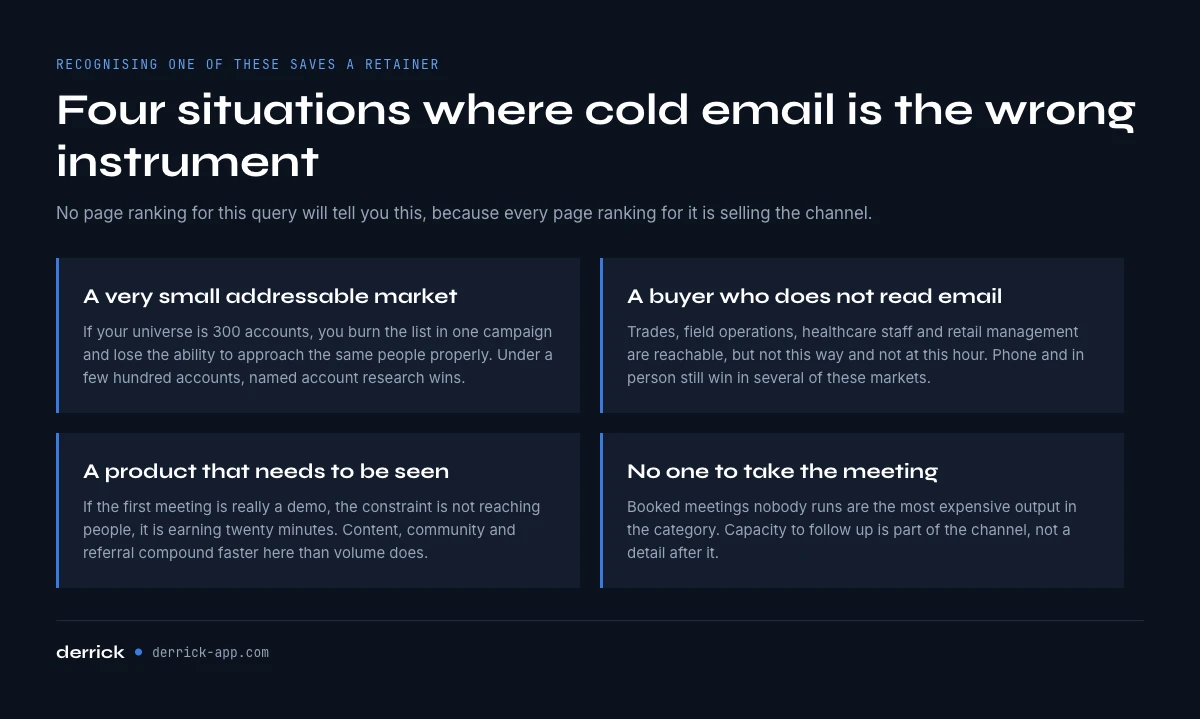
When cold email is not the right channel
No page ranking for this query will tell you this, because every page ranking for this query is selling the channel. Cold email is a poor fit in at least four situations, and recognising one of them early saves a six month retainer.
- A very small addressable market. If your entire universe is 300 accounts, cold email is the wrong instrument: you burn the list in one campaign and lose the ability to approach the same people properly. Under a few hundred accounts, a named account approach with research per account beats sequencing every time.
- A buyer who does not read email. Trades, field operations, healthcare staff and retail management are reachable, but not this way and not at this hour. Phone and in person still win in several of these markets, and a multichannel motion is the honest answer.
- A product that needs to be seen to be understood. If your first meeting is really a demo, the constraint is not reaching people, it is earning twenty minutes. Content, community and referral compound faster here than volume does.
- No one to take the meetings. An agency that books fifteen meetings a month into a calendar nobody can staff is producing a cost, not a pipeline. Sort the receiving end first.
If two or more of these describe your situation, the useful next step is not to shortlist cold email agencies in the United States. It is to test the channel yourself at small volume for one month, with a clean list, and see whether replies come back at all. That test costs a fraction of a retainer and it answers the question the retainer is a bet on.
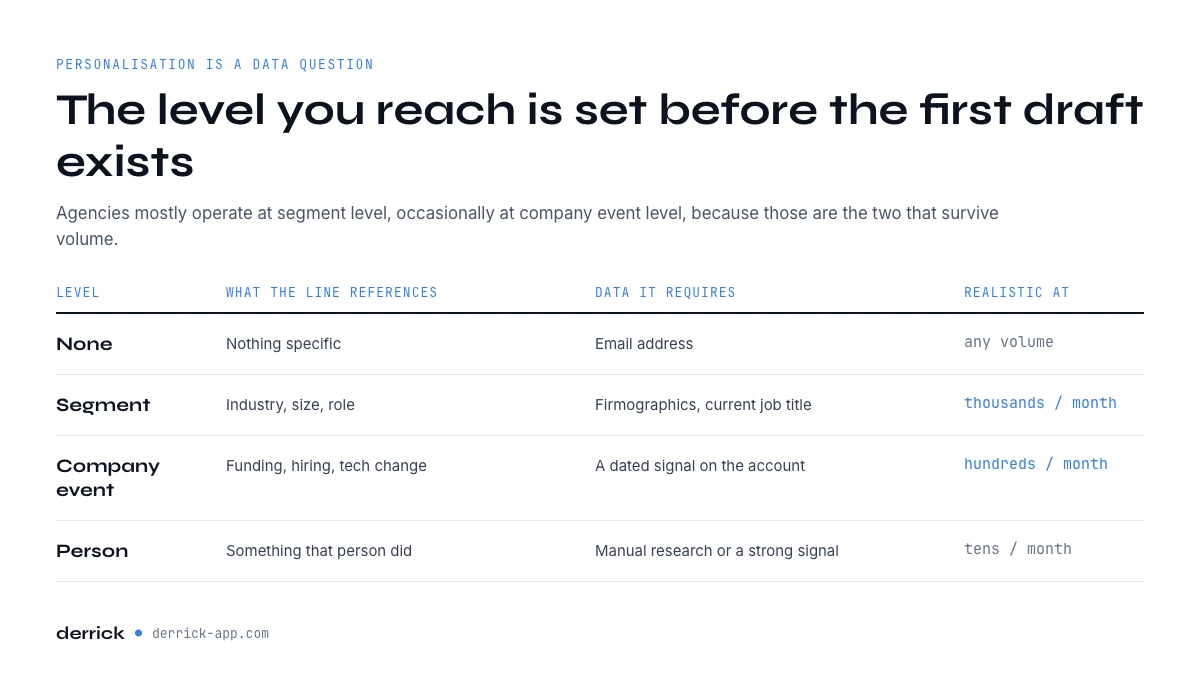
Personalisation and copywriting: what data each level needs
Personalisation is sold as a writing skill and bought as a writing skill. It is mostly a data question, and the level you can reach is set by what you know about the contact before the first draft exists.
| Level | What the line references | Data it requires | Realistic at |
|---|---|---|---|
| None | Nothing specific | Email address | Any volume |
| Segment | Industry, size, role | Firmographics, current job title | Thousands per month |
| Company event | Funding, hiring, tech change | A dated signal on the account | Hundreds per month |
| Person | Something that person did | Manual research or a strong signal | Tens per month |
Agencies mostly operate at segment level and occasionally at company event level, because those are the two that survive volume. When a proposal promises person level personalisation at three thousand sends a month, ask which of the two is really happening.
What to hold them to on testing. One variable at a time, a sample large enough to mean something, and a stated window. A subject line test declared a winner on forty sends is noise presented as a result. Expect the agency to test the opening line and the call to action before it tests the subject, because those move reply rate and the subject mostly moves an unreliable open rate.
The practical consequence for you: the richer the file you hand over, the higher the level the agency can work at without slowing down. A file carrying current role, company size, tech stack and a dated signal lets a writer work at company event level across the whole list. A file carrying name and email caps them at segment level no matter how good they are.
The list you hand over caps what a cold email agency in the United States can do
Everything above converges here. A cold email agency in the United States cannot outperform the list it is given, and the list is the one part of the engagement you can control before you sign anything.
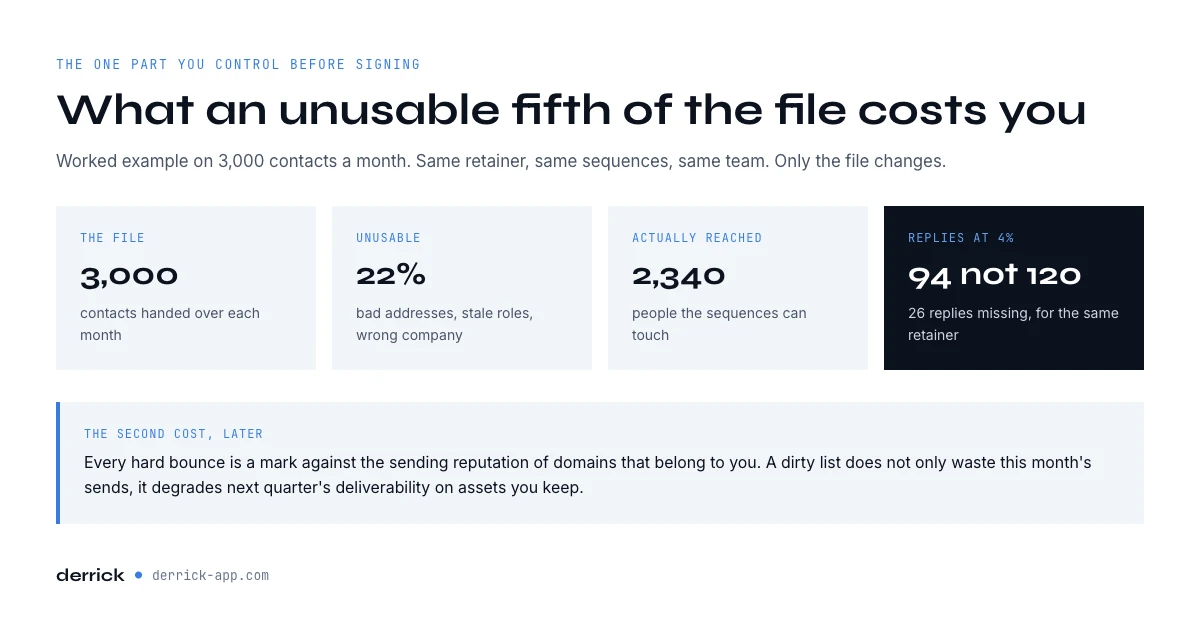
The arithmetic is unforgiving. On 3,000 contacts a month with 22% of the file unusable, the agency reaches 2,340 people. At a 4% reply rate that is 94 replies instead of 120, for the same retainer. The missing 26 replies are not a data quality footnote, they are roughly a fifth of the pipeline you are paying for, and the calculator above prices them for your own numbers.
There is a second cost that shows up later. Every hard bounce is a mark against the sending reputation of domains that, if you followed the section above, belong to you. A dirty list does not only waste this month's sends, it degrades next quarter's deliverability on assets you keep.
What a clean handover looks like
Derrick is built for exactly this step: you bring a list of accounts or profiles, and you hand back a file the agency can send on. Three things are worth doing before the kickoff call.
- Verify every address. Email Verification costs 1 credit per email and is billed only when an address comes back with a verdict. On a paid plan, from Standard at 20 EUR per month.
- Find the missing ones. Email Finder costs 5 credits per email and is billed only on an address actually found. It is a paid feature, Standard and above, so budget it as part of the list build rather than as something the free plan covers.
- Enrich for the copy. Current role, company size, industry and LinkedIn employee count are what lift the agency from segment level to company event level personalisation, as set out in the previous section.
Four ways to run it
The same work happens through whichever door fits how you already work.
- The web app when you want to import your list, run the enrichment online and get the file back, with nothing to install. This is the usual one for a pre agency handover, because the file you end up with is the file you send them.
- The Google Sheets extension when your list already lives in a spreadsheet and you want to enrich it column by column, in place, seeing every row.
- The REST API when the list build is part of an automated workflow, a CRM sync or a scheduled job. Available from the Plus plan at 47.50 EUR per month, and connectable through Zapier, Make and N8N.
- The MCP when you would rather ask the question inside Claude, ChatGPT or any MCP client, and get the answer without leaving the conversation. Same Plus plan.
The free plan gives 100 credits a month at no cost, which is enough to test enrichment and see the shape of the output. Note that Email Finder and Email Verification are paid features: a real list build starts on Standard. See the plans and credit costs before you budget the handover.
How to choose a cold email agency in the United States for your budget
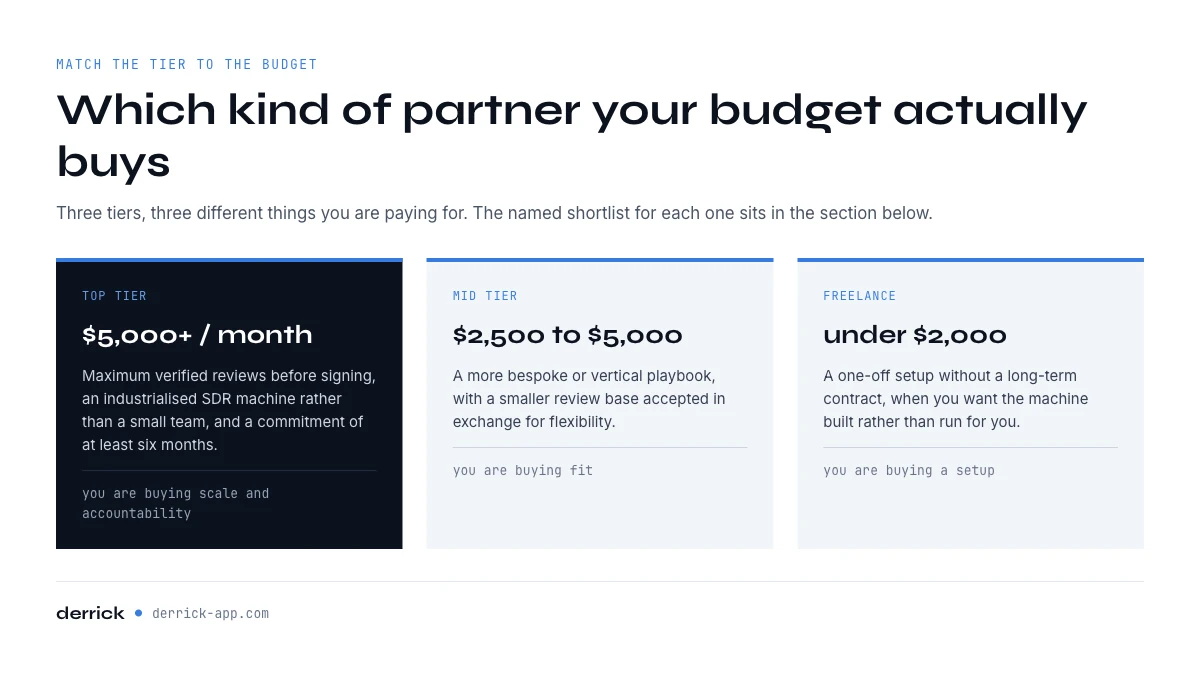
Pick a top-3 agency (Belkins, Martal, CIENCE) if:
- You want maximum verified reviews before signing
- You have a $5K+/month outbound budget for at least 6 months
- You need an industrialized SDR machine, not a small team
Pick a mid-tier agency (SalesRoads, EBQ, Operatix, SalesNash, CloudTask) if:
- Your budget is $2,500-$5,000/month
- You want a more bespoke or vertical-specific playbook
- You can accept a smaller review base in exchange for flexibility
Go with a freelancer (see best cold email freelancers in Paris for an EU example) if your budget is < $2,000/month or if you want a one-off setup without a long-term contract.
Why work with Derrick before or with a cold email agency in the United States
When you pay a US cold email agency $5,000-$10,000 a month, you pay for execution. But execution on bad data gives bad results: high bounce rate, low reply rate, burned domain in 3 months. That's the #1 reason outbound campaigns fail, regardless of the agency.
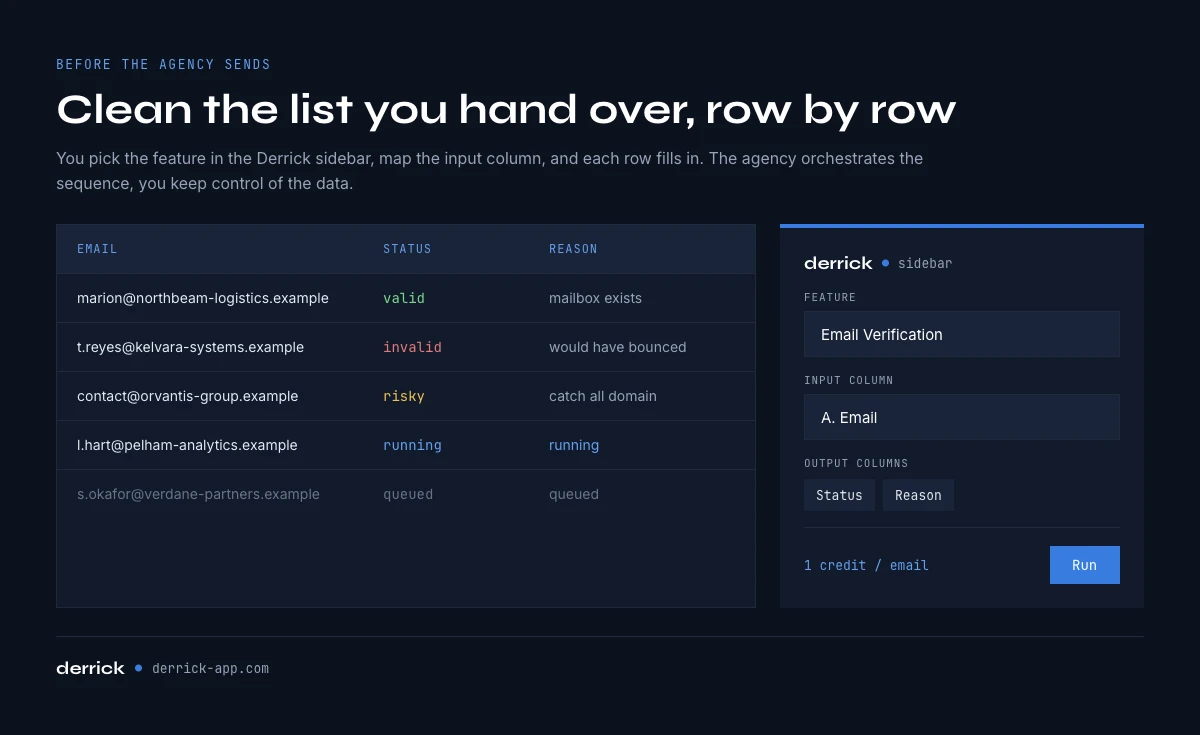
Derrick solves that part of the problem. You take a Sales Nav list of 1,000 prospects, run it through Derrick: you get 1,000 verified emails with bounce rate < 2%, enriched with current role, company size, tech stack, and a recency signal (job change, funding round, hiring).
Here's what you can do with Derrick before or in parallel with an agency:
- Email Verification in bulk, 1 credit per email billed on a result, essential before any campaign
- Full company enrichment - size, industry, tech stack, LinkedIn employee count, ICP signals
- Find work email from name + company - match rate > 70% if the agency asks you to provide a clean file
- Direct export to Lemlist, Smartlead, La Growth Machine - the agency just orchestrates the sequence
Derrick is used by 34,000+ B2B operators, including senior cold email consultants in the US and Europe. The logic: the agency focuses on orchestration and copy, you keep control of the data.
If you work with an agency, you can even share your Derrick workspace (read-only) so they enrich and clean the lists before pushing them into sequence. You keep the data, they execute. No more lock-in, no more surprise when the contract ends. API access and the MCP endpoint (Claude, ChatGPT, any MCP client) are available from the Plus plan, at 47.50 EUR per month.
Create your free Derrick account - 100 free credits, no card required. See all plans, starting at 20 EUR per month on Standard.
Frequently asked questions
How much does a US cold email agency cost in 2026?
What's the difference between a US cold email agency and an offshore one?
How long until you see results with a US cold email agency?
How do I evaluate a US cold email agency before signing?
Do I need a tool like Derrick if I hire a US agency?
Are US agencies better than European ones for the US market?
Do US cold email agencies work with tools like Lemlist or Smartlead?
Who should own the sending domains, me or the cold email agency?
Keep reading
Continue exploring this cluster


Best Cold Email Agencies in France (2026)
Read →

Best Cold Email Agencies in the UK (2026)
Read →

Best Cold Email Agencies in Canada (2026)
Read →

Best Cold Email Agencies in Germany (2026)
Read →