Sales Outsourcing: What It Costs, When It Works, and Who Owns the Data
Sales outsourcing explained: the four pricing models, in-house versus outsourced maths, the contract clauses to sign, and how to audit delivered leads.


Last updated: 2026-08-07
Sales outsourcing means paying an external team to run part of your revenue engine: building the target list, sending the sequences, booking the meetings, and sometimes closing. It is one of the fastest ways to put pipeline on the board without a hiring cycle, and one of the easiest ways to end a twelve month contract with nothing you can reuse. The cost models are public and easy to compare. What almost nobody compares is the asset you walk away with when the engagement stops.
This guide covers the four pricing models, the in-house versus outsourced arithmetic, and the part the vendor pages skip: who owns the data, how to audit the leads you are handed, and how to bring the motion back in-house without losing the pipeline you paid for.
What sales outsourcing actually covers
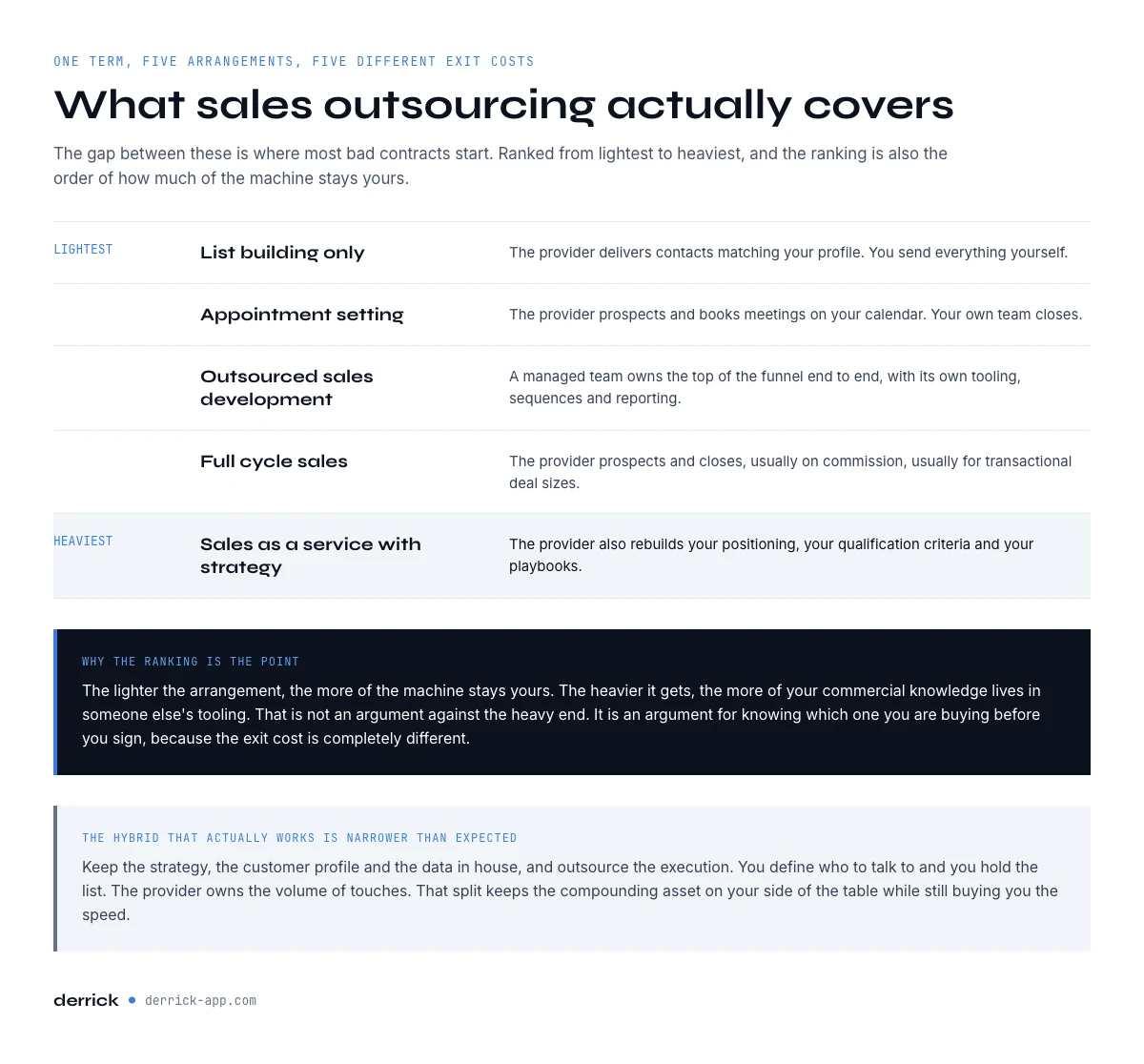
The term is used for at least five different arrangements, and the gap between them is where most bad contracts start. Ranked from lightest to heaviest:
- List building only. The provider delivers contacts matching your ideal customer profile. You send everything yourself.
- Appointment setting. The provider prospects and books meetings on your calendar. Your account executives close.
- Outsourced sales development. A managed team of representatives owns the top of the funnel end to end, with its own tooling, sequences, and reporting.
- Full cycle sales. The provider prospects and closes, usually on commission, usually for transactional deal sizes.
- Sales as a service with strategy. The provider also rebuilds your positioning, your qualification criteria, and your playbooks.
The lighter the arrangement, the more of the machine stays yours. The heavier it gets, the more of your commercial knowledge lives in someone else's tooling. That is not an argument against the heavy end. It is an argument for knowing which one you are buying before you sign, because the exit cost is completely different.
If your motion is a single channel, the specialised guides in this silo are a better starting point than a generalist provider. Compare what a focused shop delivers in cold email in the US market or in LinkedIn outreach before you buy a bundled sales development retainer.
The four pricing models, and what each one hides
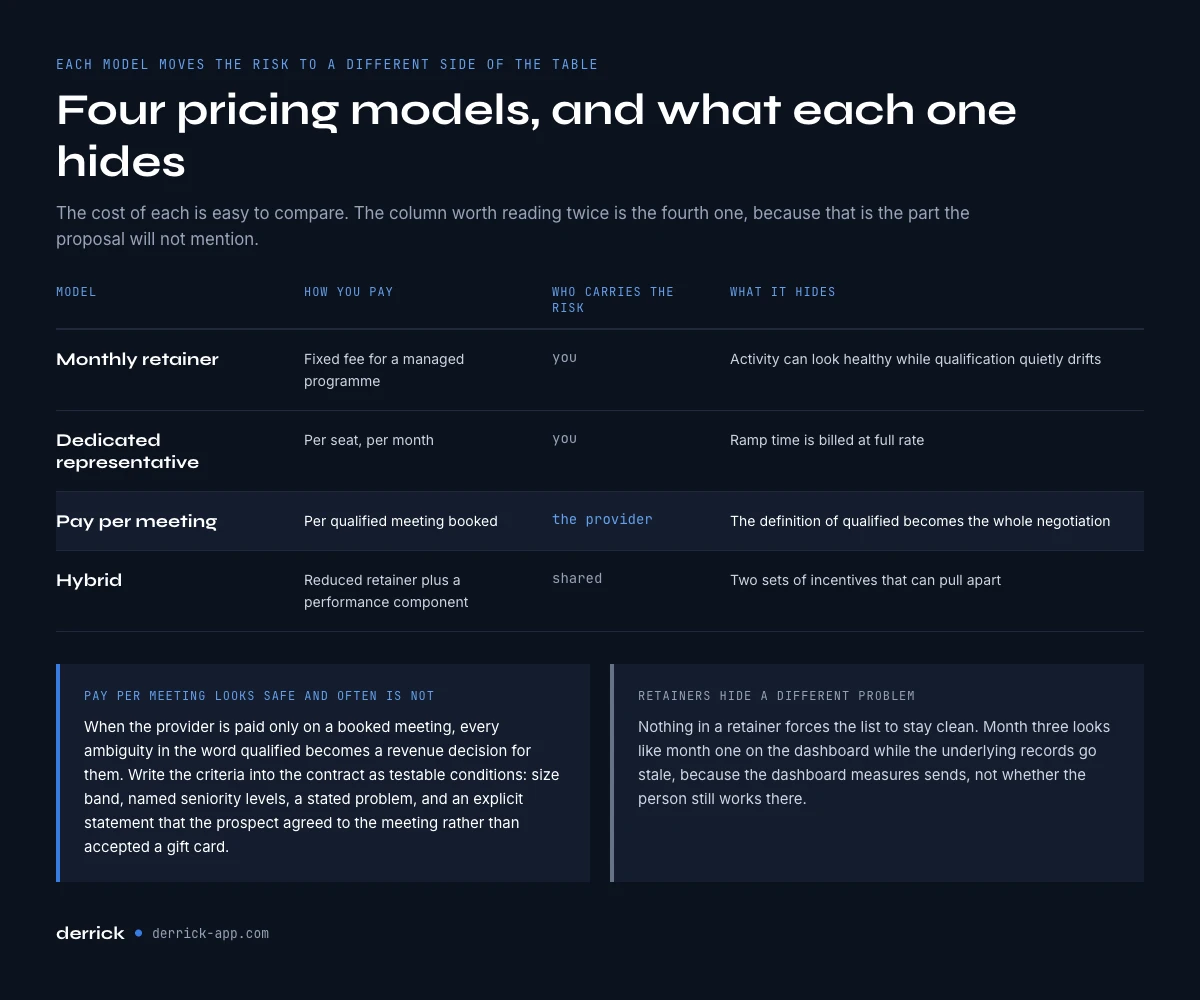
Providers price in four ways. Each one moves the risk to a different side of the table.
| Model | How you pay | Who carries the risk | What it hides | Best for |
|---|---|---|---|---|
| Monthly retainer | Fixed fee for a managed programme | You | Activity can look healthy while qualification quietly drifts | Established motion, known ICP, need for volume |
| Dedicated representative | Per seat, per month | You | Ramp time is billed at full rate | Complex products needing real product knowledge |
| Pay per meeting | Per qualified meeting booked | The provider | The definition of qualified becomes the whole negotiation | Testing a new segment or geography |
| Hybrid | Reduced retainer plus a performance component | Shared | Two sets of incentives that can pull apart | Longer engagements past the pilot stage |
Pay per meeting looks like the safe choice and often is not. When the provider only gets paid on a booked meeting, every ambiguity in the word qualified becomes a revenue decision for them. Write the qualification criteria into the contract as testable conditions: company size band, named seniority levels, a stated problem, and an explicit statement that the prospect agreed to the meeting rather than accepted a gift card. Otherwise you will spend the quarter arguing about calendar invites.
Retainers hide a different problem. Nothing in a retainer forces the list to stay clean. Month three tends to look like month one on the dashboard while the underlying data quietly decays, because contact records go stale at roughly two to three percent per month as people change jobs. The dashboard measures sends, not whether the person still works there.
In-house, outsourced, or hybrid
The honest comparison is not cost per representative. It is cost per attended meeting with a company that matches your ideal customer profile, measured over at least two quarters.
In-house wins when the product needs real technical fluency, when the deal cycle is long enough that relationship continuity matters, and when you already know your ideal customer profile well enough to write qualification criteria a new hire can follow. It loses on speed: a hire plus ramp is a multi-month project before the first meeting lands.
Outsourcing wins on speed and on optionality. A provider can be live in weeks, and you can stop. It is the right call for entering a market you have never sold into, for covering a time zone you do not staff, and for absorbing a temporary spike without a permanent headcount decision.
The hybrid that works best in practice is narrower than most people expect: keep the strategy, the ideal customer profile, and the data in-house, and outsource the execution. You define who to talk to and hold the list. The provider owns the volume of touches. That split keeps the compounding asset on your side of the table while still buying you the speed.
The question nobody asks before signing: who owns the data?
Here is the scenario that repeats. A company runs an outsourced sales development programme for fourteen months. The provider builds the list, enriches it, runs the sequences in its own sending infrastructure, and reports weekly on meetings booked. The engagement ends. The company receives a spreadsheet of the meetings that happened, and nothing else. The list of eleven thousand qualified accounts, the verified contacts, the notes on who replied and who bounced, the mapping of which job titles actually answered: all of it lives in the provider's stack, and none of it was contractually yours.
Fourteen months of market learning, gone. The next provider starts from zero, and so does the in-house team if you build one.
This is not malice. It is the default. The provider's tooling is the provider's tooling, and unless the contract says otherwise, the enriched records generated inside it belong to whoever pays that tool's bill. The fix is not exotic. It is deciding, before the first sequence goes out, that the data layer lives in a system you own, and that the provider works inside it.
Concretely, that means the account and contact list sits in your spreadsheet or your CRM, and enrichment happens against your own account. With Import Leads from a Prompt (1 credit per lead, available on the free plan) you describe the segment in plain language and the matching companies and people land in your own list, in the web app or in your own Google Sheet. Verification runs in the same place with Email Verification at 1 credit per email. The provider then sends against a list you hold, rather than handing you a report about a list you never saw.
Keep your prospect data in your own stack with Derrick. The free plan includes 100 credits per month, which is enough to test the arrangement on a real segment before you renegotiate anything.
The app works through your list row by row. 100 free credits every month.
Nine clauses to put in a sales outsourcing contract
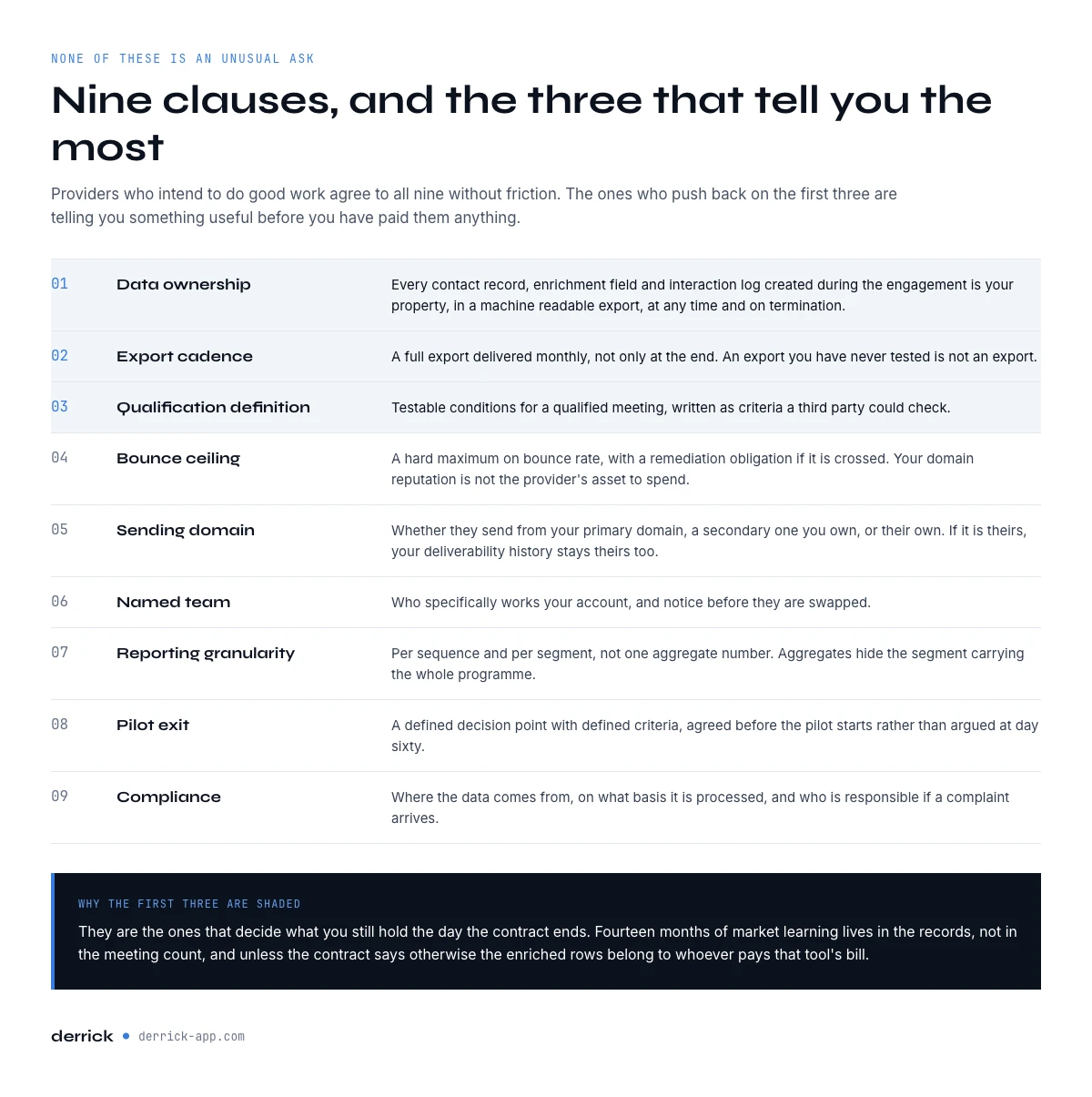
None of these are unusual asks. Providers who intend to do good work agree to all nine without friction, and the ones who push back on the first three are telling you something useful.
- Data ownership. Every contact record, enrichment field, and interaction log created during the engagement is your property, in a machine readable export, at any time and on termination.
- Export cadence. A full export delivered monthly, not only at the end. An export you have never tested is not an export.
- Qualification definition. Testable conditions for a qualified meeting, written as criteria a third party could check.
- Bounce ceiling. A hard maximum on bounce rate, with a remediation obligation if it is crossed. Your domain reputation is not the provider's asset to spend.
- Sending domain. Whether they send from your primary domain, a secondary domain you own, or their own. If it is theirs, your deliverability history stays theirs too.
- Named team. Who specifically works your account, and notice before they are swapped.
- Reporting granularity. Per sequence and per segment, not one aggregate number. Aggregates hide the segment that is carrying the whole programme.
- Pilot exit. A defined decision point with defined criteria, agreed before the pilot starts rather than argued at day sixty.
- Compliance. Where the data comes from, on what legal basis it is processed, and who is responsible if a complaint arrives.
How to audit the leads a provider delivers
You do not need to trust the reporting. You can check it, on a sample, in an afternoon.
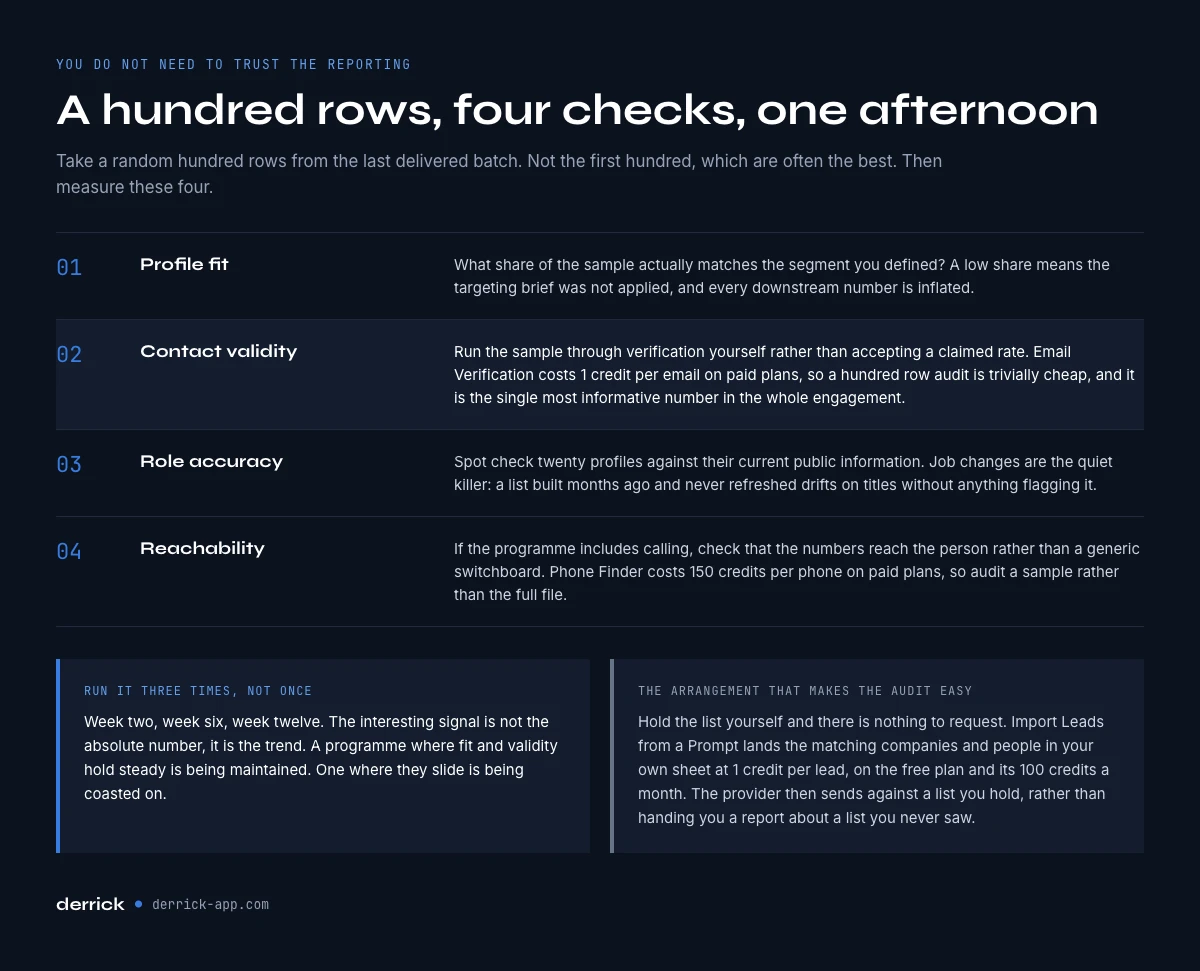
Take a random hundred rows from the last delivered batch. Not the first hundred, which are often the best. Then measure four things.
Ideal customer profile fit. What share of the sample actually matches the segment you defined? Anything below eighty percent means the targeting brief was not applied, and every downstream number is inflated.
Contact validity. Run the sample through verification yourself rather than accepting a claimed rate. At 1 credit per email, a hundred row audit is trivially cheap and it is the single most informative number in the whole engagement.
Role accuracy. Spot check twenty profiles against their current public information. Job changes are the quiet killer: a list built nine months ago and never refreshed can be a quarter wrong on titles.
Reachability. If the programme includes calling, check that the numbers connect to the person and not to a generic switchboard. Phone Finder costs 200 credits per phone, so audit a sample rather than the full file.
Run this audit at week two, week six, and week twelve. The interesting signal is not the absolute number, it is the trend. A programme where fit and validity hold steady is being maintained. A programme where they slide is being coasted on.
Running a sixty day sales outsourcing pilot
Almost every failed engagement skipped the pilot or ran one that could not fail. A pilot that tells you something has four properties: a single narrow segment, a written definition of success agreed before day one, a data audit at week two and week six, and a real exit that both sides expect to be used.
Keep the segment narrow enough that a bad result is unambiguous. One industry, one country, one seniority band. If you spread a pilot across four segments you will get a mediocre average and no idea which part worked.
Set the success criteria in outcomes, not activity. Meetings held rather than meetings booked. Meetings that converted to a qualified opportunity rather than meetings held. Activity metrics are useful for diagnosis and useless for the decision.
Expect the first three weeks to be slow. Messaging iterations, deliverability warm-up, and qualification calibration all land in that window. Judge weeks four through eight, and hold the exit conversation on the date you agreed rather than the date the results become uncomfortable.
Bringing sales outsourcing back in-house
Most outsourced programmes end. The good outcome is that it ends because you grew into your own team, and the transition costs you a few weeks rather than a few quarters.
Three things make that transition survivable, and all three are decided at the start rather than at the end.
First, the list has to be yours already. If enrichment ran against your own account in your own spreadsheet or CRM, there is nothing to migrate. If it ran in the provider's stack, you are negotiating for an export at the exact moment your leverage is lowest.
Second, the qualification logic has to be written down. Which titles answered, which industries converted, which opening line worked in which segment. That is the real output of a year of outsourced prospecting, and it is worth more than the meeting count. Ask for it monthly, in writing.
Third, the sending reputation has to be attached to a domain you control. If the provider sent from their own infrastructure, your new team starts a warm-up from scratch on day one.
Teams that get all three right treat the outsourcing period as a paid learning exercise on a market, with the pipeline as a bonus. Teams that get none of them right pay for fourteen months of learning and keep the receipts.
Where this leaves you
Sales outsourcing is a legitimate and often correct decision. Buy it for speed, for a market you cannot yet staff, or for a spike you do not want to make permanent. Do not buy it as a substitute for knowing who your customer is, because no provider can define that for you, and the ones who offer to are selling you a strategy engagement in a sales development wrapper.
Whatever you buy, hold the data layer. The lists, the verified contacts, the record of what worked: those compound, they are cheap to keep on your side, and they are the only part of the arrangement that is still worth something the day the contract ends. Derrick runs in its web app, inside Google Sheets, through the MCP server for AI clients, and through the REST API, so the enriched records stay in a system you own regardless of who is sending.
Frequently asked questions
What is sales outsourcing?
How much does sales outsourcing cost?
Should I outsource sales or hire in-house?
Who owns the prospect data in a sales outsourcing engagement?
How do I audit the leads an outsourced sales team delivers?
How long should a sales outsourcing pilot run?
What should be in a sales outsourcing contract?
How do I bring an outsourced sales motion back in-house?
Keep reading
Continue exploring this cluster


Best Cold Email Agencies in France (2026)
Read →

Best Cold Email Agencies in the US (2026)
Read →

Best Cold Email Agencies in the UK (2026)
Read →

Best Cold Email Agencies in Canada (2026)
Read →