
Data enrichment basics: the complete buyer's guide (2026)
Six core guides that establish what enrichment is, why it matters, and how a process works end-to-end - plus the 5 misconceptions that kill most projects in their third month.

If you've ever wondered what makes one enrichment stack effective and another a credit sinkhole, this cluster is where to start. Read these six guides in order to build the mental model that everything else in the silo rests on - from the four data classes that matter to the anatomy of a production pipeline.
Why this cluster matters
Most enrichment projects fail not because the tools are bad - but because the team skipped the basics. They don't agree on what counts as a data class, what a match rate actually measures, or what the process should look like before they buy the first credit. This cluster removes that ambiguity in 30 minutes of reading.
For who · First-time buyers, RevOps leads onboarding, founders evaluating whether to build vs buy.
What you'll learn
- A precise definition of B2B data enrichment that holds up in a 5-minute board pitch
- The 4 data classes (contact, firmographic, technographic, intent) and when each one shifts revenue
- The 5-step anatomy of any enrichment process - input, source, match, verify, deliver
- The 12 most common B2B use cases mapped to the team that owns each one
- The vocabulary you need to talk enrichment with RevOps without getting lost
All guides · 6
All 6 guides in this cluster
What is data enrichment?
The clearest possible definition + the 5-step process behind every enrichment workflow. Read the guide → FoundationsA short history of B2B enrichment
From paid contact lists in 2010 to self-serve enrichment in a web app or a spreadsheet today - a 15-year arc that explains why prices keep dropping. Read the guide → FoundationsThe 4 types of enrichment data
Contact, firmographic, technographic, intent - the four data classes and when each one actually moves the needle. Read the guide → FoundationsEnrichment glossary
Match rate, multi-source lookup, intent score, catch-all - every term you need to talk enrichment with your RevOps. Read the guide → FoundationsAnatomy of an enrichment process
The 6 building blocks every enrichment pipeline shares, from input list to CRM-ready output. Read the guide → FoundationsTop use cases by team
Inbound forms, ABM lists, recruiting sourcing - the 12 most common B2B enrichment plays. Read the guide →5 misconceptions about data enrichment that kill projects in their third month
Most failed enrichment projects don't die in the budget meeting. They die quietly, around month three, when someone in RevOps pulls a coverage report and the numbers don't move. What killed them wasn't a bad vendor - it was a wrong assumption baked in at week one. After watching dozens of stacks land and a fair number flame out, the same five misconceptions show up over and over. Here they are, with what's actually true.
1. "Match rate is the only metric that matters"
Match rate is the headline number every vendor leads with. It's also the easiest to game. A provider showing you 85% match rate on a sample list might be hitting 40% on yours, because their sweet spot is US tech buyers and you're hunting French SMB founders. And even when the match rate holds up, it tells you nothing about the cost of those matches or how fresh the data is.
What to track instead: cost-per-verified-match, data freshness (median age of the records you got), and downstream conversion (do enriched leads convert at the same rate as your hand-picked ones?). If you only watch match rate, you'll end up paying €0.40 per email that bounces within 30 days. Three providers in, that's a serious leak.
How Derrick handles it: we surface cost-per-verified-match per provider in real time and only bill on validated results. The vanity match rate number is in the UI too, but it's not what we optimize for.
2. "More providers means better coverage"
The multi-source lookup logic is real - chaining 2-3 providers genuinely lifts match rates from ~50% to 80%+. But the curve flattens fast. Adding a fourth source typically gains 3-5 percentage points. The fifth gains 1-2. The sixth gains almost nothing while doubling your per-record cost and the complexity of debugging which provider returned what.
The sweet spot for almost everyone is 3 to 4 providers, chosen for complementarity, not for raw size. Two providers that both source from LinkedIn give you a 5% lift. One that scrapes LinkedIn plus one that aggregates from job-board postings gives you 25%. Provider diversity beats provider count, every time.
How Derrick handles it: our default multi-source lookup chains 10 complementary sources, curated specifically so each one fills the gaps the previous ones missed. You don't have to pick or rank - the chaining logic is built-in.
3. "Enrichment replaces prospecting"
This is the one founders make most often. They buy a Cognism seat thinking it'll generate pipeline. What it actually does is amplify the prospecting you're already doing. If your ICP is sloppy, enrichment will get you 10,000 enriched leads no one wants to talk to. If your outbound copy doesn't work, having phone numbers won't fix it.
The discipline is: get your ICP tight enough to fit in two sentences, get your outreach to land 1+ reply per 50 sends with cold lists, then add enrichment to scale. Doing it in the other order is the most common reason teams burn 6 months of credits before realizing the funnel was the problem, not the data.
How Derrick handles it: Derrick runs in its web app, with nothing to install, and also inside Google Sheets, where your ICP work, list-building and outreach prep often already happen. No new tool to learn, no CSV exports breaking your workflow. Enrichment slots into the prospecting you've already got.
4. "It's a one-time project"
B2B data decays at roughly 30% per year - people change jobs, companies pivot, phone numbers get reassigned. The CRM you enriched in January is meaningfully worse by June. By month 18, half your enriched contact records are stale.
An enrichment program is therefore not a project - it's a continuous hygiene practice. You need a schedule: refresh top-tier accounts monthly, mid-tier quarterly, long-tail annually. You need an alerting rule for bounces above threshold. You need ownership (most often RevOps). Treating enrichment as install-and-forget is what makes the data quality silently rot until someone runs a campaign and 28% bounces.
How Derrick handles it: scheduled refresh jobs run on whatever cadence you set (monthly, quarterly, on-demand), bounce alerts notify you when deliverability drops, and stale records are auto-flagged in the Sheet so RevOps doesn't have to chase them manually.
5. "Compliance can wait"
This one is the most expensive misconception by orders of magnitude. GDPR fines have crossed €1M for B2B enrichment misuse in Europe, and CCPA enforcement is accelerating in California. The risk isn't theoretical - providers themselves have been fined and pulled offline, taking their customers' data flows with them.
Before any provider goes live, you need three things in writing: (1) their legitimate-interest basis under GDPR Article 6, (2) a DPA you've signed, and (3) a process for handling data-subject-access-requests on enriched records. None of these is hard. All three are routinely skipped. The day a regulator knocks, the team that skipped them is the one that explains to legal why a quick CRM refresh just became a year-long lawsuit.
How Derrick handles it: every provider in our multi-source lookup ships with a documented legal basis, our DPA is signed at account creation, and DSAR requests on enriched records are handled via a one-click flow. Compliance is the default, not a config you have to remember.
The pattern across all five: enrichment fails when treated as a tool decision rather than an operational discipline. Pick the right metrics, the right number of providers, the right scope, the right cadence, and the right compliance posture before you swipe the card.
If you'd rather have all five baked in by default - a 10-source lookup, cost-per-verified-match billing, scheduled refresh, bounce alerts, a web app plus a Google Sheets add-on, and EU-compliant providers - try Derrick free in the web app (100 credits/month, no credit card, nothing to install). The six guides below cover everything else.
Explore the other clusters
Pipeline & techniques
Seven deep-dives into the engineering choices that separate a hobby script from a system your team can actually depend on - including the architecture patterns nobody documents.
7 guides →Sources & use cases
Eight concrete plays - webform inbound, anonymous web traffic, business card OCR, LinkedIn URLs - each with the provider stack that actually works for it, and the costs spelled out.
8 guides →Pitfalls & deep-dives
Five honest reads on what goes wrong - plus the 12 anti-patterns that have torpedoed real enrichment projects, with the fix for each one.
5 guides →Foundations
Start enriching your list in 30 seconds
Free for 100 credits/month. No credit card.
Install the add-on and enrich your lists without leaving your spreadsheet.
Install in Google Sheets →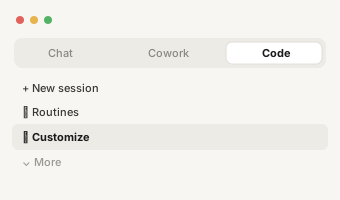
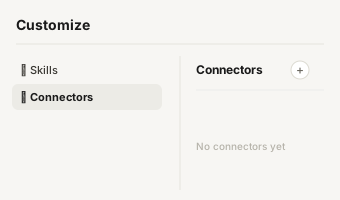
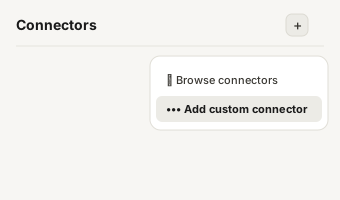
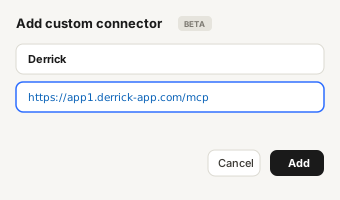
https://app1.derrick-app.com/mcp Call the same enrichment endpoints straight from your own stack or workflow.
Read the API docs →