Sales conversion rate calculator
Enter how many accounts or leads reach each stage of your funnel. The calculator gives the conversion rate of every step, the end-to-end rate, and the stage that loses the most.
Where does your sales funnel leak?
Enter the count at each stage for one period. Rename the stages to match your own funnel. The rates and the diagnosis update as you type.
The calculator runs in your browser. Nothing is sent or stored.

At scale
derrick •
When the leak is in the list
A step that loses people before any message is sent is fixed with a better list. In the Derrick web app, describe the people you want to reach in one sentence, import the matching leads, and complete each profile before you write to anyone.
- Web app: nothing to install, no credit card
- Free plan: 100 credits every month
- API and MCP from the Plus plan (€47.50/month)
Install the add-on and enrich your lists without leaving your spreadsheet.
Install in Google Sheets →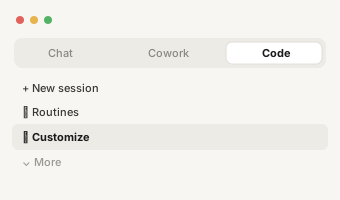
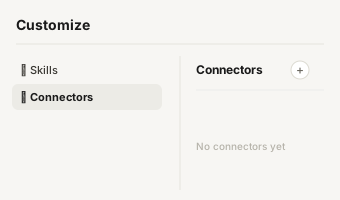
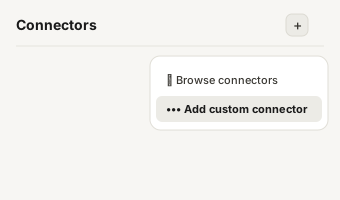
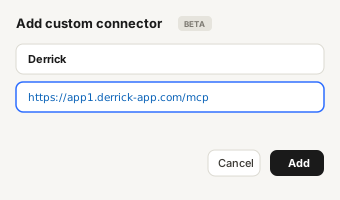
https://app1.derrick-app.com/mcp Call the same enrichment endpoints straight from your own stack or workflow.
Read the API docs →
How to calculate a sales con
How to calculate a sales conversion rate
A sales conversion rate is the share of records that move from one stage to the next. The formula is the same at every step: count at the next stage, divided by count at the current stage, times 100. The end-to-end rate uses the first and the last stage only.
Take the example loaded in the calculator. Out of 200 target accounts, 158 have a decision maker identified (79%). Of those, 71 can actually be reached (45%). 68 are contacted (96%), 5 reply (7.4%) and 2 book a meeting (40%). End to end, that is 2 out of 200, or 1%.
These numbers are a worked example, not a benchmark. Rates depend on your market, your offer and how you define each stage, which is why the calculator compares your stages with each other and with your own usual rate instead of an outside average.

Reading the result
Reading the result: three different answers
A funnel has more than one weak point, and they do not call for the same decision.
- The lowest conversion rate. In the example it is the reply step, at 7.4%. Reply rates are low in every funnel, so a low rate alone does not prove a problem.
- The largest loss in volume. In the example, 87 decision makers are lost between "identified" and "reachable". That is more people than the reply step loses, and it happens before any message is sent.
- The step furthest below your usual rate. This is the real leak. If a step normally passes 60% and passes 45% this month, something changed there. Enter your usual rate next to a step and the calculator shows what returning to it would give at the end of the funnel.

List
List, message or process: what kind of leak is it?
Each step of a sales funnel fails for one of three reasons, and the fix depends on which one.
- A list step fails before anyone reads a word: the right person is not found, the role does not exist at that company size, or the email and phone on file no longer work. Better copy changes nothing here.
- A message step fails after delivery: the person was reached and did not answer. Look at targeting and at the first line before you look at volume.
- A process step fails in between: records that were ready and never contacted, sequences that never started, sending limits, bounces.
Set the kind of each step in the last column. When the calculator points at a step, it tells you which of the three readings applies.

What to count at each stage
What to count at each stage
- One period, one cohort. Count the same group of accounts at every stage. Mixing this month's contacts with last month's replies produces rates above 100%.
- One unit. Accounts or people, not both. If the first stage counts companies, every stage counts companies.
- Stages you can observe. "Interested" is an opinion. "Replied" and "meeting booked" are events.
- Your own stage names. Rename the rows. A funnel that starts with inbound leads, or ends at signed deals, works the same way.

Three mistakes that distort
Three mistakes that distort a conversion rate
- Judging a step against another step. A 7% reply rate next to a 96% contact rate is not the weaker one by nature. Compare each step with its own history.
- Counting delivered as contacted. A message that bounced did not reach anyone. Count first messages delivered.
- Fixing the last step first. The bottom of the funnel has the smallest numbers and the noisiest rates. A swing from 2 to 3 meetings looks like a 50% gain and may be chance.
From the leak to the fix
From the leak to the fix
When the leak is a list step, the work is on the data: find the missing decision makers, then complete what you know about them before writing. In Derrick, Enrich Leads fills a profile from its LinkedIn URL for 1 credit, and the free plan includes 100 credits per month. It needs your LinkedIn account connected through the Derrick Chrome extension.
When the leak is a message or a process step, the data is not the lever. Our guide to sales pipeline stages covers what each stage should require before a deal moves, and the guide on how to build a prospect list covers the list itself.