
The State of B2B Data Attributes 2026: Which Fields Actually Move the Needle
B2B data attributes report 2026: the 7 families rated on freshness and impact, the over-enrichment paradox, and why data availability beats field count.


Last updated: 2026-06-18
The instinct in B2B data is to enrich everything: every field a provider offers, every attribute a record can hold. This report argues, with the numbers, that the instinct is wrong. The value of a prospect record comes from a handful of current, high-leverage attributes, not from the count of fields attached to it. We map the seven families of B2B data attributes, rate each on freshness, availability, and business impact, and show why a lean record of fresh fields beats a bloated one of stale ones.
The thesis underneath is that the real constraint is not how many attributes you can collect, it is whether the few that matter are available and current at the moment you act. Data availability, getting the right field at the source when you need it, is the bottleneck, not field quantity. A record with thirty stale fields is worth less than one with the five that decide the deal, verified today.
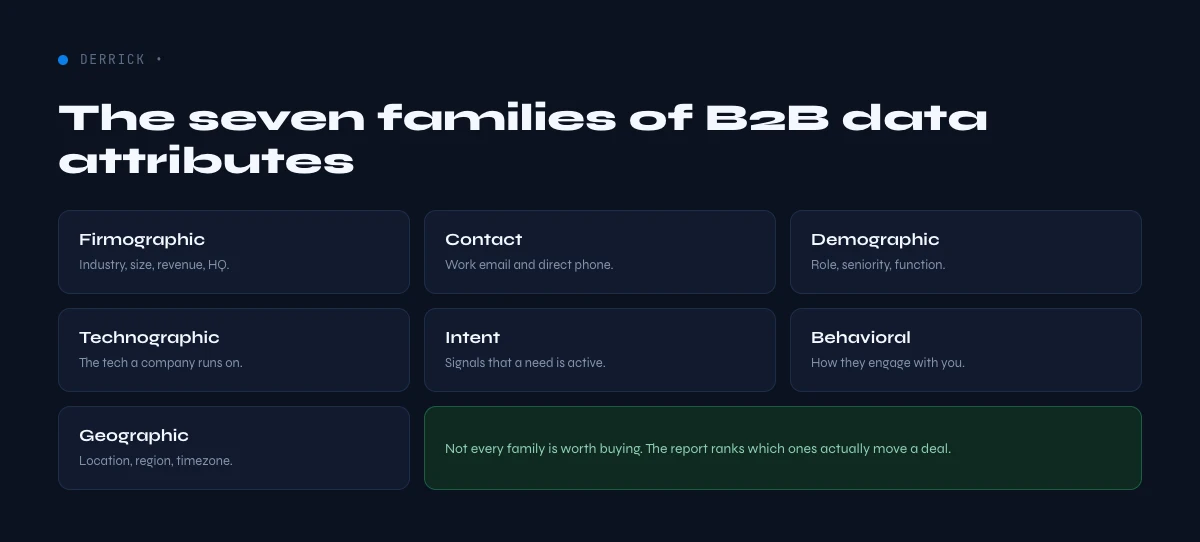
The seven attribute families
B2B data attributes fall into seven families, each with a distinct purpose and a distinct shelf life. Firmographic (industry, size, location) describes the company. Contact and demographic (name, role, verified email, direct phone) lets you actually reach a person. Technographic (the tools a company uses) signals fit and timing. Financial (revenue, funding) sizes the opportunity. Behavioral and intent (research activity) hints at readiness. Timing and triggers (job changes, funding rounds, hiring) flags a buying window. Custom attributes capture whatever your model needs.
Rated honestly, these families differ sharply on the three axes that matter. Contact data is the highest-impact and the most perishable, a verified email and phone are what turn a target into a conversation, and they decay fastest. Timing and triggers are the highest decisional value but only in a narrow window. Firmographic and technographic are moderately stable and widely useful. Behavioral and intent are powerful but hard to source cleanly. Custom is high-value when it exists and often the hardest to obtain.
The point of the map is to stop treating attributes as a flat list to maximize and start treating them as a portfolio to prioritize. The families you most need are usually the ones hardest to keep fresh, which is exactly why availability, not quantity, is the right lens. The contact-data layer is detailed in the essential contact attributes guide.
A useful way to read the map is by combining impact with perishability. The attributes that are both high-impact and fast-decaying, contact data above all, are the ones that demand a re-verification process rather than a one-time capture. The attributes that are high-impact but stable, like core firmographics, can be captured less often. And the low-impact families, however easy to collect, deserve the least investment regardless of how complete the vendor makes them look. Impact times perishability, not raw count, is what should drive where you spend.
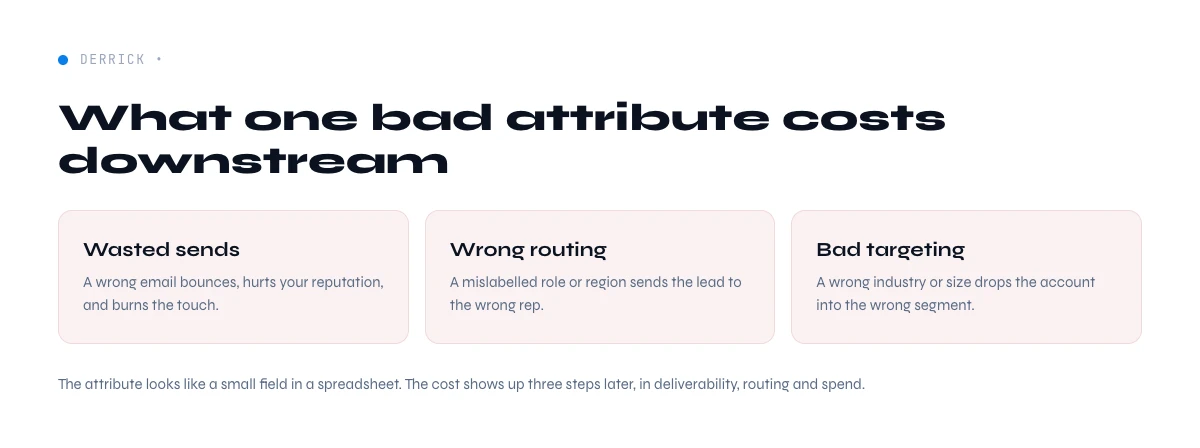
The hidden cost of bad attributes
Before optimizing which fields to collect, it helps to size what wrong fields cost. Gartner estimates poor data quality costs organizations an average of 12.9 million dollars per year, and has put the revenue impact around 15 percent. Experian's research has gone further, attributing as much as a quarter of potential revenue lost to poor-quality data once you count the misdirected effort and the decisions made on wrong inputs.
The more revealing statistic is that a large majority of organizations, around 60 percent in Gartner's work, do not measure the cost of their bad data at all. You cannot manage what you do not measure, and unmeasured data cost is exactly why the problem persists quarter after quarter: it never appears as a line item, only as a soft number somewhere downstream that gets blamed on something else.
This reframes the attribute question as an economic one. Every field you collect and trust is a small bet that it is correct; a wrong field is not neutral, it carries a cost that propagates into segmentation, routing, and outreach. The goal is therefore not maximal coverage but maximal correctness on the fields that drive decisions, which is a very different optimization. A simple five-question audit, covered in Part 05, surfaces where your unmeasured cost is hiding.
In the web app or Google Sheets
Test which fields move your numbers
The only way to know which attributes matter for you is to have them on the same list. Derrick fills the profile fields on an existing list, so you can group your replies by seniority or by company size and see which cut actually separates.
- Feature
- LinkedIn Leads Profile Enrichment
- Credit cost
- 1 credit per lead enriched
The first button opens the web app (nothing to install): 1 credit per lead enriched, 100 free credits every month. The second details the feature and its cost per plan.
The over-enrichment paradox
Here is the counter-intuitive finding. A record stuffed with dozens of attributes does not convert better than a leaner record with the right few, and often converts worse, because the extra fields add noise, cost, and decay surface without adding decision value. Every attribute you store is something that can go stale and mislead; piling on low-value fields just widens the area where your data can be wrong.
The high-leverage shortlist is short. For most B2B outreach, the attributes that actually move the needle are a verified way to reach the right person, enough firmographic and technographic context to confirm fit, and a timing signal to know when. That is a handful of fields, kept current, not a hundred fields captured once. Beyond that shortlist, additional attributes show steeply diminishing returns and rising maintenance cost.
This is why over-enrichment is a trap dressed as diligence. It feels thorough to fill every column, but completeness on low-value, decaying fields is not quality, it is just volume. The disciplined move is to identify the few attributes your decisions actually depend on and keep those verified, rather than chasing a complete-looking record that is mostly stale padding. The firmographic core of that shortlist is in the top firmographic attributes guide.
The over-enrichment trap also has a cost most teams never tally: maintenance. Every field you choose to store is a field someone implicitly promises to keep current, and the more fields you carry, the more of them silently rot because no one can refresh them all. A lean record is not just cheaper to buy, it is cheaper and more honest to maintain, because you are only ever promising freshness on the handful of fields you actually use to decide.
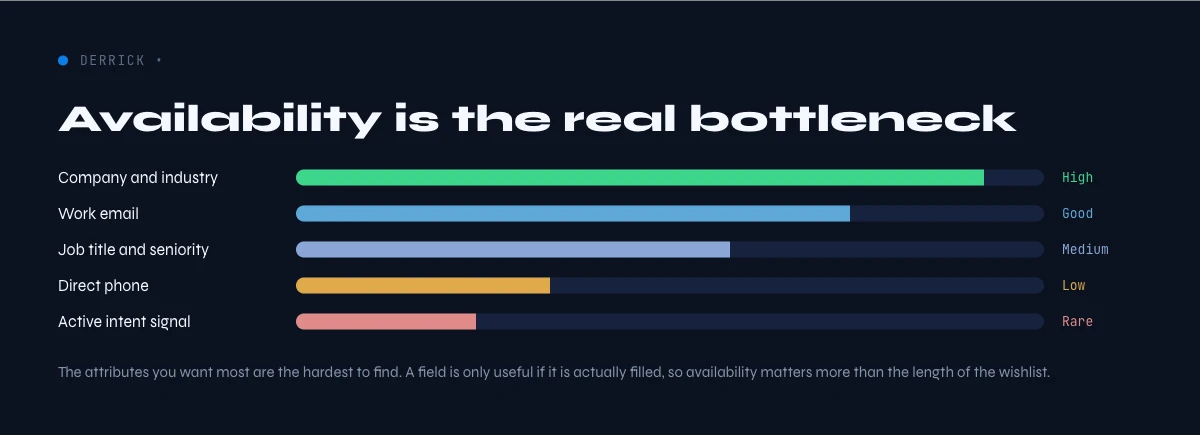
The real bottleneck: availability
If the right few attributes are what matter, the constraint becomes getting them, accurately, at the moment of use. This is data availability, and it is the genuine bottleneck most teams mislabel as a coverage problem. The issue is rarely that an attribute cannot be known; it is that it is not available, fresh and correct, in the place and at the time you need to act on it. A field that exists in some database but is stale or out of reach when you act is, functionally, not available.
This is the layer Derrick is built for. Rather than selling a static file of every possible field, Derrick fetches each attribute at the source through a multi-source lookup, the verified email and phone, firmographic and company data, the technologies a company runs through its Website Technologies lookup, and profile enrichment, on demand, in the Derrick web app or directly inside Google Sheets. The model treats availability as the product: the right attribute, confirmed at the moment of use, rather than a warehouse of fields collected once and left to age.
Framed this way, the attribute strategy and the tooling choice converge. You do not need a provider with the longest field list; you need one that can make the few attributes you depend on available and current when you act. That is a question about sourcing and freshness, not about catalog size, and it is why availability is the right design center for a data program. The technographic angle is detailed in the technographic data guide.
Availability also reframes how to evaluate a data source. The right test is not how many attributes appear in the catalog, but how reliably the source returns a correct, current value for the few attributes you depend on, on your own records, at your own volume. A source that returns a fresh verified email and a confirmed firmographic profile every time beats one that lists fifty attributes but is stale or blank on the ones that decide your outreach. Measure the source on the short list, not the catalog.
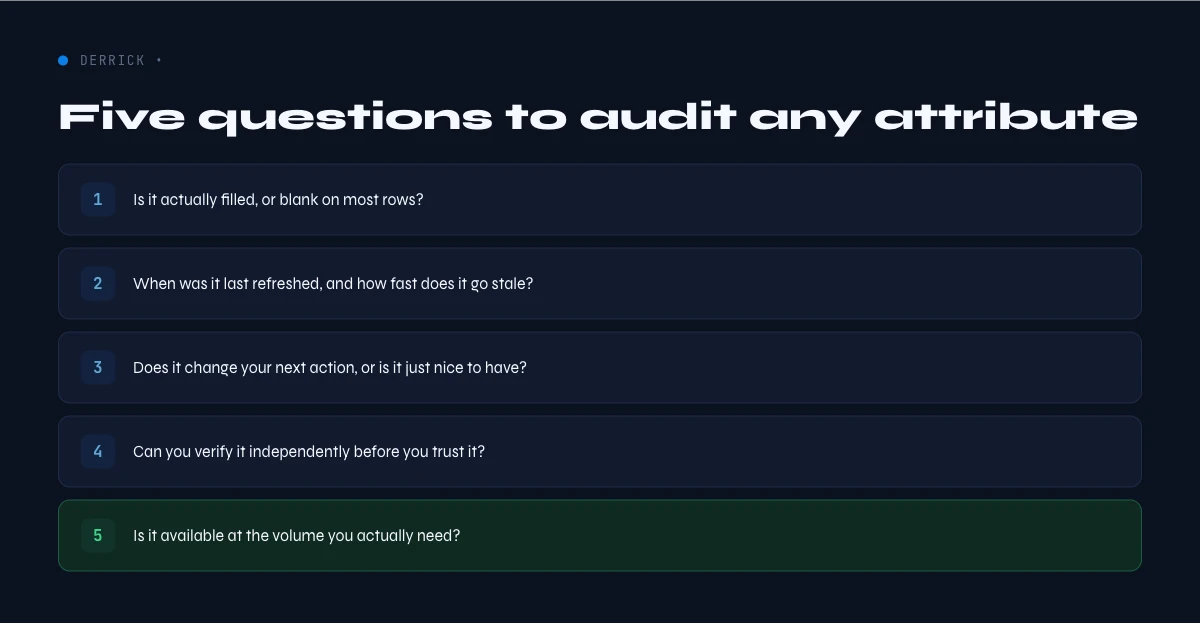
The timing layer and a 5-question audit
Among all attribute families, timing and triggers carry the highest decisional value per field. A job change, a funding round, or a hiring spree marks a moment when a buying window opens, and the research is clear that new executives in particular are far more likely to bring in external vendors as they reshape their function. The catch is that this value is concentrated in a narrow window and only realizable if the contact data is also current, a trigger you act on with a stale email is a missed window, not a signal.
Use this five-question audit to find your own gaps. One, can you state which handful of attributes actually drive your conversions? Two, do you know how fresh each of those is right now? Three, can you reach the right person today, or only as of when the record was built? Four, do you act on timing triggers while the window is open? Five, do you measure the cost of the fields you got wrong? Most teams cannot answer at least two of these, and those gaps are where the unmeasured cost lives.
Derrick supports the high-value end of this directly: it re-verifies contact data on demand so a timing trigger can be acted on with current details, and it enriches the firmographic and technographic context that confirms fit, all in the web app or the spreadsheet where the work happens. Get the few attributes that matter, verified on demand, with Derrick, free for 100 credits per month, in the web app or in Google Sheets. The timing-attribute detail is in the sales trigger events guide.
There is a measurement discipline that makes this concrete. Pick your top conversions over a recent period and look at which attributes were actually present and correct on those records at the moment of outreach. You will almost always find the same short list recurring, and a long tail of fields that were present but irrelevant to the outcome. That exercise, done once, usually settles the breadth-versus-freshness debate for a team faster than any vendor pitch, because it is grounded in your own results rather than a catalog.
This is why the availability framing scales down as well as up. A solo founder and a large RevOps team face the same underlying question, are the few decisive attributes correct at the moment of use, and the answer for both is a process that fetches and verifies on demand rather than a bigger static file. The discipline is identical regardless of volume, which is part of why it is the right design center: it does not change as you grow, only the throughput does.
Methodology and sources
This report draws on non-vendor, primary sources: Gartner on the cost of poor data quality (an average of 12.9 million dollars per year, around 15 percent of revenue, and the finding that roughly 60 percent of organizations do not measure it); Experian on the share of potential revenue lost to poor-quality data; Harvard Business Review on new executives turning to external vendors; and Statista, McKinsey, and Salesforce for macro context on data adoption and sales productivity. Decay is discussed as a general tendency rather than with a specific figure, because the readily available decay statistics in this space trace to data-vendor marketing, which we deliberately do not cite.
A closing thought. The data industry sells breadth, the longest list of attributes, because breadth is easy to advertise and easy to compare. Production rewards the opposite: a short list of the attributes your decisions actually depend on, kept available and current at the moment you act. Map your seven families, find the handful that move your conversions, measure what the wrong ones cost, and invest in availability rather than accumulation. The record that wins is not the one with the most fields, it is the one whose few decisive fields are right when you use them.
Frequently asked questions
What are the families of B2B data attributes?
Should I enrich as many fields as possible?
What is the real bottleneck in B2B data?
How much does bad data cost?
Which attributes have the highest value?
Keep reading
Continue exploring this cluster


The 20 Essential Contact Attributes to Nail Your B2B Prospecting
Read →

The 30 Essential Firmographic Attributes for B2B Targeting
Read →

Technographic Data: How to Identify Your B2B Prospects' Tech Stack
Read →

Timing Attributes in Data Enrichment: Complete Guide (Job Change, Funding, Hiring)
Read →