How to Find Phone Numbers That Actually Connect: the B2B Playbook
How to find phone numbers that actually connect: discover 7 verified B2B methods, accuracy by region, real costs and the Google Sheets bulk workflow.


How to find phone numbers for B2B is a different problem from looking up a personal number in a directory. You are not searching a phone book: you start from a person and a company, and you need a line that is still live today, attached to the right individual, and legal to dial.
Last updated: 2026-06-21
A B2B phone number is a direct dial to a decision-maker at a target company. When cold email reply rates sit in the low single digits and inboxes filter harder every year, a real phone conversation is often the shortest path from a name on a list to a booked meeting.
This guide breaks down seven legitimate ways to find verified B2B phone numbers in 2026, with realistic accuracy expectations, costs, and the bulk Google Sheets workflow most outbound teams now rely on.
Why B2B phone numbers still matter in 2026
Three things changed in a few years. Cold email volume exploded, mailbox providers tightened sender-reputation thresholds and penalise high bounce rates, and AI-assisted filtering pushes more cold sequences into spam. The phone went from "old-school" to "the channel that still connects".
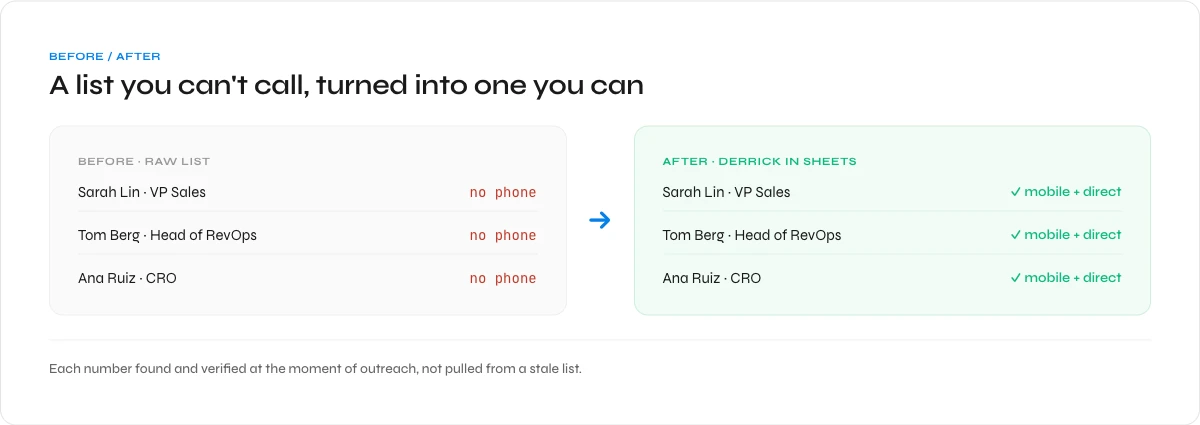
A direct dial reaches a person; a switchboard reaches a gatekeeper. That is why outbound teams treat a verified mobile or direct line as one of the highest-leverage assets in the stack. The catch is simple: the number has to be current. A line that was accurate last year is often dead today, which is why how you source and verify matters as much as where you source from. Our mobile vs landline benchmark shows how line type alone changes pickup rates.
How to Find Phone Numbers in 2026: the 7 Methods That Work
1. LinkedIn profile + multi-source lookup
The highest-yield method for prospecting at scale. Start from a LinkedIn profile URL, run it through a multi-source lookup, and a large share of the time you get back a direct dial or a verified mobile. LinkedIn is where decision-makers keep an up-to-date identity, so it is the strongest single input. See how to find a phone number from a LinkedIn URL.
Realistic accuracy: highest in the US, lower across the EU where consent rules limit mobile storage, and lower again across much of APAC.
2. Company website contact page
Free, but it returns a switchboard number rather than a direct dial. Useful as a fallback. A website-contact extractor can pull phone, email and social links from any company URL in seconds, which helps for SMB targets that only list a main line. For company-level numbers specifically, see how to find a company phone number.
3. SEC filings and 10-K reports (US public companies)
Free and reliable for executive contacts at US public companies. A 10-K lists corporate HQ phone and sometimes executive direct lines, and SEC EDGAR is fully searchable. Best for account-based selling into enterprise.
4. Companies House and EU business registries
Companies House (UK) returns a verified corporate phone for any registered company, for free. France has Pappers and Infogreffe, Germany has the Unternehmensregister, Spain has the Registro Mercantil. You get a corporate line rather than a direct dial, but it is verified and free.
5. Dedicated direct-dial data
Specialist contact databases sell self-reported direct dials, usually on an annual contract. Coverage can be good for large markets, but two costs are easy to miss: the price per seat, and the share of records that have gone stale since the file was last refreshed. Worth it for very high call volumes; overkill for most teams under a few dozen reps.
6. Contact intelligence layered on your CRM
If your CRM already enriches contacts, you may have phone data sitting in records you never query. Audit that before paying for another source. Coverage is usually best for inbound-heavy books where contacts opted in.
7. Bulk lookup in Google Sheets (the modern workflow)
The 2026 standard for SDR teams: paste a column of LinkedIn URLs into a Google Sheet, run a lookup, and get back direct dials, mobiles and verification status in minutes, with no CSV export and no separate dashboard. This is where Derrick lives, in its web app or as a sidebar inside the spreadsheet you already use. If you want to start without paying, see how to find a phone number for free.
Comparison: which sourcing method fits your team
There is no single best B2B phone number finder; there is a best method for your volume, geography and budget. Here is how the main approaches compare on what actually matters at the dialer.
| Method | Typical cost | Where it runs | Returns | Freshness |
|---|---|---|---|---|
| LinkedIn + multi-source lookup | Per verified result | Sheets / API | Mobile or direct dial | Live at lookup |
| Website contact page | Free | Any browser | Switchboard | As published |
| Public registries (SEC, Companies House) | Free | Gov portals | Corporate line | Filing date |
| Dedicated direct-dial data | Annual contract | Vendor dashboard | Direct dial | Last refresh |
| CRM contact layer | Bundled | Your CRM | Mixed | Varies |
| Derrick (web app or Sheets sidebar) | From ~EUR 0.32 / verified phone | Native Google Sheets | Mobile + direct, line-type checked | Live at lookup |
How to Find Phone Numbers in Bulk: the Google Sheets Workflow
The fastest path to a column of verified direct dials, end to end.
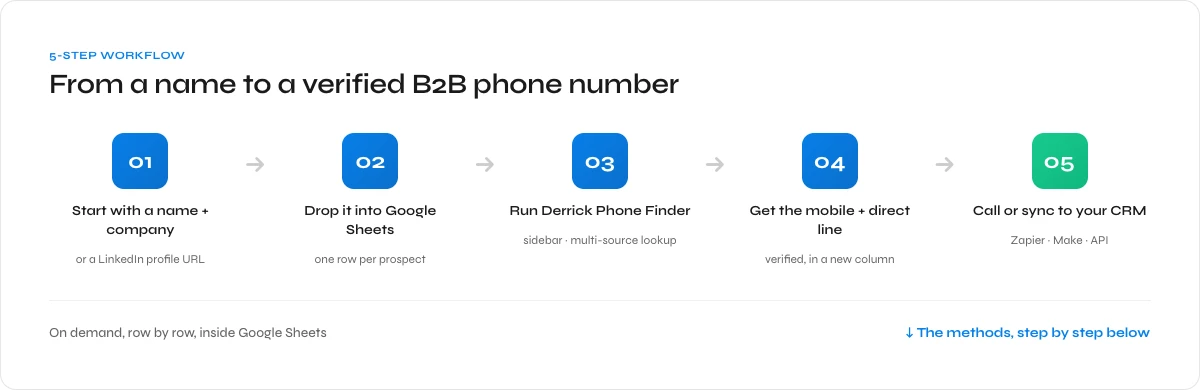
Step 1. Put your prospects in a sheet, one row each, with a LinkedIn URL (or a name plus company) in a column.
Step 2. Open the Derrick web app, or install Derrick from the Google Workspace Marketplace and open it from the Extensions menu. In Sheets it runs as a sidebar, not as spreadsheet formulas.
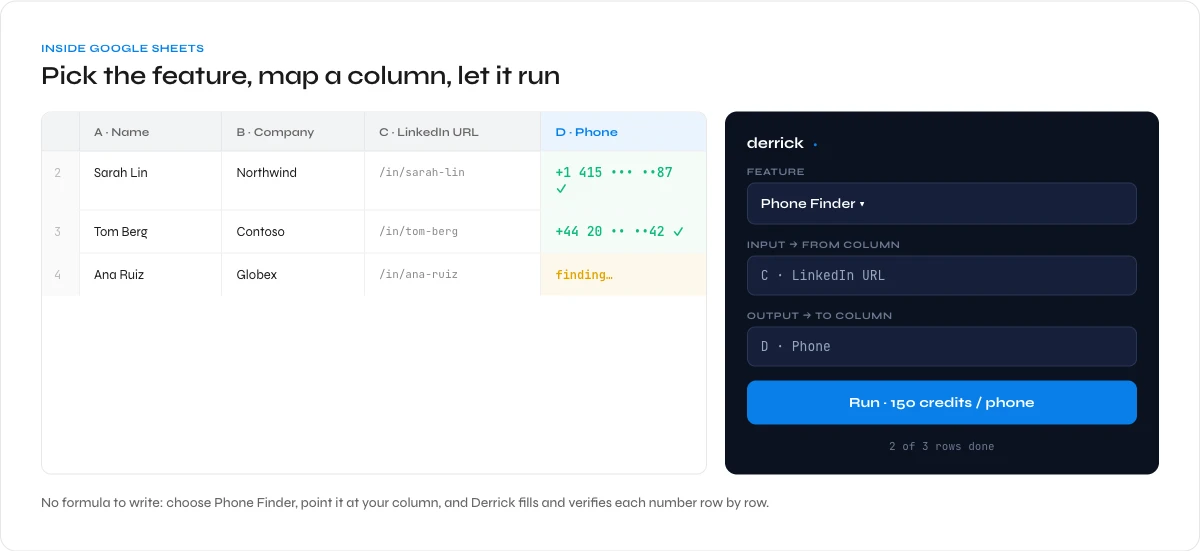
Step 3. In the sidebar, choose the Phone Finder feature and map your input column. There is no syntax to memorise.
Step 4. Run it. Derrick performs a multi-source lookup row by row and writes the highest-confidence number into a new column. You are billed 200 credits per phone found, so you pay for hits, not attempts.
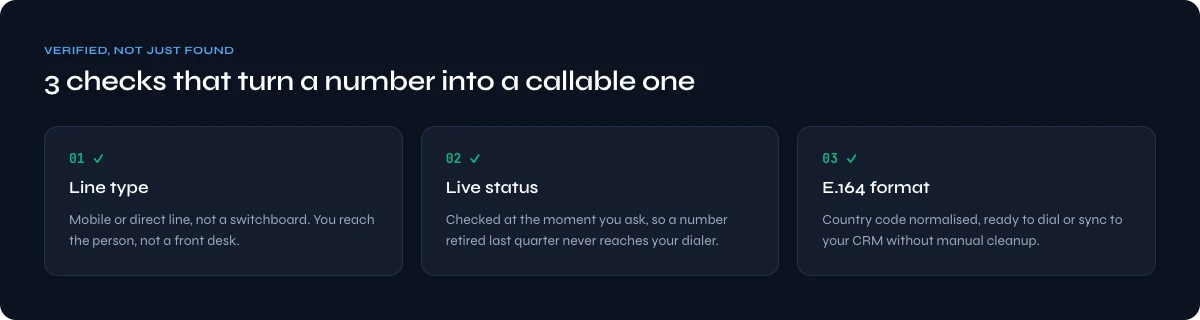
Step 5. Each number comes back with its line type (mobile or landline) checked, so dead and switchboard numbers are flagged before they reach your dialer. For a deeper pass, see how to run a phone number validation.
Output: a clean column of dial-ready numbers you can sync to your dialer or outreach tool in a couple of clicks.
How accurate are B2B phone number databases?
Accuracy comes down to three things: freshness, geography and verification.
Freshness. Direct dials decay every month as people change roles and numbers. A database built two years ago carries a large share of dead records today. This is the core argument for live lookup: when a number is fetched and checked at the moment you ask, freshness equals query time instead of "whenever the file was last refreshed".
Geography. Expect the best coverage in the US, noticeably lower across France and Germany where consent rules restrict mobile storage, and lower again across much of APAC. Any vendor claiming near-perfect global accuracy is selling a headline, not a result.
Verification. Self-reported data (scraping, public records) is cheap and less accurate. Network-checked data, where a carrier HLR lookup confirms line type and validity, is more accurate. A multi-source lookup that reconciles several signals and verifies line type at the end is the best balance, and that is what Derrick does, in its web app or inside Sheets.
In the web app or Google Sheets
Numbers that connect, billed only when found
The playbook ends on the same problem: most numbers in a B2B file do not reach anyone. Derrick returns a number or nothing on each row, and charges only in the first case, so the file you build is the file you can call.
- Feature
- Lead Phone Finder
- Credit cost
- 200 credits per phone found
The first button opens the web app (nothing to install): 200 credits per phone found, 100 free credits every month. The second details the feature and its cost per plan.
Is it legal to find someone's B2B phone number?
The legal frame depends on jurisdiction, and no tool changes that: compliance stays with you.
United States. Generally legal for B2B outreach. The TCPA restricts robocalls and pre-recorded messages, but live human calls to a business number sourced from public or professional records are allowed. Screen against the National Do-Not-Call Registry.
European Union. GDPR applies. You need a lawful basis (legitimate interest under Article 6(1)(f)) and must honour opt-outs, so document your basis. A tool can help you keep data current and sourced, but it does not make your outreach compliant on its own; that responsibility is yours.
United Kingdom. UK GDPR plus PECR. B2B calling is more permissive than B2C, but check the Telephone Preference Service before any B2C dial.
Common mistakes when sourcing B2B phone numbers
Buying a database, then calling without verifying. Even premium files carry a meaningful slice of dead numbers. A quick line-type and validity check before dialing saves your reps from burning time on disconnected lines.
Treating "valid" and "reachable" as the same. A number can be live but screened to voicemail. Track pickup rate by source, not just validity.
Relying on a single source. One feed leaves gaps. A multi-source lookup that reconciles several signals lifts coverage and confidence well above any one provider.
Skipping the consent check in the EU. One fine costs more than years of tooling. Keep a documented lawful basis for EU prospects.
Great number, generic opener. Even a perfect direct dial gets you hung up on with a weak first line. Test a few openers and keep the one that earns a conversation.
Why Derrick is the modern B2B phone number tool
Derrick runs a multi-source lookup behind its web app and its Google Sheets sidebar. You pick the Phone Finder feature, map your input column, and it fills and verifies a column of numbers row by row, with no separate dashboard, no CSV round-trip and no annual lock-in. It is built for direct-dial lookups, mobile numbers and line-type checks, in the web app with nothing to install or inside the spreadsheet your team already works in, and it scales the same whether you run 100 rows or 100,000.
What is different: you are billed 200 credits per phone actually found, so you pay for results rather than attempts; credits roll over instead of resetting each month; the Free plan gives 100 credits with no card; and the API plus a native MCP make Derrick scriptable from Claude, ChatGPT or any MCP-compatible assistant. Paid plans start at the STANDARD tier (EUR 20), and at the PRO tier the per-credit floor puts a verified phone at roughly EUR 0.35. Start free in the web app, or see the Phone Finder feature.
The app works through your list row by row: 200 credits per phone found, nothing is billed without a result.
What You Need Before You Start: Name Alone Is Not Enough
A name on its own resolves to dozens of people. Every reliable lookup needs at least two anchors: the person and the organisation they work at right now. Give the process one anchor and you get a plausible number for the wrong human, which is worse than no number at all. The second anchor is easier to get than most teams assume: a published leadership page such as Apple's leadership bench or the executive team at Sony gives you the name, the exact title and the employer in one place.
| Input you hold | What it can return | Confidence |
|---|---|---|
| Full name only | Nothing usable in B2B | None, do not dial |
| Full name plus company name | Switchboard, sometimes a direct dial | Medium |
| LinkedIn profile URL | Direct dial or mobile, tied to that exact person | High |
| Professional email address | Direct dial, via the person behind the address | High |
| Company domain only | Main line and department numbers | High for the company, none for the person |
The practical rule: the LinkedIn profile URL is the best single anchor in B2B, because it is unique per person and it carries the current employer with it. Start your sheet with a URL column, not a name column.
How to Find Phone Numbers with Google Search Operators
Search operators are the cheapest method and the least reliable one. They work when a number has been published somewhere public: a press release, a conference speaker page, a PDF signature, a job listing. They fail silently the rest of the time, which is most of the time.
Four patterns are worth keeping. Replace the placeholders with your target's details.
site:example.com "first last" phonepulls a number published on the company's own site."first last" "example.com" filetype:pdfcatches signatures inside PDFs, which is where direct dials leak most often."first last" ("mobile" OR "direct" OR "cell") "company"targets the words that sit next to a real number.site:example.com "+44" OR "+33"lists the country-coded numbers a company has published anywhere on its domain.
Treat anything you find this way as unverified. A number published three years ago in a conference bio is a historical artefact, not a contact. Run it through a line check before it reaches a dialer, and never build a campaign list this way: the method does not scale past a handful of names, and the hit rate collapses outside large, media-visible companies.
How to Find Phone Numbers for Free (and Where Free Stops Working)
Free routes exist and they are genuinely useful for a short list. They break down on three things: volume, freshness and line type. Knowing exactly where each one stops saves you from discovering it mid-campaign.
| Free route | Realistic ceiling | Where it breaks |
|---|---|---|
| Company contact page | Main line, reception | Never a direct dial to the decision-maker |
| Google operators | A handful of names | No coverage guarantee, results often stale |
| Company legal or registry filings | Registered head office line | Administrative number, rarely answered by the team |
| Conference and speaker pages | Occasional direct dial | Only for people who speak publicly |
| Asking a mutual contact | One number, high quality | Does not scale, spends social capital |
Derrick's free plan gives you 100 credits every month with no card, which covers company and profile enrichment so you can build a clean, deduplicated list before spending anything on phone lookups. Our guide on finding a phone number for free goes through each free route in detail.
How to Find Phone Numbers vs Reverse Lookup: Two Opposite Problems
Forward lookup starts from a person and returns a number. Reverse lookup starts from a number and returns a person. They use different data and they answer different business questions, and confusing them is why people try consumer lookup sites for B2B prospecting and come away empty.
- Forward lookup is the prospecting direction. Input: a profile URL, an email, or a name plus a company. Output: a direct dial or a mobile. This is what an outbound team needs.
- Reverse lookup is the inbound and diligence direction. Input: a number that just called you or sat unlabelled in your CRM. Output: who it belongs to. Consumer lookup services are built for this, and their coverage is largely personal, not professional.
For B2B, the reverse question usually has a better answer inside your own systems: match the number against your CRM, then against the company switchboard ranges you already hold. If it is a mobile you have never seen, the honest answer is often that you cannot confirm it, and calling back blind is a risk rather than an opportunity.
Direct Dial, Mobile or Switchboard: Which Number to Chase
Three line types, three completely different outcomes at the dialer. Chasing the wrong one is the most common reason a "complete" list produces no conversations.
| Line type | Who picks up | Best use |
|---|---|---|
| Switchboard | Reception or an automated menu | Company verification, last resort routing |
| Direct dial | The person, at their desk | Office-based roles, scheduled callbacks |
| Mobile | The person, anywhere | Field roles, founders, hybrid teams |
| Department line | Whoever is on rota | Support and procurement contexts |
Line type also decides compliance and timing. A mobile reached at 8pm reads as intrusive; the same conversation at 10am on a direct dial reads as normal business. Our breakdown of mobile versus landline in B2B covers how the mix has shifted and what it means for connect rates.
Verify Before You Dial: the Five Minute Pre-Call Check
A number that exists is not a number that connects. Five checks, none of which take more than a minute across a whole list, remove most wasted dials and protect your caller reputation.
- Line status. Confirm the line is active and not disconnected before it enters a dialer queue.
- Line type. Know whether you are calling a mobile or a fixed line. It changes the script and the calling window.
- Country code coherence. A number whose country code contradicts the contact's country is a mismatch, not a bonus.
- Duplicate check. The same number appearing on three different contacts almost always means a switchboard was captured as a direct dial.
- Recency. Anything enriched more than a quarter ago should be refreshed before a campaign, not after it underperforms.
Our guide to phone number validation details how each check works and what to do with the rows that fail.
Key takeaways
- B2B phone numbers are direct dials to decision-makers, the highest-leverage channel in 2026 outbound when email reply rates have collapsed.
- Accuracy is highest in the US and lower across the EU and APAC; treat any near-perfect global claim with suspicion.
- The modern workflow: LinkedIn URLs, a multi-source lookup in the web app or in Sheets, line-type verification, then your dialer.
- Free starting points: Companies House, SEC EDGAR, and Derrick's Free plan (100 credits, no card).
- Legal: B2B outreach is generally allowed in the US and UK with a reasonable basis; the EU needs a documented lawful basis and honoured opt-outs.
Conclusion: how to find phone numbers you can actually dial
The phone is back as the highest-leverage channel in B2B outbound. Cold email is congested and LinkedIn DMs hit limits, but calls still work when you have the right number. Pick the method that fits your geography, use a multi-source lookup for coverage, verify the line type before you dial, and the channel pays back faster than email.
FAQ: B2B phone number sourcing
What's the best free B2B phone number finder?
For corporate lines, public registries like Companies House and SEC EDGAR are free and reliable. For direct dials, Derrick's Free plan gives 100 credits with no card, in the web app or in Google Sheets, so you can test real lookups before committing to a paid tier.
How accurate are B2B phone number databases?
Accuracy ranges widely by geography and freshness: highest in the US, lower across the EU. Always check line type and validity before dialing, because a meaningful slice of any static file is stale within months. Live lookup at query time avoids most of that decay.
Is it legal to use B2B phone numbers from public sources?
In the US, yes for B2B outreach within TCPA limits. In the EU you need a lawful basis (legitimate interest under Article 6(1)(f)) and must honour opt-outs. The tool documents and refreshes the data; the compliance call stays with you.
What is a multi-source lookup for phone numbers?
A multi-source lookup reconciles signals from several sources for a single contact and returns the highest-confidence number, then verifies its line type. It lifts coverage and accuracy well above any single feed, and Derrick runs it automatically, in its web app or inside Sheets.
How do I verify a B2B phone number before calling?
Use a carrier HLR (Home Location Register) lookup, which pings the network and returns validity, line type (mobile or landline), and carrier. Derrick checks line type as part of Phone Finder, and you can run a deeper phone validation on imported lists.
Can I find a B2B phone number from a LinkedIn URL?
Yes. A profile URL is the strongest single input. Derrick takes a LinkedIn URL and returns a verified direct dial or mobile for a large share of US contacts; the bulk version is to load a column of URLs in the web app or in Sheets and run Phone Finder. See find a phone from a LinkedIn URL and find a mobile phone number.
What does a B2B phone number cost in 2026?
Free for corporate lines from public registries. For verified direct dials, expect to pay per result: with Derrick, Phone Finder is 200 credits per phone found, which at the PRO per-credit floor works out to roughly EUR 0.35 per verified number, and you only pay for hits.
Frequently asked questions
What is a B2B phone number?
How accurate are B2B phone number databases?
Is it legal to find a B2B phone number?
How can I find B2B phone numbers for free?
What is the fastest way to find B2B phone numbers in bulk?
Can I find a phone number from a name alone?
How do I find phone numbers with Google search operators?
Is a reverse phone lookup useful for B2B prospecting?
Keep reading
Continue exploring this cluster


Phone Number Validation: International Formats and Best Practices
Read →

Phone Number Lookup from LinkedIn: How to Find Phone Numbers in 2026
Read →

How to Find a Company's Phone Number: 5 Effective Methods in 2026
Read →

How to Find a Mobile (Cell) Phone Number for B2B Sales (2026)
Read →