How to Find a Phone Number for Free: 8 Methods (2026)
Find a phone number for free in 2026: 8 methods (LinkedIn, company sites, WHOIS, directories) and where free stops working. 100 free credits, no card.


Last updated: 2026-06-15
You can find a phone number for free, but only up to a point. The genuinely free methods (the LinkedIn Contact Info section, a company website, a few Google search operators, public directories, and the free tier of a B2B tool) cover roughly 20 to 30 percent of business contacts and almost none of the senior decision-makers you actually want to reach. This guide walks through eight free ways to find a phone number, shows exactly where each one stops working, and explains when a sales-intelligence tool becomes the faster path.
If your goal is one number for one person, free is often enough and you should not pay for it. If your goal is 200 direct dials for a prospecting list by Friday, free turns into hours of manual digging with a low hit rate. Knowing which situation you are in is the whole game.
Can you really find a phone number for free?
Yes, for a meaningful share of contacts. No, not reliably or at scale. Free methods lean on data that someone has chosen to publish: a contact page, a directory listing, a public profile. That works well for small business owners, freelancers, support lines, and anyone whose job depends on being reachable. It works badly for a VP of Engineering at a 2,000-person company who has every reason to keep a personal mobile phone number off the open web.
Two numbers set expectations. Direct-dial pickup rates sit around 18 to 25 percent in the US, versus 5 to 8 percent on a switchboard, which is exactly why a direct line is worth the effort. And free or manual sourcing tends to return a usable number for only 20 to 30 percent of a B2B list, far less for senior roles. So free is a real starting point, not a finish line.
There is also a data-freshness tax that free methods do not solve. People change jobs, companies rebrand, and direct lines get reassigned, so a number you found on a two-year-old press release may already be dead. US business numbers go stale at roughly 3 percent per month, which means a list built once and never refreshed loses a third of its accuracy inside a year. Free sourcing gives you no easy way to re-verify at scale, and that is part of why teams eventually move to a tool that re-checks numbers on demand.
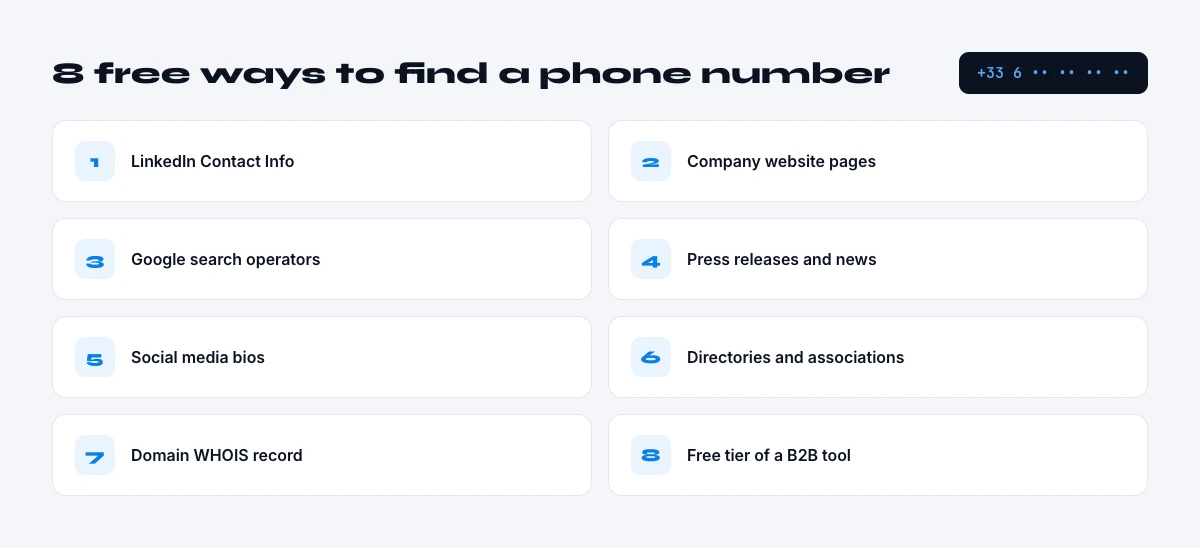
8 free ways to find a phone number
1. Check the LinkedIn Contact Info section
Open the profile, click "Contact info" under the headline, and look for a phone field. Some professionals list a number there, especially consultants, recruiters, founders, and anyone open to inbound. It is free and it is first-party data, so when it is present it is usually accurate. The catch is coverage: most people leave the field blank, and you only see it if you are connected or the profile is set to public. For a structured way to pull what a profile does expose, see our guide on a phone number lookup from LinkedIn. One practical tip: check the activity feed and the "About" section as well, since people sometimes drop a number in a post, a featured link, or a calendar booking page rather than the formal contact field. Those signals are easy to miss on a quick scan but cost nothing to read.
2. Dig through the company website
The Contact, About, and Team pages are the most underused free source there is. Small and mid-sized companies routinely publish a main line, and many list department or named-person numbers. Check the page footer, a "Press" or "Media" page (journalists get a direct contact), and any "Meet the team" section. You will usually land on a switchboard rather than a direct dial, but a receptionist who can transfer you is still a warm path in. Do not skip Google Maps and Google Business Profile either: local and service businesses list a public number there precisely because they want calls, and it is often more current than the website footer. When you need the company line specifically, our guide to finding a company phone number goes deeper.
3. Use Google search operators
Search engines index pages that internal site search hides. Try the person or company name with a site filter and an intent term, for example "Jane Doe" "Acme" phone or site:acme.com contact. Add a region or a format hint such as a country dialing code to narrow results. Operators like intext: and quotation marks force exact matches and cut noise. This takes patience, but it costs nothing and often surfaces a number buried in a PDF, a slide deck, or an old press release.
4. Read press releases and announcements
Press releases almost always end with a media contact block: a name, an email, and a direct line. Funding announcements, product launches, and partnership news are gold here. Search the company newsroom, PR Newswire, Business Wire, or a simple query for the company name plus "press release". The contact listed is often a marketing or comms lead, which is a useful first touch even if they are not your end target. For public companies, earnings-call transcripts and investor-relations pages add another free layer: they name executives and frequently route through an IR line that a real person answers.
5. Scan social media bios
Beyond LinkedIn, an X (Twitter) bio, a Facebook business page, an Instagram business profile, or a personal site linked from a profile can carry a phone number. Business pages on Facebook and Google Business Profile in particular expose a public line by design, since the point is to be contacted. This is hit or miss for individuals but reliable for local and service businesses.
6. Search professional directories and associations
Industry directories, chambers of commerce, bar associations, medical boards, and trade bodies publish member contact details, often including a phone number. National business registries do too: Companies House in the UK, the SEC's filings for US public companies, Pappers in France. These are free, authoritative, and frequently overlooked. For regulated professions, the licensing body is often the single best free source. Local sources help too: municipal business registers, chamber member lists, and even a well-maintained Yellow Pages entry can carry a current line for small firms that never publish one on their own site.
7. Look up the domain WHOIS record
Every registered domain has a WHOIS record that can include a registrant phone number. Run the company domain through a free WHOIS lookup. Privacy services now mask most personal entries, so this works best for older domains and smaller companies that never enabled WHOIS privacy. When it hits, you get a number tied directly to the business owner.
8. Use the free tier of a B2B tool
Several sales-intelligence tools give you free credits to test them, which is a legitimate free method for a small batch. Derrick, for example, gives 100 free credits with no credit card, so you can try real lookups before deciding anything. Free tiers are perfect for a handful of contacts; they are not built to run a 500-row list, which is the line where free stops and a paid plan starts making sense. The smart way to use a free tier is as a test: run ten of your real contacts through it, check how many numbers come back and whether they connect, and let that hit rate decide whether the tool is worth a paid plan for your specific market.
In the web app or Google Sheets
When the free methods run out
The eight methods here cost nothing and work at small volume. Past that, Derrick does the same lookup on a whole column, and the pricing is per number actually returned, so an empty row costs nothing either.
- Feature
- Lead Phone Finder
- Credit cost
- 200 credits per phone found
The first button opens the web app (nothing to install): 200 credits per phone found, 100 free credits every month. The second details the feature and its cost per plan.
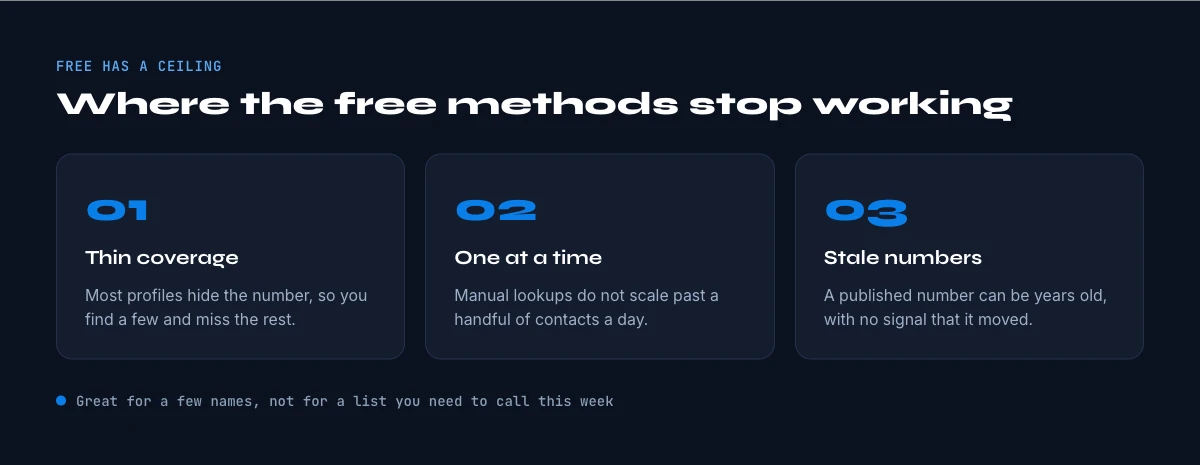
Where free methods hit their ceiling
Free works until any one of three things happens: the volume climbs, the seniority climbs, or the deadline shrinks. Manually checking a profile, a website, and a directory might take three to five minutes per contact when it works, and it fails outright for most senior people. Multiply that by a list of a few hundred and the "free" number has a very real cost measured in hours.
| Approach | Coverage | Time per contact | Best for |
|---|---|---|---|
| Free manual methods | ~20-30% | 3-5 min | One-off lookups, SMBs, local businesses |
| Free tool credits | Varies | Seconds | Testing accuracy on a small batch |
| ✦ Sales tool at scale | ~70-80% direct dials | Seconds, in bulk | Prospecting lists, senior roles, deadlines |
There is a hidden second cost too: context-switching. Hunting one number means hopping between LinkedIn, a website, a directory, and a search engine, then copying the result somewhere usable. Done a few hundred times, that fragmentation is where the real hours go, not the lookups themselves. A tool collapses those steps into one column, in a web app or in a sheet you already work in.
The honest read: free methods are the right tool for low volume and reachable people. The moment you are sourcing direct dials for a target account list, the time cost of free outruns the price of a tool.
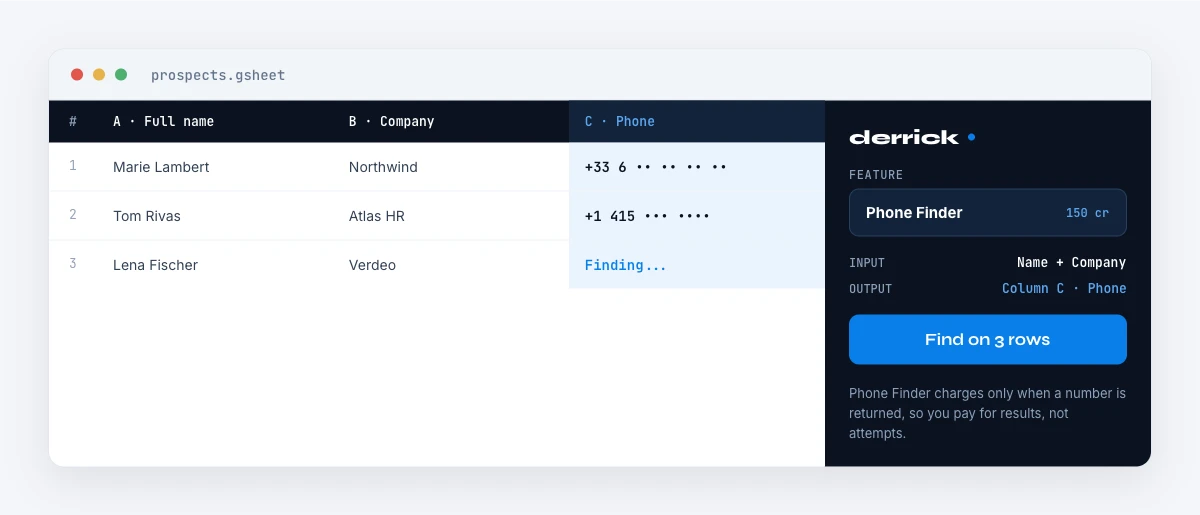
Scaling beyond free with Derrick
When a list outgrows manual lookups, Derrick runs the same job in bulk in the web app or in Google Sheets. It is a sidebar, not a formula: you paste a column of LinkedIn URLs or company and contact names, open the sidebar, and the Phone Finder feature fills a column with direct dials. Pricing is per result: Phone Finder costs 200 credits per phone number found, and you are billed for results, not attempts, so an empty lookup does not burn credits.
You can try it before paying anything. The free plan includes 100 credits per month with no credit card, which is enough to validate accuracy on your own contacts. Paid plans start at 20 euros per month when you need volume, and the model scales from a handful of numbers to large lists without changing tools. A good workflow is to enrich emails first with the verified B2B methods approach, then layer phone numbers on the rows that matter most, and finally run a phone number validation pass before your team starts dialing.
The reason this beats a standalone database for most teams is that the numbers land where the list already lives, in the Derrick web app (nothing to install) or in your spreadsheet. There is no export, no CSV round-trip, and no database to learn. You keep your own columns, your own filters, and your own notes, and the numbers simply appear next to the contacts they belong to. That is the practical difference between a one-off free lookup and a repeatable process you can run every week as new accounts land on the list.
Start with 100 free credits and test it on your own list before committing to anything.
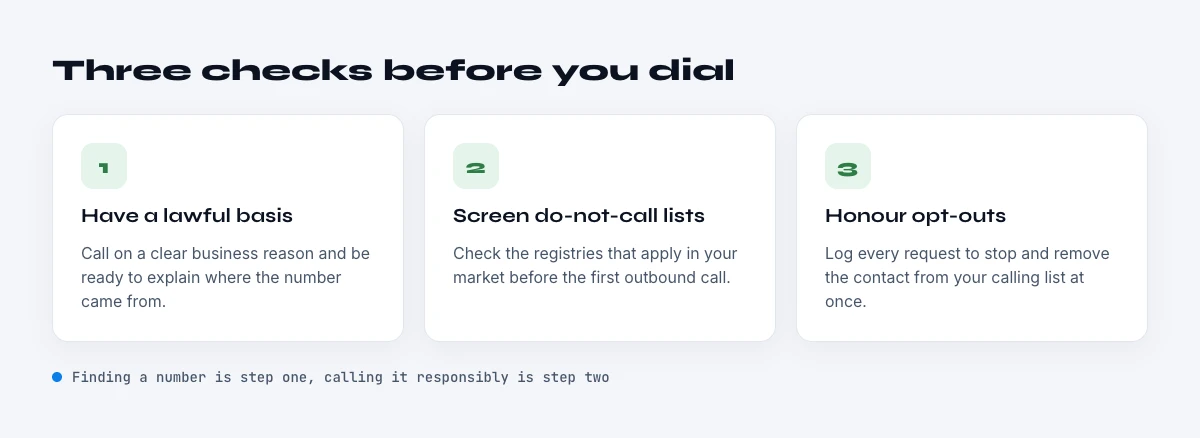
Stay compliant when you call
Finding a number is one thing; calling it legally is another. In the US, live business-to-business calls from public or professional sources are broadly allowed, but you must respect the National Do-Not-Call Registry for personal mobiles. In the EU and UK, GDPR and UK GDPR require a legitimate-interest basis and an easy opt-out, and you must stop contacting anyone who asks. In France, B2B calling also has to respect the Bloctel opposition list. The rule of thumb that keeps you safe: contact people in their professional capacity, about something genuinely relevant to their role, and honor every opt-out on the first request. Keep a simple record of where each number came from, since being able to show a lawful source is what turns a compliance question into a non-issue.
The bottom line
Start free. Check LinkedIn, the company site, a directory, and a Google operator or two, and you will find plenty of numbers for one-off outreach at no cost. When the list grows past what your time can absorb, switch to a tool that runs in a web app or in your spreadsheet and bills only for the numbers it actually finds. Free and paid are not rivals here; they are two stages of the same workflow.
Frequently asked questions
Is it legal to find someone's phone number?
Can you find a cell phone number for free?
How accurate are free phone-finding methods?
What is the fastest free way to get a B2B phone number?
Why is a number on LinkedIn but not public elsewhere?
How many numbers can I find on Derrick's free plan?
Do free phone lookup sites work for business contacts?
Keep reading
Continue exploring this cluster


How to Find B2B Phone Numbers: 7 Verified Methods + Tools (2026)
Read →

Phone Number Lookup from LinkedIn: How to Find Phone Numbers in 2026
Read →

How to Find a Company's Phone Number: 5 Effective Methods in 2026
Read →

Phone Number Validation: International Formats and Best Practices
Read →