
B2B Sales Cycle: How Data Enrichment Shortens Every Stage
Learn how long a B2B sales cycle runs, what slows each stage and how data enrichment removes the waiting steps your reps actually control.


Your reps are spending hours qualifying prospects, tracking down the right contact, and crafting personalized messages - and deals still aren't moving. The sales cycle stretches. Follow-ups pile up. Meanwhile, your competitors are closing.
The root cause is rarely the product or the price. A large part of a B2B sales cycle is waiting: waiting for the right contact, for an email that does not bounce, for an answer your rep could have found alone. If you want the textbook version first, here is what a sales cycle is. This page is about why yours runs long, and which part of the wait data can actually remove.
B2B data enrichment fixes this at the source. By automatically filling in the gaps in your prospect records - job title, company size, tech stack, verified email, direct phone number - you give your sales team everything they need to move fast and pitch right. This article walks you through exactly how enrichment accelerates each stage of your pipeline and how to implement it.
How long is a B2B sales cycle?
There is no single number: a B2B sales cycle runs as long as its deal size, its number of decision-makers and its account type allow.
Those three variables explain most of the spread. A small deal bought by one person can close in days. A large contract that needs a buying committee, a security review and a legal pass can take most of a year. Selling more to an existing customer is usually faster than winning a new logo, because trust, contracts and contacts are already in place.
The only benchmark that really matters is your own, and your CRM already holds it. Take the deals closed won over the last two quarters and count the days between the first logged touch and the signature. Then split that figure by segment and by stage: the stage where deals sit longest is the one to work on first.
Two habits make the number useful. Use the median rather than the average, so one deal that dragged on for a year does not hide the rest. And track lost deals separately: a cycle that ends in a no after five months costs far more than one that ends in a no after three weeks.
Why B2B sales cycles drag on (and what it actually costs you)
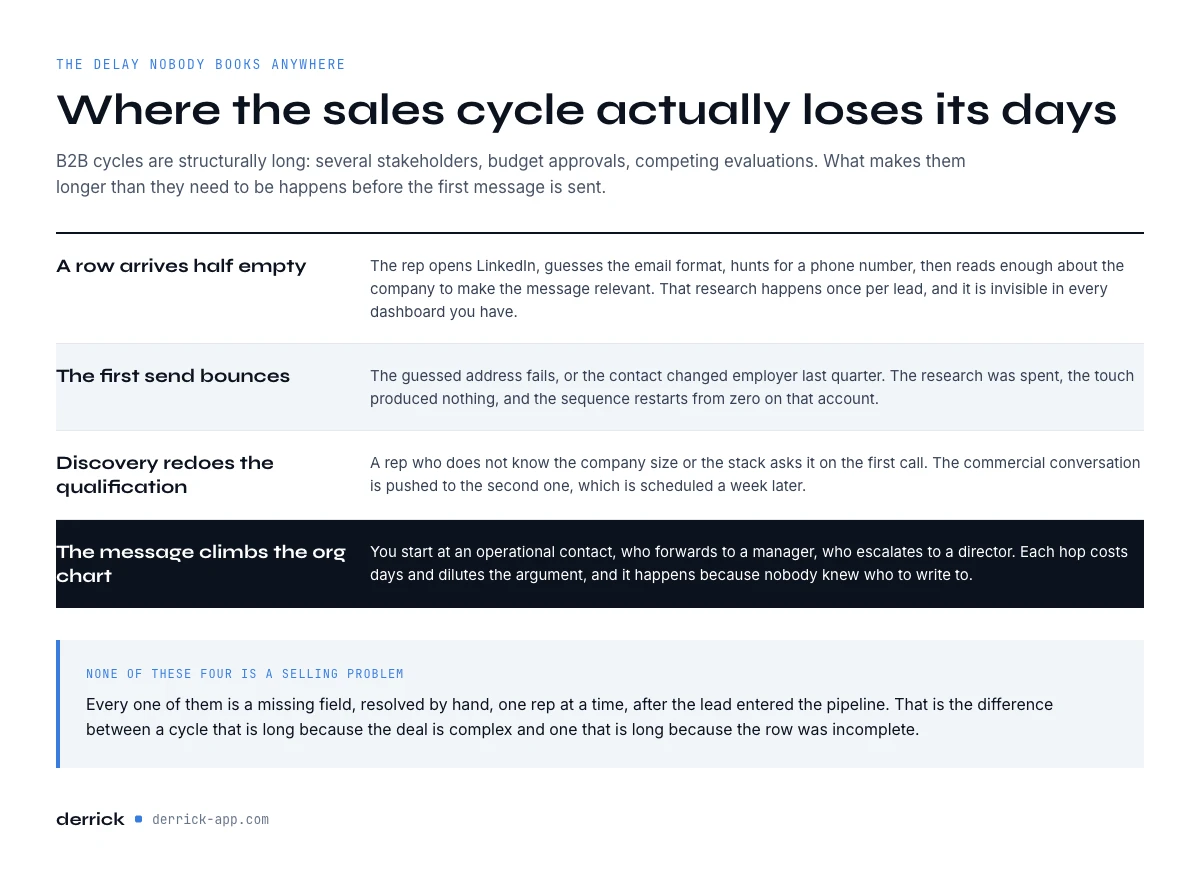
B2B sales cycles are structurally longer than B2C: multiple stakeholders, budget approvals, competitive evaluations. But there's one variable that makes them even longer than they need to be - and it's often overlooked: the quality of your contact data.
When an SDR receives a prospect list with missing fields, the first thing they have to do is manually fill in the blanks. Find the right contact on LinkedIn. Guess the email format. Track down a phone number. Understand enough context to make the outreach relevant. This research phase can eat 20 to 30 minutes per lead - and often leads nowhere if the contact has changed roles or the email bounces on the first send. What that costs a whole team over a quarter is worked out in our page on SDR productivity.
The downstream impact shows up in your metrics: high bounce rates, low reply rates on initial outreach, follow-ups going to the wrong people. Every friction point extends the cycle. Every wasted touch delays a decision.
Data enrichment removes this friction by giving reps a complete prospect picture before the first contact is ever made. It's not just a time saver - it's a structural acceleration of your pipeline.
What enrichment will not shorten
Part of the time in a B2B sales cycle has nothing to do with data, and no tool removes it. A buying committee still has to meet. A legal team still reads the contract, and security questionnaires still come back with follow-up questions. A company that sets its budget once a year will not sign in March because your list was clean.
What enrichment removes is the avoidable part: the research before the first message, the bounce, the call with the wrong person, the week lost while a proposal is forwarded up the chain. On a long enterprise cycle, that avoidable part can be a modest share of the total. Measure it in your own pipeline before you promise anyone a shorter quarter.
Stage by stage: what slows a deal down, and the data that removes the wait
Most teams name the stages of their cycle in roughly the same way. The playbook for each one lives in our guide to the steps of the sales process. The table below only looks at time: where a deal waits, and whether a missing field is the reason.
| Stage | What slows it down | The data that removes the wait |
|---|---|---|
| Prospecting | Building the list by hand, guessing who to contact at each account | Company list with size, industry and website, plus the people who work there |
| Qualification | Discovery calls spent on basics the rep could have looked up | Headcount, industry, location, tech stack |
| Discovery | Talking to someone who cannot decide, then waiting to be forwarded | Exact job title, seniority, the people around the buyer |
| Proposal | The proposal sits unread in the wrong inbox | Verified email or direct phone of the person who signs |
| Negotiation | Procurement, legal review, budget approval | Very little: this wait is mostly not about data |
| Closing | Chasing signatures, a champion who left mid-deal | A re-enriched contact record, to catch a job change before it stalls the deal |
Read the table from the bottom up: the further a deal moves, the less data helps. That is why enrichment pays off early in the cycle, and why it is worth being clear about where it stops.
In the web app or Google Sheets
Remove one waiting step from the cycle
A cycle stretches on every round trip that waits for a reply. When the direct number is on the row, the follow-up that took a week of emails becomes a call. Derrick returns the number in your list, and charges only when it finds one.
- Feature
- Lead Phone Finder
- Credit cost
- 200 credits per phone found
The first button opens the web app (nothing to install): 200 credits per phone found, available from the STANDARD plan. The second details the feature and its cost per plan.
How data enrichment shortens the B2B sales cycle at every stage
Enrichment doesn't just improve one phase. It compresses the B2B sales cycle across the board. Here's how it plays out at each stage.
1. Faster qualification with firmographic data
Qualification is where time hemorrhages most. A rep who doesn't know whether a company fits their ICP ends up asking basic discovery questions on the first call - which delays the real commercial conversation by days or even weeks.
With enriched firmographic data - industry, company size, location, estimated revenue, tech stack - qualification happens before outreach begins. Sarah, an SDR at a B2B SaaS company, can filter a 500-lead list down to the 80 accounts that actually match her ICP in a matter of minutes. She stops spending 20-minute calls discovering that the company has three employees and no budget.
In practice, firmographic enrichment powers automated lead scoring and account prioritization. What once took three days of manual research now takes a few hours - and the leads entering the pipeline are already pre-qualified. The fields that make a lead worth working are detailed in our guide on how to improve B2B lead quality.
2. Personalized first touch to get a response faster
Generic outreach gets ignored - and ignored outreach means more follow-ups, which means a longer cycle. Enrichment flips this dynamic.
When Mike, a Growth Marketer at a demand generation agency, knows the prospect's exact job title, the tools their company uses, their team size, and relevant company context, he can write a targeted first message that lands. Reply rates go up. The number of follow-ups needed drops. And the commercial conversation starts earlier.
The enrichment data that drives personalization most effectively: job title, tech stack (to show contextual relevance), company news or growth signals, and LinkedIn headline. These inputs make the difference between a message that gets a reply on day one and one that gets ignored for three weeks.
3. Direct access to decision-makers, skipping the gatekeeping chain
One of the biggest structural causes of long B2B sales cycles is not reaching the right person fast enough. You start with an operational contact, who forwards to a manager, who escalates to the director - and the timing gets diluted at every step.
Contact enrichment solves this by identifying the right stakeholder upfront: their exact title, seniority level, and verified work email. Emma, a Sales Ops manager at a mid-market tech company, uses Find a company's people, at 1 credit per person on paid plans, to map an entire target company's leadership team in minutes, roles and names included. She reaches the VP of Operations directly instead of working her way up from an account manager.
That kind of directness can take weeks off your sales cycle length by skipping the internal forwarding chain entirely.
4. Enriched lead scoring to focus energy on the right deals
Without enrichment, lead scoring relies on thin signals - usually just industry and company size. With enriched data, scoring becomes genuinely predictive: you can factor in the tech stack (a strong signal of fit or incompatibility), recent headcount growth, estimated revenue, and digital maturity.
A better-scored pipeline means reps work the highest-probability deals first. Conversion rates go up - and when you convert more reliably, you convert faster. Deals move quickly because they were selected for their likelihood of closing, not just their position in the queue.
Better conversion naturally compresses the cycle length: when fewer deals stall in the middle, the median time to close drops with them. To check the effect on your own numbers, compare conversion by stage before and after enrichment, as laid out in our page on B2B conversion rate benchmarks.
The app works through your list row by row: 200 credits per phone found, nothing is billed without a result.
The enrichment data that actually shortens your sales cycle
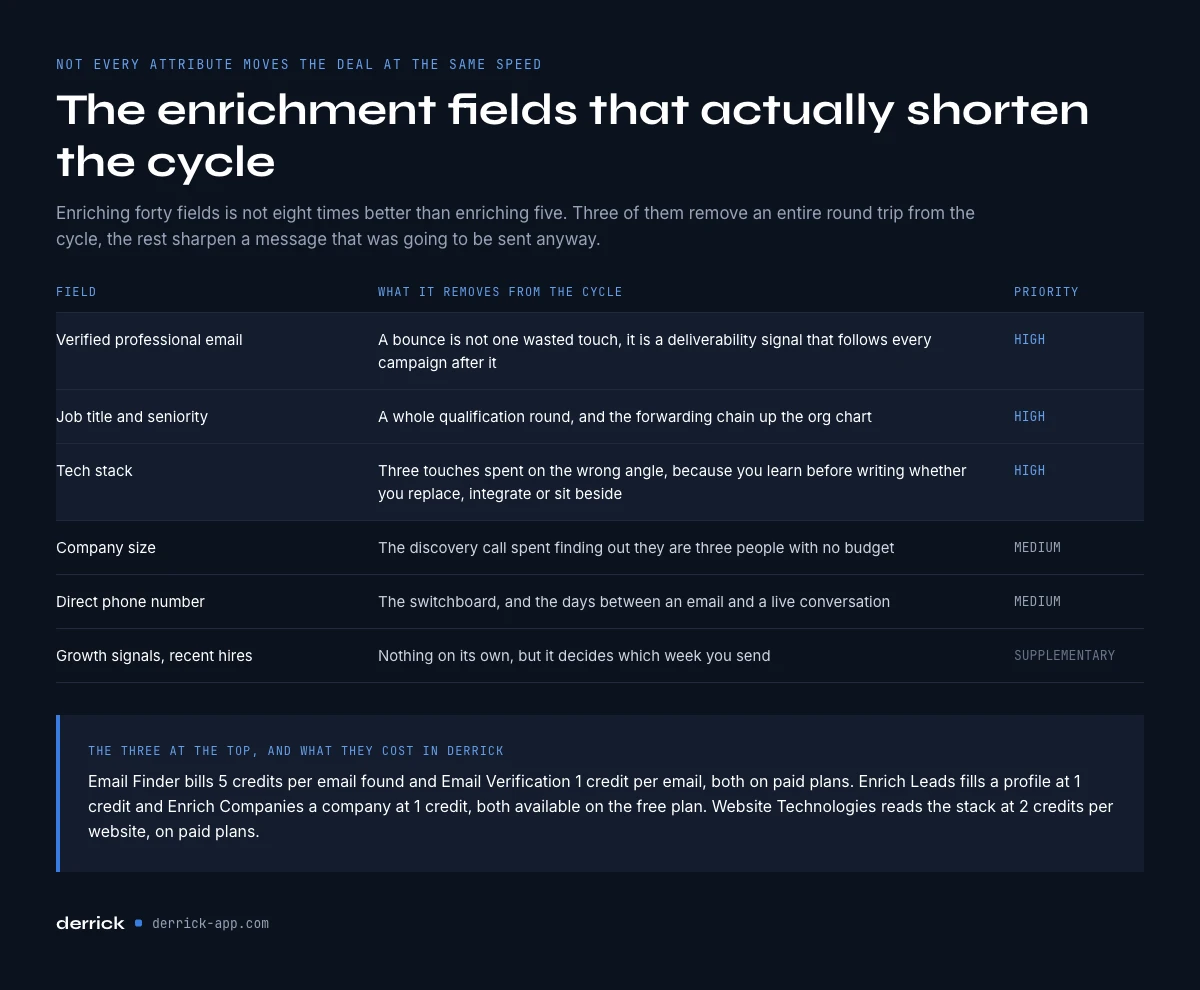
Not all enrichment attributes have the same impact on deal velocity. Here's what matters most.
| Enriched data point | Impact on sales cycle | Priority |
|---|---|---|
| Verified professional email | Eliminates bounces, removes a full cycle of wasted outreach | High |
| Job title and seniority | Direct qualification + decision-maker targeting | High |
| Tech stack | Personalization + fit scoring | High |
| Company size | ICP qualification, pitch calibration | Medium |
| Industry vertical | Segmentation, relevance of messaging | Medium |
| Direct phone number | Bypass switchboard, faster live conversation | Medium |
| Growth signals (recent hires) | Optimal timing for outreach | Supplementary |
| Estimated financials | Budget qualification | Supplementary |
Verified email deserves special mention: a hard bounce on a first send isn't just a wasted effort - it's a deliverability signal that affects every campaign that follows. Running email verification before outreach (1 credit per email, on paid plans) is one of the highest-ROI steps any sales team can take.
Tech stack data is equally powerful. If you sell a solution that integrates with HubSpot and the prospect runs HubSpot, that's an immediate, credible hook. If they don't, better to know before investing three touches on the wrong angle. Role and seniority work the same way: knowing you are aiming at Salesforce's chief revenue officer rather than "someone in sales" removes a whole qualification round from the cycle before the first touch.
Derrick surfaces all of this data directly from LinkedIn and other sources - enriched into your list, in the web app or in Google Sheets, in minutes, without manual lookup or CSV exports.
How to build an enrichment process that actually accelerates your pipeline
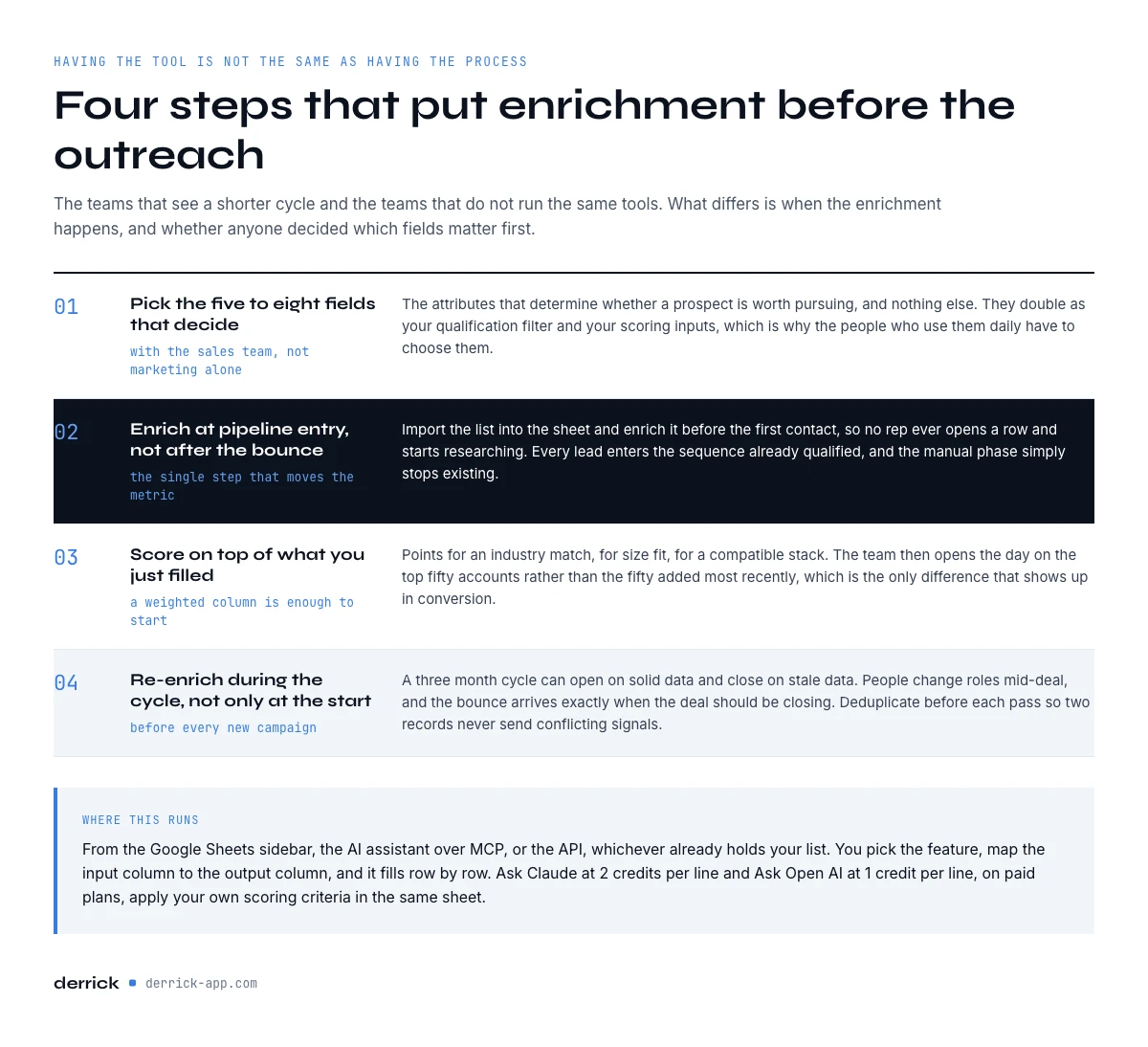
Having an enrichment tool isn't enough. The difference between teams that see results and teams that don't comes down to process. Here's a four-step framework to integrate enrichment into your sales workflow.
Step 1: Define the data fields that drive your qualification
Before enriching anything, identify the 5 to 8 attributes that determine whether a prospect is worth pursuing. For most B2B sales teams, this means job title, company size, industry, tech stack, and the presence of a valid email.
These criteria serve as both your qualification filter and your scoring inputs. Define them with the sales team - not just marketing - since they're the ones who'll use this data day-to-day.
Expected outcome: A clear set of priority fields that guides your enrichment and prevents you from collecting data you'll never act on.
Step 2: Enrich leads at pipeline entry, not after the first bounce
The most effective enrichment happens as early as possible - ideally when a lead enters your pipeline, not after several fruitless outreach attempts. For outbound teams, this means enriching the list before the first contact, not after.
With Derrick, you import your LinkedIn profiles or company list into the web app or into Google Sheets and run enrichment right there. Within minutes, every row contains the job title, verified email, company info, and firmographic data your reps need to start strong.
Expected outcome: Every lead enters your sequence already qualified, with no manual research phase before outreach.
Step 3: Build automated scoring on top of enriched data
Once the data is in place, use it to rank your leads. Scoring can be as simple as a weighted column in Google Sheets: +10 for industry match, +5 for size fit, +15 for relevant tech stack, and so on.
Derrick's Ask AI, in the web app or in Google Sheets, takes this further: Ask Claude at 2 credits per line and Ask Open AI at 1 credit per line, on paid plans, apply your own scoring criteria to each row automatically. A list of 500 prospects gets ranked in minutes, so your team opens their day working the top 50, not the first 50 in the list.
Expected outcome: Your team prioritizes the right accounts first, not just the most recently added ones.
Step 4: Keep data fresh throughout the sales cycle
B2B contact data decays fast. Roughly 25 to 30% of contacts change roles or companies every year. A B2B sales cycle that lasts three months can start on solid data and end on stale information - causing bounces, misdirected outreach, and timeline slippage right when a deal should be closing.
Schedule regular re-enrichment of active leads - at minimum quarterly for nurture sequences, and before every new outreach campaign. Pair this with deduplication and data normalization so that duplicate records don't create conflicting signals in your pipeline.
Expected outcome: A pipeline consistently fed with reliable data, with no unpleasant surprises mid-cycle.
Sales cycle metrics to track
Three numbers tell you whether the cycle is really getting shorter, and none of them needs someone else's benchmark:
- Sales cycle length: median days from first touch to signature, per segment.
- Sales velocity: open deals times win rate times average deal value, divided by cycle length. It shows whether a shorter cycle also brings in more revenue per month.
- Stage conversion: the share of deals that move from one stage to the next, and the number of days they spend in each.
Record them for a full quarter before you change anything, so you have a baseline to compare against. The indicators that tie these numbers back to the data itself are listed in our guide to data enrichment KPIs.
The mistakes that stop enrichment from paying off
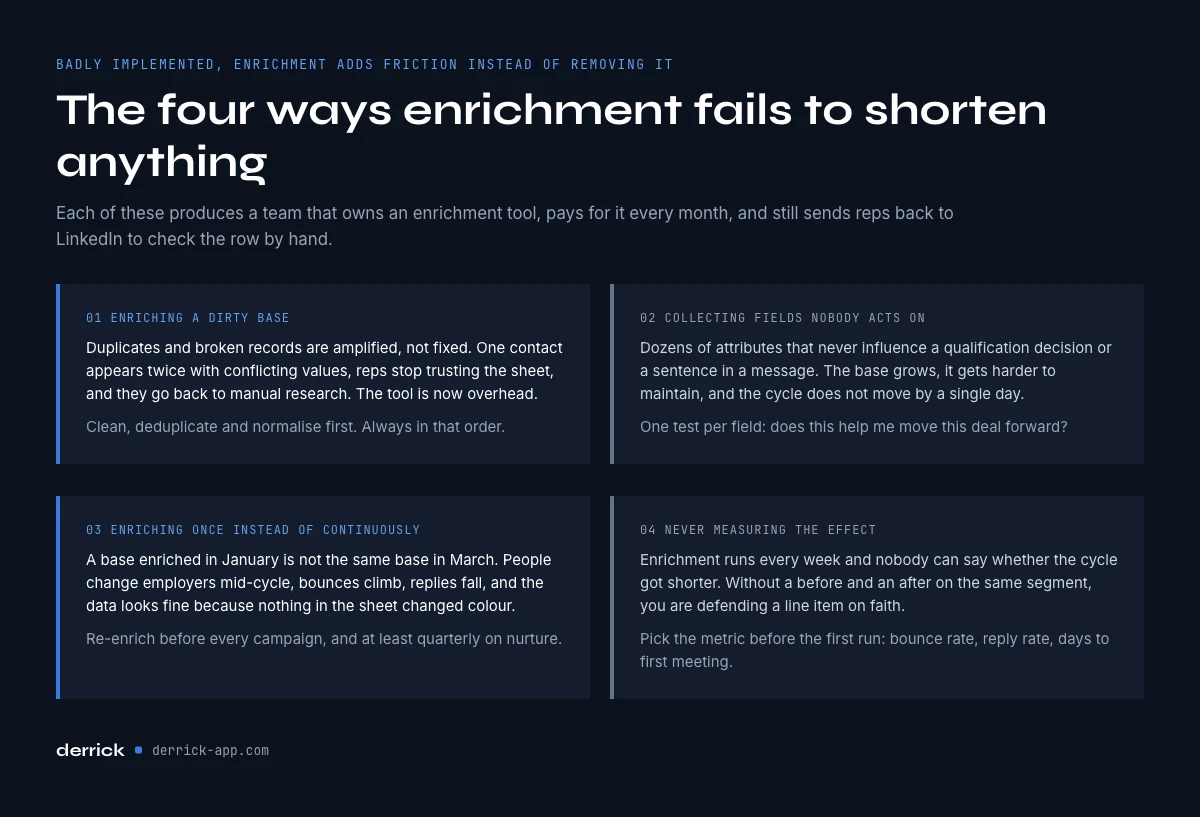
Poorly implemented enrichment can add friction instead of removing it. Here are the four most common mistakes.
Problem 1: Enriching a dirty database
Impact: Duplicates and badly structured records in your base get amplified after enrichment. A contact appears twice with conflicting data. Reps don't know which record to trust. Confidence in the data erodes - and reps go back to manual research, defeating the entire purpose.
Solution: Clean before you enrich. Deduplicate your list and standardize existing fields before running any enrichment. Derrick includes Find Duplicates, unlimited and available on the free plan, and Find Names & Domains by Email Addresses, which splits an email into its name parts and its company domain, also unlimited on the free plan.
Problem 2: Collecting data that doesn't connect to the sales process
Impact: Teams enrich dozens of attributes that never influence a qualification decision or a personalized message. The database grows, becomes harder to maintain, and reps feel overwhelmed by fields they don't use. More data, but no faster cycle.
Solution: Only enrich data that answers the question: "Does this information help me move this deal forward?" Anything that doesn't pass that test is noise.
Problem 3: One-time enrichment instead of a continuous process
Impact: Your database is enriched in January. By March, some of those contacts have already changed jobs. Bounces start climbing. Reply rates drop. The sales cycle stretches again - because the foundation has degraded.
Solution: Treat enrichment as an ongoing process, not a one-time project. Set a re-enrichment cadence based on your average sales cycle length.
Problem 4: Not measuring enrichment's impact on commercial metrics
Impact: Enrichment happens but no one knows whether it's actually shortening the cycle. Without measurement, it's impossible to justify the investment or optimize the process.
Solution: Track at least three metrics before and after implementing enrichment: first-touch reply rate, average number of follow-ups before a first meeting, and average qualification cycle duration. Movement in these numbers tells you exactly what your enrichment investment is delivering.
Key takeaways
- A B2B sales cycle has no universal length: measure your own median, by segment and by stage.
- Incomplete data is one of the few causes of a long cycle your team fully controls. Committees, legal review and budget calendars are not.
- Enrichment accelerates every stage of the pipeline: qualification, personalization, decision-maker access, and lead scoring.
- The highest-impact data points are verified email, exact job title, and company tech stack.
- Enrich at pipeline entry - not after multiple failed attempts.
- Re-enrich regularly: 25 to 30% of B2B contact data goes stale every year.
- Measure reply rate, follow-up count, and qualification cycle length to validate your ROI.
Conclusion: start with the data, close faster
B2B sales cycles don't shorten by adding more follow-ups or pushing harder. They shorten by removing friction - and the biggest source of friction is incomplete or inaccurate data at every step of the process.
Data enrichment is the structural fix. Feed your pipeline with accurate, complete information from the start, and your team qualifies faster, personalizes better, reaches the right decision-makers, and closes sooner.
Derrick makes this process available in the web app or in Google Sheets: import your leads from LinkedIn or Sales Navigator, enrich them with emails, phone numbers, and company data, score them with Ask AI (Claude or GPT), and walk away with a qualified list ready for outreach. You can start on the free plan, with 100 credits a month, and keep the stage table above as your checklist.
Frequently asked questions
How long is the average B2B sales cycle?
Does data enrichment actually shorten the sales cycle?
What are the stages of a B2B sales cycle?
Which enriched data points have the biggest impact on deal velocity?
How often should I re-enrich my prospect database?
How do I measure the ROI of data enrichment on my sales cycle?
Keep reading
Continue exploring this cluster


The 10 Essential KPIs to Measure Your B2B Data Enrichment
Read →

B2B Conversion Rate Impact: Case Studies and Concrete Levers
Read →

Cost per Qualified Lead: How Data Enrichment Cuts Your CPQL in Half
Read →

SDR Productivity: The Measurable Gains You Can Actually Hit
Read →