
What Is an SMB in Business?
What is an SMB in business? Learn the SBA, EU and INSEE thresholds, see five examples by company size, and find the data field that proves it.


What is an SMB in business? An SMB, or small and medium sized business, is a company with fewer than 500 employees in common US usage and fewer than 250 in the European Union. The official SBA size standards vary by industry, set per NAICS code in employees or in annual receipts, as detailed below.
SMB is one of those acronyms everyone uses and nobody defines the same way. A marketer means a company with under a hundred people. A federal contracting officer means a company under a threshold that changes by industry code. A European analyst means something a regulation defines precisely, with a revenue ceiling attached. All three are correct in their own context, and that is exactly why segments built on the word quietly fall apart.
This guide does two things. It gives you the thresholds that actually carry authority, side by side, so you can see where they disagree. Then it answers the question the definition articles never reach: when you are looking at a list of ten thousand companies, which field tells you an account is an SMB, how reliable is it, and what do you do when two sources give you two different headcounts for the same business.
What is an SMB in business?
SMB stands for small and medium sized business. It describes a company that is past the one person stage but has not reached the size where a dedicated procurement function, a multi layer org chart and a formal vendor review process appear. In most English speaking business contexts, and particularly in software, SMB is the bucket that sits below mid-market, which in turn sits below enterprise.
The acronym travels with a sibling. SME, for small and medium sized enterprise, is the term used by the European Commission, by INSEE in France and by most statistical agencies. SMB is the American and technology industry habit. They point at broadly the same population, but SME has a legal definition with numbers attached and SMB usually does not.
The short answer to the question, then, is that an SMB is a company small enough that the person you need to convince is often the person who signs. Everything below is about turning that into a filter.
What is an SMB in business, in practice? Five characteristics
Definitions give you a ceiling. In day to day business, SMBs share a handful of traits that matter more than the exact number, and those traits are the reason the segment behaves so differently from enterprise accounts.
- Headcount. From a handful of people up to a few hundred. Most SMBs sit far below any official ceiling, run by a founder and a small team.
- Revenue. From a few hundred thousand to a few tens of millions a year. The European ceiling for a medium sized enterprise is 50 million euro of turnover.
- Decision structure. Short. The owner or a small leadership team signs, often within the week, without a procurement department or a formal vendor review.
- Software budget. Limited and watched closely. Tools are bought by the month, often on a company card, and one person may run sales, marketing and operations from the same few apps.
- Ownership. Usually independent and privately held, which is also why revenue is rarely published and headcount becomes the field you can actually observe.
None of these traits is a legal test. They are what makes the segment worth naming, and they explain why the same product is sold, priced and supported differently to a 30 person agency and to a 3,000 person group.
SMB, SME and mid-market: three words, three scopes
- SMB is a market segment word. It is used by vendors to describe who they sell to, and its boundaries move with the vendor.
- SME is a regulatory word. In the European Union it is defined by Recommendation 2003/361/EC, and qualifying gives access to specific programs, so the thresholds are precise and enforced.
- Mid-market is the band immediately above SMB, and it is the least standardized of the three. Most vendors place it somewhere between one hundred and one thousand employees, which is a range wide enough to contain two very different sales motions.
Treat these as three different questions and the confusion drops. If you are writing a contract, use the regulatory definition. If you are building a territory, use the band your own sales cycle data supports. If you are writing marketing copy, use the word your reader uses.
Official SMB thresholds: SBA, EU and INSEE
Three definitions carry real authority, and none of them is a single number.
Why SMBs matter. Small businesses are not a niche. The SBA Office of Advocacy counts 36.2 million of them in the 2026 edition of its small business FAQ: 99.9 percent of all United States businesses, employing 62.3 million people, or 45.9 percent of private sector employees. Its research definition is simpler than the contracting rules below, an independent business with fewer than 500 employees. In the European Union, the Commission counts SMEs as 99 percent of all businesses. That is why almost every B2B pipeline is mostly made of them, whether or not anyone segmented for it.
United States, Small Business Administration. There is no universal SBA threshold. Size standards are set per NAICS industry code, expressed either in employees or in average annual receipts. The SBA's own reference points are 500 employees or fewer for most manufacturing companies and average annual receipts under 7.5 million dollars for many non manufacturing businesses, with exceptions by industry and real standards ranging far wider across the code list. Employees are averaged over the last 24 months, receipts over the last five fiscal years, and affiliates count toward the total. The SBA standards govern eligibility for federal contracting and loan programs. They are not a general purpose business definition, and applying them outside that context is the most common mistake in the American literature.
European Union, Recommendation 2003/361/EC. The cleanest of the three, because it is a two part test. The thresholds are published by the European Commission and have not moved since 2003. Headcount is mandatory, then either turnover or balance sheet total must also be under a ceiling.
| Category | Headcount | Turnover | or Balance sheet |
|---|---|---|---|
| Micro | under 10 | up to 2 M euro | up to 2 M euro |
| Small | under 50 | up to 10 M euro | up to 10 M euro |
| Medium | under 250 | up to 50 M euro | up to 43 M euro |
One nuance most tables leave out: a company under 250 employees that exceeds both financial ceilings at once also leaves the category. The headcount figure is the entry test, not the whole test.
France, INSEE. The national categories follow the same logic: a PME has fewer than 250 people and either turnover up to 50 M euro or a balance sheet up to 43 M euro. Above that sits the ETI, the intermediate sized company, a category that has no clean English equivalent and that quietly breaks a lot of cross border segmentation.
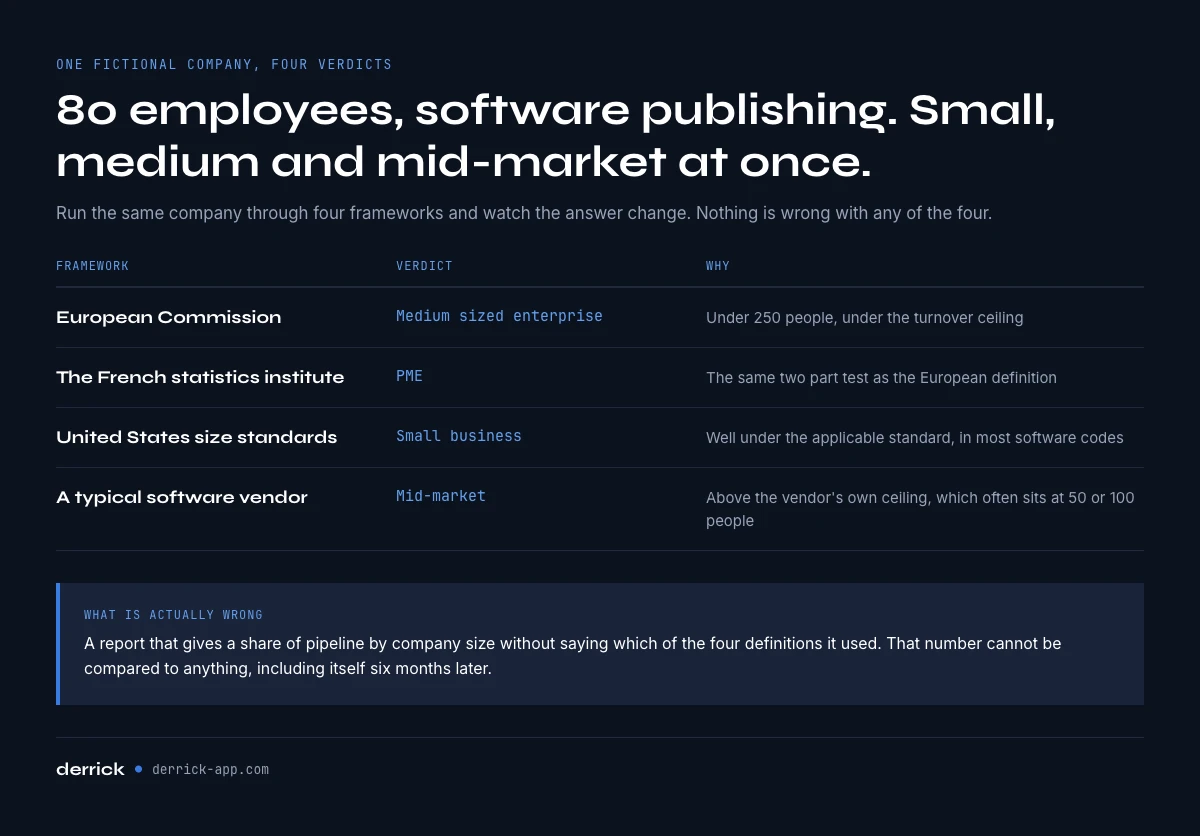
The same company is an SMB in one definition and not in another
Take one fictional company: 80 employees, 12 million euro in annual revenue, software publishing. Run it through the three frameworks and watch the answer change.
| Framework | Verdict | Why |
|---|---|---|
| European Commission | Medium sized enterprise | Under 250 people, under the turnover ceiling |
| INSEE, France | PME | Same two part test as the EU definition |
| SBA, United States | Small business, in most software codes | Well under the applicable size standard |
| Typical SaaS vendor | Mid-market | Above the vendor's own SMB ceiling, often 50 or 100 people |
The same company is small, medium, and mid-market at once. Nothing is wrong with any of the four verdicts. What is wrong is a report that says "SMB share of pipeline" without saying which of the four it used, because the number cannot be compared to anything, including itself six months later.
SMB examples: what is an SMB in business at 12, 150 and 400 people?
The 80 person software publisher above sits in the middle of the range. Five more profiles, all fictional, show how the verdict moves as a company grows. Revenue figures are rounded.
| Profile | European Commission | INSEE, France | SBA, United States | Typical vendor |
|---|---|---|---|---|
| Marketing agency, 12 people, 1.5 M euro | Small enterprise | PME | Small, under a receipts based standard | SMB |
| Accounting firm, 35 people, 4 M euro | Small enterprise | PME | Small, under a receipts based standard | SMB |
| Industrial parts maker, 150 people, 30 M euro | Medium sized enterprise | PME | Small, under the 500 employee manufacturing reference | SMB or mid-market |
| B2B software company, 400 people, 70 M euro | Not an SME | ETI | Depends on the NAICS code, measured in receipts for software | Mid-market |
| Logistics group, 1,200 people, 300 M euro | Not an SME | ETI | Above the 500 employee reference | Enterprise |
Two things stand out. The 12 person agency and the 1,200 person group get the same answer everywhere, which is why nobody argues about them. The disagreement lives between 50 and 500 people, exactly where most B2B pipelines sit, so that is the band where your own definition has to be written down. Run your own company, or a target account, through the check below.
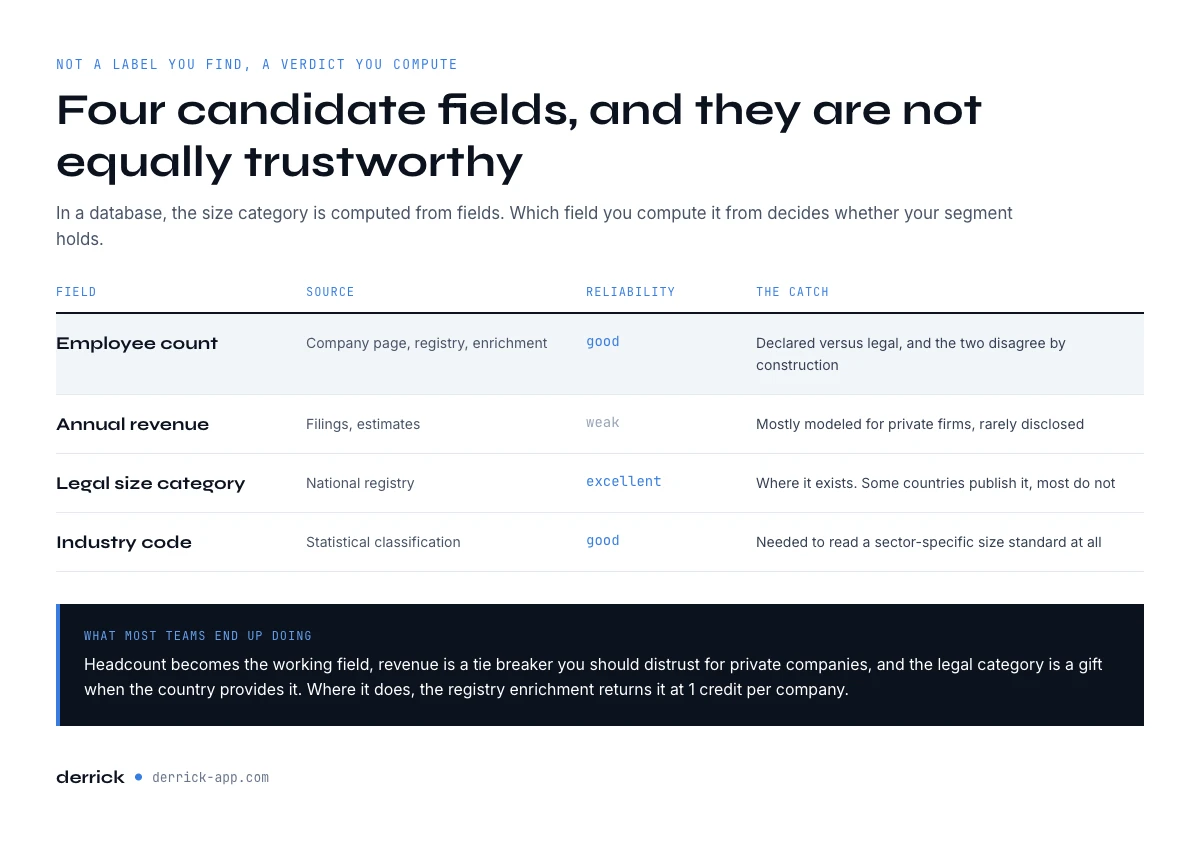
What is an SMB in business data terms?
Here is where the definition becomes operational. In a database, "SMB" is not a label you find, it is a verdict you compute from fields. Four candidates exist, and they are not equally trustworthy.
| Field | Source | Reliability | Catch |
|---|---|---|---|
| Employee count | Company page, registry, enrichment | Good | Declared versus legal, see below |
| Annual revenue | Filings, estimates | Weak for private firms | Mostly modeled, rarely disclosed |
| Legal size category | National registry | Excellent where it exists | France publishes it, most countries do not |
| Industry code | NAICS, NAF, registry | Good | Needed to read an SBA standard at all |
Headcount ends up being the working field for almost everyone, revenue is a tie breaker you should distrust for private companies, and the legal category is a gift when the country provides it. In France it does: the SIRET and SIREN enrichment returns identity, activity, revenue, headcount and legal data at 1 credit per company, which is to say the two fields the verdict depends on, which includes the registry view of the business rather than its self description.
For the rest of the world, you derive the verdict from an enriched headcount. Enrich Companies fills company fields at 1 credit per company once your LinkedIn account is connected through the Chrome extension, and Import Companies from a Prompt builds the list in the first place at 1 credit per company with LinkedIn connected (10 without), which means you can describe the segment in plain language rather than assembling it by hand.
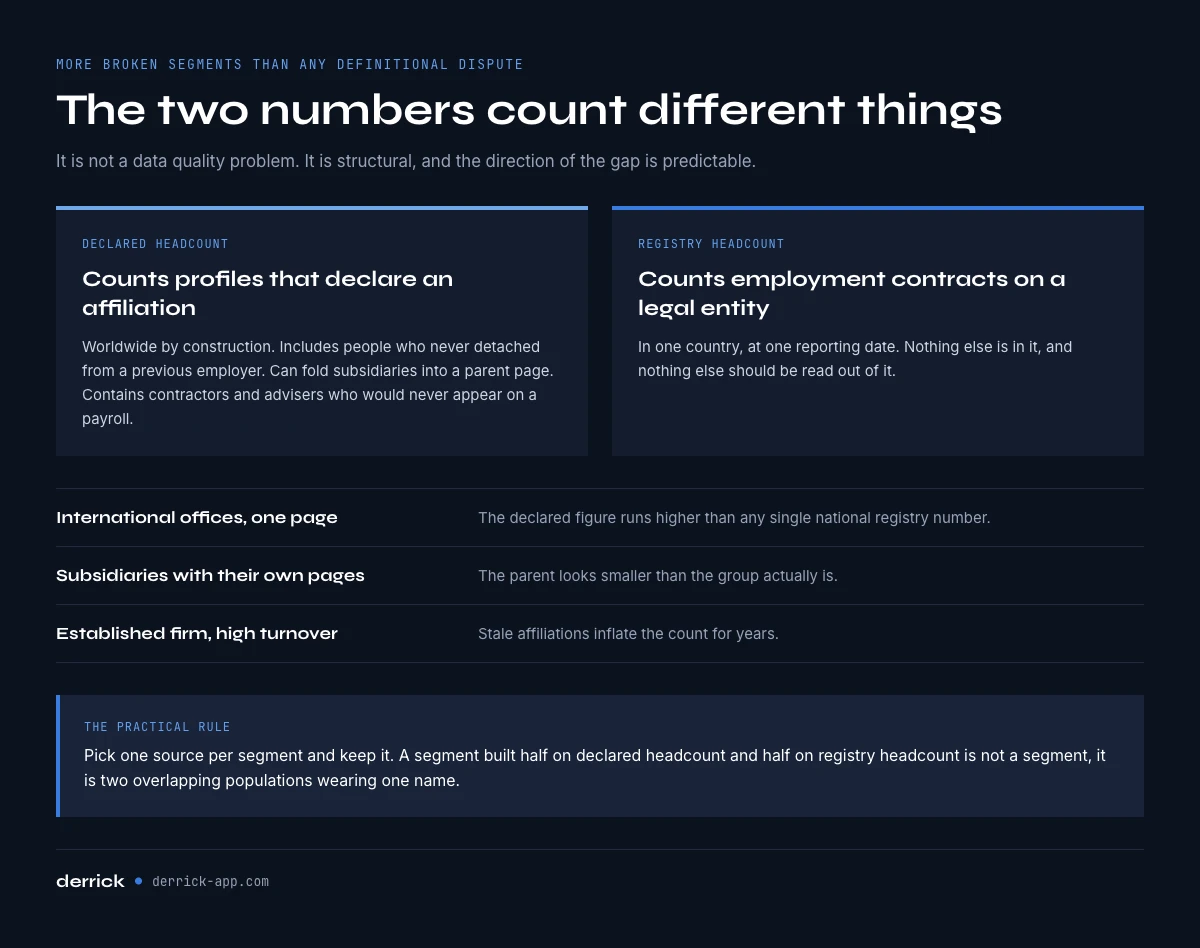
Why LinkedIn headcount and legal headcount disagree
This single mismatch causes more broken SMB segments than any definitional dispute, and it has a simple structural explanation. The two numbers count different things.
A company page headcount counts profiles that declare an affiliation. It is worldwide by construction, it includes people who never detached from a previous employer, it can fold subsidiaries into a parent page, and it contains contractors and advisers who would never appear on a payroll. A registry headcount counts employment contracts attached to a legal entity, in one country, at one reporting date.
The consequences are directional and worth memorizing. For a company with international offices under one page, the declared figure runs higher than any single national registry number. For a group whose subsidiaries maintain their own pages, the parent looks smaller than the group actually is. For an established firm with high turnover, stale affiliations inflate the count for years.
The practical rule: pick one source per segment and keep it. A segment built half on declared headcount and half on registry headcount is not a segment, it is two overlapping populations with one label. And when the two disagree by more than a band, treat the account as unclassified rather than guessing.
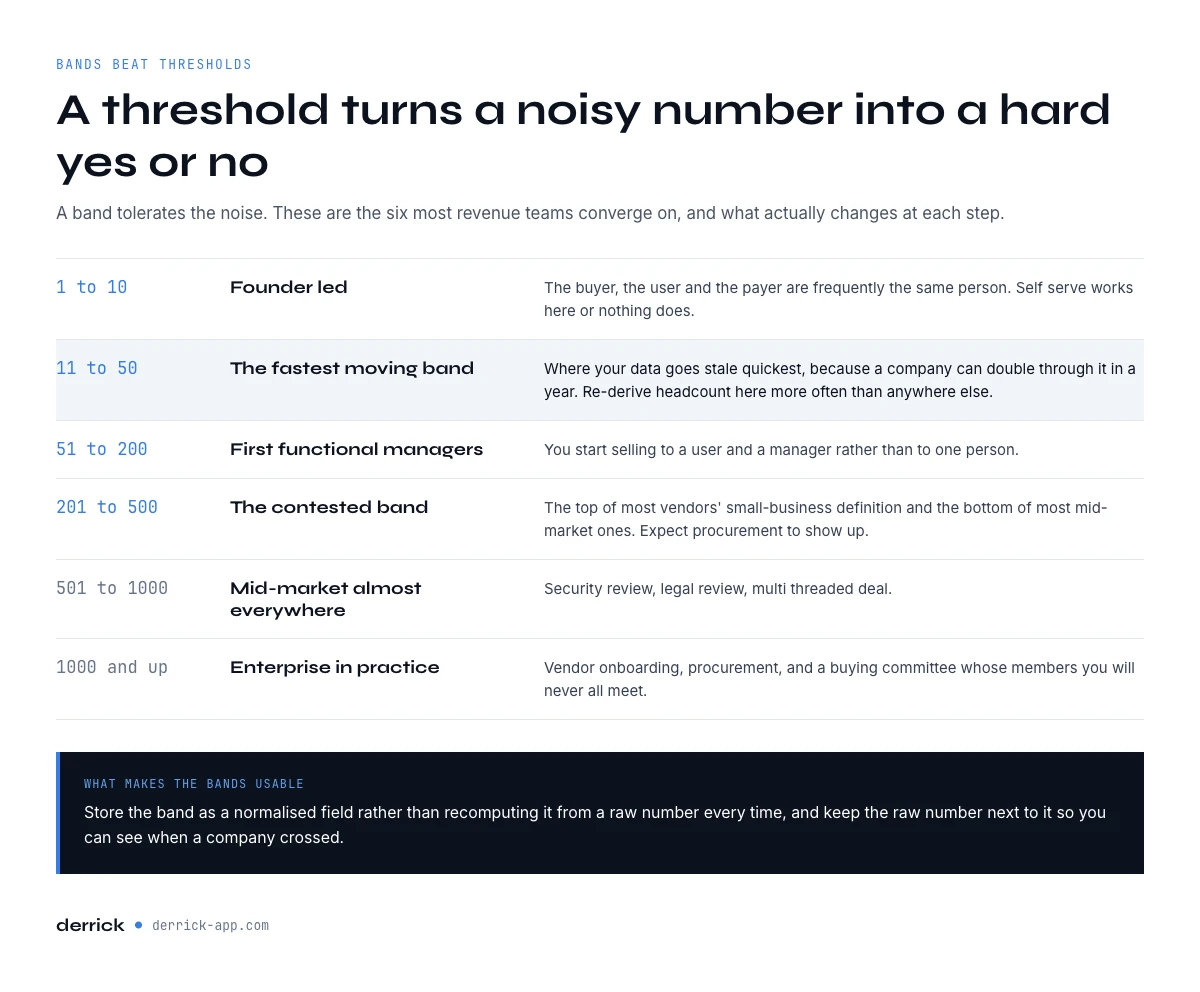
Headcount bands that actually segment
Bands beat thresholds, because a threshold turns a noisy number into a hard yes or no and a band tolerates the noise. Size sits alongside the other firmographic attributes in any serious targeting model. The set below is the one most revenue teams converge on.
- 1 to 10. Founder led. The buyer, the user and the payer are frequently the same person. Self serve works here or nothing does.
- 11 to 50. The fastest moving band, and the one where your data goes stale quickest, because a company can double through it in a year. Re-derive headcount here more often than anywhere else.
- 51 to 200. First functional managers appear. You start selling to a user and a manager rather than to one person.
- 201 to 500. The top of most vendors' SMB definition and the bottom of most mid-market ones. Expect procurement to show up.
- 501 to 1000. Mid-market in almost every framework. Security review, legal review, multi threaded deal.
- 1000 and above. Enterprise, in practice if not in any statute. Vendor onboarding, procurement, and a buying committee whose members you will never all meet.
Two rules make these bands usable. Store the band as a normalized field rather than recomputing it from a raw number in every report, and store the date the headcount was derived. A band without a date ages invisibly, which is the same failure mode as contact attributes that nobody timestamps.
What changes when you prospect an SMB
Size is a firmographic signal, not a demographic one, and the two answer different questions. The segmentation work only pays off if the outreach actually differs, and it should differ in three ways.
Start with the business on the other side. SMBs share a familiar set of challenges: financing is harder to get and more expensive than for large companies, resources are thin, so one person often covers several functions, and technology adoption is uneven, with modern tools sitting next to spreadsheets and a shared inbox. Cash is watched week by week. Each of these shapes how you should approach them as a seller: a short trial, a clear price, a product one person can set up alone, and a message that respects how little time the reader has. The three changes below follow from that.
The decision maker is named, not titled. At a large company you target a role, because whoever holds the VP of Operations job will own the problem. In a small company you target a person, usually the founder or a first functional hire, and the title on their profile may describe half of what they actually do. That makes the individual contact lookup more valuable than the org chart.
The direct line beats the switchboard. Smaller companies often have no switchboard at all, and the generic address is read by the same person you are trying to reach. That changes which channel is worth the credit.
Email patterns are less standardized. Large organizations enforce a format. Small ones accumulate exceptions, founders keep an address from before the rebrand, and the pattern you inferred from two employees fails on the third. Verification matters more here, not less, and it is billed per result on the paid plans rather than per attempt.
What an SMB deal is worth: read it off the sales cycle
Size is worth segmenting on because it predicts the shape of the deal, not just its value. Below roughly fifty employees you are usually talking to one or two people, there is no formal vendor review, and the cycle is measured in days or weeks. Above two hundred, a security questionnaire appears, a second stakeholder has to be convinced, and the cycle stretches into months.
That is why the interesting threshold for most teams is not the regulatory one. It is the headcount at which your own self serve motion stops closing on its own. Find it in your closed won data, name that as your SMB ceiling, and write it down next to the field contract. It will not match the SBA, the European Commission or INSEE, and that is fine, as long as the report says which definition it used.
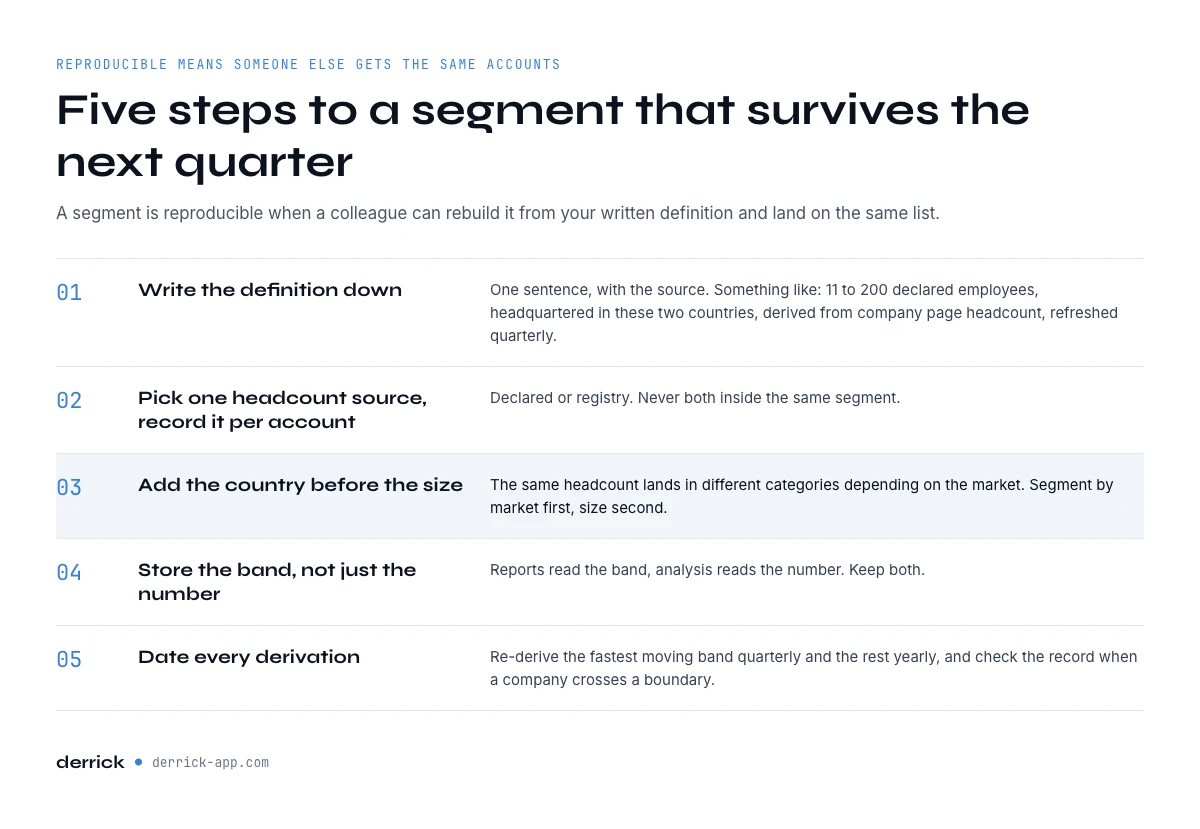
Build a reproducible SMB segment
A segment is reproducible when someone else can rebuild it from your written definition and get the same accounts. Five steps get you there.
- Write the definition down. One sentence, with the source: "SMB means 11 to 200 declared employees, headquartered in France or the United States, derived from company page headcount, refreshed quarterly."
- Pick one headcount source and record it per account. Declared or registry, never both in the same segment.
- Add the country before the size. A 150 person company is an SMB in the United States and, in France, a PME approaching the ETI boundary. Segment by market first, size second.
- Store the band, not just the number. Reports read the band, analysis reads the number.
- Date every derivation. Re-derive the 11 to 50 band quarterly and the rest yearly, and check against your financial attributes when a company crosses a boundary.
Where to run the segment: the web app, Sheets, an AI chat, or the API
The same segment can be built on four surfaces, and the right one depends on who rebuilds it and how often.
- The web app for the first build with nothing to install: import the companies from a prompt and the company columns fill next to them.
- Google Sheets for anything a human should eyeball in a spreadsheet. The sidebar fills the company columns next to your list, so you see the headcount that produced the band before you commit to it.
- An AI assistant over MCP when the question is exploratory: ask for companies matching a description, check what comes back, refine. Derrick MCP works with Claude, ChatGPT and any MCP compatible client. Check the plan page for the tier it starts on.
- The REST API when the band has to be recomputed automatically, for instance when a new account is created in the CRM or on a quarterly schedule, next to the technographic fields you refresh on the same pass.
Whichever surface you choose, the cost is countable in advance: company enrichment is 1 credit per company, and Find Similar Companies expands a seed account into a matched list at 1 credit per company. Derrick starts at 100 credits a month at no cost on the free plan, then 20 euro on Standard, 47.5 euro on Plus, 175 euro on Pro and 320 euro on Scale, where the unit price floors at 0.0016 euro per credit. It works the same on two hundred accounts and on two hundred thousand.
Frequently asked questions
What is an SMB in business?
What does SMB stand for, and is it the same as SME?
How many employees does an SMB have, and do SBA standards apply everywhere?
Is a 200 employee company an SMB or mid-market?
Which data field tells me a company is an SMB, headcount or revenue?
Why does LinkedIn show more employees than the company filed?
What is the difference between SMB and enterprise?
How do SMB software needs differ from enterprise?
Keep reading
Continue exploring this cluster


The State of B2B Data Attributes 2026: Which Fields Actually Move the Needle
Read →

The 20 Essential Contact Attributes to Nail Your B2B Prospecting
Read →

The 30 Essential Firmographic Attributes for B2B Targeting
Read →

B2B Demographic Data: Definition, Types & Complete Usage Guide
Read →