
LinkedIn Profile Data Decay Report 2026: How Fast B2B Profile Data Goes Stale
2026 report: how fast LinkedIn profile data goes stale field by field (title, company, seniority), why titles inflate, and the only reliable fix to use.


Last updated: 2026-06-18
The LinkedIn profile has quietly become the de facto source of truth for B2B data: job title, company, seniority, location, all read off the profile and trusted. But a profile is a moving target. Professionals change roles constantly, and the data describing them drifts field by field, so a profile that was accurate when you captured it is partly wrong months later. This report quantifies that drift, attribute by attribute, and shows why the only reliable defense is re-enriching the profile at the moment of use rather than trusting a captured snapshot.
The thesis is specific to the profile as a record: it does not decay uniformly, it decays by field. The title drifts as people get promoted or reframe their role, the company changes with every move, seniority inflates, and contact details break. Treating the profile as a stable source of truth is the mistake; treating it as a snapshot that needs refreshing is the fix.
The profile as a moving source of truth
B2B teams treat the LinkedIn profile as ground truth because, at the moment it is read, it usually is. The profile is self-maintained, public, and richer than most CRM records, which is exactly why it became the reference. The problem is that this ground truth is only true at the instant of capture, and most workflows capture it once and reuse it for months, by which point the ground has moved underneath.
The drivers are ordinary and constant. Industry research and labour statistics put median job tenure under four years and falling, and roughly 15 to 20 percent of professionals change roles in a given year, with LinkedIn's own Economic Graph and Workforce reporting tracking that mobility directly through profile updates. Every one of those moves changes at least the company and title, and often the seniority and contact details too.
So the practical reframe is to stop asking whether a profile is accurate and start asking how recently it was confirmed. A profile read today is a strong source of truth; the same profile data sitting in a list from last quarter is a weakening one. The field-level guides for company and title are in the find company guide and the job title guide.
There is a lag that makes this worse than the raw mobility number suggests. People do not update their profile the instant they change roles; there is a delay between the real-world move and the profile reflecting it. So at any given moment a profile base contains not just the people who have moved and updated, but a hidden layer of people who have moved and not yet updated, whose profile still shows the old role. The visible accuracy of a profile list therefore overstates its true accuracy, because the not-yet-updated movers look fine until you reach them.
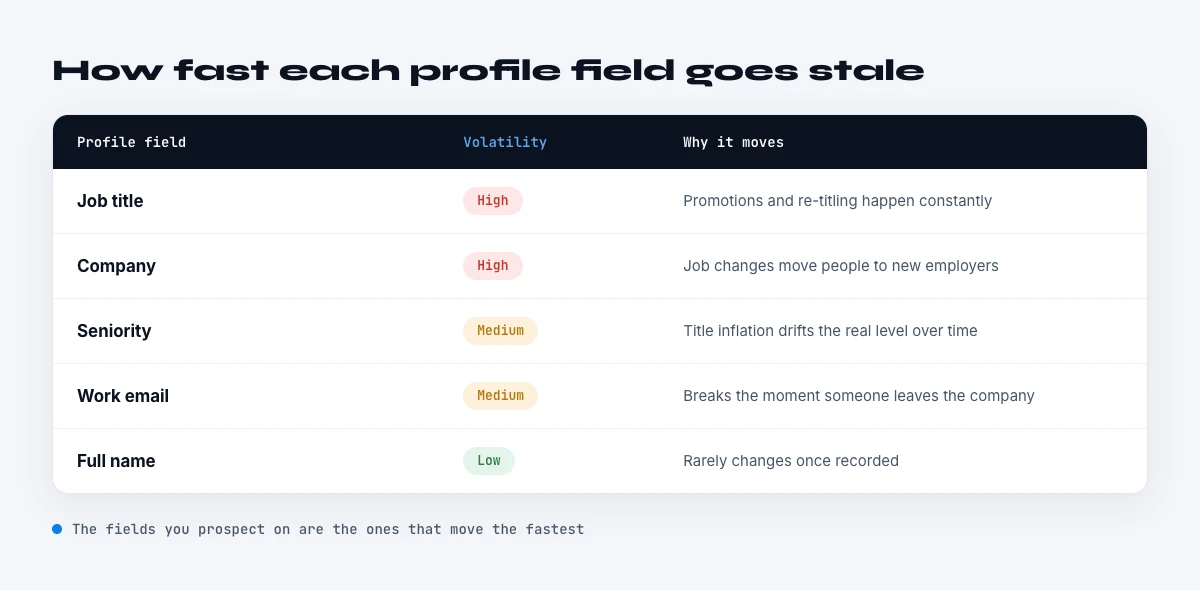
Decay by field
The key insight is that profile fields decay at very different rates. Company and job title are the most volatile, because a single job change invalidates both at once, and with 15 to 20 percent annual mobility a meaningful share of any profile list has the wrong company or title within a year. Contact details, the email and phone often attached to a profile record, follow the general B2B decay curve of roughly 2.1 percent per month, compounding to about 22 to 30 percent per year. Location is moderately stable; the name is essentially permanent.
This uneven decay matters because it breaks the assumption that a profile is either right or wrong. A profile can have a perfectly correct name and a completely wrong title and company at the same time, which means a record that looks plausible on the fields you glance at can be wrong on exactly the fields that drive targeting and personalization. Checking the stable fields tells you nothing about the volatile ones.
The implication is to prioritize re-verification by volatility. The fields you most rely on for B2B targeting, current company and title, are the ones decaying fastest, so they are the ones that need confirming at the moment of use rather than trusting from a capture. The headline field, which compresses role and positioning, is its own moving target, covered in the headline guide.
It also pays to separate the two ways a field can be wrong. A field can be stale, correct once and now outdated, or it can be distorted, never a clean fact in the first place. Company and contact details fail the first way; titles and seniority fail the second. The remedies differ: stale fields need refreshing, distorted fields need interpreting. Treating both as a simple correct-or-wrong flag misses that a current title can still be a bad seniority signal.
In the web app or Google Sheets
Be told about the change instead of measuring it
Profile data goes stale mostly through job changes. Signal watches the leads in your list and tells you when someone moves, which turns a decay rate into a dated event on a specific row.
- Feature
- Lead changed job on LinkedIn (live)
- Credit cost
- 1 credit
The first button opens the web app (nothing to install): 1 credit, available from the STANDARD plan. The second details the feature and its cost per plan.
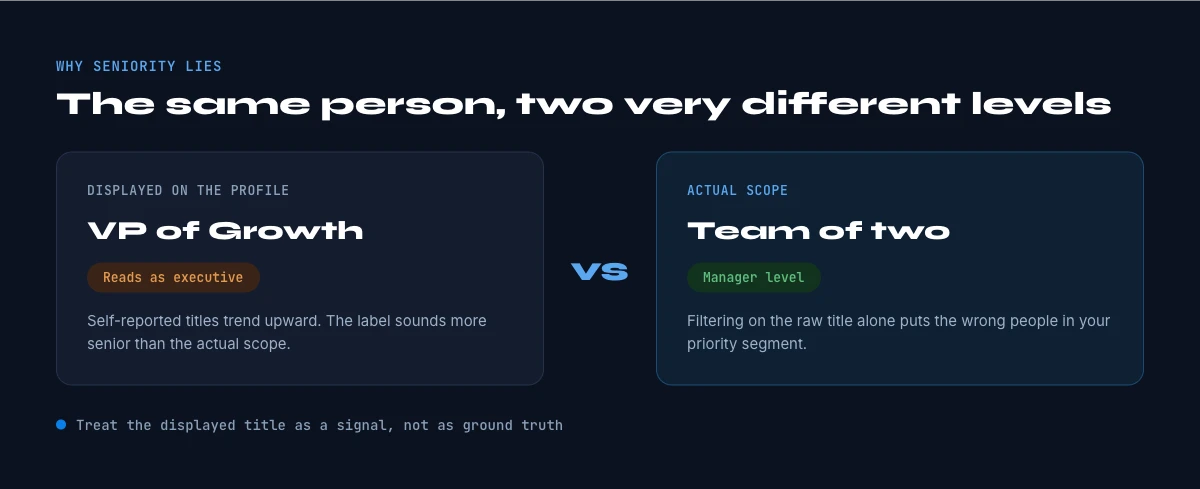
Title inflation: why seniority lies
Beyond decay, profile data carries a quieter distortion: title inflation. Job titles on LinkedIn are self-assigned and trend upward, with seniority labels applied generously and inconsistently across companies and regions. The same real responsibility can be a manager at one company and a head or director at another, so reading seniority off the raw title at face value systematically misjudges who actually holds decision power.
This is a quality problem distinct from freshness: even a perfectly current title can mislead about seniority. For B2B targeting that depends on reaching decision-makers, a list filtered on title strings alone will over-include inflated titles and under-include modest ones, mis-routing outreach in both directions. The title is real-time accurate and still an unreliable proxy for the thing you actually care about, which is authority.
The practical takeaway is to treat title and seniority as signals to be interpreted, not facts to be filtered on blindly. Combine the title with company size, function, and other context rather than trusting the label alone, and re-confirm it at the moment of use so you are at least interpreting a current title rather than an inflated and stale one. The skills field, another self-reported and noisy attribute, is covered in the skills guide.
Consider what this does to a saved search or a static segment. A list built on title and company filters at one moment will, a few months later, contain people who no longer match the filter at all, they moved, changed function, or had their title reframed, while genuinely matching people who updated their profile after the capture are missing entirely. The segment looks stable in your tool but describes a population that has partly dispersed, which is why re-running and re-enriching beats trusting a saved list.
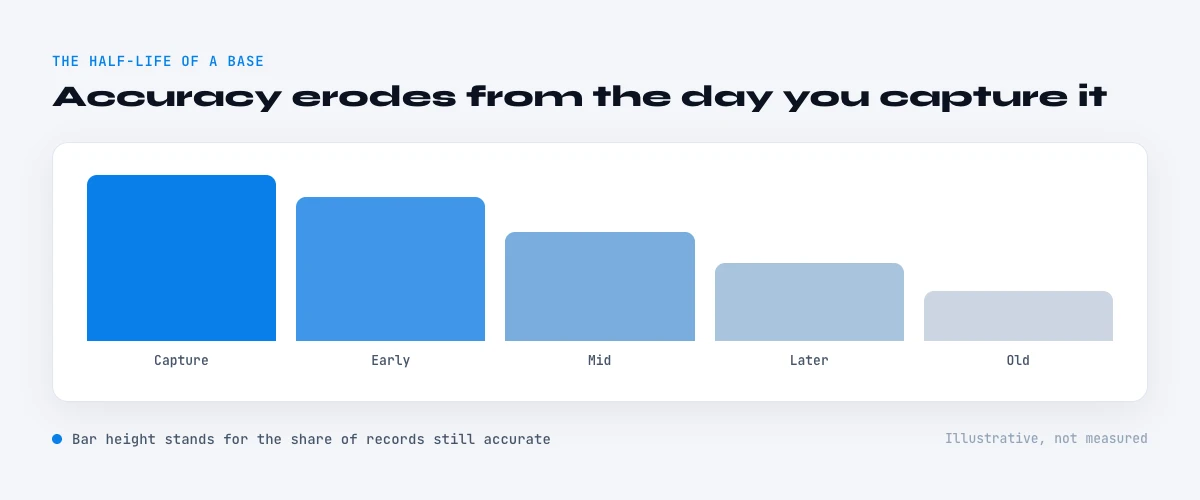
The half-life of a profile base
Put the decay rates together and a profile list has a measurable half-life. With company and title turning over at 15 to 20 percent a year and contact fields decaying around 2 percent a month, a base of profiles captured once and never refreshed is materially wrong within months and roughly a quarter to a third wrong within a year on its most useful fields. The list does not fail all at once; it degrades steadily and invisibly until a campaign hits the decayed portion.
The cost compounds the way any bad-data cost does. Gartner estimates poor data quality costs organizations an average of 12.9 million dollars per year, and a stale profile base is a direct contributor: outreach to people who changed roles, personalization built on an old title, segmentation that routes on a company someone left. None of it announces itself as a data problem; it shows up as a weak campaign or a soft quarter.
This is the same underlying decay our companion LinkedIn scraping report models from the export side; here the focus is the profile record itself as a source of truth. Either way the conclusion is identical: a one-time capture is a depreciating asset, and the only way to keep a profile base trustworthy is to refresh the volatile fields at the point of use.
The right mental model is a depreciation schedule, not a binary. On day zero a freshly captured profile field is at full value; by three months the volatile fields have lost a noticeable slice; by six months a meaningful fraction is wrong; by twelve months the company and title fields are roughly a quarter to a third unreliable. Knowing that schedule lets you decide, per use case, when a capture is still good enough and when it must be refreshed, instead of pretending the data is timeless.
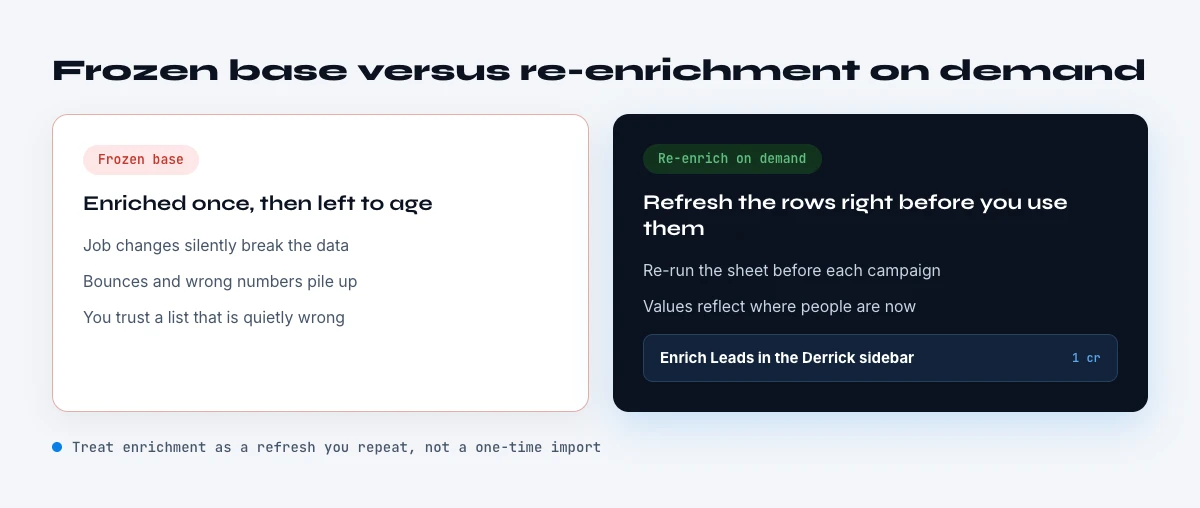
Frozen base versus re-enrichment on demand
That leaves a clear decision: maintain a frozen profile base and accept its decay, or re-enrich on demand at the moment you use a record. A frozen base is cheap to hold and expensive to act on, because you pay for the decay in bounced sends, mis-targeted outreach, and wrong personalization. Re-enrichment on demand inverts that: you confirm the volatile fields exactly when they matter, so the data is current at the only moment that counts.
This is where Derrick fits. Rather than relying on a captured profile that ages, Derrick re-enriches a LinkedIn profile on demand in the web app or in Google Sheets, refreshing the current company and title, finding and verifying the email and phone, and pulling profile and follower data, at the moment of use. The captured snapshot becomes a live record, which mechanically answers the field-by-field decay this report documents, without ever pretending the underlying profile data is anything other than a moving target.
Re-enrich your LinkedIn profile data on demand with Derrick, free for 100 credits per month, in the web app or in Google Sheets. Start with the fields that decay fastest, company and title, then verify contact details before each use. The starting point for any of this is a valid profile URL, covered in the valid LinkedIn URL guide.
The economics of re-enrichment are favorable precisely because the volatile fields are few. You do not need to refresh forty attributes; you need to confirm the two or three that decide whether outreach lands, current company, current title, working contact details. Refreshing that short list at the moment of use costs little per record and removes most of the decay risk, which is a far better trade than periodically re-buying or re-scraping an entire base to fix a handful of fields.
None of this is an argument against using LinkedIn profile data, it is the richest B2B source there is. It is an argument against using it as if it were frozen. Read it live, refresh the volatile fields when you act, and the same data that quietly decays in a static list stays an asset.
Methodology and sources
This report draws on non-vendor, primary sources: Gartner for the cost of poor data quality; LinkedIn's Economic Graph and Workforce reporting for professional mobility and how job changes are tracked through profile updates; US labour statistics for median job tenure; and McKinsey for context on B2B buying and sales productivity. Per-field decay rates are presented as a market consensus and recalculated for illustration rather than attributed to any data vendor; where a statistic could only be traced to an enrichment vendor's marketing, we did not use it.
A closing thought. The LinkedIn profile earned its status as the B2B source of truth honestly: at the moment it is read, it is usually right. The mistake is treating that momentary truth as durable. Profiles drift by field, titles inflate, and a captured list depreciates from the day you build it. Read the profile as a snapshot, prioritize the volatile fields, interpret seniority rather than filtering on it, and refresh at the point of use. Do that and the profile stays the excellent source of truth it is, instead of quietly becoming a list of who people used to be. The discipline is small and the payoff compounds: a base you refresh on use never silently rots, and the rep acting on it is always talking to who the prospect is today, not who they were when the list was built.
Frequently asked questions
How fast does LinkedIn profile data go stale?
Why not trust the LinkedIn title for seniority?
Which profile fields should I re-verify first?
How much does a stale profile base cost?
How does Derrick help against profile decay?
Keep reading
Continue exploring this cluster


How to Find Someone's Current Company from a LinkedIn Profile (2026)
Read →

How to Extract Job Title from a LinkedIn Profile URL (2026)
Read →

LinkedIn Headline 2026: Character Limit + Examples That Work
Read →

How to Find Someone's LinkedIn Skills: Complete Guide 2026
Read →