B2B data glossary Definition

What Is a Sales Quota? Definition, Types and How to Set One

A sales quota is the revenue, deal count, activity or margin a rep or team must reach in a set period, and it drives their variable pay. Managers set a sales quota top-down from the company goal, bottom-up from what each territory can produce, or both, and track it as quota attainment: closed results divided by quota.

Updated
Try the app free
or use it in
Google Sheets
Claude
API
4.6 / 5 on Google Workspace Marketplace4.5 / 5 on G2254 upvotes on Product Hunt
Part 1 / 7

Definition

Definition: Sales Quota

A sales quota is the minimum revenue, number of deals or activity a sales rep or team must deliver in a set period (month, quarter or year), and it sets how much variable pay they earn. Quota is the line between a rep who is on plan and a rep who is behind it.

Sales managers set a quota by splitting the company revenue goal across the people who carry it (top-down), by measuring what each territory can realistically produce (bottom-up), or by reconciling both. The quota then drives three things at once: the forecast, the compensation plan and the territory design. Progress against it is tracked as quota attainment, the share of the quota a rep actually closed in the period.

Outside sales, the word quota simply means a fixed share or limit, such as an import quota or a storage quota. In a sales organization it always means a number someone is accountable for, with a deadline and money attached to it. That is why a sales quota is set per rep, reviewed every period and written into the comp plan, while broader company goals and team targets sit above it.

Part 2 / 7

How it works

How Sales Quota works

Every sales quota has four parts: a metric (revenue, deals, activities or margin), an owner (one rep, a pod or a whole team), a period (month, quarter or year) and a consequence (the variable pay attached to it). Change any of the four and you have a different quota, even if the number looks the same.

Sales quota vs sales target vs sales goal

The three words get used as synonyms in meetings. They mean different things, and mixing them up is how reps end up chasing a number nobody will pay them for.

  • Who owns it. A sales quota belongs to a named rep or team. A sales target usually belongs to a team, a region or a product line. A sales goal belongs to the company or to sales leadership.
  • Link to pay. The quota is wired into the compensation plan: hit it and you earn your on-target pay. A sales target can carry a bonus or a contest, but rarely the core commission. A goal is not paid at all.
  • Cadence. Quotas reset on a fixed schedule written in the comp plan, usually monthly or quarterly. Targets move with campaigns and launches. Goals are set once a year and reviewed at board level.
  • Visibility. A quota is shared between the rep and their manager and checked in every pipeline review. A target is shared with the team. A goal is the headline number everyone hears at the sales kickoff.
  • Consequence of a miss. Missing quota hits the rep's pay and, over several periods, their job. Missing a target means a campaign underperformed. Missing a goal means the company revises its plan or its budget.

An example makes the difference concrete. A company sets a sales goal of $12M in new revenue for the year. Sales leadership turns it into a sales target of $3M per quarter for the North America team. Each of the 8 account executives on that team then carries a sales quota of $375,000 per quarter, and their commission is calculated against that number, not against the $12M.

The 6 types of sales quotas

Most comp plans use one of six types, or a mix of two. The right one depends on what the rep actually controls.

1. Revenue quota. A dollar amount of closed revenue (bookings, new ARR or invoiced sales) in the period. When to use it: for account executives who own the deal from first call to signature. It is the most common type because it maps straight to the company goal. Example: $375,000 in new ARR per quarter.

2. Volume quota. A number of units or deals, whatever their size. When to use it: when deal sizes are fairly uniform (a fixed-price product, small seat-based packages) or when the company pushes a new product and cares more about adoption than revenue. Example: 25 new customers per quarter.

3. Activity quota. A count of the actions that create pipeline: calls, emails, meetings booked, demos held. When to use it: for SDRs and new reps whose job is to open doors rather than close them. Example: 12 qualified meetings held per month. Tie it to an outcome (meetings held, not calls dialled), or it rewards noise.

4. Profit quota. A gross margin amount instead of top-line revenue. When to use it: when reps can discount, bundle services or negotiate price, and the company wants to stop them buying deals with margin. Example: $120,000 of gross profit per quarter.

5. Combination quota. Two or three metrics with weights, for example 70% revenue and 30% new logos. When to use it: when one metric alone would push the wrong behaviour, such as a rep who only upsells existing accounts and never opens a new one. Keep it to two or three components, or nobody can work out where they stand.

6. Forecast quota. A number derived from historical results, seasonality and market conditions rather than from the top-down goal. When to use it: for mature territories with several years of history, or to sanity-check a top-down number before it reaches the reps.

How to calculate a sales quota

There are two honest ways to get to the number, and good sales ops teams run both.

Top-down formula. Start from the revenue the company needs and divide it by the selling capacity you have.

Quota per rep = team revenue goal ÷ number of fully ramped reps

A rep who is still ramping counts as a fraction. If the team goal is $3M for the quarter, with 7 fully ramped reps and 2 new hires at 50% capacity, the team has 8 ramped equivalents. Each ramped rep carries $375,000 and each new hire carries $187,500. Many teams also assign a little more than the goal in total, a buffer that absorbs the reps who will miss.

Bottom-up formula. Start from what the territory can actually produce.

Territory capacity = addressable accounts × expected win rate on those accounts in the period × average deal size

Take a rep whose territory holds 600 companies that fit your ideal customer profile. If the team historically turns 2% of a territory's accounts into customers each quarter and the average deal is $30,000, the territory supports about 600 × 2% × $30,000 = $360,000 per quarter. Compare that with the top-down share. If the top-down quota is $375,000, the gap is small and the quota is fair. If a second rep carries the same $375,000 on a territory of 250 accounts, capacity is about $150,000, and no amount of effort will close that gap.

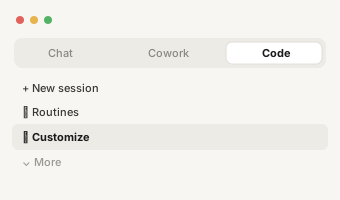
The weak point of the bottom-up method is the first number: most teams estimate the count of addressable accounts instead of counting them. This is where Derrick fits. In the Derrick web app you describe the segment (industry, headcount, country), import the matching companies from a prompt, then enrich each company with headcount and industry, so the capacity math starts from a real list. Derrick does not set the quota. It gives you the account count and the firmographics behind it.

Top-down, bottom-up or hybrid

  • Top-down is fast and guarantees that the quotas add up to the plan. Its limit: it ignores the territory, so two reps with very different markets get the same number.
  • Bottom-up respects what each market can produce and makes quotas easier to defend in front of the reps. Its limit: the sum rarely matches the company goal, and it is only as good as the account count and the win-rate history.
  • Hybrid runs both, then reconciles. Where bottom-up capacity is far below the top-down share, you fix the territory (add accounts, split a region) or lower that quota. Where capacity is far above it, you have room to raise the number or add a rep. Most teams that set quotas well end up here.

How to set a sales quota in 5 steps (quota planning)

  1. Read the history. Pull at least four quarters of closed results per rep and per territory, with win rates and average deal size. Note the seasonality, such as a December spike or a summer dip.
  2. Measure the territory. Count the addressable accounts in each territory and the open pipeline on them, then run the bottom-up formula. If territories are uneven, fix the split first. Sales territory planning comes before the quota, not after it.
  3. Apply ramp and experience. New hires get a ramp quota, for example 25%, 50%, 75% and then 100% of full quota over their first four months. A rep moving into a new segment can get a short ramp too.
  4. Write the adjustment rules. Decide in advance what triggers a mid-period change: a territory reassignment, a long leave, a lost key account, a price change. Written rules stop quota changes from feeling arbitrary.
  5. Validate with the team. Share the method and the numbers with managers and reps before the period starts. A quota that most of the team can reach with good work keeps people engaged. A quota only one or two reps can hit pushes the others to give up by mid-quarter.

To check whether the pipeline can carry the number, run a rep's figures through the sales velocity calculator. Opportunities, win rate, deal size and cycle length give you the revenue a rep produces per day, which you can compare with the daily pace the quota requires.


Part 3 / 7

Examples

Real-world examples

The four sales quota examples below use realistic numbers for a B2B team. They are illustrations, not benchmarks.

1. A SaaS account executive with a ramp

A SaaS company hires an account executive with a full quota of $600,000 in new ARR per year, which is $150,000 per quarter or $50,000 per month. Her ramp is 25% of the monthly quota in month 1, 50% in month 2 and 75% in month 3. Her first-quarter quota is therefore $12,500 + $25,000 + $37,500 = $75,000. She closes $82,000, so her quota attainment for the quarter is 109%, even though she sold far less than a ramped rep. Measured against the full $150,000, she would have shown 55% and looked like a hire to worry about.

2. An SDR activity quota tied to meetings

An SDR team used to carry a quota of 60 calls a day. Calls went up, meetings did not. The team switched to an activity quota on an outcome: 12 qualified meetings held per month, where "held" means the prospect showed up and the account executive accepted the meeting. An SDR who books 15 meetings, 11 of which are held, reaches 92% attainment. The quota now pays for the work that feeds pipeline, not for the dialling.

3. A combination quota with weights

A mid-market team wants growth from new logos, not only from upsells. Each rep carries a combination quota: 70% weight on revenue ($300,000 per quarter) and 30% weight on new customers (6 per quarter). A rep who closes $270,000 and signs 8 new customers scores (270,000 ÷ 300,000 × 70%) + (8 ÷ 6 × 30%) = 63% + 40% = 103%. Most plans cap each component, for example at 150%, so one metric cannot carry the whole score on its own.

4. A bottom-up quota built from a territory of 2,000 companies

A RevOps manager has to set quarterly quotas for four reps who sell to software companies with 50 to 200 employees, one rep each in Texas, Florida, Georgia and North Carolina. The plan gives the team $1M of new revenue to bring in each quarter. Instead of guessing what each state can produce, she builds the account list. In the Derrick web app she imports the companies that match that description, about 2,000 of them, then enriches each one to get its headcount and industry. The list is not exhaustive, but it is a count she can check rather than a guess.

The cost, object by object. 2,000 companies imported from a prompt, at 1 credit per company with LinkedIn connected: 2,000 credits (it is 10 credits per company without LinkedIn connected, so 20,000). 2,000 companies enriched, at 1 credit per company: 2,000 credits. Total: 4,000 credits, which fits in the Standard plan (20 EUR per month, 10,000 credits), with room left for a second pass that month. The free plan (100 credits per month, no credit card) covers 50 companies imported and enriched, enough to test the method on one segment first.

The count changes the conversation. Texas holds 820 accounts, Florida 540, North Carolina 330 and Georgia 310. With a 2% quarterly win rate and a $25,000 average deal, quarterly capacity is about $410,000, $270,000, $165,000 and $155,000, which adds up to the $1M target. An even split would have given each rep $250,000: the Texas rep would have coasted, and the reps in Georgia and North Carolina would have missed by design. She rebalances the territories, or sets quotas in line with capacity, before any number goes out.

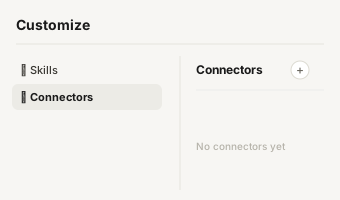
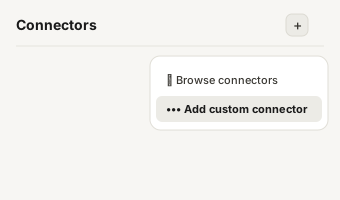
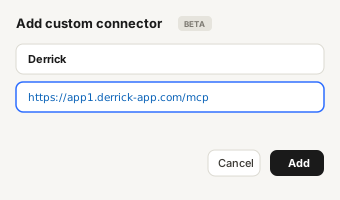
The same work runs on other surfaces if that suits the team better. In the Google Sheets sidebar you can filter and count the territory list by headcount or state. In Claude, through the Derrick MCP server, a RevOps lead can ask an exploratory question such as "how many software companies with 50 to 200 employees are there in Texas?". Through the REST API, the territory accounts can be refreshed every quarter inside the planning workflow. API and MCP access start on the Plus plan (47.5 EUR per month).

Part 4 / 7

Why it matters

Why Sales Quota matters in 2026

Quota attainment: how to measure it

Quota attainment = actual results ÷ quota × 100. A rep with a $500,000 quota who closes $400,000 is at 80% quota attainment. Track it per rep and per period, and look at how it is distributed across the team, not just at the average.

The shape of that distribution tells you where the problem is. If attainment is spread very wide (a few reps at 150%, many at 40%), the quotas or the territories are probably uneven, not the reps. If one rep swings from 140% to 50% and back to 120%, look at deal timing and territory before talking about performance. If almost nobody reaches 100%, the quota is set above what the market can give. Check pipeline coverage early in the period too: a rep who starts the quarter with too little open pipeline against quota will miss whatever the effort.

Quotas drive forecast and capacity planning

Quotas are the input of the sales forecast and of headcount plans. If the plan needs $12M and a ramped rep realistically produces $1.5M a year (an illustrative figure), finance knows it needs eight ramped reps, and when to hire given the ramp. Quotas also force territory design: if quotas are realistic and a territory still cannot support one, the territory is the problem. That is why the account count of each territory, read against your total addressable market, belongs in the quota conversation.

Quotas and compensation

The sales quota anchors the comp plan. On-target earnings (OTE) are what a rep earns at 100% of quota: base salary plus variable pay. Above 100%, accelerators raise the commission rate (for example 1.5x on every dollar past quota), which rewards the reps who overperform. Some plans cap earnings, and most sales leaders avoid caps because they tell top reps to stop selling once they reach the ceiling. Quota relief covers what the rep does not control, such as a territory change or a long leave: the quota is reduced pro rata, so nobody is penalised for a decision made above them.

To go further on the numbers behind a sales team, see which sales pipeline metrics to track and how to split accounts with B2B customer segmentation. One email every 2 weeks on go-to-market and sales data tactics: subscribe to the Fill Down newsletter.

Part 5 / 7

Tools

Sales Quota & Derrick: tools to operationalize

Pipeline, forecast, territory, ICP refresh: Derrick keeps the account and contact data behind them fresh. Work in the web app, or run the same enrichment from Google Sheets, Claude (MCP) or the API.

Compare sales tools →
Part 6 / 7

Common mistakes

Common mistakes

  • Splitting the goal evenly. Dividing the company number by headcount ignores territory size and account quality. Two reps with the same sales quota and very different markets will post very different results, and those results will say nothing about their skill.
  • Ignoring ramp. A new hire on full quota from day one misses for three months, loses confidence and often leaves before the pipeline they built has closed.
  • Setting a quota without counting the accounts in the territory. Estimating the addressable market instead of listing it is how unfair quotas happen. Count the companies that match your profile in each territory before you fix the number.
  • Changing the quota mid-period without a written rule. Raising a number because a rep is ahead, or cutting it because the team is behind, destroys trust in the plan. Write the triggers down before the period starts.
  • Using an activity quota disconnected from results. Paying for calls dialled or emails sent rewards volume. Tie activity quotas to an outcome such as meetings held.
  • Capping earnings. A cap tells your best reps to push deals into the next period once they hit it. Use accelerators and, if you must, a review threshold for very large windfall deals.
  • Leaving an annual quota in one block. A yearly number with no quarterly or monthly milestones hides problems until it is too late to fix them. Break it down and review attainment at each milestone.

Why teams choose Derrick.

Powerful features that save time and boost your sales pipeline.

ENRICHMENT

100+ data points on companies & leads.

AI POWERED

Built-in AI, no separate subscription.

FOUR SURFACES

The web app, Google Sheets, your AI assistant, or the API.

BEST VALUE

Same quality data, for a fraction of the cost.

From a search to a campaign, in one place

The four steps Derrick covers in the web app, and the features behind each one.

Any questions?

Stop copying data around. Start enriching.

What is a sales quota?

+
A sales quota is the minimum revenue, number of deals, activity or margin a sales rep or team must deliver in a set period, usually a month, a quarter or a year. It is tied to variable pay: reaching 100% of quota pays the rep's on-target earnings.

What is the difference between a sales quota and a sales target?

+
A sales quota belongs to a named rep or team and is tied to their commission. A sales target is usually a team or regional number that can carry a bonus but is not the core of the comp plan. A sales goal is the company-level number that quotas and targets are built from.

How do you calculate a sales quota?

+
Top-down, divide the team revenue goal by the number of fully ramped reps, counting new hires as a fraction. Bottom-up, multiply the addressable accounts in the territory by the expected win rate and the average deal size. Good teams run both and reconcile the gap.

What is quota attainment?

+
Quota attainment is the share of the quota a rep actually delivered: actual results divided by quota, times 100. A rep with a $500,000 quota who closes $400,000 is at 80%. Read it across the whole team, because a very wide spread usually points to uneven quotas or territories.

What are the main types of sales quotas?

+
The six common types are revenue quotas, volume quotas (units or deals), activity quotas (meetings, calls, demos), profit quotas (margin), combination quotas (a weighted mix of two or three metrics) and forecast quotas (based on history and market conditions).

What happens if a sales rep misses quota?

+
In the short term the rep earns less variable pay, because commission is calculated against quota. Repeated misses usually lead to a performance plan. Before blaming the rep, check the quota itself: territory capacity, ramp and pipeline coverage explain many misses.

How often should sales quotas be reset?

+
Most teams set an annual quota broken into quarterly quotas, and some use monthly quotas for high-velocity sales. Reset on the schedule written in the comp plan, and change a quota mid-period only for triggers defined in advance.

What data do you need to set a realistic sales quota?

+
At least four quarters of results per rep (closed revenue, win rate, average deal size, cycle length), the open pipeline, and the number of addressable accounts in each territory. Derrick builds that account list in its web app by importing and enriching the companies that match your segment.
Start enriching LinkedIn profiles today

Open the Derrick web app, import a LinkedIn search or your own list, nothing to install. The free plan gives you 100 credits every month, no credit card.

Try the app free
or use it in
Google Sheets
Claude
API
100 credits free every month
1 credit per LinkedIn profile imported
5 credits per email found (paid plans)