



B2B data glossary Definition

What Is Consultative Selling? Definition, 7 Steps and Examples

Consultative selling is a sales approach where the rep acts as an advisor, not a presenter. The rep prepares the account, asks open questions, diagnoses the buyer's real problem with them and recommends only what solves it, even when that means a smaller deal. Trust and the quality of the diagnosis win the sale, not the pitch.

Updated
Try the app free
or use it in
Google Sheets
Claude
API
4.6 / 5 on Google Workspace Marketplace4.5 / 5 on G2254 upvotes on Product Hunt
Part 1 / 7

Definition

Definition: Consultative Selling

What is consultative selling?

Consultative selling is a sales method in which the seller behaves like an advisor rather than a presenter. The rep studies the account, asks open questions, diagnoses the problem together with the buyer and recommends a fix that fits, including a smaller deal when that is the honest answer.

Consultative Selling: Consultative selling is a sales approach that focuses on understanding the customer's needs and providing tailored solutions through dialogue and collaboration. Consultative selling is essential in digital marketing and sales automation because it emphasizes building relationships and trust with customers by genuinely understanding their challenges and goals. In contrast to traditional sales methods, consultative selling involves actively listening to customers, asking insightful questions, and delivering personalized recommendations that align with the customer's objectives. This approach is particularly effective in complex sales environments where products or services require customization or where decision-making involves multiple stakeholders. By leveraging data insights and customer interactions through sales automation tools, sales professionals can enhance their consultative approach, ensuring that recommendations are data-driven and aligned with customer needs. Ultimately, consultative selling not only increases customer satisfaction and loyalty but also drives more effective and meaningful sales engagements, leading to better business outcomes.

Consultative vs product vs solution selling

The three approaches get mixed up in sales meetings. What separates them is where the conversation starts and who does most of the talking.

  • Product selling starts from the catalog. The rep presents features, compares specs and negotiates price. It works when the buyer already knows what they need and is choosing between options.
  • Solution selling starts from a pain the buyer has already named. The rep maps that pain to a package of products and services and builds the business case around it. It works when the problem is clear but the fix is not.
  • Consultative selling starts from the buyer's situation, before anyone agrees there is a problem. The rep asks, listens and diagnoses, and sometimes finds that the real issue is not the one the buyer called about.

Side by side, criterion by criterion:

  • Starting point. Product: the catalog. Solution: a stated pain. Consultative: the buyer's situation.
  • Who talks most. Product: the seller. Solution: shared. Consultative: the buyer.
  • Typical question. Product: "Which option do you want?" Solution: "How do we fix this pain?" Consultative: "What is actually going on?"
  • Best fit. Product: simple, low-price purchases. Solution: known problems with several possible fixes. Consultative: complex deals with several stakeholders.
  • Main risk. Product: competing on price alone. Solution: fixing the wrong problem well. Consultative: a long cycle on a buyer who was never qualified.

Many teams blend the three over a single deal. The consultative part sits at the front, in discovery, and shapes everything after it. When a lead comes in already convinced, the rep can move faster to the recommendation: the playbook for that case is in our guide to inbound sales. Consultative sales simply start one step earlier than the other two.


Part 2 / 7

How it works

How Consultative Selling works

The consultative method follows the same broad arc as any B2B sale. The difference is that every step is built around the buyer's problem instead of the product demo. Here is the process most teams run. For the generic version of these stages, see our breakdown of the steps of a sales process.

The consultative selling process in 7 steps

  1. Prepare the account before the call. Spend 15 to 20 minutes on the company before you speak to anyone. Four things are worth checking. Size: headcount and how it moved over the last year, because a team that doubled has different problems from a team that froze hiring. Stack: the tools they already run, visible on their website, in their job posts and on their integrations page, so you know what you would replace or plug into. Hiring: open roles show where the money goes right now. Five sales openings mean a growth push. A first sales operations hire means the process is breaking. News: a funding round, a new executive, an acquisition, a product launch, a new office. Then write down two or three hypotheses about what might hurt. You will test them on the call. You will not pitch them.
  2. Open the conversation. Say why you are calling, how long it will take and what the buyer gets out of it. Share one observation from your research and ask whether it matches their reality. A good opening earns the right to ask questions. A weak one puts the buyer on the defensive.
  3. Discover. This is the core of the method. Ask open questions about goals, the current process, what has already been tried and who is involved. Listen actively: rephrase what you heard, ask "what do you mean by that?", leave silences. A structured needs assessment keeps you from skipping whole areas.
  4. Diagnose the problem. Connect what you heard into a cause. Say it back in the buyer's words and check you got it right: "So the issue isn't lead volume, it's that your reps spend two days a week cleaning lists. Is that fair?" Put a cost on it together if you can. A diagnosis the buyer agrees with is worth more than any slide.
  5. Recommend. Propose the fix that matches the diagnosis, and only that. Explain why each part is there and what you left out. If your product is not the right answer, say so. The deal you walk away from buys trust for the next one.
  6. Handle objections. Treat an objection as more discovery, not as a fight. Find out what sits behind it (budget, timing, risk, a stakeholder who isn't convinced) before you answer.
  7. Close and follow up. Agree on a concrete next step with a date. Send a short written recap of the diagnosis and the recommendation. Check in after the start to see whether the problem is actually solved. Consultative sales don't end at the signature: renewals and referrals come from the follow-up.

Some teams run step 3 with a question framework such as SPIN selling (situation, problem, implication, need-payoff). It fits inside the consultative process well. SPIN gives you the order of the questions. The consultative approach gives you the posture.

Questions to ask in a consultative sale

Good consultative questions are open, specific and about the buyer, never about your product. Here are 10 of them, grouped by step.

  • Opening. "What made this a priority now, and not six months ago?"
  • Opening. "What would you need from this call for it to be worth your time?"
  • Discovery. "Walk me through how this works today, from start to finish."
  • Discovery. "What have you already tried, and what happened?"
  • Discovery. "Who else feels this problem, and how does it show up for them?"
  • Diagnosis. "If nothing changes over the next year, what does it cost you?"
  • Diagnosis. "Which part of this hurts your team the most, day to day?"
  • Recommendation. "How will you judge, three months from now, whether a fix is working?"
  • Objections. "What would make you hesitate to move forward?"
  • Close. "Who else needs to be part of the decision, and what will they ask?"

Ask less than you prepared. Two follow-ups on an answer that surprised you beat racing through a list. Write down the buyer's exact words. You will reuse them in the diagnosis and in the proposal, and buyers notice when their own phrasing comes back to them.

Principles and skills of a consultative seller

  • Curiosity before the pitch. The seller wants to understand the business before proposing anything.
  • Active listening. Listening to understand, not to reply. Rephrasing, taking notes, asking for an example when an answer stays vague.
  • Preparation. Knowing the account well enough that the buyer doesn't have to explain the basics.
  • Business sense. Knowing how the buyer makes money, which numbers they are judged on and what their manager expects from them this quarter.
  • Honesty about fit. Saying when the product is not the answer, and saying what it doesn't do.
  • Patience. Accepting a slower first cycle in exchange for a bigger and steadier relationship.
Part 3 / 7

Examples

Real-world examples

The examples below are illustrations. The people and companies are fictional and no figure is a benchmark.

1. A discovery call, line by line

Sam sells a planning tool to mid-sized logistics companies. Before his call with Priya, operations director at a regional freight company, he checks the account: a few hundred employees, three dispatcher roles open, a new warehouse announced last quarter. His hypothesis: dispatch is stretched by growth.

Sam: Thanks for the time. I saw you opened a new warehouse and you're hiring dispatchers. Is dispatch where things feel tight right now?

Priya: Partly. Hiring is slow. But honestly the bigger issue is the planning itself.

Sam: What do you mean by the planning itself?

Priya: Every morning two people rebuild the schedule in spreadsheets, because orders change overnight. It takes them until ten.

Sam: So some trucks wait until the plan is done?

Priya: Some, yes. And customers call to ask where their delivery is.

Sam: When the second warehouse is running, what happens to that morning?

Priya: We'd need two more planners. Which is why I'm hiring, I suppose.

Sam: Let me check I've got it. The hiring is a symptom. The real problem is that the plan gets rebuilt by hand every morning, and that work grows with every new site. Is that right?

Priya: Yes. That's it.

Sam never showed his product. He tested his hypothesis, found it was only half right, and reached a diagnosis Priya confirmed in her own words. In the follow-up meeting he recommends the planning module only, not the full suite, because that is what the diagnosis supports.

2. Turning an objection into more discovery

A week later, Priya's finance lead says the price is too high. Sam doesn't discount. He asks what the price is being compared with. The answer: the salary of one planner. Sam rebuilds the comparison with the two extra planners Priya said the second warehouse would need, and the objection becomes a question of timing. More on this pattern in our guide to handling sales objections.

3. The same method in a software sale

A sales rep at a marketing automation vendor gets a meeting with a prospect. Instead of opening with features, the rep runs a discovery call on the prospect's marketing challenges, conversion rates and growth goals, then on the sales funnel, the team and what frustrates them in their current tools. The demo that follows shows only the automation features that fix the workflow bottlenecks and reporting gaps the prospect named. Case studies from similar companies and a return-on-investment estimate built with the client complete the picture. The outcome is a solution matched to the client's needs instead of a generic pitch, and a smoother rollout.

Part 4 / 7

Why it matters

Why Consultative Selling matters in 2026

Buyers now reach the first call with most of their research done. They have read the pricing page, compared vendors and asked an AI assistant for a shortlist. A rep who repeats the website adds nothing. A rep who helps them understand their own problem is worth the meeting. That is the whole case for the method in 2026.

Benefits of consultative selling

  • Better odds on complex deals. When several stakeholders are involved, a shared diagnosis gives them something to agree on before they argue about price.
  • Bigger, better-fitted deals. Discovery surfaces needs the buyer had not mentioned, and the recommendation covers them on purpose rather than through a late upsell.
  • Less discounting. The price gets compared with the cost of the problem, not with another vendor's quote.
  • Stronger retention. Customers who bought a fix for a diagnosed problem know why they bought. They adopt it and renew.
  • Trust and referrals. A seller who once said "this isn't for you" gets the next call, and often an introduction to a peer.
  • Cleaner forecasts. A deal with a confirmed diagnosis and a dated next step is easier to qualify than a deal built on a good demo.

When the consultative approach is the wrong fit

It costs time. For a low-price, self-serve product, or a buyer who already knows exactly what they want, a long discovery slows everything down and annoys the buyer. Match the depth of discovery to the size and complexity of the deal. For the other approaches and when to pick each one, see our overview of sales techniques.

One email every 2 weeks on go-to-market and sales tactics: subscribe to the Fill Down newsletter.

Part 5 / 7

Tools

Consultative Selling & Derrick: tools to operationalize

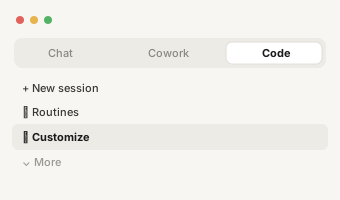
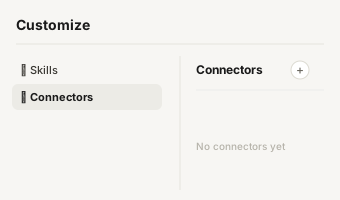
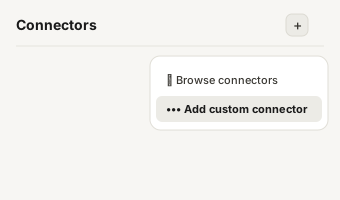
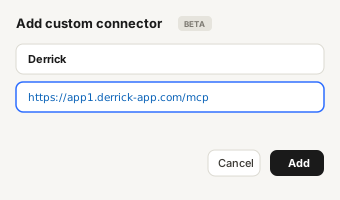
Pipeline, forecast, territory, ICP refresh: Derrick keeps the account and contact data behind them fresh. Work in the web app, or run the same enrichment from Google Sheets, Claude (MCP) or the API.

Compare sales tools →
Part 6 / 7

Common mistakes

Common mistakes

  • Calling a demo a discovery call. If you present for 40 minutes of a 45-minute call, it was a pitch. In discovery, the buyer does most of the talking.
  • Skipping preparation. "So, what does your company do?" wastes the buyer's time and tells them you didn't look. Check size, stack, hiring and news before the call.
  • Asking closed or leading questions. "Wouldn't it be great if...?" is a pitch in disguise. Open ones start with what, how, who and why.
  • Diagnosing alone. A diagnosis the buyer hasn't confirmed is your opinion. Say it back and get a yes.
  • Recommending everything. Stuffing every module into the proposal breaks the trust you just built. Recommend what the diagnosis supports.
  • Spending consultative sales time on unqualified prospects. Deep discovery is expensive. Check budget, authority and fit first. Our guide on how to qualify sales leads covers the criteria.
  • Disappearing after the signature. The relationship goes on after the deal. Check that the problem you diagnosed is really solved.

Why teams choose Derrick.

Powerful features that save time and boost your sales pipeline.

ENRICHMENT

100+ data points on companies & leads.

AI POWERED

Built-in AI, no separate subscription.

FOUR SURFACES

The web app, Google Sheets, your AI assistant, or the API.

BEST VALUE

Same quality data, for a fraction of the cost.

From a search to a campaign, in one place

The four steps Derrick covers in the web app, and the features behind each one.

Any questions?

Stop copying data around. Start enriching.

How would you define consultative selling in simple terms?

+
Consultative selling is a way of selling where the rep acts like an advisor. They research the account, ask open questions, diagnose the buyer's problem with them and recommend only what solves it, even if that means a smaller deal.

What are the 7 steps of consultative selling?

+
1. Prepare the account before the call. 2. Open the conversation. 3. Discover the buyer's goals and current process. 4. Diagnose the problem with the buyer. 5. Recommend the fix that matches the diagnosis. 6. Handle objections as more discovery. 7. Close with a dated next step and follow up after the start.

What is an example of consultative selling?

+
A rep calls an operations director whose company is hiring dispatchers. Through open questions he learns that the real issue is a morning schedule rebuilt by hand, a cost that grows with every new site. He recommends only the planning module that fixes it, instead of pitching the full product.

What is the difference between consultative selling and solution selling?

+
Solution selling starts from a pain the buyer already knows and builds a package around it. Consultative selling starts earlier, from the buyer's situation, and uses discovery to find the real problem before any solution is discussed.

What questions should you ask in consultative sales?

+
Open questions about the buyer: what made this a priority now, how the process works today, what has been tried, who else feels the problem, what it costs if nothing changes and how they will judge whether a fix works.

What skills does a consultative seller need?

+
Curiosity, active listening, preparation, business sense, honesty about fit and patience. The most important one is listening to understand rather than to reply.

Is consultative selling the same as SPIN selling?

+
No. SPIN selling is a questioning framework (situation, problem, implication, need-payoff). Consultative selling is the broader approach, and many teams use SPIN questions inside its discovery step.
Start enriching LinkedIn profiles today

Open the Derrick web app, import a LinkedIn search or your own list, nothing to install. The free plan gives you 100 credits every month, no credit card.

Try the app free
or use it in
Google Sheets
Claude
API
100 credits free every month
1 credit per LinkedIn profile imported
5 credits per email found (paid plans)