
Lawyers Email List: The License Is Public, the Inbox Is Not
Build a lawyers email list, also searched as an attorney email list, from public bar rosters: firm, attorney, verified address, real cost per row.


Lawyers email list: the short answer
A lawyers email list is built by resolving the firm first and the named attorney second, because in the legal profession the license is public and the inbox almost never is. Bar authorities publish who is admitted, in which jurisdiction, under which number and in what standing. Very few of them publish a working email address. That gap is the entire job: you start from a public roster or a map of firms, you resolve each firm to a domain, you resolve the right person inside it, and only then do you find and verify an address.
The second half of the job is deciding which lawyer you actually mean. The American Bar Association counted 1,374,720 licensed lawyers in the United States in 2025, up from 1,355,963 the year before, the first meaningful rise since 2020. Nobody wants to email 1.37 million people. A search for a lawyers email list almost always means one of three narrower things: the managing partner who signs a software contract, the practice group leader who owns a specific caseload, or the operations and marketing layer that buys tools without practicing law at all. Those are three different lists pulled from the same profession, and mailing them the same message is why most attorney campaigns underperform.
This guide walks the pipeline in order: define which lawyer you want, pull the firms, resolve the named person, find and verify the address, then price the result per usable row. If your starting point is a city rather than a bar roster, our guide on finding local business email addresses covers the geography-first version of the same pipeline, and the architects email addresses guide covers the same licensed-profession pattern in a different vertical.
Attorney email list vs lawyers email list: same list, two searches
An attorney email list and a lawyers email list are the same file under two names. "Attorney" is the word printed on most state bar records and firm letterheads, "lawyer" is the everyday word, and so the search splits in two while the data does not. Both point at the same record: a person admitted to a state bar, attached to a firm or a legal department, with a mailbox that may or may not still work.
The distinction that matters sits somewhere else. A file sold under either name is usually every admitted name a vendor could join to an address, while the list you want is a subset defined by role, firm size and jurisdiction. Name the subset first, and the word you typed into the search stops mattering.
Who you are actually emailing inside a law firm
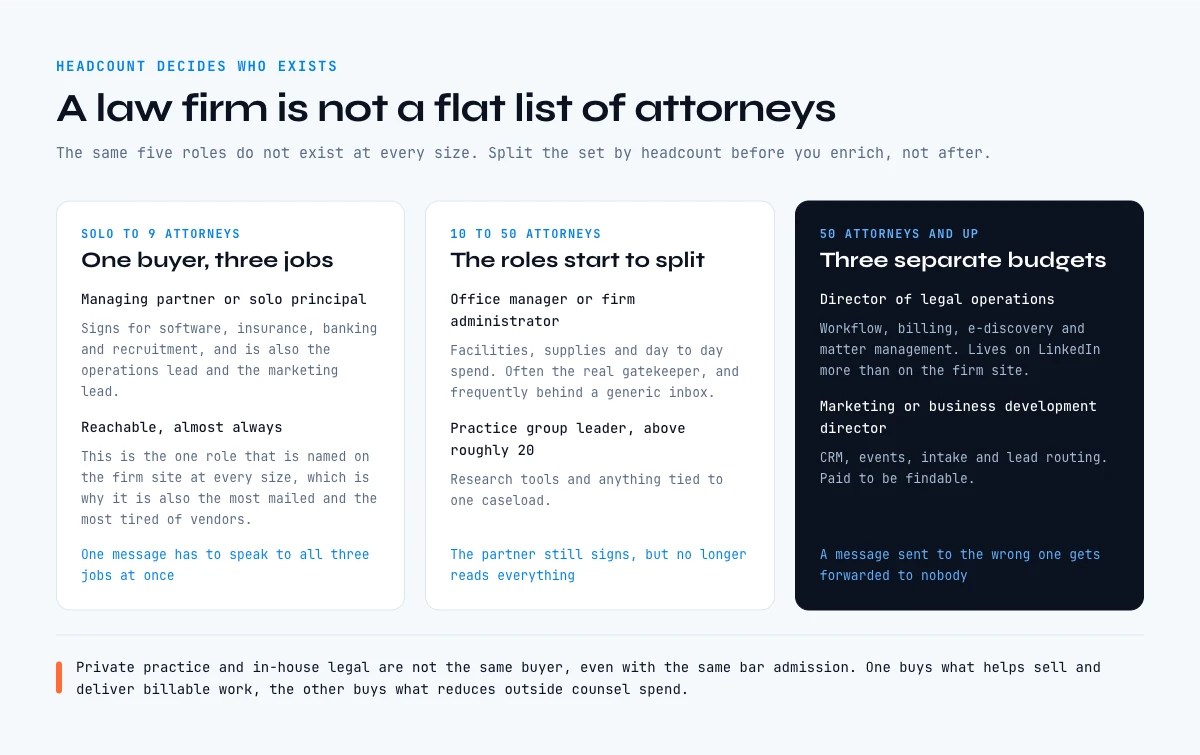
A law firm is not a flat list of attorneys. It has an equity layer, a practice layer and an operations layer, and each one buys different things with different money. Sending a case management software pitch to a first year associate, or a legal research subscription pitch to an office manager, wastes the address you just paid to find.
| Role | What they decide | Typical firm size where they exist | How reachable the address is |
|---|---|---|---|
| Managing partner or solo principal | Software, insurance, banking, recruitment, anything with a signature | All sizes, and usually the only buyer under 10 attorneys | High: almost always named on the firm site |
| Practice group leader | Research tools, expert networks, anything tied to one caseload | Roughly 20 attorneys and up, where practice groups formally exist | Medium: named on the site, harder to attribute to a group |
| Director of legal operations | Workflow, billing, e-discovery, matter management | Mid-size and above, and in-house legal departments | Medium: a job title that exists on LinkedIn more than on the firm site |
| Marketing or business development director | CRM, events, content, intake and lead routing | Roughly 30 attorneys and up | High: this role is paid to be findable |
| Office manager or firm administrator | Facilities, supplies, payroll tools, day to day spend | Small and mid-size firms, often the real gatekeeper | Medium: frequently behind a generic inbox |
Headcount is the variable that decides which of those roles exists at all. In a three attorney practice the managing partner is also the operations director and the marketing director, and the message has to speak to all three jobs at once. In a two hundred attorney firm those are three separate people with three separate budgets, and a message addressed to the wrong one gets forwarded to nobody. Split the set by size before you enrich, not after, or you will pay to find addresses you cannot write to.
One more distinction that quietly ruins campaigns: a lawyer in private practice and a lawyer in an in-house legal department are not the same buyer, even with the same bar admission. Private practice buys things that help sell and deliver billable work. In-house buys things that reduce outside counsel spend. If your list mixes them without a flag, your reply rate is an average of two campaigns you never actually ran.
Where a lawyers email list actually comes from
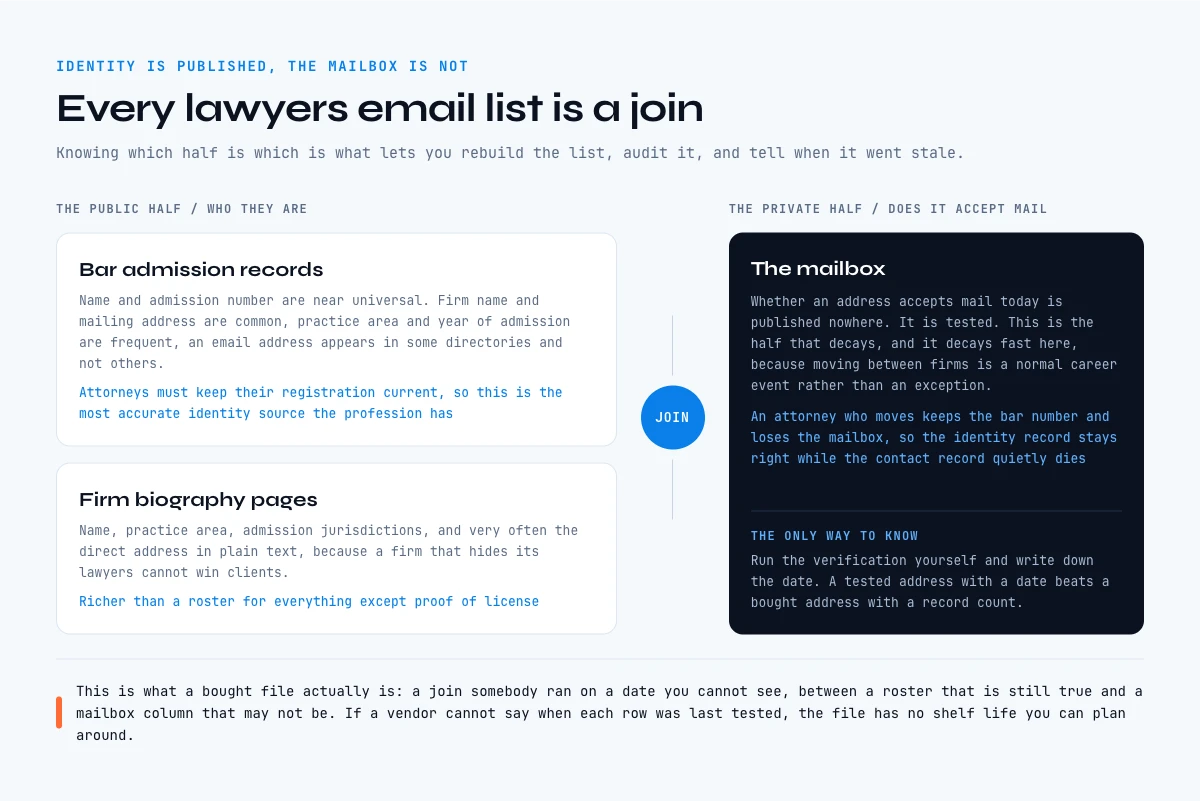
Every lawyers email list on the market is a join between a public identity source and a private contact source. Understanding which half is which is what lets you rebuild it, audit it, and know when it went stale.
The public half: bar admission records. In 44 states and the District of Columbia, the licensing or regulatory authority publishes a searchable database so anyone can check whether an attorney is licensed, active and in good standing. Six states do not publish one online. What those directories contain varies by jurisdiction: name and admission number are near universal, firm name and mailing address are common, practice area and year of admission are frequent, and an email address appears in some directories and not others. Because attorneys are required to keep their registration current, these records are usually the most accurate identity source that exists for the profession. They are also the reason nobody has an excuse for a list full of people who never passed a bar exam.
The public half, second source: the firm itself. Law firms publish attorney biography pages as a marketing requirement. Those pages carry the name, the practice area, the admission jurisdictions, and very often the direct email in plain text, because a firm that hides its lawyers cannot win clients. A firm website is a richer source than a bar roster for everything except proof of license.
The private half: the mailbox. Whether a given address actually accepts mail today is not published anywhere. It is tested. That is the part that decays, and it decays fast in this profession specifically, because lateral movement between firms is a normal career event rather than an exception. An attorney who moves keeps the bar number and loses the mailbox, so the identity record stays correct while the contact record silently dies.
This is why a bought file behaves the way it does. It is a join somebody ran on a date you cannot see, between a roster that is still true and a mailbox column that may not be. If a vendor cannot tell you when each row was last tested, the file has no shelf life you can plan around, and a large record count is not evidence of anything except a large join.
Build the list: from bar roster to firm domain to verified address
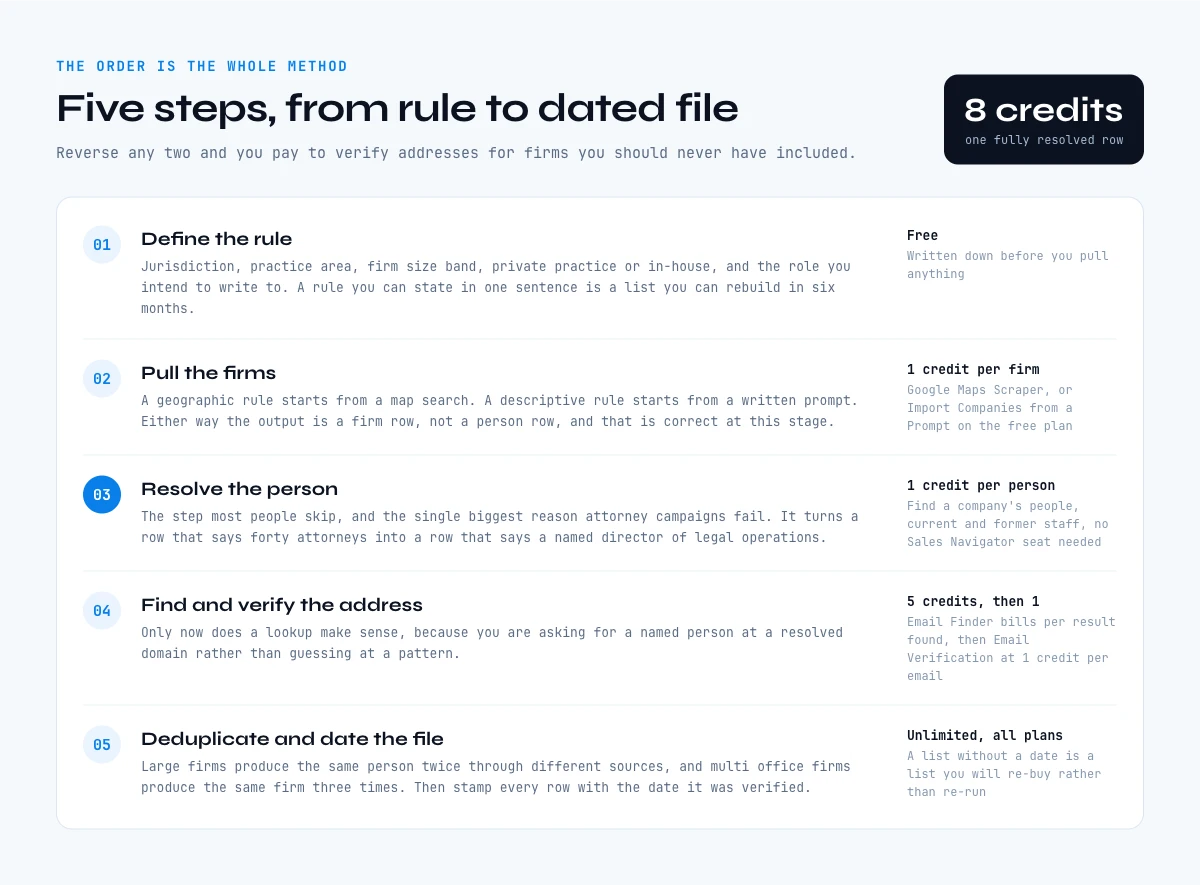
The pipeline has five steps and they only work in this order. Reversing any two of them is how people end up paying to verify addresses for firms they should never have included.
Step one, define the rule. Write the definition of a row before you pull anything: jurisdiction, practice area, firm size band, private practice or in-house, and the role you intend to write to. A rule you can state in one sentence is a list you can rebuild in six months. A file you inherited is not.
Step two, pull the firms. There are two honest entry points. If your rule is geographic, a map search returns practices with name, phone, website, rating and address, which is everything you need to start resolving domains. If your rule is descriptive, a written prompt gets you a matching company set directly. Either way, the output is a firm row, not a person row, and that is correct at this stage.
Step three, resolve the person. This is where most people stop and settle for the firm's general inbox, which is the single biggest reason attorney campaigns fail. Listing the people of a firm, current and former staff, optionally filtered by job function, turns a row that says "Harris and Wells, 40 attorneys" into a row that says "Harris and Wells, director of legal operations, full name". Find a company's people costs 1 credit per person and does not require Sales Navigator, which matters because a large share of the operations and marketing layer inside law firms is invisible to a job title filter built for sales roles.
Step four, find and verify the address. Only now does an email lookup make sense, because you are asking for a specific named person at a specific resolved domain rather than guessing at a pattern. Email Finder costs 5 credits per email found, and it bills per result rather than per attempt, so a row that resolves to nothing does not cost you five credits. An address the Email Finder returns has already been verified, so those rows need no second pass. Keep Email Verification, at 1 credit per email, for the addresses you did not find yourself: emails copied from a bar directory, a firm page or an older file, checked before anything leaves your sending tool.
Step five, deduplicate and date the file. Large firms produce the same person twice through different sources, and multi office firms produce the same firm three times. Find Duplicates is unlimited on every plan, including free. Then stamp every row with the date it was verified, because a list without a date is a list you will re-buy rather than re-run.
What a lawyers email list really costs, bought or built
Bought files are priced per record, which sounds cheap and hides the real number. The cost that matters is cost per usable row: a row where the person is the right role, at the right firm, and the mailbox accepts mail. A file at a low price per record with a large share of wrong roles and dead mailboxes is more expensive than a smaller file you built, and it also costs you sender reputation, which does not appear on any invoice.
Built lists are priced per operation, so you can compute the number in advance. Working from the credit costs above, a fully resolved row that starts as a map result and ends as a verified address at a named person is roughly: 1 credit for the firm, 1 credit for the person, 5 credits for the email if one is found, and the address comes back already verified. That is around 7 credits for a row you can actually write to, before deduplication, which is free. Add 1 credit per address only for emails that came from somewhere else and need a verification pass. On the free plan at 100 credits a month you can test your firm rule at no cost; the people lookup and Email Finder are on the paid plans. Paid plans start at 20 euros a month, and the per credit price falls as volume rises, down to a floor of 0.0016 euros per credit on the largest plan.
| What you are paying for | Bought file | Built list |
|---|---|---|
| Unit of pricing | Per record, fixed at purchase | Per operation, only on rows you keep |
| Date of the contact data | Unknown unless the vendor states it per row | The date you ran it |
| Role targeting | Whatever the file was built for | Your rule, decided before the first credit is spent |
| Rows that fail verification | Already paid for | Not paid for, because lookups bill on results |
| Re-running it in six months | Another purchase | The same definition, run again |
The comparison people skip is the third one. A bought file locks you into somebody else's definition of a lawyer, and you discover the definition only by mailing it. If you want the full accounting of what a purchased file costs beyond its price, our guide on how to buy an email list and what it really costs goes through it line by line.
Verify a lawyers email list before the first send
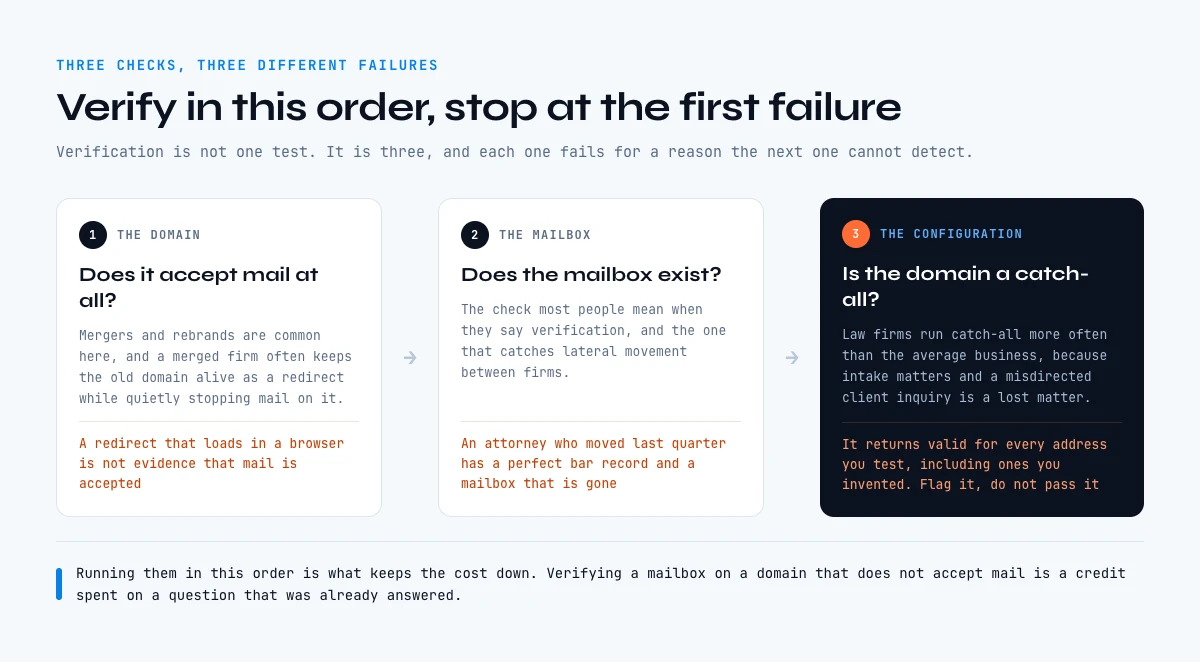
Verification is three separate checks that fail for three different reasons, and stopping at the first failure is what keeps the cost down.
- Does the domain resolve and accept mail at all? Firm mergers and rebrands are common in this profession, and a merged firm frequently keeps the old domain alive as a redirect while quietly stopping mail on it. A redirect that loads in a browser is not evidence that mail is accepted.
- Does the mailbox exist? This is the check most people mean when they say verification, and it is the one that catches lateral movement. An attorney who moved firms last quarter has a bar record that is still perfectly accurate and a mailbox that is gone.
- Is the domain a catch-all? Law firms run catch-all configurations more often than the average business, because intake matters and a misdirected client inquiry is a lost matter. A catch-all domain accepts everything, which means a verification pass returns valid for an address that no human will ever read. Treat catch-all as its own status rather than as a pass, and read our guide on detecting and managing catch-all domains before you decide how to handle them.
An address returned by Email Finder has already passed these checks. They matter for every address you copied from a directory, a firm page or a file you inherited.
Run those in order and stop at the first failure, because verifying a mailbox on a domain that does not accept mail is a credit spent on a question that was already answered. If you want the mechanics of what a good pass actually returns, the bounce checker guide covers the thresholds worth holding yourself to.
Practice area and firm size: the segmentation that moves reply rate
Two variables explain most of the variance in attorney outreach, and neither of them is seniority.
Practice area decides the problem. A litigation practice and a transactional practice run on different clocks, buy different research, and measure their year differently. Personal injury firms buy intake and marketing because their constraint is case volume. Corporate practices buy diligence and document tooling because their constraint is turnaround. Immigration and family practices buy client communication because their constraint is caseload volume at low ticket size. The same message sent across all of them reads as generic to every one of them, and practice area is published on both the bar record and the firm biography page, so there is no excuse for not having the column.
Firm size decides who reads it. Under roughly ten attorneys, one person is the buyer and the user, and the message should be about the outcome. Above roughly fifty, the buyer and the user are different people, and a message about the outcome addressed to a legal operations director reads as a message about somebody else's job. The threshold is not exact, but the shape holds.
Jurisdiction: where the ten largest lawyer populations are
The third cut is geography, because the bar that admits a lawyer is the roster you start from. The 2025 edition of the ABA National Lawyer Population Survey, the same one that counts 1,374,720 resident active lawyers nationwide, shows how concentrated the profession is: the ten jurisdictions below hold about 62 percent of the total, and New York and California alone hold about 27 percent.
| Jurisdiction | Resident active lawyers, 2025 | Share of the US total |
|---|---|---|
| New York | 190,015 | 13.8% |
| California | 181,048 | 13.2% |
| Texas | 99,867 | 7.3% |
| Florida | 80,976 | 5.9% |
| District of Columbia | 65,824 | 4.8% |
| Illinois | 61,945 | 4.5% |
| Pennsylvania | 47,764 | 3.5% |
| Massachusetts | 42,653 | 3.1% |
| New Jersey | 39,670 | 2.9% |
| Ohio | 37,086 | 2.7% |
Source: ABA National Lawyer Population Survey, 2025 edition, resident active attorneys as reported by each licensing agency. Shares computed on the 1,374,720 national total.
Read the table as a sizing tool, not as a target list. A large roster is also a market where your message competes with more vendors, and a mid-size state where your practice area clusters in two or three cities can be the better first test.
Who sells to law firms, and what each seller needs from the row. Legal technology vendors selling practice management, billing or e-discovery need the operations layer and the firm size band. Professional liability insurers and brokers need the managing partner and the jurisdiction, because cover varies with the state and the area of practice. Legal recruiters need the named attorney and the practice group, and they care most about recent moves. Legal publishers and research providers need the practice area column before anything else. Banks, IT and cybersecurity providers and marketing agencies sell to the firm as a business, so they need the managing partner or the firm administrator. One list can serve all of them, but only if those columns exist.
A fourth variable is worth a column even though it is not a segment: recent movement. An attorney who has just changed firms, or a firm that has just opened a new office or absorbed another practice, is in the short window where existing vendor relationships are open for review. That is the highest intent signal available in this profession and no bought file contains it, because it is a change rather than a fact. Signal tracks leads and accounts for job changes, funding, hiring sprees and tech stack moves, and starts at 20 euros a month.
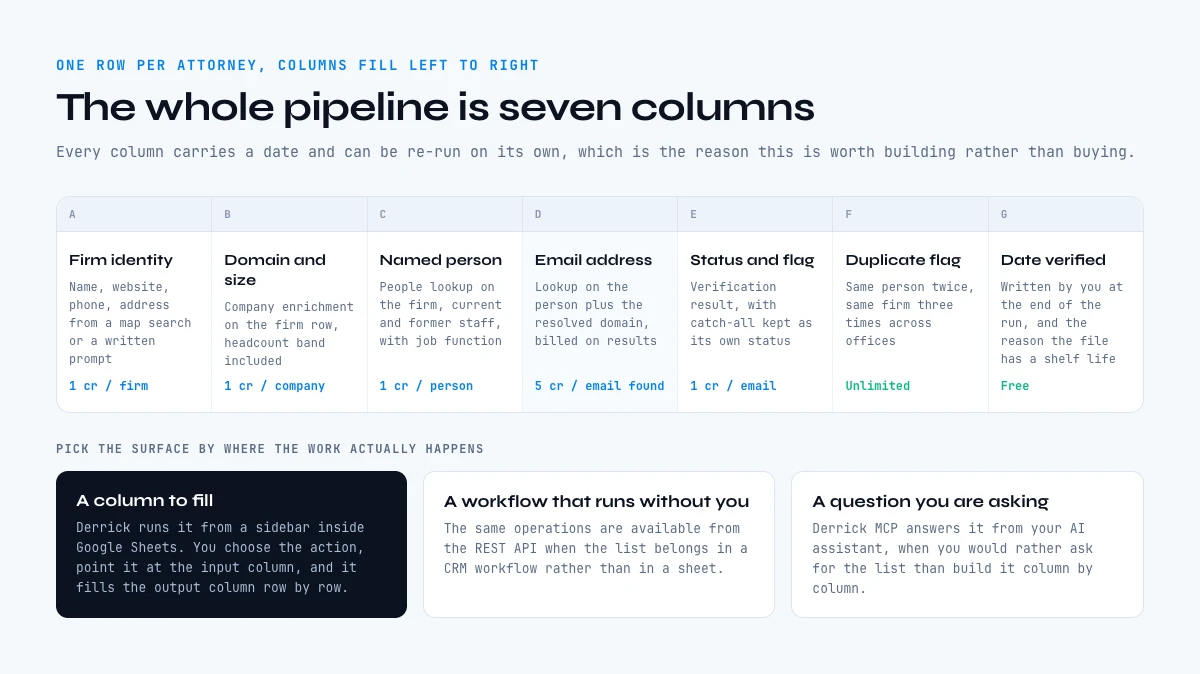
Running the whole pipeline in one sheet
The reason this pipeline is worth building rather than buying is that it lives in one spreadsheet you control, and every column carries a date. In practice the sheet has one row per attorney and the columns fill left to right, each one a step you can re-run on its own.
| Column | Where it comes from | What it costs |
|---|---|---|
| Firm name, website, phone, address | Map search or a written prompt | 1 credit per firm |
| Firm domain and headcount band | Company enrichment on the firm row | 1 credit per company, free plan included |
| Named person and job function | People lookup on the firm, current and former staff | 1 credit per person |
| Email address | Email lookup on person plus domain | 5 credits per email found |
| Verification status | Returned with the found email, or a verification pass for imported addresses | Included with a found email, 1 credit per imported email |
| Duplicate flag | Deduplication across sources | Unlimited, all plans |
| Date verified | Written by you at the end of the run | Free and non negotiable |
What one row of an attorney email list looks like
Here is one complete row, field by field. Every value is fictional and the domain uses the reserved .example extension, so nothing below points at a real person or firm.
| Field | Example value (fictional) | Where it comes from |
|---|---|---|
| Full name | Jordan Avery | Firm biography page |
| Firm and size | Avery and Cole LLP, 34 attorneys | Map search or prompt, then company enrichment |
| Role | Practice group leader, employment litigation | People lookup filtered by job function |
| Bar admission | Illinois, active, admitted 2011 | State bar directory |
| Firm domain | averycole.example | Company enrichment |
| j.avery@averycole.example | Email Finder, returned already verified | |
| Verification status | Valid | Returned with the email; a verification pass only for imported addresses |
| Source and date | Bar directory and firm page, date of the run | Written by you |
A bought file usually gives you the name, the firm and an email. The columns in between are what make the row writable, and the last one is what makes it defensible.
Derrick runs this from its web app or a Google Sheets sidebar, so the list is built where it already lives rather than in an export you have to reconcile. The same operations are available from the API when the list belongs in a CRM workflow instead, and from Derrick MCP when you would rather ask for the list from an AI assistant. Pick the surface by where the work actually happens: a column to fill is a spreadsheet job, a workflow that has to run without you is an API job, and a question you are asking in a chat is an MCP job.
Scale is not the interesting part of this. The pipeline is the same for 40 firms in one county and for 4,000 across a region. What changes is only how long you let it run.
Compliance and record keeping for attorney outreach
Two practical points, and neither is legal advice. First, attorneys are unusually well equipped to notice when an outreach practice is sloppy, and a complaint from this audience is more expensive than from most. Second, the defensible position in almost every jurisdiction is the same one that produces better campaigns anyway: a professional address, obtained from a public professional source, contacted about something relevant to that professional role, with a working opt out and a record of where the row came from.
In the United States those rules are written down in the CAN-SPAM Act, which covers every commercial email, business to business included: each message needs honest header and subject lines, a valid physical postal address and a clear way to opt out, and opt-out requests have to be honored within 10 business days. The FTC compliance guide also states that hiring another company to handle your email does not transfer your legal responsibility.
That last part is the one people skip. Keep the source and the date on every row. If a row came from a bar directory in March and a firm website in June, the row should say so. It costs one column and it is the difference between answering a question in a minute and re-auditing a file you no longer understand. Bought files are hard to defend precisely because that column does not exist in them.
Finally, resist the temptation to scrape everything a firm site exposes because it is technically reachable. The address of a named partner published on a biography page for business purposes and the personal contact details of a junior associate are not the same thing, even when the same crawler returns both. Our guide on what an email scraper actually returns covers why undifferentiated extraction is also the main reason lists bounce.
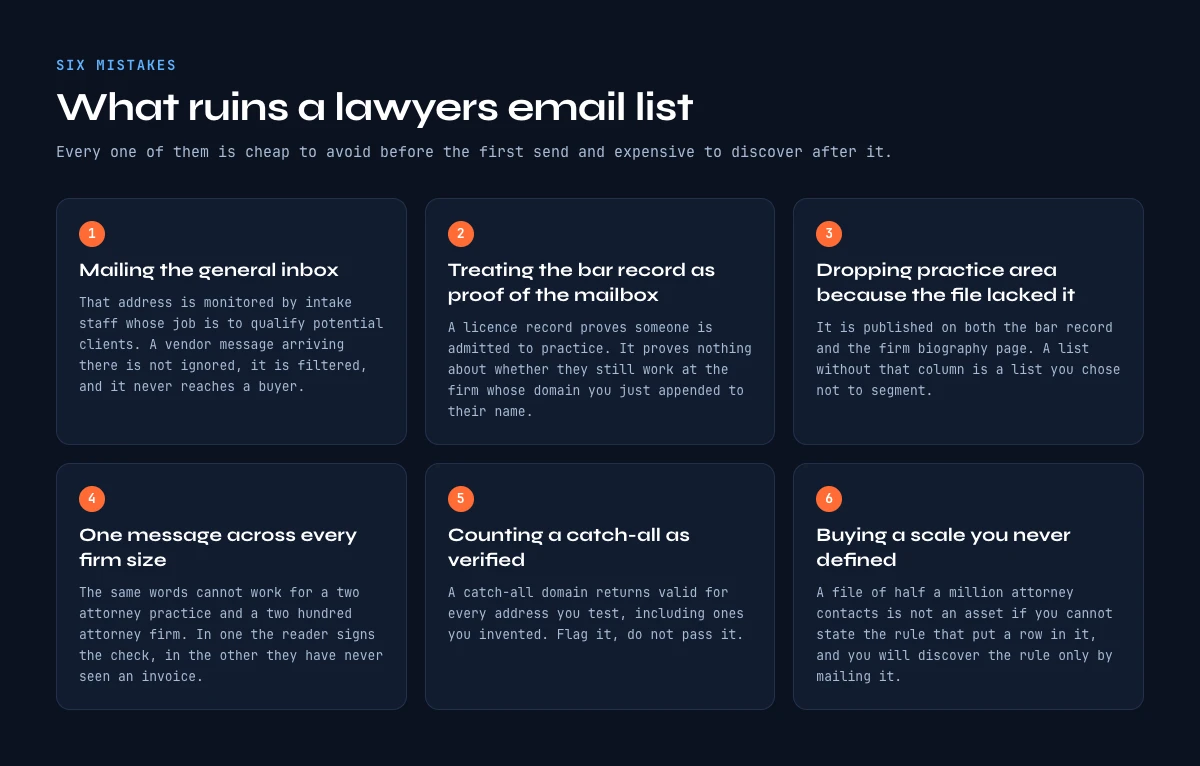
Six mistakes that ruin a lawyers email list
- Mailing the general inbox. The firm's contact address is monitored by intake staff whose job is to qualify potential clients. A vendor message arriving there is not ignored, it is filtered, and it never reaches a buyer.
- Treating the bar record as proof of the mailbox. A license record proves someone is admitted to practice. It proves nothing about whether they still work at the firm whose domain you just appended to their name.
- Ignoring practice area because it was not in the file you bought. It is published on both the bar record and the firm biography page. A list without it is a list you chose not to segment.
- Sending one message across every firm size. The same words cannot work for a two attorney practice and a two hundred attorney firm, because in one the reader signs the check and in the other they have never seen an invoice.
- Counting a catch-all as verified. A catch-all domain returns valid for every address you test, including ones you invented. Flag it, do not pass it.
- Buying a scale you never defined. A file of half a million attorney contacts is not an asset if you cannot state the rule that put a row in it, and you will discover the rule only by mailing it.
Key takeaways
- A lawyers email list is built by resolving the firm, then the named person, then the address, in that order.
- The license is public and the inbox is not: 44 states and the District of Columbia publish a searchable admission database, and almost none of them publishes a working email.
- There were 1,374,720 licensed lawyers in the United States in 2025, so the useful question is never "all lawyers" but which of the five buying roles you mean.
- Lateral movement between firms is the main decay driver, which is why the identity record stays true while the mailbox quietly dies.
- Verify domain, mailbox and catch-all status in that order, and stop at the first failure.
- Building costs roughly 7 credits per fully resolved row on a paid plan, with the address returned already verified, and leaves you a dated, re-runnable definition instead of a static file.
Frequently asked questions
How do you build a lawyers email list?
What does an attorney email list include?
Are attorney bar records public?
Who should you email inside a law firm?
Is it better to buy or build a lawyers email list?
What does it cost to build a lawyers email list?
Why do attorney email campaigns bounce more than expected?
What is the highest intent signal on a law firm?
Keep reading
Continue exploring this cluster


Lead Email Finder: The Complete Guide to Finding Your Prospects' Emails
Read →

How to Find a Company Website: Complete 2026 Guide
Read →

Find Company Name & Website from Email: 4 Methods (2026, Tested)
Read →

Valid Email Finder: How to Find and Verify Valid Professional Emails
Read →